
How to Move Past an Emotional Affair
Your marriage has been blindsided by an emotional affair. One of you is struggling with thoughts and feelings of betrayal, shock, and hurt. One of you is struggling with thoughts and feelings of confusion, guilt, and sadness. How can your marriage move past this? The good news is, your marriage can not only move past this emotional affair; it can grow stronger because of this difficult circumstance—but both spouses need to be willing to to navigate the aftermath well, both individually and together.
The Spouse Who Had The Emotional Affair
Maybe you weren’t even sure you were having an emotional affair. You might have slid down the slippery slope of innocent friendship to emotional dependency and intimacy with someone who’s not your spouse. Maybe there were issues in your marriage that made it easier for you to begin to disconnect from your spouse and build a relationship with someone else. Maybe this is all about you and the little spark you got from the novelty of someone new and the secrecy of your interaction with them.
Bottom Line: You were doing marital work with someone who wasn’t your marriage partner. You crossed the boundary of faithfulness, exclusivity, deception, and betrayal.
Please read this account of how this individual was able to move past an emotional affair and how their marriage survived and grew stronger. ★ Note the steps that were taken.
[Information in brackets is mine.]
- I admitted it: Shame can only exist in secret. When I was able to voice what was really going on, all the complexities of why I allowed it to go as far as it did and how I had realized the line had been crossed, the shame that surrounded the entire situation dissipated. [This is the first step. Friendships that are innocent don’t have to be kept a secret from your spouse and are nothing to be ashamed of. Come all the way clean with your spouse.]
- I stopped it: I wrote my ex co-worker a lengthy email telling him our friendship had crossed a line and that I felt it was unfair to ourselves and our spouses to continue it. I let him know that I had told my husband and encouraged him to tell his wife and take time refocusing on his marriage too. [Inform this person that your relationship is over. Full stop. Your spouse might want to read your email or listen via conference call. This is one of the first steps in rebuilding trust with your spouse.]
- I set personal boundaries: Hindsight is 20/20, so I was able to look at my mistakes and create a guide for boundaries in future opposite-sex friendships. Such as, I will never write another man something that I wouldn’t want my husband to read. [Your spouse will likely have input for the boundaries to protect your marriage. Be willing to do whatever it takes.]
- I reinvested in my marriage: Obviously no marriage is perfect. There is always work that needs to be done. With my energy and attention refocused on my husband, we grew stronger, together. [This is the key. Your marriage is in the ICU. The “what came first” question doesn’t matter. It’s time to reconnect with your spouse and pour your energy and attention into your marriage.]
I would only add to that excellent advice that you need to apologize to your spouse, ask for their forgiveness and express your commitment to them and your marriage.
If you want to move past the emotional affair, communicate your willingness to do whatever it takes to rebuild trust and your relationship. ☆ You may need professional help to break out of the fantasy world you created and to deal with the addiction-like dynamics of your experience. You may also need professional help to reconnect with your spouse and to pour yourself into your marriage.
Emotional affairs can be just as shocking and damaging to a spouse as a sexual affair. Your spouse might bounce back and forth between hurt, anger, and normalcy. Be open to their needs, whether it is to answer questions or be alone. Understand it will take more than words and it will take time.
You need to be open to and compliant with any accountability related to your phone or other devices as you begin to rebuild trust. You need to accept any other accountability that your spouse deems necessary, including whatever else they need to feel secure, heal, and continue to rebuild trust (even if you think they’re going overboard or being unreasonable). They are probably navigating severe anxiety and hypervigilance. This is not the time to try to negotiate; it’s the time to live out true self-sacrificial love.
This is when you need good friends who are for your marriage and accountability.
The Spouse Who Was Betrayed By The Emotional Affair
You didn’t make your spouse have an emotional affair. Know this, believe this, feel this, but it is also true that affairs do not happen in a vacuum. There is always a context to infidelity and betrayal. The marriage and the affair are usually connected.
Often, the marital context allows for a better understanding of the emotional affair. As marriage therapist Esther Perel points out, “The victim of the affair is not always the victim of the marriage.” As the therapist puts it, “The betrayed spouse, to one degree or another, can be one dimension of the infidelity—just like narcissism, low self-esteem, addiction, or a mid-life crisis can be a key for understanding your spouse’s [emotional] infidelity.”
But make no mistake, your spouse chose to have an emotional affair. Probably in a series of little choices. It all could have been avoided by choosing to ignore a text, to not eat lunch with a coworker, to unfollow someone on social media, to not divulge things to someone that only a spouse should hear. They could have chosen to work on your marriage.
At a minimum, you should know the following:
- Who the emotional affair partner was.
- How long the affair lasted.
- How often they met.
- Where they met.
- How they communicated. (Email, secret texting apps, phone or burner phone, etc.)
If the marriage survives, this information is essential to avoid future affairs and for appropriate accountability and to put boundaries in place. Take time to think about what would be most helpful for you to know. Sometimes when affairs are uncovered, the betrayed spouse says they want to know every single detail of the relationship, only later to discover that all that information wasn’t really helpful.
Understand that men and women generally view emotional affairs differently. In fact, according to a survey by VictoriaMilan.com, an online affair dating site (the U.K.’s AshleyMadison.com) for people who are already married or in relationships, there are some clear distinctions between how men and women view emotional affairs.
Here’s what they discovered:
- 72% of men said sexual affairs were worse than emotional affairs.
- 69% of women said emotional affairs were worse than sexual affairs.
- 76% of women said they would forgive their partner for a strictly sexual affair
- Only 35% of men said they would forgive their partner for a strictly sexual affair.
- 80% of men said they would forgive an emotional affair.
- Only 30% of women indicated they would forgive an emotional affair.
According to this and other research, women are much more unforgiving of emotional connections while men are much more unforgiving of physical ones. Again, understand that, in general, men and women look at emotional affairs very differently.
This is important to acknowledge as you work toward understanding what happened, heal, rebuild trust, grow in security, and strengthen your marriage. Take care of yourself so that you are physically and emotionally healthy and whole.
When you’re ready, you need to offer and communicate true forgiveness. Be open and willing to change as an individual and in how you relate to your spouse. You can’t “dance the same dance” anymore. This is your new, second marriage even though it is with the same spouse. Be intentional about making it strong and healthy!
Expect good and bad days, ups and downs, three steps forward and two steps back. Healing as an individual, healing for your spouse, and healing as a couple is a process. Don’t be discouraged by bad days or setbacks. Have a friend who is for your marriage who can keep you accountable, and you can be honest with and vent to.
Don’t blame and focus on their affair partner. This is understandable but completely counter-productive, can re-traumatize you, fuel intrusive thoughts, and impede healing.
Find resources that work for you. Don’t hesitate to seek out professional counseling for yourself and marriage counseling for you both.
★ Only about 15% of marriages break up directly because of infidelity and end in divorce. According to counselors, couple’s therapists, and marriage coaches, whether the marriage will survive is based on how each spouse responds to the emotional affair.
Some Other Helpful Resources:
- How To Rebuild Trust In Marriage
- Will My Spouse Ever Forgive Me
- How To Save A Marriage That Is Falling Apart
- I Can’t Forgive My Spouse
- Infidelity And Forgiveness
- How Fear Impacts Your Marriage
- Does Your Marriage have Backbone
- How To Find A Good Marriage Counselor
- 5 Ways To Protect Your Marriage
***If you or someone you know is in an abusive relationship, contact the National Hotline for Domestic Abuse. At this link, you can access a private chat with someone who can help you 24/7. If you fear that someone is monitoring your computer or device, call the hotline 24/7 at 1−800−799−7233. For a clear understanding of what defines an abusive relationship, click here.***
Do you have realistic expectations for your marriage? Fast forward to being married. You text your spouse about how long your day is and how you’ll be home late. They respond saying they actually got to go home early and can’t wait until you get home.
You think to yourself, “Ah, so glad they’re getting home early, now they can get started on dinner and some of the dishes that have piled up.”
You walk in the door and let out a big sigh with the clank of your keys on the key tray and just as you’re about to say “I love you. How was your day?” you see the dishes still in the sink and the second thing your spouse says after “Hey!” is “What’s for dinner?”
I imagine you’re frustrated at this point. Your day was long and coming home to more things to do and no time to relax was not how you pictured the night going. However, did your spouse know your expectation was for them to do those things? Normally you take care of the dishes and dinner!
No one can meet an expectation they don’t know is there.
Unrealistic expectations are also unspoken expectations. If you and your spouse hadn’t talked about what you expect each other to do when one spouse gets home late, then it’s unrealistic to believe they would know what you want.
When you have unspoken expectations or aren’t willing to meet halfway, there’s no chance for either you or your soon-to-be spouse to win. What seems to be a very realistic expectation to you is very unrealistic to them because there’s been a lack of communication. You run the risk of resentment and disappointment when you judge your spouse on expectations they can’t meet or didn’t know existed in the first place.
Common Unrealistic Expectations:
Your partner is responsible for your happiness.
Your husband/wife will definitely play a role in your happiness, but they can’t be the only source. Think about things that make you happy and things that make your spouse happy. Are they all the same? Probably not. They can be your everything without being everything for you. You, like them, are human. You’ll make mistakes, you’ll fall short, and ultimately, that’s okay if you handle it in a healthy way.
Your spouse will anticipate what you want and all of your needs since you’re married now.
As amazing as that would be, being married doesn’t make you or them a mind reader. Sorry if this is a bummer for you! I’m definitely guilty of this. I often think… “Well, since my husband knows me more intimately than anyone else and since we’ve been together so long, he’ll do things without me asking. He’s just that aware. That loving. That good.” As time and experts will tell, the only way my husband can truly know what I need is by me talking to him about it. It doesn’t make his actions any less genuine because he didn’t come to the conclusion on his own (another unrealistic expectation I held when we were dating). Instead it gives him the opportunity to love and care for me in the way I specifically want and need.
The way you approach an expectation is the only right way.
If we’re honest, being right feels good, and there’s a comfort in doing things your way instead of someone else’s. However, there’s a time to set aside the “right way” if it means you get to a resolution. Choose your battles. If you expect your spouse to do the dishes, then putting the bowls on the bottom rack instead of the top rack like you do needs to be okay. Is the job still getting done? In short, yes!
You will handle conflict the same way.
You two have to come to an agreement together on how you will handle/manage conflict. If one of you needs space and the other needs to talk it out immediately, find a compromise that benefits both of you, like a timeout, and choose a time to talk about it a little bit later. Or, if your spouse feels like something needs to be said in the moment, be willing to listen first and then take a timeout. It’s important to voice your expectations so the health of your marriage doesn’t suffer on the account of unspoken words!
A Few Realistic Expectations:
- Communicate well and often; talk about how you’re feeling on a regular basis.
- Speak to each other with kindness, no matter what.
- Show respect to each other in every situation.
- Pursue each other daily.
- Say “I love you” every chance you get.
- Give your best effort at all times, and know this looks different depending on the week!
On your wedding day, you’ll vow to go above and beyond for each other, love one another wholeheartedly (flaws and all), and support each during all of the “for better or for worse” times. Remember, you’re starting your marriage with vows to meet halfway and sacrifice your preferences. Don’t let unrealistic expectations keep your marriage from being the wonderful relationship it has the potential to be.
Here are some blogs I think you might find helpful as well:
- Conversations Every Engaged Couple Should Have Before They Say, “I Do”
- 8 Must-Have Conversations for Couples
- How to Prepare Yourself for Marriage
- How to Deal With Unspoken Expectations
- EXPECTATION FRUSTRATION PART 1: Unspoken Expectations
***If you or someone you know is in an abusive relationship, contact the National Hotline for Domestic Abuse. At this link, you can access a private chat with someone who can help you 24/7. If you fear that someone is monitoring your computer or device, call the hotline 24/7 at 1−800−799−7233. For a clear understanding of what defines an abusive relationship, click here.***
It’s that time of year! The leaves are changing colors and falling. There’s a cool breeze in the air. Pumpkin spice is the flavor of the season. We’ve moved past the laid-back summer and now it’s FALL, the season of football, fun… and romance.
Here are several romantic fall fun date ideas that bring out the best in the season and in your relationship!
(Be aware that there may be limited availability due to social distancing constraints. Have fun, but be safe!)
- Go to a pumpkin patch. Select a pumpkin. Take it home and carve it.
- Bake seasonal goodies (pies, cakes, cookies) together.
- Go antique shopping.
- Take a carriage ride.
- Go to a drive-in movie.
- Listen to your favorite old songs and dance around your home.
- Take a scenic walk.
- Go camping.
- Go apple picking in an orchard.
- Take a scenic train ride.
- Take a scenic drive to see fall foliage.
- Go to a Fall Festival.
- Go for a hike.
- Watch a scary movie.
- Go for a bike ride.
- Host a game night with friends and family.
- Take a day trip.
- Have a picnic either in a park or your backyard.
- Go for a wine or cider tasting.
- Go horseback riding.
- Stargaze and see who can find the most constellations.
- Rake the leaves, like adults. Jump in the leaves, like kids.
- Sit in front of a fire and read a book out loud together.
- Go to a high school football game.
- Movie marathon/binge watch your favorite TV series.
- Go on a local history tour.
- Take a painting class.
- Have a bonfire in your backyard and make S’mores.
- Go on a fall getaway weekend.
- Take part in a First Things First Virtual Date Night!
Conversation Starters:
Check out this list of 200 questions for couples to get the conversation started.
1. What makes you the happiest?
2. What’s worse? The barista getting your order wrong? Or finding a motorcycle in a parking spot you thought was empty?
3. What food best describes your personality?
4. What are your five most important personal values?
5. What kind of physical touch best says “I love you” to you?
6. If you could only eat one food for the rest of your life, what would it be?
7. Who is the person, currently alive, that you most want to meet right now?
8. What is your favorite type of romantic gesture?
9. What crazy thing do you want to try someday?
10. What’s one thing I can do to improve our relationship?
Now is the perfect time to get adventurous by exploring your community and creating quality time with each other. Play and fun builds intimacy in your relationship.
Now, go have some romantic FALL FUN as you try out these date ideas!
6 Exercises to Strengthen Emotional Intimacy in Your Marriage
When your relationship has a high level of emotional intimacy, you share your feelings, needs, fears, successes, and failures knowing you will continue to be loved and cared for by your partner.
Building strong intimacy in your marriage can give your marriage the satisfying fulfillment you desire.
Here are 6 exercises to strengthen emotional intimacy in your marriage:
1. Do something new and engaging together.
- Prepare new, exotic meals together from beginning to end. Search recipes for some cuisine the two of you would like to try. Together, buy the groceries, prepare the meal, and of course, eat together.
- Learn a new language together. Focus on learning relationship-specific words that will help you express appreciation, be affectionate, and flirt.
- Create a marriage bucket list and then get started on completing your list.
Research shows that doing new activities can reignite the passion in your relationship. They help the two of you experience challenges, successes, and failures together. You’re able to see each other’s authentic self without the pressure of being perfect.
2. Show affection.
- Each day, give each other a deep, passionate kiss for at least 20 seconds. Your body will release chemicals in your brain helping you to increase the connection between you. (We aren’t responsible for whatever happens next.😉 )
- Each day, give each other a great big hug for a minimum of 20 seconds. This has a similar effect of increasing the bond and connectedness. Just good, old-fashioned affection.
- Cuddle. Yes, that simple. Cuddle and rest in each other’s presence.
3. Do marriage enrichment together.
- Take a class.
- Attend a retreat.
- Participate in a marriage webinar.
- Read a book together and talk about it.
- See a good marriage counselor.
All are good ways you can invest in your marriage to help you share, grow closer to each other and strengthen emotional intimacy.
4. Make time to talk.
- Practice focused, uninterrupted talking and listening. Take 15-30 minutes each day to share whatever is on your heart. Your one goal is to make sure that each of you feels heard and understood. Some days the conversation may be a rundown of the day. Other days you may each reveal deeper levels of transparency and vulnerability.
- Be curious. Ask each other questions. Be vulnerable and transparent as you share your thoughts. Increase your intimacy with these 200 conversation starters for couples.
- Set aside regular time to connect. Dr. Linda Duncan, a marriage researcher and Professor Emeritus at Tarleton State University, shares that couples can build intimacy by intentionally connecting at four distinct points throughout their day: 1. When you wake up. 2. Before you depart for the day. 3. When you reconnect after work/school. 4. As you go to bed.
How you connect at each of these four moments can have a tremendous impact on the intimacy within your relationship. “Connecting” can be as simple as getting your spouse a cup of coffee and saying “Good morning,” giving them a kiss goodbye, and saying “I love you,” giving them a hug when they get home, and some pillow talk before saying “goodnight.”
5. Celebrate your togetherness.
- Stroll down memory lane, revisit memorable date nights, or look at pictures and videos while reminiscing on the experiences you’ve shared.
- Take 15 minutes to exchange genuine compliments or express appreciation for each other.
6. Make the most of pillow talk.
- Eliminate the tech devices and potential distractions. Invest that time into one another.
- Give kids a bedtime or at least a quiet time when they are in their rooms for the night leading up to bedtime.
- Share with each other how they can make you feel safe, cherished, and valued.
- Talk about what arouses each of you.
Each of these 6 exercises on their own may not strengthen your emotional intimacy. However, if you do these with a heart of gratitude and appreciation toward your partner and you make them a habit, you’ll begin to feel closer and more connected. You’ll find yourself sharing more of yourself and getting to know your partner more fully.
***If you or someone you know is in an abusive relationship, contact the National Hotline for Domestic Abuse. At this link, you can access a private chat with someone who can help you 24/7. If you fear that someone is monitoring your computer or device, call the hotline 24/7 at 1−800−799−7233. For a clear understanding of what defines an abusive relationship, click here.***
4 Ways to Be More Present With Your Spouse
Have you ever gotten into bed, rolled over, and said “I miss you,” after sitting next to your spouse on the couch all evening? Or thought it silently to yourself as you question, “What did we even do? I mean we were next to each other—how can I miss them?” Just being in the same room with your spouse doesn’t make you present with each other in ways that make your marriage stronger.
I know I’ve felt this when the busyness of life comes crashing in—uninvited and without warning. The circumstances right now in 2020 alone can cause all sorts of unrest, even in the places we’ve felt the most at home. There’s COVID and the adjustments constantly being made because of it, social justice at the forefront of conversations, political division, online schooling, and then there are your personal struggles outside of what’s going on in the world.
All of these things can cause your relationship to feel robotic, like you are just going through the motions. It is monotonous, it’s boring, it lacks depth and it lacks the intimate connection you both need to enjoy life together—not just go through it together.
The fix for this? Finding ways to be more present with your spouse. Think of it as the way you spend your time together. Quality over quantity… though if you can make time to have your cake and eat it, too, a high quantity of quality time sounds amazing.
Here are 4 Ways to Be More Present with Your Spouse:
1. Intentional conversation.
When you have time (make time) to catch up, do it intentionally. Turn the phones on silent or put them aside. Let the world take a backseat and really tune in to each other. “How are you feeling?” “What do you think about…?” “What was the best or worst part of your day and why?” “How can I be there for you?” “How can I show you I love you today?” Here are 20 questions you can ask each other besides, “How was your day?”
While you’re having conversations, hold hands, or place your hand on your spouse’s arm. Little moments of touch without distraction go a long way. Speaking of touch…
2. Touch.
Though being present with your spouse goes beyond being physically present, your body language and how you interact can say a lot about how you feel toward one another. If you’re both exhausted after a long day and just want to sit on the couch and watch a movie, do it! It doesn’t take much to communicate, “Hey I’m here with you and I want to be here.” Get close, cuddle up, and kiss a few times (or lots of times!)
A daily 6-second kiss will increase your emotional and physical intimacy. Hey! Research says that physical contact releases oxytocin (the bonding or trust hormone), and dopamine. This can improve your mood (for days at a time), and can help you stay calm. To top it off, something as simple as holding hands, hugging, getting close, and yes, making out, can lessen your stress hormones (cortisol) and enrich your sense of relationship satisfaction.
3. Pay attention to ways you can connect throughout the day…
Dr. Linda Duncan found four powerful ways for couples to connect throughout the day. Being intentional about connecting at these times on a regular basis can increase the intimacy in your marriage and make your spouse feel like you’re present, not just there.

- When you wake up, start with an “I love you,” a kiss or cuddling up beside your spouse (whichever is their cup of tea). Unless of course, they aren’t a morning person. Then maybe you just make the coffee and put a cup on the nightstand without saying a word. 😉
- When you part for the day, even if you’re just sitting at the dining room table and your spouse is in the other room working from home, how you say see ya later sets the tone for how you think about your relationship throughout the day. The symbolic start of your workdays can be coupled with “Thanks for working so hard. I can’t wait to spend time together when you’re done with work.” Think about what you could say that would encourage and recognize your spouse.
- How you greet each other once you’re done with work. A hug, kiss, or “I’m so glad you’re home!” are great ways to show you care and acknowledge your spouse coming home is important to you.
- How you say goodnight is the last point of connectedness. Take a few moments between letting your head hit the pillow and falling asleep to talk about your day or your day tomorrow. Asking “Is there anything I can help you with tomorrow?” and ending with another “I love you.” (Because you can’t say it enough!)
4. Make time for fun!
I know life is busy, but we make time for the things we care about, and being present with your spouse is one of those things for you or you wouldn’t be reading this blog. If you operate on opposite schedules, it may look like compromising some sleep and getting up earlier or going to sleep later. Maybe it’s a date night once a week or every other week. Having fun to look forward to will build anticipation, just be sure to talk about what you both want to do so there aren’t hidden expectations!
Incorporating a date night is essential! The New York Times writes about the importance of reinventing date night: “The theory is based on brain science. New experiences activate the brain’s reward system, flooding it with dopamine and norepinephrine. These are the same brain circuits that are ignited in early romantic love…” When you have fond feelings for each other, being present will feel more natural and you’ll crave that kind of quality time.
Being more present with your spouse doesn’t have to take a lot of time or energy. But it does take being intentional with the time and energy you can offer each other.
Additional Blogs:
- 5 Ways to Be More Present When Talking to Someone
- How To Have More Meaningful Conversations With Your Spouse
- Keys to Effective Communication in Marriage
- 3 Great Dates To Enhance Communication In Your Marriage
***If you or someone you know is in an abusive relationship, contact the National Hotline for Domestic Abuse. At this link, you can access a private chat with someone who can help you 24/7. If you fear that someone is monitoring your computer or device, call the hotline 24/7 at: 1−800−799−7233. For a clear understanding of what defines an abusive relationship, click here.***
Image from Unsplash.com
Feeling Lonely in Your Marriage? Here’s What to Do.
You thought the words “marriage” and “loneliness” were oxymorons. Now you realize that isn’t the case. A Cigna study reports that in over 40% of marriages, one of the partners experiences loneliness and is unable to connect and be vulnerable with their spouse. What do you do if you’re feeling lonely in your marriage?
1. Communicate exactly what you’re feeling to your spouse.
Do not assume your spouse knows how you’re feeling. Keeping a journal where you are able to write down your thoughts and feelings is a good way to ensure that you communicate exactly what’s on your mind. Your partner may or not feel the same way. Don’t set yourself up for disappointment by expecting them to know or because they haven’t sensed the disconnect. That’s not helpful. Ask for their undivided attention, plan a special date or getaway, and be sure to share your heart. Work together to understand each other’s needs and how the two of you can reconnect emotionally.
2. Do a self-check.
It’s possible you’re expecting more from your spouse than they should be expected to give. Your spouse may be making attempts to connect with you and yet you’re unable to shake the loneliness. More and more couples are expecting their spouse to be their best friend, lover, therapist, social partner, and mentor. Studies have shown that couples tend to be less lonely when they have other positive social connections. Think through times where you felt more connected and less isolated. If you entered your marriage battling loneliness, then you may have hoped that the marriage would be the cure. Journaling, connecting with friends, getting sufficient sleep, and practicing mindfulness and self-care may be the antidote to your feelings of loneliness and isolation.
3. Create intentional times to connect.
Coffee and toast each morning. Make sure the kids have a bedtime or at least a lights out and stay in their room time. Monthly date night using a trusted family friend to babysit. Use these times to create a ritual of emotionally connecting, even if it’s just for a few minutes. You can even plan specific questions to ask or topics to discuss.
You may be feeling lonely in marriage because you feel unable to share all of yourself with your partner or because your partner doesn’t share with you. Make a point during your intentional times of connection to ask questions like: “What is bringing you the most joy and the most sadness in your life? What dreams do you have that are the most important to you? Is there anything that concerns or worries you? What do you need the most from me? What makes you feel emotionally safe?” Listen intently to each other giving cues that you’re understanding. (Check out this article on active listening skills—especially the Six Levels of Listening.)
4. Create shared experiences.
Doing fun and engaging activities together releases tensions and can create an environment of safety in your relationship. Dance, karaoke, hike, cook, go on an adventure, etc. Sharing experiences will create memories, spark conversations, and cultivate curiosity about one another. And it releases dopamine which is the “feel good” chemical in your brain.
Be intentional about getting to know each other during these experiences. Understand why your partner enjoys certain activities, what causes them fear or discomfort, and what about doing this with you makes it enjoyable.
5. Seek help.
There may be issues the two of you are finding difficult to discuss, let alone resolve. These issues may be fueling your loneliness. Talk to trusted married friends. Find a good marriage counselor to help you unpack the root of your loneliness and help you get on the path to reconnection.
Loneliness is not an unusual feeling to experience in marriage from time to time. However, it is something that couples can identify and often work together to overcome and grow stronger. Working together to emotionally connect and share yourself with your spouse will help you both reap benefits for your marriage for years to come.
***If you or someone you know is in an abusive relationship, contact the National Hotline for Domestic Abuse. At this link, you can access a private chat with someone who can help you 24/7. If you fear your computer or device is being monitored, call the hotline 24/7 at 1−800−799−7233. For a clear understanding of what defines an abusive relationship, click here.***
All the kids have gone to sleep. You and your spouse are lying in the bed and… Silence. You can’t think of anything you want to say, though there’s probably a lot of things you’d like to say. This is happening quite often. There are more and more moments where you and your spouse are together and there’s just silence—while you’re in the car together, eating a meal, or even on the phone when you’re apart. You feel disconnected from one another. Is it possible to start talking with your spouse again?
How do you break the silence and start talking to your spouse again?
1. Do something together.
Shared experiences can provide great conversation starters. Hiking, playing tennis, taking a dance class, and attending events together create shared interests and experiences that lead to discussions about what each of you saw, heard, and think about what you’re encountering. Dr. Howard Markman, co-director of the University of Denver’s Center for Marital and Family Studies, says their research indicates the more you invest in fun, friendship, and being there for your partner, the happier the relationship will get over time. Getting out, having fun, and investing in your marriage has shown to help increase communication within marriage.
2. Put your marriage before the children.
You can get so busy tending to the needs of your children, work, and community that the connection in your marriage suffers. Next thing you know, the only time you talk is to discuss administrative tasks like who’s taking who where and what time they need to be picked up. According to Dr. Paul Pearsall, author of Super Marital Sex, “The marriage comes first. All other people and events come after the marriage. Children, parents, work, and play all benefit most by marital priority instead of marital sacrifice because the marriage is the central unit to all other processes.”
3. Be curious about your spouse.
Take an interest and ask them about their dreams, goals, and future desires. Ask them about the most impactful experiences in their childhood they believe frame who they are today. When you focus on learning and getting to know your spouse, you may hear about their secret fears and struggles. Look for those moments where you find yourself saying, “We’ve been married all this time and I never knew that about you!”
4. Put questions in a hat and pull out one or two each day.
Look through the internet for questions to ask your spouse. Write them down on a slip of paper and put them in a hat. Each night before bed, pick one or two. Have a real discussion about the question. Some questions can take you down memory lane while others may cause you to reflect on yourself or the marriage.
5. Listen to your spouse.
We all have a desire to be known, respected, valued, and understood. If we don’t feel like we are being heard so that we can be known, then your solution may be to shut down and withdraw. Be to your spouse what you’d like them to be to you. Help your spouse realize that you want to know and understand them.
6. Use daily points of connection.
Dr. Linda Duncan, researcher and Professor Emeritus at Tarleton State University, reveals four powerful points of connectedness between couples. Paying attention to how you connect when you wake up, how you depart for work/school for the day, how you reconnect after being apart, and when you go to sleep can affect how you engage one another in conversation. Making this part of your routine provides a consistent opportunity for the two of you to connect.
7. Seek help.
Are there unresolved issues you continue to rehash with no solution? Maybe you keep having the same conversation over and over? Talking to a trusted couple or seeking out a good marriage counselor may help you work through the unresolved issues that are stifling communication in your marriage.
Many couples experience times within a marriage where they seem to have nothing to say to one another. This is not necessarily a sign that you’ve run out of things to talk about or that the marriage is falling apart. Being intentional about pushing through those times can launch your marriage into new levels of intimacy and connectedness. Now that’s something to talk about.
***If you or someone you know is in an abusive relationship, contact the National Hotline for Domestic Abuse. At this link, you can access a private chat with someone who can help you 24/7. If you fear someone is monitoring your computer or device, call the hotline 24/7 at 1−800−799−7233. For a clear understanding of what defines an abusive relationship, click here.***
What if I told you that your perception of your spouse—whether you see them in a positive or negative light—determines your total marriage satisfaction both now and in the future?
And then, what if I said your perception of your spouse is something you have the power to determine?
It doesn’t take much to put us on a track where we see everything our spouse does or says as negative. Perception is our reality and it picks up momentum. It’s like the proverbial snowball that begins rolling down a hill. One annoyance, one disagreement, one little thing your spouse says that rubs you the wrong way can cause a perpetually growing snowball of thinking the worst of your spouse.
Of course, at times bigger things are at play, especially if there’s been a major incident that compromises the trust of your marriage. But assuming these incidents are fewer and farther in between, it’s safe to say that a negative outlook on your spouse is something that reinforces itself over time.
It turns out, the way spouses perceive each other has so much to do with both present and future marital satisfaction. In a recent groundbreaking study, Samantha Joel and Paul Eastwick, in collaboration with many other researchers, found that what mattered most in a happy, healthy marriage included perceived partner commitment (which ranked top of the list), appreciation for one’s partner, and perceived partner satisfaction. In other words, if I believe my spouse is truly committed to and happy with our marriage, and if I appreciate them (and if they feel the same way), then our chances for marital satisfaction are much, much greater.
☆ Fine. Wonderful. But what if I don’t perceive my spouse in these ways?
Then there is some work to do. But the good news is, with diligence and perseverance, it’s possible to change your perception.
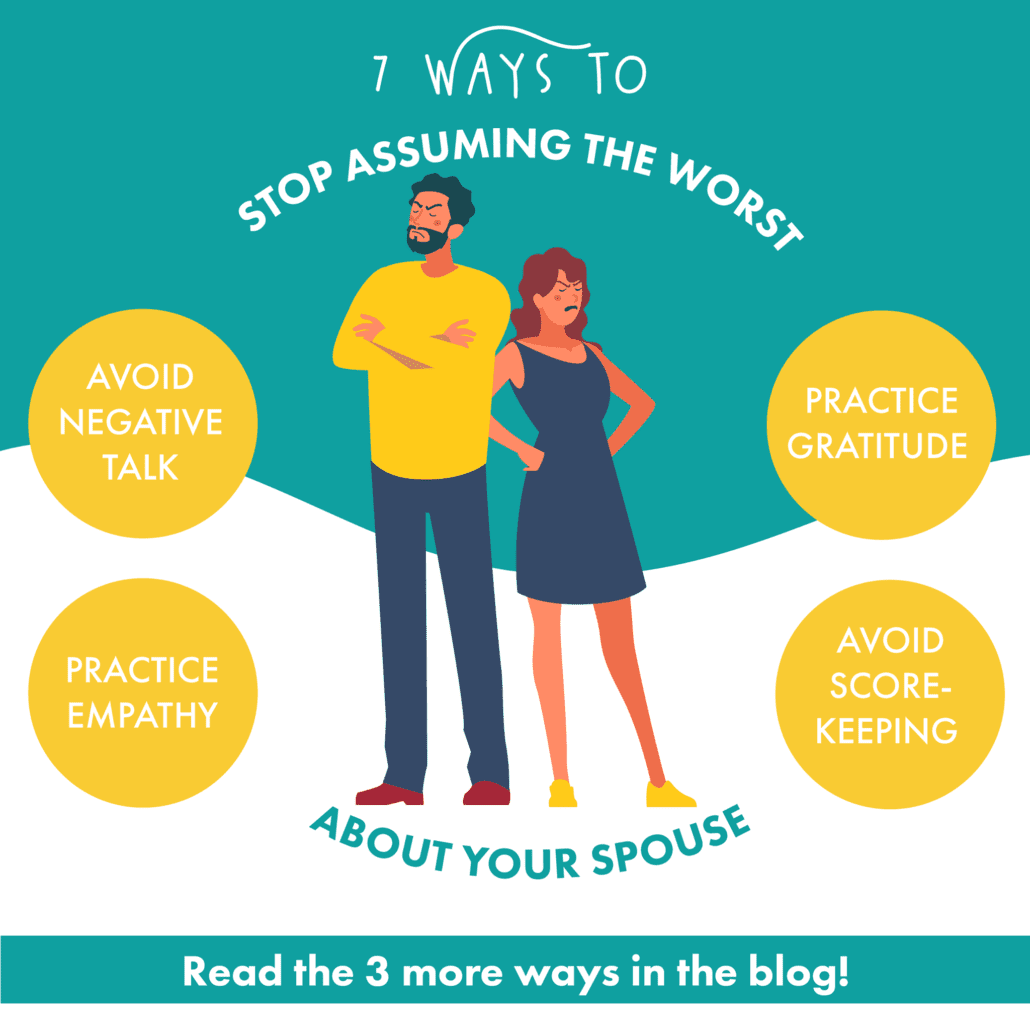
Below are seven ways to stop assuming the worst about your spouse. But one caveat needs to be made before working through these: changing your perspective is a mental exercise. And like any exercise, it needs to be practiced consistently before you start seeing results.
- Ask: What led you to start assuming the worst about your spouse? Can you narrow it down to an incident or a season of life? What was going on during that time? Were you experiencing feelings of stress, sadness, anger, grief, or pain? Reflecting on what started the snowball can shed light on the origins of negative thoughts and provide a frame of reference for how to change them. Even if you can’t pinpoint how the negative thoughts started, you can still work to change them.
- Practice gratitude. Research has shown that when we consciously consider all that we are thankful for and express that gratitude, our emotional and relational health improves. So ask yourself: What are the qualities I truly appreciate about my spouse? What positive contributions do they make to our relationship? And then, thank them. Express your thankfulness to them on a daily basis. It might help to keep a daily gratitude log, with each day’s entry simply finishing the sentence, “Today I am thankful for my spouse because…” Exercising gratitude is a very significant tool for eliminating negative thoughts about your spouse.
- Change the climate of your relationship. Make it your mission to connect more with your spouse. Create opportunities for simply being together, having calm, easygoing conversations, laughing and joking. Here’s a great idea: Ask your spouse out on a date. It doesn’t have to be elaborate, but put effort into it and romance your spouse. Regular doses of courtship and connection can help change a negative perception and help you stop assuming the worst about your spouse.
- Keep your own health in check. Many times negative thoughts (about anything) emerge from the fact that we aren’t taking care of ourselves, whether physically, mentally, or emotionally. And then those negative thoughts quickly find a target, usually the person closest to us. Adopt a lifestyle of self-care. Eat clean, get plenty of sleep, and get in some regular physical activity. Get outside more and absorb some sunshine.
- Practice mindfulness and relaxation techniques. Stimulate your thinking with books, articles, or educational videos. Throw away negative self-talk and mental put-downs, and start affirming yourself. Keep in mind that these aren’t just shallow, feel-good therapeutics. Self-care is a lifestyle that can improve your relationship with your spouse.
- Avoid negative talk, exaggerated talk, and the comparison game. All three of these serve to push that snowball of negative thinking faster and faster down the hill. Do everything you can to withhold negative comments, name-calling, and hostile sarcasm, even in the face of conflict. Practice healthy conflict-resolution techniques and take a time-out when necessary. Avoid using phrases such as You never… or You always… And be especially careful not to measure your spouse up against the people you see on television or social media. Those images don’t reflect reality (even on reality shows), which means your spouse would never be able to win that comparison game.
- Avoid scorekeeping. One sure-fire way of growing the negative-thought snowball is to keep reflecting back on all the wrongs and annoyances (no matter how big or small) that your spouse has committed in the past. And if you want to make matters even worse, keep reminding them of those wrongdoings. But, if you want to stop assuming the worst about your spouse, practice forgiveness, let the past go, and move on. This does not mean you don’t learn from the past or simply forget it. It does mean you choose not to let past events control the lens through which you see your spouse.
- Practice empathy. A good bit of research tells us that the practicing empathy does a lot for relationship health and how we think of our spouse. Empathy helps you to consider what it’s like to be in your spouse’s shoes, to take on their feelings, and spark compassionate action. This keeps your negative assumptions and thoughts toward your spouse in check. When you begin to think the worst about your spouse, stop and seek to understand what’s going on in their mind and heart at the moment.
I’m not going to lie. Trying to stop assuming the worst of your spouse isn’t easy. Sometimes it feels more like trying to stop an avalanche rather than a snowball. But if you make a regular practice of the above exercises—not just try them out, but dive into them with grit and determination—you’ll place yourself well on the road to changing your perspective and boosting your marriage satisfaction to the next level.
***If you or someone you know is in an abusive relationship, contact the National Hotline for Domestic Abuse. At this link, you can access a private chat with someone who can help you 24/7. If you fear that someone is monitoring your computer or device, call the hotline 24/7 at 1−800−799−7233. For a clear understanding of what defines an abusive relationship, click here.***