
3 Ways to Have Better Sex in Marriage
I have good news for you: an exciting sex life is salvageable and well within your reach for you and your spouse.
Here are three ways you and your spouse can take your sexual relationship from mundane to mind-blowing:
1. Don’t make fun the point of sex.
Wait, what? Did he just say that? Isn’t fun the point? Yes, I did, and no, it isn’t! It seems counterintuitive and requires a change in your thinking. Zack Brittle, certified therapist and blogger for the Gottman Institute, says sex isn’t just about the act itself (or at least it’s not all about the act), but rather it’s about sharing the body, mind, and soul as a couple. Sex is about connecting, bolstering intimacy, and exercising vulnerability with the one you’ve chosen to love the most. It’s a part of your relationship that’s meant to strengthen your relationship.
If the attention to your sex life with your spouse is centered merely on fun, you forget the overall essential role sex plays in your marriage, and the irony is that fun becomes a casualty. Focusing on connecting with your spouse in your sex life goes beyond the fun; it makes sex better.
And here’s where it becomes even more ironic: when you do focus on connection, sex becomes a lot more fun, adventuresome, and playful! (For a more in-depth look at the relationship between sex and intimacy, check out our Marriage Course: Discover Deeper Intimacy In Your Marriage!)
2. Dedicate to communicate.
Say it with me: Communication affects the sex. (Doesn’t that rhyme nicely?) Couples who struggle with communication struggle with other areas of their marriage, including their sex life; it’s all connected. But those who work on better, healthier ways to communicate thoughts, feelings, and needs with each other experience more connection, friendship, and intimacy. And this, as we’ve learned, is directly correlated with healthy (and fun) sex!
There are many resources out there for improving marital communication (see the links below for some great advice), but what I would emphasize to you here is frequency and depth of communication. Strive to communicate on a daily basis with your spouse, and aim for deeper levels of conversation than simply small talk. Work on communicating your opinions, dreams, ideas, needs, and emotions with each other — and listening to those of your spouse without value judgment. Simply listen to understand and draw closer to the one you love the most.
One more thing needs to be said about communication and sex.
Working on your marital communication is vital; however, marital sex is even better when you work on talking about sex. According to marriage researcher Dr. John Gottman, only 91% of couples who can’t comfortably talk about sex with one another report sexual dissatisfaction. (So, Salt-N-Pepa had it right when they rapped “Let’s Talk About Sex, Baby…” back in the 90s.)
Talking with your spouse about what turns you on, your interests and preferences, vulnerabilities, and sexual playfulness can be uncomfortable for many. But the good news is that it’s a learned skill that can greatly increase your comfort level. In her book, The Sex-Starved Marriage, therapist Michele Weiner-Davis says the right way to approach conversations about sex with your spouse is very much akin to approaching healthy conversation all around: Pick a time you both feel ready to talk; don’t talk when you’re tired, angry, or in a bad mood; pick a safe, comfortable environment; use “I” messages and talk about what you want rather than criticize. The more you wade into the discomfort of talking about sex, the more comfortable and natural it quickly becomes.
3. Super-glue your marriage — including your sex life — to the top of the priority scale.
This is crucial, especially if you have children (of any age) running around your house. Life is busy, schedules are hectic, money is tight. Attention to your marriage and your spouse must supersede these potential speed bumps. A wise person once said, “Show me your calendar and your checkbook, and I’ll show you what’s important to you.”
Set reminders on your phone to leave love notes. Schedule date times. Adjust your monthly budget to include some funds — even if it’s a small amount — toward nicer dinners (alone) or romantic gifts. ☆ Pay attention to your spouse’s love language — how is it that they feel most loved? Work out childcare with family or neighbors so you can get two hours alone with your spouse. Trade babysitting services with another parent — you’ll watch their kids one night and they’ll watch yours another.
Prioritizing your marriage doesn’t take doing anything elaborate.
It’s the small things that build and grow a marriage. But it has a direct and powerful impact on your sexual relationship. Foreplay doesn’t begin in the bedroom; rather, the turn-ons, attractions, and mood-making happen during continual moments of boosting your spouse to the top of your priority list.
Fun, playful sex is within the reach of you and your spouse, and you can bounce boredom out the window with some simple, intentional strategies. So here’s your assignment: Pursue your spouse. (No, not in a creepy, follow-them-around-all-day kind of way.)
- Remember when you were first dating, and there was nothing in your focus except this person?
- Remember how things were fun, but that wasn’t the point — you were just wanting to be together and get to know them better?
- Do you remember how you talked and talked, and actually listened with interest?
- And remember how you set the time and energy to be with that person, and it didn’t matter that you had to wake up early the next morning, or that you were tired from the work day, or that you barely had any cash in the account?
Pursue your spouse like this, and watch your marriage—including your sex life—be rejuvenated and energized.
Great articles for improving your marital communication:
- Communicating Effectively
- Keys to Effective Communication in Marriage
- 6 Tips to Have a Difficult Conversation with Your Spouse
- The Importance of MeaningLESS Conversations
- Talk to Me Like Lovers Do – Date Night Video
Also:
10 Things Every Couple Needs to Know About Sex
***If you or someone you know is in an abusive relationship, contact the National Hotline for Domestic Abuse. At this link, you can access a private chat with someone who can help you 24/7. If you fear your computer or device is being monitored, call the hotline 24/7 at: 1−800−799−7233. For a clear understanding of what defines an abusive relationship, click here.***
My Spouse and I Have Different Political Views
When Trump was elected President in 2016, Wakefield Research found 1 in 10 couples ended relationships over their political differences. For millennials, it was twice that. With that in mind, many wonder if marriages with different political views can survive the increased volatility of the times.
Susan and Darrell* have been married for more than a decade. During that time, they have experienced two presidential elections where they each voted for opposite sides of the aisle. If you ask them how their marriage is today, they will tell you it’s great…
But how can your marriage be great when you disagree on such huge issues?
Susan and Darrell certainly aren’t alone when it comes to being on opposite sides of the political spectrum. Nearly 30% of married households are bipartisan. In fact, there are some pretty well-known, long-married couples who have navigated these waters for years. Take James Carville, a Democrat and Mary Matalin, a Republican. Married since 1993, Carville says in Love & War: Twenty Years, Three Presidents, Two Daughters and One Louisiana Home, which he co-authored with his wife, “I’d rather stay happily married than pick a fight with my wife over politics.”
That right there is the key. A study published in the Journal of Social and Personal Relationships (Explaining the impact of differences in voting patterns on resilience and relational load in romantic relationships during the transition to the Trump presidency) found that couples who actively maintain their relationship are better able to “weather the storm” of an election because they build up positive emotions that protect the relationship during difficult times. So, even if you vote differently, actively maintaining your relationship can help you keep feeling emotionally connected to each other and reduce the propensity for stress and conflict.
For example, in an interview with U.S. News and World Report, Mary Matalin shares that she and her husband have many interests other than politics that they enjoy doing together like fishing, cooking and learning about history. “Talking about the impact of the minimum wage is just not something that is high on our list of fun things to do,” she says.
What does this mean for couples who find themselves with opposing political perspectives? Susan and Darrell, along with other couples in the same political boat say this: “Instead of allowing your political differences to divide you, see it for what it is and don’t allow it to take center stage in your marriage. There are a lot of things we agree on and enjoy doing together. We choose to focus on those things.”
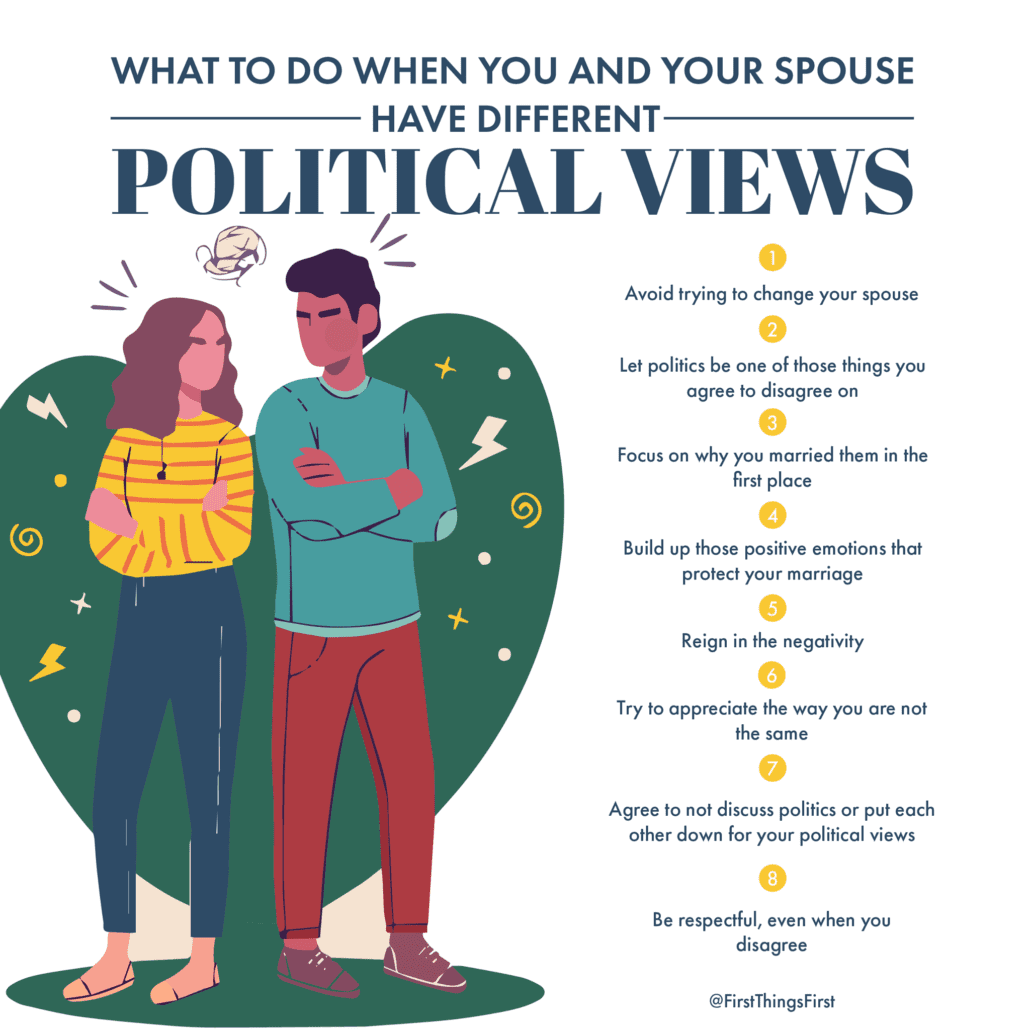
When you find that you and your mate differ on things like politics, these tips can help you navigate through those differences for the good of your marriage:
- Avoid trying to change your spouse. Trying to get your spouse to change will only create angst in your marriage. You can appreciate the fact that they are active in the political process and exercise their right to vote (just like you), which is a really good thing and not something to take for granted.
- Know that every married couple has issues they agree to disagree on for the duration of their marriage. Let politics be one of them.
- Focus on why you married them in the first place.
- Build up those positive emotions that protect your marriage. Compliment your spouse. Speak kindly about them to others. Be intentional about focusing on the things you love about your spouse and your relationship.
- Rein in negativity. The more you think negative thoughts about your differences, the more you teach your brain to think negatively about your spouse. This is a dangerous downward spiral that can take you places you do not want to go.
- Appreciate ways that you are not the same. Differing opinions and perspectives can offer depth and the ability to practice empathy in a relationship.
- Put safeguards in place such as agreeing that you aren’t going to talk about politics and you for sure are not going to chide your spouse about their political persuasion.
- Remember what matters most. Your marriage is more important than many differences you have, including politics. It will likely outlast any president’s tenure.
- Be respectful. Even when you disagree with your spouse, you can still be respectful. (Here’s why respect matters.)
A pandemic + a struggling economy + an election all in the same year can = frayed nerves, anxiety and an unusual level of sensitivity.
These things can magnify differences in your marriage that normally wouldn’t be a big deal. Knowing that this moment in time is especially extraordinary and putting some safeguards in place can protect your marriage. This allows you to focus on the goals you have set for your marriage… even when you disagree.
*names have been changed.
You and your spouse are arguing constantly. Maybe there’s a never-ending tension-filled silence at home when you’re around your partner. Or you feel like you can’t ever believe anything your significant other says.
You’ve heard that marriages can be hard work. But you’re not sure if this is “good” hard work, if you just have problems to work through, or if your marriage is truly a toxic marriage.
Here are 10 signs that are often present in a toxic marriage and what you can do about it…
Destructive communication.
You react to each other most often with criticism, contempt, defensiveness, or withdrawal/stonewalling. Dr. John Gottman, marriage researcher and therapist, calls these The 4 Horsemen. Each of these communication styles do a lot more to drive you apart than they do to bring you together. Healthy couples respond to each other as equals and approach conflict with respect for one another. They also take responsibility for their role in a conflict.
Conflict is never resolved or managed. It just grows.
It’s true that there are some things the two of you will never totally agree on. In fact, Dr. Gottman has identified 10 common differences within marriage that couples may not agree on for the duration of their marriage. Issues surrounding parenting, family and in-laws, work/life balance, and sex are all areas you may never see the same way. A marriage isn’t toxic because of these differences. When the relationship is unable to manage the differences and learn how to respect and work with one another, resentment and bitterness creeps in and creates high levels of toxicity. Being different doesn’t mean one of you is deficient. The world and your family needs the differences you both exhibit.
Intimacy is non-existent.
There’s little to no connection physically, emotionally, or spiritually. It breaks my heart to hear a spouse say, “I’m lonely.” Living with someone you love and feeling unable to feel seen, heard, or valued can leave one feeling lonely. Sharing intimate moments, whether they are times of deep, relational, and emotional connection or sexual experiences may be difficult when the marriage is toxic.
Secrecy.
It’s not that you should share every detail and every interaction you have with your spouse. However, purposely withholding information, financial information, or heavily censoring interactions you have with other people is a sign that there’s some potentially serious disconnect within your marriage. This can destroy trust and lead to betrayal. A healthy marriage works to build trust. It also works to understand why you’d risk the trust of your spouse for self-gratification.
Constant criticism.
We can always find something wrong with our spouse. But, if you are constantly criticizing or constantly being criticized, your relationship is not in a good place. The tone of voice and nonverbal communication are significant indicators as to how you communicate and how it will be received.
You consistently seem to bring out the worst in each other.
Whether enabling negative behaviors or provoking one another, a toxic relationship encourages you to be your worst self. You may constantly react to one another with anger, hostility, jealousy or any number of emotions. You may find yourself being manipulative, deceitful, or controlling. In healthy relationships, people look for ways to humbly help one another be their best selves, not from a place of superiority, but one of love and care.
Never fighting the right fight.
This isn’t about being physical. Sometimes couples argue so much they never actually discuss the real issue. She’s frustrated he won’t help with the dishes after eating. He’s always complaining that the family is rushing to this and that event. She wants more sex. He wants more peace and quiet. They’ve argued about the same thing for years and never actually talked about the real issue. The issue may be about valuing family time or lack of intimacy. Sometimes digging into the roots and understanding the real issue takes time and the help of a professional counselor. You want to fight the right fight, the right issue, the real issue.
Control and isolation.
Controlling or being controlled can have severe consequences to one’s mental and emotional health. Dictating where the other goes, what they do, how much money they can spend, what they say and who they spend time with are strong indicators of a toxic marriage or relationship. This is unhealthy behavior. Seek professional help.
Disrespect and disregard for each other.
This may look like a total lack of care or interest in one another. Dismissing and neglecting one another’s being in the marriage is a deep sign of trouble. Stepping back and appreciating the strengths of your spouse and their contributions to both you as a person and the marriage is a sign of a vibrant relationship.
Neither of you is becoming a better version of yourself.
The relationship is having a negative impact on your character. You’re becoming deceitful, manipulative, or more self-centered. While this may not always be attributed to the marriage, it’s important to look at marriage and determine what type of character the marriage is feeding.
★ So, What Can You Do?
Self-Care.
You’re not expected to be perfect, but you can work to take care of yourself, mentally, physically and emotionally. Eating well, getting plenty of rest, setting aside time to meditate/pray and be mindful are all proven ways to help you think better. These things can also help you respond to stress in a productive way. Research by The Institute for Family Studies indicates couples who cultivate mindfulness through activities such as meditation “may experience a feeling of greater connection within their romantic and sexual relationships.”
Focusing on the friendship within the marriage is focusing on the marriage.
Separating the marital expectations from the growth of a friendship can help the two of you focus on getting to know one another again. Friends talk, listen, support and share. When the marriage itself feels toxic, focus on being a good friend to one another. You’ll be strengthening your marriage.
Communicate.
Numerous studies confirm the number one issue couples experience in marriage is poor communication. Have honest, non-judgmental conversation with your spouse about your concerns. Don’t blame. Don’t speak to your partner with contempt as though you have all the answers. There’s no guarantee your spouse will receive it well or even reciprocate. We can hope, but not expect. Part of being a healthy you is sharing your honest thoughts and emotions.
Schedule your fights.
Many toxic relationships are characterized by incessant arguing. Your mind has become trained to only communicate conflict, disagreement and strong, negative emotions. Set aside a time where you will discuss your disagreements and conflicts. This may give one spouse the security of knowing that issues will not be avoided while giving the other person the space to get their thoughts together. As you develop a pattern of dealing with your issues in a healthy, productive way at a given time, it will become easier to coexist. It will also be easier for you enjoy one another at other times because there’s no fear that you’re ignoring your issues.
Seek Counseling.
As stated earlier, sometimes counseling is necessary. If your spouse isn’t willing, you may choose to seek counseling on your own to help understand the root issues of the toxicity. You may also find out what, if any, contributions you have made to the relationship’s toxic nature.
Find ways to express gratitude.
There’s something good about your spouse. Otherwise, you would have never been attracted to them. Relationship expert Dr. Jack Ito says, “little acts of love and kindness go a long way (in marriage).” Help your brain see the good in your spouse by showing and expressing gratitude for the good, regardless of how big or small it is.
Talk with healthy couples. Limit interaction with toxic couples.
You can expect to be contaminated with more poison when you continually interact with other toxic couples. During this season when you’re trying to eliminate toxicity, it’s crucial that you interact with couples who are relatively healthy—not perfect, but healthy. You won’t find any perfect couples.
***If you or someone you know is in an abusive relationship, contact the National Hotline for Domestic Abuse. At this link, you can access a private chat with someone who can help you 24/7. If you fear someone is monitoring your computer or device, call the hotline 24/7 at: 1−800−799−7233. For a clear understanding of what defines an abusive relationship, click here.***
Love is the most exhilarating emotion, until it’s the most frustrating because you’re dealing with COVID-19 and quarantine and you aren’t sure your spouse loves you anymore.
When you fell head over heels in love with your spouse, nobody gave you the heads up that you would endure a pandemic where you were together 24/7 for months on end.
There are no books on how to navigate the economy, homeschooling, anxiety over aging parents and kids coming home from college, politics, social injustice, and general uncertainty all at one time. These are just some of the things that have most of us on edge, much more so than usual. There’s a lot that preoccupies our thoughts and attention these days, which could easily leave someone wondering if their spouse still loves them.
Have they lost that lovin’ feeling?
First, are you questioning your spouse’s feelings for you because they are no longer doing the things they did before that made you feel loved? Have current life circumstances just gotten in the way of you feeling loved by your spouse? Or maybe you’ve spent so much time together lately that your relationship feels a bit stale or boring—like the fireworks just aren’t there?
How do you receive love?
People have various ways of expressing and receiving love. It is not unusual for love to look different in the midst of a crisis. Some people just don’t feel loveable at the moment.
Some people think saying “I love you” is enough to express their feelings and make someone feel their affection. Working hard and providing could be a way of showing love, but if that person is never home, it may not feel like love to the other spouse. Another spouse might show love by keeping the car clean and full of gas, but a clean car isn’t really a big deal to their spouse. You get the idea. My point is, how someone feels love is different from person to person.
If you are wondering if your spouse still loves you, there’s one sure way to find out: ASK!
Let’s Talk!
Find a good time to have an honest conversation with them. Let them know what their affection means to you and share that you are struggling a bit with knowing they still care. If there are ways they expressed love to you in the past that they aren’t currently doing, perhaps you could let them know you miss those things.
You also might ask if there is something bothering your spouse that the two of you need to discuss and work through. Maybe something is creating a disconnect between the two of you that you have no clue about.
Communication is the key.
If you avoid talking about how you are feeling, you could end up operating out of a lot of assumptions, none of which may be true. Your spouse may love you very much and it may surprise them that you are questioning their love for you.
Do they know what speaks love to you? Everybody has a different love language. If they ask you for specific ways they can help you feel their love, be prepared to give them some specifics.
It is totally possible that your spouse loves you deeply, but doesn’t love who they are very much at the moment. Stress and high anxiety have a way of making us feel prickly, and you know how that goes—the ones we love the most and are the closest to get the brunt of it when we are struggling.
Ask for help.
If in having the conversation with your spouse, you find that there are issues between the two of you, don’t be afraid to seek help. There are plenty of excellent counselors who can help you work through whatever has come between you.
Don’t underestimate the toll COVID-19 can be having on your marriage. There are so many things hitting on your marriage at the same time, it magnifies our feelings, our thoughts, and our responses. Now is not the time to make any hasty decisions concerning your marriage. Now is the time to be patient, keep putting one foot in front of the other, and trust that COVID-19 will not go on forever.
***If you or someone you know is in an abusive relationship, contact the National Hotline for Domestic Abuse. At this link, you can access a private chat with someone who can help you 24/7. If you fear that someone is monitoring your computer or device, call the hotline 24/7 at: 1−800−799−7233. For a clear understanding of what defines an abusive relationship, click here.***
I WAS MAD! Furious, in fact. Bitter and fed up. Totally resenting my husband. This was like the gazillionth Saturday in a row my husband got up and left the house to go do a job for someone. And I definitely felt like he left me with all the laundry and housework. Both of us had full-time jobs and paying someone else to do it was not an option.
This particular Saturday I decided I’d had enough. So, when he walked back through the door late that afternoon, I let him have it. I had rehearsed all day what I was going to say and how I was going to say it to make sure he didn’t miss a thing. The “deer-in-the-headlights” look I got in return let me know he was 100% clueless. He had no idea that resentment had been building up in me for a while. How in the heck could he NOT know?
That happened about three decades ago, but I remember like it was yesterday. That was the day I realized resenting my husband was more dangerous than his cluelessness.
So, here’s what this resentful spouse learned about how to stop resenting her husband.
Ultimately, I had to ask myself, “Are there any ways I am contributing to the resentment I feel?”
I learned that I was following behind everything he attempted to do like folding the towels, vacuuming, or even putting the dishes in the dishwasher and criticizing how he did it. I finally figured out that criticizing him made him shut down, so I decided to stop.
Instead of thinking he could read my mind or SEE what needed to be done, like the laundry basket I intentionally left sitting in the middle of the family room, I started telling him that I needed help with certain things. AND I didn’t tell him “the right way” (i.e. “my way”) to do whatever I asked him to do.
If I am always at odds with my husband, I’m not very pleasant to be around.
I honestly don’t want to resent my husband. What I really want is for us to enjoy time together. I decided when I felt myself getting irritated and resentful, I would literally stop what I was doing, take a walk around the block, and ask myself: “What is really at the crux of the matter?”
Sometimes, I actually noticed, I just needed someone to be irritated with and he was an easy target. Other times, something didn’t go like I thought it should—date night, dinner plans, or his arrival time home. Or maybe he didn’t do what he said he was going to do because he forgot or whatever and I felt justified in my resentment. Now what?
One time when I was ranting about all of my husband’s shortcomings, a very wise woman asked me, “So, I guess he never experiences any of this from you, right?” The fact that she was 90 and I was 30 kept me from losing it. The truth was, she had a great point. I forget, not often, but I do. There are plenty of things I do that get on his nerves that he could resent about me.
Then she said to me, “In the end, what is it you want? I mean, what is your resentment going to accomplish in your relationship? At the very best you will be two people who figure out how to co-exist in the same house. At the very worst, you won’t stay together. Is that how you want to live?” The answer was an emphatic NO! At that moment, I decided I was going to kick ongoing resentment out of our house and relationship.
When I feel resentment trying to creep in, I figure out where it is coming from and if it is worthy of a conversation.
If I believe that it is conversation-worthy, I ask my husband for a good time to talk. PRO-TIP: We have learned that if you are tired, hungry, or angry, that is not the time to try and have a conversation. When I can calmly explain, “I am exhausted and need help with our daughter,” or “I really need time with you—I am missing us,” it is a much better conversation than, “You never help with anything around here,” or “I think you don’t love me because you never want to spend time with me.” Trust me with this.
✭ Let me be straight up with you: if you are experiencing resentment because you are in a physically, emotionally, or sexually abusive relationship, seek help. ✭ Abuse is serious and unacceptable. It will be difficult to navigate change in your relationship on your own.
To Be Resentful or Not to Be Resentful?
If I were having coffee with my 29-year-old self, I would have no shortage of lessons learned to share, that’s for sure. Maybe one of the most important lessons I’ve learned when it comes to resentment is this: I have a choice. I can choose to be resentful or I can choose not to be resentful. When I can see clearly, what I know about my husband is, he is trustworthy, hardworking, funny, respectful, honest, a good father, reliable and he really does care about me and us. When I think about those things, often what I am resentful about pales in comparison.
What kind of guy is your husband? Have you trained your brain to only see his shortcomings? Here’s a challenge: for the next 30 days, focus on your husband’s positive character qualities instead of his “flaws.” Appreciation goes a long way when it comes to relationship restoration. How you feel about him at the end of the challenge might surprise you, and how he responds to you just might surprise you as well. 😉
Perhaps you’ve decided to wait around for him to realize that he’s the problem and he needs to change. If that’s the case, I am pretty confident you will be disappointed. It just takes one person doing something different to bring about change in your marriage. The question is, how badly do you want something to be different?
***If you or someone you know is in an abusive relationship, contact the National Hotline for Domestic Abuse. At this link, you can access a private chat with someone who can help you 24/7. If you fear that someone is monitoring your computer or device, call the hotline 24/7 at: 1−800−799−7233. For a clear understanding of what defines an abusive relationship, click here.***
If you have ever watched Everybody Loves Raymond, you know firsthand how overbearing in-laws like Ray’s mom can be. Giving her opinion when nobody asked for it, making off-handed comments about their parenting, criticizing decisions they make, and talking about them to each other was Marie’s style for sure. And, Raymond found it really hard to stand up to his mom, and we all know how that impacted their marriage. [Cue: Laugh Track]
Funny how so many have said they could truly identify with much of what happened on that show because they felt like they lived it every day. While some can kind of laugh it off, plenty of other couples find themselves actually having conversations about divorce because while they still love each other, they cannot figure out how to get one or both sets of parents out of their business. That’s NOT funny. Can you relate?
★ If you believe it is truly unhealthy for your family to be around your in-laws, your first responsibility is to your spouse. If being around your in-laws creates safety issues or requires you to put your family in an unhealthy situation—setting limits or creating boundaries is completely appropriate. Sometimes it may be necessary to make the decision that it’s in the best interest of your family not to be around your in-laws for a period of time. ★
If you feel like your in-laws are all up in your business, but it isn’t unsafe to be around them, the good news is, you’ve got options. You can:
- Limit the amount of time you spend with them.
- Plan ahead for how you will handle a visit that goes south.
Great! Got that part! But please tell me strategies for building a protective perimeter around my marriage!
Okay—here you go!
1. Your Marriage Is The Primary Relationship.
You both have to be intentional about making your marital relationship first. Marital distress may occur if one spouse doesn’t want to hurt his/her parents’ feelings and doesn’t see how them “investing” in your marriage is harmful. The two of you are a family and on the same team. Each person is responsible for communicating with their own parents in a way that does not throw your spouse under the bus. So, “We aren’t coming to your house this weekend because he doesn’t want to come,” is not an option on the table. Ever.
2. Stop Anticipating And Start Planning.
When you rehearse conversations in your brain, it actually gets you revved up. Stop playing it through in your mind how you think your in-laws are going to react or respond. Instead, discuss with your spouse how you want to approach or avoid certain topics. In essence, you are creating a strategy to help you both engage them and avoid being triggered by them. Make your plan together with your spouse. It may take a minute to get on the same page about how to move forward. It’s vital at this point however to remember that your spouse comes first, not your parents.
Here’s a side note worth mentioning: Before you and your spouse talk, spend some time thinking about where the angst with your in-laws is the most intense.
- Are they interfering with your marriage?
- Are they interfering with your parenting?
- Do they say things that hurt your feelings or rub you the wrong way?
This is important to know in order to make a plan to help you move forward constructively.
3. Decide How You Will Respond.
Straight out of the gates, make a commitment to respond versus react. Every time you react to a situation, you are giving over power and control. When you respond, you are calm, think before you speak, take the time to get with your spouse and discuss feelings and opinions and then share your response with your in-laws. Think through the typical scenarios that tend to take place and decide what your response will be.
If something out of the ordinary happens and you aren’t sure what to do, you are probably better off taking a moment to breathe. Maybe even take a walk around the block with your spouse to decide the best plan of action. People often regret flying off the handle, but rarely regret an intentional, constructive response. Before you say a word, ask yourself, “Will my response build up or further tear down the relationship?”
4. Set Appropriate Boundaries.
As a couple, it is important to have clear rules of engagement with extended family. When you are being clear with established boundaries, you are choosing your marriage, not between your spouse and parent.
Examples of this could include:
- We will call before we come to visit and we are asking you to do the same.
- Yes, we have given you a key to the house in the event of an emergency, but we are asking you not to use it unless there is actually an emergency.
- If we ask for your thoughts about our parenting style, please share your wisdom with us. Otherwise, we are not looking for unsolicited advice.
But what about power struggles? For real!
The best thing you can do is seek to avoid them. That sounds easier said than done, but if you and your spouse are on the same page, there shouldn’t be “power” up for grabs.
⇨ Don’t underestimate the power of a positive attitude. I know it’s hard. Dig deep. ⇦
➤ Remember, they are family. No matter the conflict, they are part of your family. Be aware of the level of tension, tones of voice, and language choice. All of these things can and will impact your children (their grandchildren). Are there behaviors you can choose to ignore? Give the benefit of the doubt? Extend grace? Ask yourselves, “Is this really worth ruining the relationship over?”
➤ Don’t assume they are intentionally trying to be difficult. In many instances, people think they are being helpful. They don’t realize that dropping by unannounced or giving unsolicited marital or parenting advice is not appreciated. Get with your spouse and brainstorm things that your in-laws could do that would be helpful. Then sit down with your in-laws and talk about what you would appreciate them doing. Also, discuss things that you would like them to stop.
➤ Relationships change and evolve. Believe it or not, many couples have been in exactly the same place you are at the moment. Through some advance planning, agreement on changes that need to be made, and strategic conversations, they now have a healthy and respectful relationship with the in-laws. It may take a minute, along with some tears and hard conversations, but don’t give up.
Are you feeling frustrated with your spouse?
Do things just seem more intense between the two of you?
Is working from home and/or taking care of the family making you tired?
Are you worn out from keeping up with the household duties?
Do you find that you and your spouse are arguing and disagreeing more?
Are differences being exposed as a result of COVID-19 and social unrest?
Do you sometimes lie in bed and wonder if you married the right person?
Before we dig into this, I want to be clear that if you are in a relationship where someone is abusing you in any way, stop here and seek help.*
As you went through the list above, you may have answered yes to some or all of the questions. These are trying times for sure. Right now, I want to focus on the last question.
Have you caught yourself entertaining the question: Did I marry the right person?
When we experience challenges that exist for an extended period of time, it can bring out the best and the worst in all of us. Before you fully convince yourself that everything is your spouse’s fault, here’s something to consider. Everybody has been under extra pressure for the last 106-plus days and as a result, may be acting a bit extra. That being said, it’s important to recognize that most marriages go through challenging times.
Although throwing in the towel may sound tempting, it might be helpful to set the wheels in motion to have a constructive conversation with your spouse about your marriage and how to ride these waves together.
Here are some things to think about as you prepare for the conversation.
What exactly is making you question whether or not you married the right person? Sometimes we entertain thoughts but have nothing of substance to back them up. Try to nail down where this idea is coming from.
Then ask yourself, based on history in your marriage, is this narrative something that has recently come up or has it been ongoing for an extended period of time, as in long before COVID-19 hit?
☆ Does your spouse know you are having these thoughts? If you shared what you are thinking today, would they be blindsided? ☆
Here’s the thing: When you start getting irritated with your spouse, you can actually teach your brain to only see the things that get on your nerves or irritate you about them. And, the more you go there, the more you tell yourself your thoughts are justified and accurate. It’s kind of like confirmation bias. This can be very misleading and has caused plenty of people to call it quits on a perfectly good marriage.
Talk It Out
★ Maybe you are not feeling valued or heard. Or, you just don’t feel connected anymore and are bored. Instead of deciding that you are finished, find a time where both of you can sit and have a conversation away from distractions. Beware of telling them all the things they aren’t doing—instead, talk about how you are feeling and ask for what you need.
“I need help with the children.”
“I’m feeling very distant from you. I would like for us to spend time together.”
“I’m scared about all that is going on.”
“I don’t feel appreciated or respected. Can we talk about that?”
“I am bored.”
Lead-ins like this are more likely to take you to a conversation instead of a meltdown because someone feels attacked. It’s totally possible that your spouse has no idea you are feeling like this and that they would be willing to do some things differently. (It’s also possible that your spouse is struggling, too.)
[Pause right here and take a deep breath.]
Instead of thinking your marriage might be coming to an end because you are questioning whether or not you married the right person, this could be the beginning of breathing new life into your relationship.
All marriages go through hard times. Talk with anybody who has been married any length of time and they will tell you, it was the times when they were hanging on to each other in the midst of the storm that brought them to the other side stronger and more energized.
Here’s the other secret: many couples have learned that there are times when they don’t like each other very much or the strong romantic passion toward each other ebbs and flows. The key is, their commitment to their relationship remains strong. And, as they continue to put one foot in front of the other, things transition—like children get older, COVID-19 calms down, work gets less intense, children are back in school, everybody is healthy, and more.
Problems and difficulties occur in ALL marital relationships. Your marriage can thrive when you respect, recognize, and appreciate what you each bring to your marriage. When you look back over your relationship, you may actually see that you have had many more good times than bad times. Be aware that we all are experiencing unique situations that we have never faced.
You might really be really asking yourself, “Did I marry the right person?” In reality, there are so many questions you are probably trying to answer right now. Give each other space and time to express and deal with the stress and anxiety from these unprecedented sets of circumstances. Avoid making any impulsive decisions right now.
***If you or someone you know is in an abusive relationship, contact the National Hotline for Domestic Abuse. At this link, you can access a private chat with someone who can help you 24/7. If you fear someone is monitoring your computer or device, call the hotline 24/7 at: 1−800−799−7233. For a clear understanding of what defines an abusive relationship, click here.***
Help! My Spouse and I Have Nothing in Common
Ahhhh, it finally happened. You and your spouse sat down to eat and… dead silence. In fact, this has happened a lot lately: while lying in bed, riding in the car, sitting on the couch, deciding what to do for fun. You realize that the two of you have absolutely nothing in common to talk about. If you aren’t talking about the kids, work, responsibilities, or bills—there’s nothing.
Many emotions creep in—Fear. Sadness. Concern. Bewilderment. What happened to us? We used to talk non-stop for hours. We had endless fun and romantic dates. And now it feels awkward and forced.
Yes, I remember those feelings. My wife and I have had that moment where we sat in the bed, both wide awake, and couldn’t think of anything to talk about. We’ve had the arguments about us never wanting to do the same thing for a date or for fun. We’ve experienced the tension of not being able to connect intimately. And we know the awkwardness of not being able to talk about what’s going on at work.
So, what do you do? These 9 things can help you really connect when you feel like you have nothing in common.
1. Accept that it’s NORMAL.
You’re not the first couple to experience this, nor the last. Marriages go through stages. The Gottman Institute, a relationship research institute says that “a person’s inner world changes as they pass through the seasons of life.”1 Each of you may be growing, changing, and evolving. That’s not a bad thing. It’s a good thing. It’s likely that you’re becoming better versions of yourself which is good for both you and the marriage. There are times when it is difficult to connect with your spouse because your way of connecting is becoming different.
2. Be aware of letting the world creep in to your marriage.
- Is all your brain energy focused on work?
- Are you consumed with social media? Work, kids, and social media are, in and of themselves, not distractions. However, we can place a higher priority on each to the detriment of our marriage.
- Are you taking the allotted vacation time from work?
- Do you care more about your success at work than your marriage?
- Are you totally focused on your children and that’s all you talk or think about?
- Are you overscheduling your children so that there’s no couple time?
- Do you find yourself sharing all of your thoughts and getting absorbed in the information and conversation on social media? When your brain is focused elsewhere it can feel like you don’t have anything in common with your spouse.
It may be time to evaluate where your time and mental energy is going. If you are communicating, who are you communicating with and what are you communicating about? Be willing to make the necessary changes to ensure that your relationship is priority. Regular date nights may be in order.
3. Curiosity is key.
Commit to learning new things about your spouse. Remember—you used to talk all the time. Part of that was because you were learning all kinds of new things about each other and it was fresh. There’s a good chance that one or both of you has grown or changed in the time you’ve been married. Kids may be grown and gone. Your philosophies on parenting or success may have changed. Instead of being bored with your spouse, take the initiative to become a student of your spouse. Talk about their dreams, what success means, or how they like to spend their time.
4. Focus on loving the differences.
Get into your spouse’s world and learn about it. Sometimes we allow our differences to drive us apart. We begin making value judgments about our differences. For instance, I like to make lists and get things done on Saturday morning which I think is way better than my wife who likes for us to take Saturday morning and visit with other families. She’s an introvert—I’m an extrovert who likes to socialize and build relationships any and everywhere and I often think my way is better.
Don’t let differences lead to judgments. Instead, allow your differences to take you down a path of learning more about your spouse. She likes to garden and you don’t. Spend time with her in the garden. He likes to read, you’d prefer to watch a movie. Read a book together. Consider the ways that your spouse’s differences are not only likable, but helpful to the marriage. There’s a saying, “If both of you were the same, then one of you would be unnecessary.”
5. Plan and do some everyday things together.
Planning our weekly menu and cooking together was one thing that worked well for me and my wife. We didn’t focus on the silence. We were trying to accomplish a task together. For example, we started trying new recipes. We had to work together. We were learning about each other’s likes, dislikes, comforts, and discomforts. My wife is more willing to try new things. I began to appreciate and even love that more. We created some new dishes that we still eat to this day. We made memories. DIY home improvement projects, vacation and holiday planning are all fair game. The key is learning about your spouse by listening and doing things together.
6. Shared experiences create great memories.
It’s amazing how shared experiences of giving can increase your spirit and help you to remember what’s important in life.2 The two of you can accomplish more together helping someone else than you can apart from each other. Do something for an elderly neighbor. Serve food together at a community kitchen. Volunteer at Habitat for Humanity. Come together and decide what the two of you can do for someone else as a team.
7. Explore new things.
This is how my wife and I got into hiking together. She liked doing puzzles. I liked playing sports. I liked being in social settings with lots of people. She liked intimate settings with few people. I’d rather go to the movie theatre. She’d rather watch it on Netflix. We knew this wasn’t going to work forever. We needed some fun stuff to do together.
There were some hits and misses along the way. But getting outside and hiking became something that we tried and both loved. She doesn’t feel like she’s lost herself and neither do I. Be willing to try new things. Some couples create YouTube channels and post videos as a couple. Others take up doing regular community service. Don’t get discouraged. You’ll look back one day and laugh at the things you tried that both of you hated and others that one of you loved and the other hated.
8. Support your spouse’s strengths.
Is your spouse really good at building relationships, problem-solving, budgeting, fixing things, being a peacemaker, etc.? It’s not unusual that our partner’s strengths attracted us to them in the first place, especially when they are good at what we’re not. Opposites do attract. We used to admire it, encourage it, and even be excited to watch them work in their strongest areas. Look for ways to support your spouse in what they are good at.
9. Turn toward, not away.
It’s easy to build resentment or begin to think your spouse has the problem. They aren’t making you happy. We’re growing apart. And our mind will begin to complete the story for us. I can spend the next 2 pages alone making lists of all of the differences me and the wife have, and the things we don’t have in common. Don’t shut each other off. Instead, talk about your concerns. Train your brain not to think of your spouse or yourself as the issue. Check any resentment, bitterness or criticism at the door. And see this as an issue that we will work through.
When you begin to feel like you have nothing in common with your spouse, instead of looking for a way out, see it as an opportunity to learn how to enjoy the beauty of your differences. If you focus on what you don’t have in common, you will for sure find it. The opposite is true as well: if you look for what you have in common, you will find that also.
Other Related Blogs:
We’re Total Opposites! Can We Make Our Relationship Work?
What To Do When You and Your Spouse Really Are Opposites
***If you or someone you know is in an abusive relationship, contact the National Hotline for Domestic Abuse. At this link, you can access a private chat with someone who can help you 24/7. If you fear that someone is monitoring your computer or device, call the hotline 24/7 at: 1−800−799−7233. For a clear understanding of what defines an abusive relationship, click here.***
SOURCES
1Beaty, J. (n.d.). How to rescue your marriage from empty nest syndrome. The Gottman Institute. https://www.gottman.com/blog/rescue-marriage-empty-nest-syndrome/
2Boothby, E.J., et al. (2014). Shared Experiences Are Amplified. https://doi.org/10.1177/0956797614551162