
Tag Archive for: Marriage

What To Do When You Catch Your Husband Watching Porn

Try these tips for talking about it and making decisions together.

You’ve just found out your husband is watching porn. What do you feel? Disgust. Shock. Despair. Betrayal on par with infidelity. World-shattering confusion. Who is this man I’m married to? Heartbreak. Grief. Loneliness. Creeping insecurity about your attractiveness and your sex appeal. Why am I not enough? Is he thinking about pornographic images while we have sex? How is he looking at women? What is he looking at when we’re not together? Trust just went out the window.

These are just some of the things you might be struggling with right now. And you can’t be blamed for any of them.

In 2019 alone, people spent nearly 6 billion hours on Pornhub1, but all that matters to you is the porn your husband has been watching. What’s next?

WHAT DO YOU DO NOW THAT YOU HAVE DEFINITELY CAUGHT YOUR HUSBAND WATCHING PORN?

Educate yourself.

You don’t have to click very far to find people and/or therapists who believe that using porn is a safe way to burn off sexual energy or enhance sex. While it may not phase others, what matters is how YOU feel about it, what you and your husband may have agreed to regarding pornography, and what solid research says.

Guilt vs. Shame

Guilt says, “This behavior is wrong.” It’s healthy, changes us, and helps us become who we want to be. Shame says, “There’s something wrong with me.” Shame makes us feel broken and unworthy of love. There’s a big difference.2 Separate your husband’s behavior from your husband as a person.

So, is compulsive pornography use only wrong because of the shame that surrounds it?

Societal or religious taboos don’t explain the shame game when it comes to compulsive pornography use. Study after study3 shows that shame may make porn use worse for the porn consumer, but it doesn’t explain it. Of course, your goal isn’t to make your husband feel shame. However, guilt is a healthy response to objectifying and dehumanizing people.

Is pornography a legit addiction?

The Addiction Center recognizes that this is a controversial topic but cites numerous studies to justify identifying porn as an addiction.

Arguing about whether pornography is addictive is a little bit like two bald men fighting over a comb. What can’t be disputed is that many wives feel humiliation, insecurity, low self-esteem and report lower relationship quality when their husband is watching porn.

Fake sex affects real sex. Period. Full stop.

PsychCentral article reports: “…regular consumption of pornography more or less wears out your reward system.” And clinicians report seeing many more young adults who experience sexual dysfunction, performance issues, and satisfaction with a real person, but not with porn. 


Identify what you’re feeling.

Mentally recognize and name your emotions concerning your husband watching porn. For example, you may feel anger, rejection, betrayal, disgust, confusion, inadequacy, hurt, insecurity, etc. According to Dan Siegel, UCLA Professor of Psychiatry and executive director of Mindsight Institute, naming your emotions allows your brain to soothe and calm you down.5

Putting a name to what you’re feeling can help you communicate the pain his porn use is causing you.

Know what’s helpful to know.

Don’t spend lots of time searching for everything he’s been looking at. Keep it simple.

Knowing every site he visited and how many genres he watched will only increase your negative feelings. Your goal is to know enough to determine his willingness to be truthful.

Remember, he’s got the issue, not you. Even if there are other marital issues going on, he’s the one looking at pornography.

I know — easier said than done. Porn isn’t really about your guy wanting you to be someone different. When people start looking at porn, research shows they subconsciously begin to bond with the images they see onscreen.6,7 This causes the brain to crave more of what they are seeing. Eventually, it takes more intense visual stimulation to get the same satisfaction. That’s why porn can be as addictive (if not more addictive) as heroin and gambling.

What’s the goal of talking?

What do you want the goal of the conversation to be? This is bigger than getting him to stop looking at pornography. It’s about him, you, and your marriage. You want to understand what he’s willing to do to overcome this issue and how you can help.

Note: Researching information on sites like Fight the New Drug can help you become informed. It may also be comforting to know you are not alone. 

READY FOR THE TALK:

Ask him about it.

Communication is 55% body language, 38% tone of voice, and 7% the actual spoken words.8 So, for example, your demeanor and tone can say, “I’m attacking you because I can’t believe how disgusting you are,” or “I’m really hurt by this, but I want us to get through it.”

He might lie.

I wish there was a foolproof way to eliminate any possibility of him lying. People respond differently. He may even deny, minimize, or accuse you of being something you’re not.

Jay Stringer, researcher and licensed therapist, warns about the potential of hiding. Hiding happens when the user redirects the conversation when confronted or chooses to be vague about what they’re doing. He may go into self-protection mode. He may be super embarrassed he has been found out. Be mentally prepared. You can’t make a person tell the truth. But, you can create an environment for honesty and hope the other person will be truthful. 

If he lies or hides, talk about your desire to work through this as a team. Remind him that you’re not going to stop loving him simply because he got caught up in pornography. Porn is more likely to destroy your marriage if you don’t address it together.  

If he’s willing to talk about it, ask questions.

Get him talking. This may be the first time he has actually verbalized his thoughts about it. Ask him: How long? Have you told anyone else? Have you tried to stop? What started it? These are questions that may get him thinking and talking. You don’t need all the details about everything he’s seen. You need an acknowledgment that he’s been looking at porn and that he wants to stop.

Communicate your thoughts and emotions.

He needs to hear your heart and understand your feelings. With many husbands, sincerely expressing your thoughts and feelings is more effective than yelling and screaming. Clearly and directly, share any insecurity, betrayal, or violation you’re feeling. Don’t share through the voice of anger; instead, speak through the voice of the actual emotion itself. This gives a clearer picture of the damage this is causing you and your marriage.

Listen to understand without justifying.

Studies show that anywhere from 50-90% of husbands watch porn. It’s safe to say many of us don’t really want to. And many have tried to stop unsuccessfully. Most people don’t understand what they’re up against when they look at porn for the first time. Having said that, he’s not a victim. He’s a fighter, which leads us to…

Discuss and set boundaries and limits.

He has to be willing to discuss and even initiate the setting of boundaries. He will not overcome a compulsion to look at pornography because you want him to. It has to be because he wants to. You can be strong alongside him and hold him accountable. This may include: accountability partners, learning about the dangers of pornography, sharing passwords, and regular check-ins.

★ IF YOU TRY TO DO THE WORK FOR HIM, IT WON’T WORK.

Express love.

Time and time again, I hear men say, “My wife kept saying, I love you. We’re a team. We’ll get through this.” They express how it meant the world to hear this. You’re encouraging your man to be a fighter and you’re telling him that you love a fighter, you’ll stick with a fighter, you’ll help a fighter to train, you’ll help a fighter beat the enemy. You’re also saying that you recognize that a fighter may get punched in the face. He may slip again. Every fighter gets hit. But one hit, one slip, doesn’t mean you’ve lost. You’ve lost when you stop fighting.

Patience.

Pornography addictions are different because the brain isn’t trying to rid itself of a chemical dependency. It may take time for your husband to stop looking at porn even if he’s trying. It takes time to heal and rebuild trust. Overcoming pornography requires commitment from both of you. During the process, set some goals like “3 days of no porn” or “2 consecutive weeks of talking to an accountability partner.” Celebrate the goals when you reach them.

WHAT IF YOUR HUSBAND DOESN’T WANT TO STOP WATCHING PORN?

Some husbands don’t think there’s anything wrong with watching pornography. Drs. John and Julie Gottman outline how porn use can lead to reduced relationship satisfaction. Share how it makes you feel that he’s watching other people do the intimate things the two of you do to emotionally and physically connect. Talk to a trusted couple. Consider seeking professional help.

As a couple, you must talk and decide the role you’ll allow pornography to play in your marriage. Studies show its negative effects within committed relationships. If you can both agree that you won’t give pornography a place in your marriage, then you can work together to keep it out.

***If you or someone you know is in an abusive relationship, contact the National Hotline for Domestic Abuse. At this link, you can access a private chat with someone who can help you 24/7. If you fear your computer or device is being monitored, call the hotline 24/7 at 1−800−799−7233. For a clear understanding of what defines an abusive relationship, click here.***

Image from Unsplash.com
SOURCES

1Pornhub’s annual report: Can you guess the most popular porn categories in 2019? (2019). https://fightthenewdrug.org/2019-pornhub-annual-report/ 

2Gilliland, R., et al. (2011). The roles of shame and guilt in hypersexual behavior. https://doi.org/10.1080/10720162.2011.551182 

3Reid, Stein, et al. (2011). Understanding the roles of shame and neuroticism in a patient sample of hypersexual men. https://doi.org/10.1097/NMD.0b013e3182125b96 

4Voon, Mole, et al. (2014). Neural correlates of sexual cue reactivity in individuals with and without compulsive sexual behaviours. https://doi.org/10.1371/journal.pone.0102419 

5Siegel. (2010). Mindsight : the new science of personal transformation. Bantam Books.

6Rizzolatti, G. et al. (2004). The mirror-neuron system. https://doi.org/10.1146/annurev.neuro.27.070203.144230 

7Hilton, D. (2013). Pornography addiction – a supranormal stimulus considered in the context of neuroplasticity. https://doi.org/10.3402/snp.v3i0.20767 

8​​Evans, V. (2020). How does communication work? Part 2: The function of verbal vs. non-verbal cues in face-to-face interaction. https://www.psychologytoday.com/us/blog/language-in-the-mind/202001/how-does-communication-work-0

Do you find it hard to see things from your spouse’s perspective?

Do you think your spouse should see things exactly the way you do?

Is it easier for you to try to fix things for your spouse rather than listen to them? 

If this is true about you or your spouse, you may have a lack of empathy. Situations where you fail to empathize with your spouse can lead to misunderstandings and disconnection. To truly understand empathy, we must define it. Brené Brown defines empathy as “feeling with people.” In its simplest form, empathy means to care as much about your spouse’s likes, dislikes, interests, issues, dreams, goals, and problems, as you care about your own. 

It can become difficult in marriage when you recognize that your spouse is so very different from you. According to psychotherapist Cindy Sigal, AMFT,  “Empathy bridges the divide between being separate individuals with different backgrounds, feelings, and perspectives.

How do we build and/or maintain the bridge of empathy between spouses?

1. Listen, Listen, Listen

The greatest need your spouse has is to be seen, heard, valued, and understood by you. This begins with listening to understand them—not to fix a problem. Additionally, give your spouse your full attention within the conversation. Asking questions allows you to become a “compassionate detective” of your spouse. Resist the urge to tell them what to do or how to fix the issue. In doing so, you validate your spouse’s feelings and capacity to solve the problem while utilizing empathy to fuel your connection.

2. It’s Not About YOU

The key to empathy is seeing things from your spouse’s perspective—literally, putting your feet in their shoes. Think about: What do they like to do? How did they grow up? What brings them happiness and what causes them to get upset? What is their favorite activity, food, etc.? How would they see this situation? Practice putting aside your views and thoughts to focus on those of your spouse. 

3. Respect Your Spouse’s Differences

At the beginning of your marriage, you may have thought, “It’s so GREAT how different we are.” Now reality has set in and you’re probably thinking, “OMG, WE ARE different.” YES, you are. However, there is strength in your differences. Having different views can give you the opportunity to see the picture/issue from a variety of ways. Allowing each spouse their own perspective provides opportunity for out-of-the-box decision-making as well as increasing mutual respect. 

Empathy so often is considered to be the “secret sauce” in relationships. It encourages us to see past ourselves and take our spouse into consideration. It bonds couples together. Building your capacity for empathy builds your relationship.

***If you or someone you know is in an abusive relationship, contact the National Hotline for Domestic Abuse. At this link, you can access a private chat with someone who can help you 24/7. If you fear your computer or device is being monitored, call the hotline 24/7 at: 1−800−799−7233. For a clear understanding of what defines an abusive relationship, click here.***

Image from Unsplash.com

Should We Fight In Front Of The Kids?

Fighting happens. How you do it matters.

Let’s be honest. We probably already do fight in front of the kids. Whatever you want to call them—“polite” disagreements, heated arguments, emotional debates, full-on shouting matches—we have them. We don’t necessarily plan to; they can just happen. A calm, respectful conversation can escalate quickly to savage verbal bloodsport. And guess who is taking it all in?

There is definitely a marital dimension to how you fight, over what, how often, and how you make up. But what about the parental dimension? What about that little person at the dinner table, or playing within earshot, hearing the brawl through the wall?

We have a large body of research on how “interparental conflict” or fighting affects kids.

Here’s what we know:

  • Kindergartners whose parents had harsh and frequent fights were more likely to struggle with depression, anxiety, and behavior issues by the time they were in seventh grade.
  • When parents are fighting, it’s physiologically traumatic for kids. Their blood pressure increases (even in very young babies). 
  • If you play audio of two adults fighting who are not the parents of a child, even that has a negative effect on the child.
  • Depression, anxiety, rule-breaking, and aggression can be a behavior of a child who experiences their parents disagreeing regularly.
  • Arguing in front of a child can be incredibly damaging to their psyche, as it creates a sense of instability and insecurity. This can manifest as guilt and a feeling of responsibility, leading to lifelong feelings of inadequacy.
  • Parents tend to have their worst fights in front of their children.
  • Family discord can actually alter children’s brains and make them process emotions differently. So, kids who witness their parents arguing a lot at home may struggle in social situations and have trouble making friends.
  • Regardless of what parents are fighting about, children tend to blame themselves.
  • The typical married couple has about eight “disputes” a day. Children witnessed their parents’ arguments about 45 percent of the time.

Here’s the thing: kids are smarter than we realize or think they are, and their development and intelligence begin at birth. Here’s the other thing: fighting, arguing, tension, instability, and volatility all have an effect on children whether we perceive it immediately or not. Here’s yet another thing: disagreeing, arguing, and even fighting are part of marriage. 

So, how do we as parents mitigate the negative effects of fighting in front of the kids?

Story Time. Average American Family. (Mine.)

Sitting at the dinner table, son (6th grade) says he wants to try out for the school football team.

(Seemingly benign statement.) Not an uncommon thing to talk about at dinner. My wife immediately encourages him to try out. I counter with my uncertainty about football and brain health. (Still a civil conversation.) We go back and forth a bit. (Voices get a little louder and a little more intense.) My son is chiming in here and there. (It becomes clear that my wife and I are not on the same page on this.) She’s thinking I’m being overly cautious and robbing our son of fun and character-building. I’m thinking she is being cavalier with our son’s brain and there are other ways to have fun and build character. (This could quickly get personal. And ugly.)

What happens next is so important. And it is so simple. But our emotions usually have their way with us and innocent, common, organic conversations quickly escalate into harsh and harmful fighting that hurts our kids. My wife simply says, “Why don’t we discuss this later?” Me, “Dude, your mom and I will talk this through and let you know what we decide.” Conversation changes. Dinner is enjoyed. No harm done. Our son saw us disagree, have a debate, and stay on the same team.

Here’s what else we know:

  • Parents who can resolve conflicts and emerge with warm feelings toward each other instill better coping skills and emotional security in children, studies show. This requires admirable self-control, and not all marital battles can be worked out so calmly. 
  • Marital battles that spark uncontrolled emotional outbursts should happen in private or in the presence of a therapist, and name-calling, threats, or other forms of aggression are never okay. But seeing Mom and Dad emerge from less hard-to-control disagreements satisfied, without resentment, can yield big rewards for children, according to researchers and experts in conflict resolution.
  • Parents who expressed warmth and empathy toward each other during arguments also fostered a sense of security in their children that their families would be okay, according to a two-year study of 416 U.S. families.
  • The research complements findings from a 2009 study by Dr. E. Mark Cummings that children whose parents have constructive conflicts, showing support and affection for each other, and exhibit better social skills, including cooperation and empathy for peers.
  • Even if parents fight sometimes, a higher ratio of positive to negative exchanges is linked to less sadness and worry in children and teens, according to a recent five-year study of 809 families. Displays of warmth and mutual support helped offset children’s fears about parental discord.

It’s not whether parents fight, but how they fight in front of the kids that matters. And how they make up.

All conflict between parents is not harmful to children, but some conflicts may be very harmful for children to observe. Children may even benefit from observing constructive conflicts. However, destructive conflicts are linked to multiple problems in children and are stressful for them to hear or witness. Click HERE for how to fight in front of your kids.

***If you or someone you know is in an abusive relationship, contact the National Hotline for Domestic Abuse. At this link, you can access a private chat with someone who can help you 24/7. If you fear your computer or device is being monitored, call the hotline 24/7 at: 1−800−799−7233. For a clear understanding of what defines an abusive relationship, click here.***

Image from AdobeStock.com

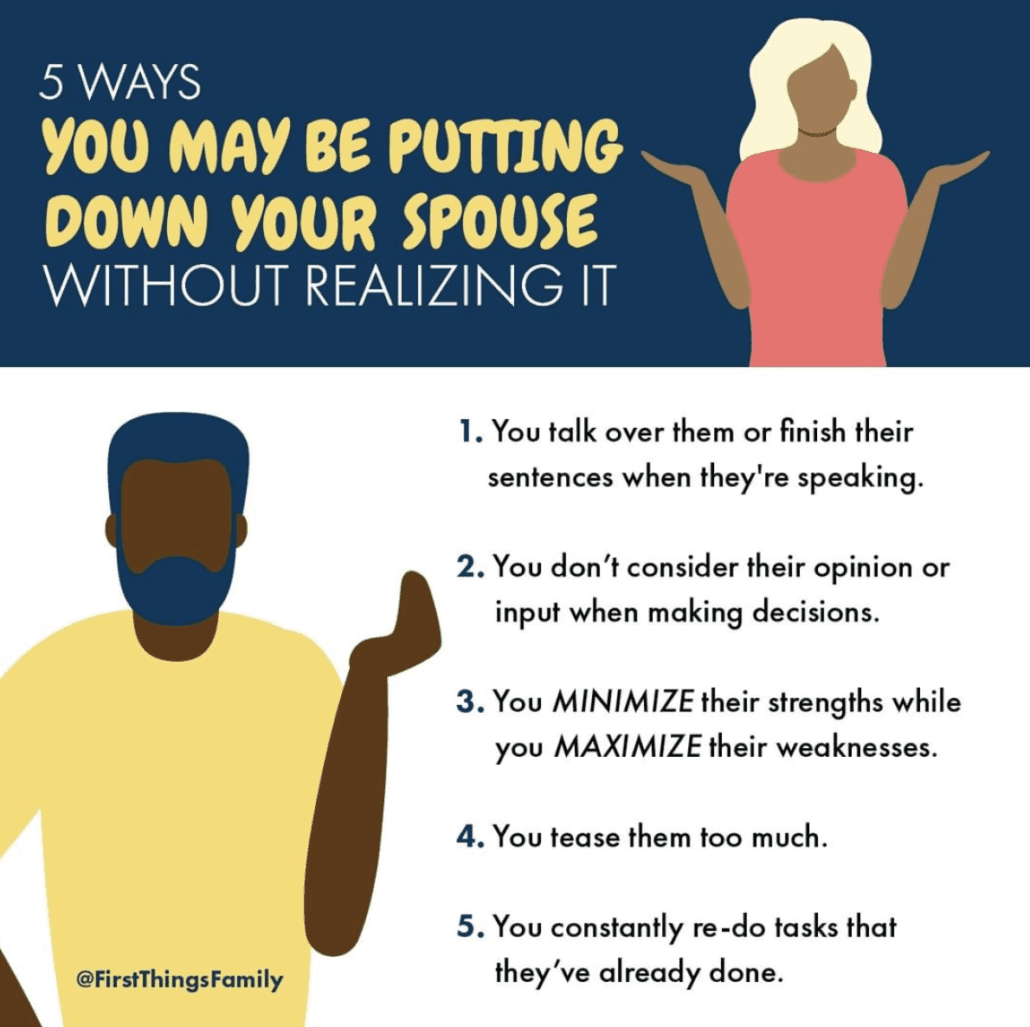
5 Ways You May Be Putting Down Your Spouse

These things undermine your relationship.

Have you ever made a joke about your spouse and they didn’t think that it was funny?

Has your spouse ever remarked on a “weakness” of yours and you felt some way about it?

Has your spouse ever made fun of you or put you down in front of your kids?

What are some of the common ways that we unwittingly put our spouses down?

1. You talk over or finish their statements when they are speaking.

It can easily become a habit to talk over your spouse or finish their statements for them. When you do this, you are sending the message to your spouse that you don’t respect their perspective and opinion. Additionally, this can minimize them in the eyes of others (family, friends, co-workers, children). 

2. You don’t consider/obtain their opinion or input when making decisions  (i.e., the kids, family vacations, or future plans).

Teamwork is important in marriage. It takes both parts of the couple contributing to make it as strong as possible. When one person makes all the decisions, it can lead to a myopic view of the situation. Having differing options and opinions can strengthen a plan. Like a well-woven tapestry, considering and respecting the input from your spouse creates a better and holistic problem-solving strategy.

3. You MINIMIZE their strengths while you MAXIMIZE their weaknesses.

When couples get together, they often say, “Where I am weak, my spouse is strong and vice versa.” After a time, it can become problematic when the focus changes to, “I really can’t believe that my spouse can’t do that.” For example: you may be very strong at directions while your spouse needs GPS to go anywhere, even places that they have been many times before. Sitting in the car as they set up the GPS, you think, “OMG, I should have just driven. They never know how to get anywhere.” You then share with anyone who will listen that your spouse is seriously DIRECTIONALLY CHALLENGED. From there you only seem to notice their deficiencies rather than their strengths.

4. You tease your spouse too much.

Whether it is about their hair, nose or the way they eat spaghetti, teasing your spouse can be a way to bring humor to your relationship. However, too much of a GOOD THING can become a problem. If you seem to nit-pick everything about your spouse even with a hint of levity, they may feel undervalued. Find ways to build up your spouse, not tear them down—even in JEST.

5. You constantly re-do tasks that your spouse has already done.

For many spouses, there are two ways to do things: MY WAY (THE RIGHT WAY) and your way. Your spouse may feel belittled as you refold the towel, remake the bed or reload the dishwasher. You inadvertently are telling them that their efforts are not wanted, needed, or appreciated. Because only YOU can do it, the RIGHT WAY.

Zig Ziglar said, “The first step to solving a problem is to recognize that it does exist.” Recognizing that you may be putting down your spouse is the initial step. While your spouse does things differently than you or even parents differently than you, it is KEY to respect those differences. Making fun of them or negating the importance of your spouse in your life and in the lives of your children undermines your relationship. Remember that the two of you are a TEAM. 

✦ Each of you has a role to play to make your family the BEST that it CAN BE!

***If you or someone you know is in an abusive relationship, contact the National Hotline for Domestic Abuse. At this link, you can access a private chat with someone who can help you 24/7. If you fear your computer or device is being monitored, call the hotline 24/7 at: 1−800−799−7233. For a clear understanding of what defines an abusive relationship, click here.***

Image from Pexels.com

3 Ways to Have Better Sex in Marriage

Here's how to rejuvenate your sex life AND your marriage.

I have good news for you: an exciting sex life is salvageable and well within your reach for you and your spouse. 

Here are three ways you and your spouse can take your sexual relationship from mundane to mind-blowing:

1. Don’t make fun the point of sex.

Wait, what? Did he just say that? Isn’t fun the point? Yes, I did, and no, it isn’t! It seems counterintuitive and requires a change in your thinking. Zack Brittle, certified therapist and blogger for the Gottman Institute, says sex isn’t just about the act itself (or at least it’s not all about the act), but rather it’s about sharing the body, mind, and soul as a couple. Sex is about connecting, bolstering intimacy, and exercising vulnerability with the one you’ve chosen to love the most. It’s a part of your relationship that’s meant to strengthen your relationship.

If the attention to your sex life with your spouse is centered merely on fun, you forget the overall essential role sex plays in your marriage, and the irony is that fun becomes a casualty. Focusing on connecting with your spouse in your sex life goes beyond the fun; it makes sex better

And here’s where it becomes even more ironic: when you do focus on connection, sex becomes a lot more fun, adventuresome, and playful! (For a more in-depth look at the relationship between sex and intimacy, check out our Marriage Course: Discover Deeper Intimacy In Your Marriage!)

2. Dedicate to communicate.

Say it with me: Communication affects the sex. (Doesn’t that rhyme nicely?) Couples who struggle with communication struggle with other areas of their marriage, including their sex life; it’s all connected. But those who work on better, healthier ways to communicate thoughts, feelings, and needs with each other experience more connection, friendship, and intimacy. And this, as we’ve learned, is directly correlated with healthy (and fun) sex!

There are many resources out there for improving marital communication (see the links below for some great advice), but what I would emphasize to you here is frequency and depth of communication. Strive to communicate on a daily basis with your spouse, and aim for deeper levels of conversation than simply small talk. Work on communicating your opinions, dreams, ideas, needs, and emotions with each other — and listening to those of your spouse without value judgment. Simply listen to understand and draw closer to the one you love the most.

One more thing needs to be said about communication and sex.

Working on your marital communication is vital; however, marital sex is even better when you work on talking about sex. According to marriage researcher Dr. John Gottman, only 91% of couples who can’t comfortably talk about sex with one another report sexual dissatisfaction. (So, Salt-N-Pepa had it right when they rapped “Let’s Talk About Sex, Baby…” back in the 90s.)

Talking with your spouse about what turns you on, your interests and preferences, vulnerabilities, and sexual playfulness can be uncomfortable for many. But the good news is that it’s a learned skill that can greatly increase your comfort level. In her book, The Sex-Starved Marriage, therapist Michele Weiner-Davis says the right way to approach conversations about sex with your spouse is very much akin to approaching healthy conversation all around: Pick a time you both feel ready to talk; don’t talk when you’re tired, angry, or in a bad mood; pick a safe, comfortable environment; use “I” messages and talk about what you want rather than criticize. The more you wade into the discomfort of talking about sex, the more comfortable and natural it quickly becomes.

3. Super-glue your marriage — including your sex life — to the top of the priority scale.

This is crucial, especially if you have children (of any age) running around your house. Life is busy, schedules are hectic, money is tight. Attention to your marriage and your spouse must supersede these potential speed bumps. A wise person once said, “Show me your calendar and your checkbook, and I’ll show you what’s important to you.” 

Set reminders on your phone to leave love notes. Schedule date times. Adjust your monthly budget to include some funds — even if it’s a small amount — toward nicer dinners (alone) or romantic gifts. ☆ Pay attention to your spouse’s love language — how is it that they feel most loved? Work out childcare with family or neighbors so you can get two hours alone with your spouse. Trade babysitting services with another parent — you’ll watch their kids one night and they’ll watch yours another. 

Prioritizing your marriage doesn’t take doing anything elaborate.

It’s the small things that build and grow a marriage. But it has a direct and powerful impact on your sexual relationship. Foreplay doesn’t begin in the bedroom; rather, the turn-ons, attractions, and mood-making happen during continual moments of boosting your spouse to the top of your priority list.  

Fun, playful sex is within the reach of you and your spouse, and you can bounce boredom out the window with some simple, intentional strategies. So here’s your assignment: Pursue your spouse. (No, not in a creepy, follow-them-around-all-day kind of way.) 

  • Remember when you were first dating, and there was nothing in your focus except this person? 
  • Remember how things were fun, but that wasn’t the point — you were just wanting to be together and get to know them better? 
  • Do you remember how you talked and talked, and actually listened with interest? 
  • And remember how you set the time and energy to be with that person, and it didn’t matter that you had to wake up early the next morning, or that you were tired from the work day, or that you barely had any cash in the account? 

Pursue your spouse like this, and watch your marriage—including your sex life—be rejuvenated and energized. 

Great articles for improving your marital communication:

Also: 

10 Things Every Couple Needs to Know About Sex

***If you or someone you know is in an abusive relationship, contact the National Hotline for Domestic Abuse. At this link, you can access a private chat with someone who can help you 24/7. If you fear your computer or device is being monitored, call the hotline 24/7 at: 1−800−799−7233. For a clear understanding of what defines an abusive relationship, click here.***

My Spouse and I Have Different Political Views

Focusing on your marriage goals can help you navigate any political disagreements you have.

When Trump was elected President in 2016, Wakefield Research found 1 in 10 couples ended relationships over their political differences. For millennials, it was twice that. With that in mind, many wonder if marriages with different political views can survive the increased volatility of the times.

political views

Susan and Darrell* have been married for more than a decade. During that time, they have experienced two presidential elections where they each voted for opposite sides of the aisle. If you ask them how their marriage is today, they will tell you it’s great…

But how can your marriage be great when you disagree on such huge issues?

Susan and Darrell certainly aren’t alone when it comes to being on opposite sides of the political spectrum. Nearly 30% of married households are bipartisan. In fact, there are some pretty well-known, long-married couples who have navigated these waters for years. Take James Carville, a Democrat and Mary Matalin, a Republican. Married since 1993, Carville says in Love & War: Twenty Years, Three Presidents, Two Daughters and One Louisiana Home, which he co-authored with his wife, “I’d rather stay happily married than pick a fight with my wife over politics.” 

That right there is the key. A study published in the Journal of Social and Personal Relationships (Explaining the impact of differences in voting patterns on resilience and relational load in romantic relationships during the transition to the Trump presidency) found that couples who actively maintain their relationship are better able to “weather the storm” of an election because they build up positive emotions that protect the relationship during difficult times. So, even if you vote differently, actively maintaining your relationship can help you keep feeling emotionally connected to each other and reduce the propensity for stress and conflict.

For example, in an interview with U.S. News and World Report, Mary Matalin shares that she and her husband have many interests other than politics that they enjoy doing together like fishing, cooking and learning about history. “Talking about the impact of the minimum wage is just not something that is high on our list of fun things to do,” she says.

What does this mean for couples who find themselves with opposing political perspectives? Susan and Darrell, along with other couples in the same political boat say this: “Instead of allowing your political differences to divide you, see it for what it is and don’t allow it to take center stage in your marriage. There are a lot of things we agree on and enjoy doing together. We choose to focus on those things.” 

When you find that you and your mate differ on things like politics, these tips can help you navigate through those differences for the good of your marriage:

  • Avoid trying to change your spouse. Trying to get your spouse to change will only create angst in your marriage. You can appreciate the fact that they are active in the political process and exercise their right to vote (just like you), which is a really good thing and not something to take for granted. 
  • Know that every married couple has issues they agree to disagree on for the duration of their marriage. Let politics be one of them. 
  • Focus on why you married them in the first place.
  • Build up those positive emotions that protect your marriage. Compliment your spouse. Speak kindly about them to others. Be intentional about focusing on the things you love about your spouse and your relationship.
  • Rein in negativity. The more you think negative thoughts about your differences, the more you teach your brain to think negatively about your spouse. This is a dangerous downward spiral that can take you places you do not want to go.
  • Appreciate ways that you are not the same. Differing opinions and perspectives can offer depth and the ability to practice empathy in a relationship.
  • Put safeguards in place such as agreeing that you aren’t going to talk about politics and you for sure are not going to chide your spouse about their political persuasion.
  • Remember what matters most. Your marriage is more important than many differences you have, including politics. It will likely outlast any president’s tenure. 
  • Be respectful. Even when you disagree with your spouse, you can still be respectful. (Here’s why respect matters.)

A pandemic + a struggling economy + an election all in the same year can = frayed nerves, anxiety and an unusual level of sensitivity.

These things can magnify differences in your marriage that normally wouldn’t be a big deal. Knowing that this moment in time is especially extraordinary and putting some safeguards in place can protect your marriage. This allows you to focus on the goals you have set for your marriage… even when you disagree.

*names have been changed.

You and your spouse are arguing constantly. Maybe there’s a never-ending tension-filled silence at home when you’re around your partner. Or you feel like you can’t ever believe anything your significant other says. 

You’ve heard that marriages can be hard work. But you’re not sure if this is “good” hard work, if you just have problems to work through, or if your marriage is truly a toxic marriage

Here are 10 signs that are often present in a toxic marriage and what you can do about it… 

Destructive communication.

You react to each other most often with criticism, contempt, defensiveness, or withdrawal/stonewalling. Dr. John Gottman, marriage researcher and therapist, calls these The 4 Horsemen. Each of these communication styles do a lot more to drive you apart than they do to bring you together. Healthy couples respond to each other as equals and approach conflict with respect for one another. They also take responsibility for their role in a conflict. 

Conflict is never resolved or managed. It just grows.

It’s true that there are some things the two of you will never totally agree on. In fact, Dr. Gottman has identified 10 common differences within marriage that couples may not agree on for the duration of their marriage. Issues surrounding parenting, family and in-laws, work/life balance, and sex are all areas you may never see the same way. A marriage isn’t toxic because of these differences. When the relationship is unable to manage the differences and learn how to respect and work with one another, resentment and bitterness creeps in and creates high levels of toxicity. Being different doesn’t mean one of you is deficient. The world and your family needs the differences you both exhibit. 

Intimacy is non-existent.

There’s little to no connection physically, emotionally, or spiritually. It breaks my heart to hear a spouse say, “I’m lonely.” Living with someone you love and feeling unable to feel seen, heard, or valued can leave one feeling lonely. Sharing intimate moments, whether they are times of deep, relational, and emotional connection or sexual experiences may be difficult when the marriage is toxic. 

Secrecy.

It’s not that you should share every detail and every interaction you have with your spouse. However, purposely withholding information, financial information, or heavily censoring interactions you have with other people is a sign that there’s some potentially serious disconnect within your marriage. This can destroy trust and lead to betrayal. A healthy marriage works to build trust. It also works to understand why you’d risk the trust of your spouse for self-gratification. 

Constant criticism.

We can always find something wrong with our spouse. But, if you are constantly criticizing or constantly being criticized, your relationship is not in a good place. The tone of voice and nonverbal communication are significant indicators as to how you communicate and how it will be received.

You consistently seem to bring out the worst in each other.

Whether enabling negative behaviors or provoking one another, a toxic relationship encourages you to be your worst self. You may constantly react to one another with anger, hostility, jealousy or any number of emotions. You may find yourself being manipulative, deceitful, or controlling. In healthy relationships, people look for ways to humbly help one another be their best selves, not from a place of superiority, but one of love and care.

Never fighting the right fight.

This isn’t about being physical. Sometimes couples argue so much they never actually discuss the real issue. She’s frustrated he won’t help with the dishes after eating. He’s always complaining that the family is rushing to this and that event. She wants more sex. He wants more peace and quiet. They’ve argued about the same thing for years and never actually talked about the real issue. The issue may be about valuing family time or lack of intimacy. Sometimes digging into the roots and understanding the real issue takes time and the help of a professional counselor. You want to fight the right fight, the right issue, the real issue.

Control and isolation.

Controlling or being controlled can have severe consequences to one’s mental and emotional health. Dictating where the other goes, what they do, how much money they can spend, what they say and who they spend time with are strong indicators of a toxic marriage or relationship. This is unhealthy behavior. Seek professional help. 

Disrespect and disregard for each other.

This may look like a total lack of care or interest in one another. Dismissing and neglecting one another’s being in the marriage is a deep sign of trouble. Stepping back and appreciating the strengths of your spouse and their contributions to both you as a person and the marriage is a sign of a vibrant relationship.

Neither of you is becoming a better version of yourself.

The relationship is having a negative impact on your character. You’re becoming deceitful, manipulative, or more self-centered. While this may not always be attributed to the marriage, it’s important to look at marriage and determine what type of character the marriage is feeding

★ So, What Can You Do?

Self-Care.

You’re not expected to be perfect, but you can work to take care of yourself, mentally, physically and emotionally. Eating well, getting plenty of rest, setting aside time to meditate/pray and be mindful are all proven ways to help you think better. These things can also help you respond to stress in a productive way. Research by The Institute for Family Studies indicates couples who cultivate mindfulness through activities such as meditation “may experience a feeling of greater connection within their romantic and sexual relationships.” 

Focusing on the friendship within the marriage is focusing on the marriage.

Separating the marital expectations from the growth of a friendship can help the two of you focus on getting to know one another again. Friends talk, listen, support and share. When the marriage itself feels toxic, focus on being a good friend to one another. You’ll be strengthening your marriage.

Communicate.

Numerous studies confirm the number one issue couples experience in marriage is poor communication. Have honest, non-judgmental conversation with your spouse about your concerns. Don’t blame. Don’t speak to your partner with contempt as though you have all the answers. There’s no guarantee your spouse will receive it well or even reciprocate. We can hope, but not expect. Part of being a healthy you is sharing your honest thoughts and emotions.

Schedule your fights.

Many toxic relationships are characterized by incessant arguing. Your mind has become trained to only communicate conflict, disagreement and strong, negative emotions. Set aside a time where you will discuss your disagreements and conflicts. This may give one spouse the security of knowing that issues will not be avoided while giving the other person the space to get their thoughts together. As you develop a pattern of dealing with your issues in a healthy, productive way at a given time, it will become easier to coexist. It will also be easier for you enjoy one another at other times because there’s no fear that you’re ignoring your issues.

Seek Counseling.

As stated earlier, sometimes counseling is necessary. If your spouse isn’t willing, you may choose to seek counseling on your own to help understand the root issues of the toxicity. You may also find out what, if any, contributions you have made to the relationship’s toxic nature. 

Find ways to express gratitude.

There’s something good about your spouse. Otherwise, you would have never been attracted to them. Relationship expert Dr. Jack Ito says, “little acts of love and kindness go a long way (in marriage).” Help your brain see the good in your spouse by showing and expressing gratitude for the good, regardless of how big or small it is.

Talk with healthy couples. Limit interaction with toxic couples.

You can expect to be contaminated with more poison when you continually interact with other toxic couples. During this season when you’re trying to eliminate toxicity, it’s crucial that you interact with couples who are relatively healthy—not perfect, but healthy. You won’t find any perfect couples.

***If you or someone you know is in an abusive relationship, contact the National Hotline for Domestic Abuse. At this link, you can access a private chat with someone who can help you 24/7. If you fear someone is monitoring your computer or device, call the hotline 24/7 at: 1−800−799−7233. For a clear understanding of what defines an abusive relationship, click here.***

Image from Unsplash.com

Love is the most exhilarating emotion, until it’s the most frustrating because you’re dealing with COVID-19 and quarantine and you aren’t sure your spouse loves you anymore.

When you fell head over heels in love with your spouse, nobody gave you the heads up that you would endure a pandemic where you were together 24/7 for months on end. 

There are no books on how to navigate the economy, homeschooling, anxiety over aging parents and kids coming home from college, politics, social injustice, and general uncertainty all at one time. These are just some of the things that have most of us on edge, much more so than usual. There’s a lot that preoccupies our thoughts and attention these days, which could easily leave someone wondering if their spouse still loves them. 

Have they lost that lovin’ feeling?

First, are you questioning your spouse’s feelings for you because they are no longer doing the things they did before that made you feel loved? Have current life circumstances just gotten in the way of you feeling loved by your spouse? Or maybe you’ve spent so much time together lately that your relationship feels a bit stale or boring—like the fireworks just aren’t there? 

How do you receive love?

People have various ways of expressing and receiving love. It is not unusual for love to look different in the midst of a crisis. Some people just don’t feel loveable at the moment.

Some people think saying “I love you” is enough to express their feelings and make someone feel their affection. Working hard and providing could be a way of showing love, but if that person is never home, it may not feel like love to the other spouse. Another spouse might show love by keeping the car clean and full of gas, but a clean car isn’t really a big deal to their spouse. You get the idea. My point is, how someone feels love is different from person to person.

If you are wondering if your spouse still loves you, there’s one sure way to find out: ASK!

Let’s Talk!

Find a good time to have an honest conversation with them. Let them know what their affection means to you and share that you are struggling a bit with knowing they still care. If there are ways they expressed love to you in the past that they aren’t currently doing, perhaps you could let them know you miss those things.

You also might ask if there is something bothering your spouse that the two of you need to discuss and work through. Maybe something is creating a disconnect between the two of you that you have no clue about. 

Communication is the key.

If you avoid talking about how you are feeling, you could end up operating out of a lot of assumptions, none of which may be true. Your spouse may love you very much and it may surprise them that you are questioning their love for you. 

Do they know what speaks love to you? Everybody has a different love language. If they ask you for specific ways they can help you feel their love, be prepared to give them some specifics.

It is totally possible that your spouse loves you deeply, but doesn’t love who they are very much at the moment. Stress and high anxiety have a way of making us feel prickly, and you know how that goes—the ones we love the most and are the closest to get the brunt of it when we are struggling.

Ask for help.

If in having the conversation with your spouse, you find that there are issues between the two of you, don’t be afraid to seek help. There are plenty of excellent counselors who can help you work through whatever has come between you. 

Don’t underestimate the toll COVID-19 can be having on your marriage. There are so many things hitting on your marriage at the same time, it magnifies our feelings, our thoughts, and our responses. Now is not the time to make any hasty decisions concerning your marriage. Now is the time to be patient, keep putting one foot in front of the other, and trust that COVID-19 will not go on forever.

***If you or someone you know is in an abusive relationship, contact the National Hotline for Domestic Abuse. At this link, you can access a private chat with someone who can help you 24/7. If you fear that someone is monitoring your computer or device, call the hotline 24/7 at: 1−800−799−7233. For a clear understanding of what defines an abusive relationship, click here.***

Image from Pexels.com