
Do I Have To Tell My Spouse Everything?
The opposite of a fact is falsehood, but the opposite of one profound truth may very well be another profound truth. -Niels Bohr
Do I have to tell my spouse everything?
Do you want your spouse to tell you everything?
It depends. It really does.
What do we know for sure?
Once you marry someone, you aren’t leading your own life anymore. You are officially in a partnership, and you need to treat it as such. It’s important to discuss and respect boundaries.
We want to be known, understood, and accepted. Viewing marriage as a lifelong commitment between two people creates a safe environment to be accurately known, completely understood, and unconditionally accepted. Striving to accomplish those things is the journey of a lifetime.
Relationships are built in good faith on a foundation of honesty, trust, and communication. If you want to have a healthy, lasting marriage, it is not wise or healthy to be doing things you aren’t comfortable sharing with your spouse. If there is something you want or need, sit down with your spouse and discuss it.
The moment you under-share, withhold relevant information, cross agreed-upon boundaries, or intentionally try to hide something, and are found out—the trust evaporates and your bond is weakened or broken. What breaks in an instant takes a long time to rebuild.
✶ I don’t know you. I don’t know your spouse and I don’t know the health of your marriage or the boundaries you have agreed to put in place to protect your relationship and make it thrive. But here are some general things to think about as you consider what needs to be shared with your spouse:
- You shouldn’t share what doesn’t belong to you. Your spouse has no claims to what friends and colleagues confide in you. “Secret” does not equal “Private.”
- There is a major difference between telling your partner everything in your past because you want to and telling your partner everything in your past because they want you to.
- You might be strong enough to share the truth, but your spouse might not be strong enough to deal with it. Sensitivity and timing are everything.
- Don’t fall into the trap of believing you only have two options: tell your spouse everything or tell your spouse nothing. There could be dozens of legitimate options in between. Be compassionately discerning.
- You need to examine your motives as to why you are sharing certain information.
- It can be a short trip from “words” to “wounds.” Choose your words carefully.
- Some of our choices bring shame, pain, and consequences to ourselves and others. Integrity doesn’t compound consequences beneath layers of lies.
“The opposite of a fact is falsehood, but the opposite of one profound truth may very well be another profound truth.” Lying, deceit, and deception are wrong, but sharing is not necessarily always caring. But don’t disconnect the profound relationship between truthfulness and love.
Related blogs:
4 THINGS EVERY COUPLE SHOULD KNOW ABOUT COMMUNICATION IN MARRIAGE
Maximize Your Marriage Series | Tips for Healthy Communication
HELP! MY SPOUSE HATES TO TALK ABOUT BOUNDARIES!
4 STEPS FOR SETTING GOOD BOUNDARIES
HOW BOUNDARIES CAN PROTECT YOUR MARRIAGE
***If you or someone you know is in an abusive relationship, contact the National Hotline for Domestic Abuse. At this link, you can access a private chat with someone who can help you 24/7. If you fear that someone is monitoring your computer or device, call the hotline 24/7 at 1−800−799−7233. For a clear understanding of what defines an abusive relationship, click here.***
The Difference Between Sacrifice and Compromise in a Relationship
We throw the words compromise and sacrifice around quite a bit in relationships. But what exactly do they mean? And don’t they mean the same thing?
Well, the short answer is, not exactly. It’s complicated, kind of like relationships are sometimes. Read on to see what I mean.
Both sacrifice and compromise require someone to lose or give something up, but in two very different ways.
Compromise involves people meeting in the middle to solve a problem. Each person gives in a little… or a lot. Here’s a simple example: one person wants to meet for coffee at 11:00, while the other prefers 11:30. They meet in the middle and decide on 11:15. Each person gave up 15 minutes; problem solved.
Sacrifice is different, though. It requires one person to meet another where they are. They give up something to accommodate the other person regardless of whether they respond or give back. Another simple example: one person can only meet at 11:00 for coffee. Rather than reschedule, the other person gives up a prior engagement to meet with this person.
Compromise is a team effort toward a common goal, resolving conflict or disagreement. It’s mutual by its very nature. Everyone involved must give up something for it to be called compromise. A compromise works out differences.
A sacrifice is a solo act done to strengthen the bond between two people. One person gives something up for the relationship; the other person doesn’t necessarily have to, although relationships generally thrive when sacrifice is mutual. Sacrifice seals commitment.
The nature of sacrifice and compromise gets hairier when you consider different levels and depths of relationships.
Here’s what I mean.
Compromising on a coffee time with a co-worker is one thing. Settling with your spouse on how to raise your kids, save money, or where you’ll spend the holidays is a totally different ballgame. Deeper relationships call for deeper considerations.
Perhaps not so much with sacrifice. Giving up a career, living in a particular city, or spending a lot of time with other people is considered good in some relationships, but downright crazy in others.
**Compromise happens in all healthy relationships to some degree. Sacrifice is probably more appropriate for long-term, committed relationships. And problems can occur when we get those two concepts mixed up.**
As a matter of fact, it’s possible to sacrifice for the wrong reason. An interesting piece of research found that when one romantic partner gave something up for the good of the relationship, both partners had higher than average relationship satisfaction.
On the flipside, both partners felt less satisfied in their relationship when a partner gave something up to avoid guilt or hurt feelings.
Did you catch that? The same behavior—sacrificing for one’s partner—had opposite effects depending on the motive behind it. Your reason for sacrifice makes a difference.
What can we take away from these ideas?
- Disagreements happen. Compromise can help solve problems and keep relationships healthy.
- Sacrifice isn’t always the best option, like maybe in a new dating relationship. It can even be harmful. But when it is appropriate (think marriage), both people benefit from it.
- Compromise costs, but it’s typically refundable. If a compromise doesn’t work, you can usually step back and try something else.
- Sacrifice is also costly, but it usually has a no-return policy. It’s risky. And it shouldn’t be done recklessly.
- Carefully weigh your relationship’s depth and outlook (and the issue you need to solve) before sacrificing or compromising.
Some say compromise is the foundation of a relationship. Others say throw compromise out the window and selflessly sacrifice.
I say there’s a time and a place for each: compromise freely and sacrifice wisely.
Related blogs:
- DOWNLOAD: STEP-BY-STEP GUIDE TO HEALTHY RELATIONSHIPS EBOOK
- 6 WAYS TO AGREE TO DISAGREE WITH MY SPOUSE
- HOW TO HAVE HARD CONVERSATIONS WITH CO-WORKERS
- COMMUNICATING EFFECTIVELY
***If you or someone you know is in an abusive relationship, contact the National Hotline for Domestic Abuse. At this link, you can access a private chat with someone who can help you 24/7. If you fear that someone is monitoring your computer or device, call the hotline 24/7 at 1−800−799−7233. For a clear understanding of what defines an abusive relationship, click here.***
4 Communication Exercises For Married Couples
Healthy communication lies at the root of any successful relationship. In marriage, this is even more of a necessity. Like our muscles, our communication skills also need to be worked out. There are practices we can make part of our regular routines that will strengthen communication in our marriage. Here are four communication exercises for married couples.
Exercise #1: The Weekly Meeting
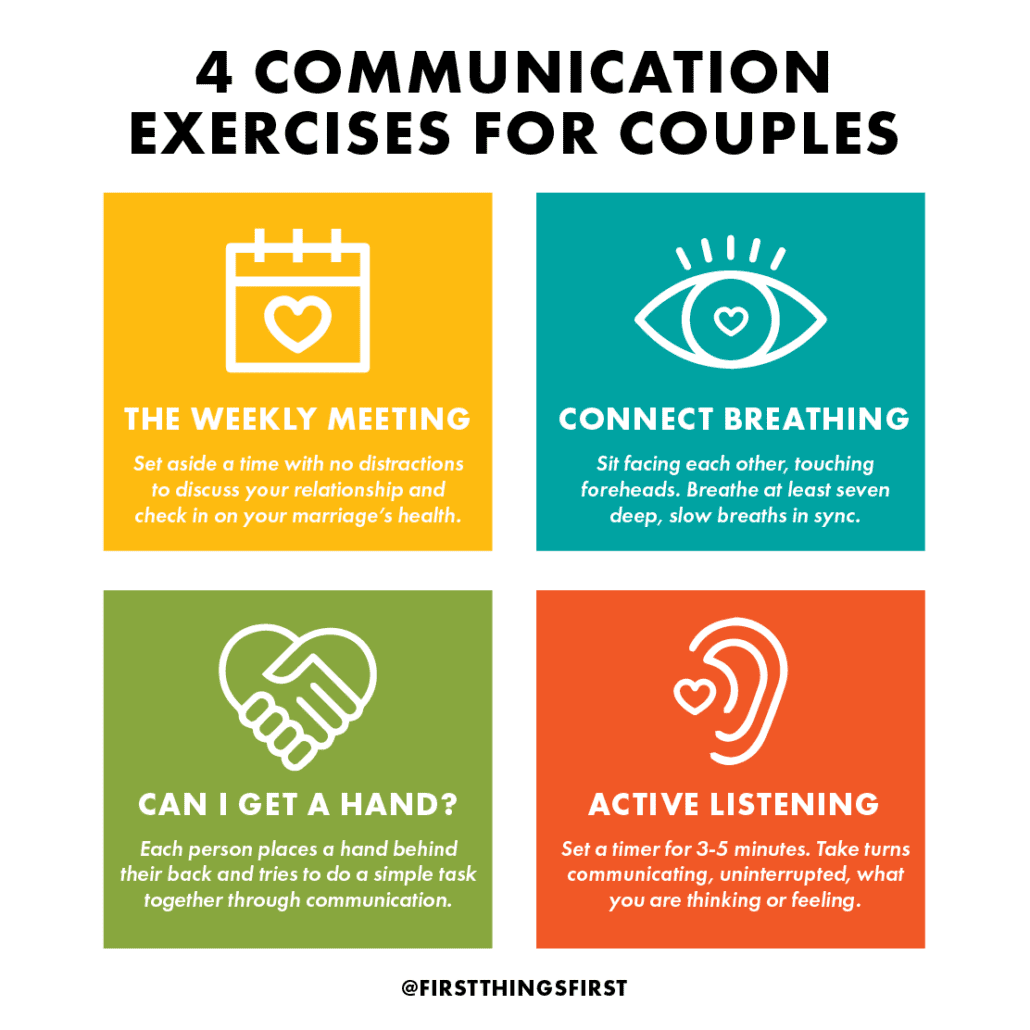
If your marriage is like mine, you’re busy. You both have schedules, and your kids have schedules… I think my kids’ schedules are often busier than mine. This exercise is excellent to carve out time to focus on your marriage intentionally.
Set aside a non-negotiable chunk of time (30 minutes is a good starting point) when you will have no distractions. No phones, no tablets, no television, no kids. This time is for you to discuss your relationship and check in on your marriage’s health.
So what do you talk about? Start here:
- How are we doing as a couple?
- Is there anything we need to finish addressing from this week?
- How can I make you feel more loved and appreciated?
You don’t have to stop here. These questions are just ideas to get you started.
As you dedicate this time each week, check out these keys to effective communication in marriage to enhance your communication.
Exercise #2: Connecting Through Breathing
The purpose of this exercise is to focus on your partner and remove distractions. To begin, sit facing each other, touching foreheads. Tilt your chins down, so you don’t bump noses.
Breathe at least seven deep breaths. Try to breathe slowly and in sync. As you get the hang of this exercise, you may choose to do more breaths or focus on breathing for a set amount of time. It’s all about connecting and focusing on one another.
When you need to slow down and refocus, this is a great practice. Once you have refocused on one another, take the time to talk about how your marriage is doing.
This exercise is ideal for clearing your minds and having a healthy conversation.

You’ve had conversations with your spouse, even arguments, and maybe straight-up fights about this issue or that problem, BUT those interactions often don’t lead to any solutions. But why is that exactly?
Join us for this 20-minute webinar to find out!
Exercise #3: Can I Get A Hand?
Often in marriage, misunderstandings come from not sharing our needs. Your spouse is not a mind reader, so it’s vital to communicate your needs clearly and effectively. This exercise will help.
In this exercise, you’ll both be working toward a common goal. Each person will place a hand behind their back, and together you’ll try to do a simple task such as buttoning a shirt, pouring a cup of coffee, or any other task around the house. Be as clear as possible in communicating with each other to accomplish the task together.
This was a pretty enlightening experience for me. We had some really good laughs AND I learned there were some things I could do to communicate more clearly with my wife.
Exercise #4: Active Listening
This exercise focuses on verbal and nonverbal communication.
Set a timer for 3-5 minutes. One spouse communicates whatever they are feeling or thinking, uninterrupted. The other spouse listens and communicates nonverbally. When the timer goes off, both of you discuss the experience.
Then switch roles and practice again.
These are just a few exercises you can practice to increase communication in your marriage. Healthy communication plays an essential role in any thriving relationship. Make exercising your communication muscles a priority in your marriage and take it to the next level.
Ready, set… time to work out!
Related:
How To Improve Bad Communication In Marriage
3 Ways Good Communication Can Enhance Sex In Marriage
4 Things Every Couple Should Know About Communication In Marriage
How To Improve Bad Communication In Marriage
Every couple experiences little instances of communication breakdown. It just happens.
Of course, the little things can gradually chip away at your connectedness in your marriage. Small drops of water from a leaky pipe over time lead to big problems.
Minor bad communication habits are like that. Not that big of a thing in the moment, but given time… you get the picture.
So with that in mind, here are four common communication habit scenarios every couple experiences. The good news is, you can fix or improve bad communication with a little intention:
Scenario 1:
Fred asks Wilma if it’d be okay to go bowling with Barney tonight. Wilma replies, “Sure, you can go if you want.” However, Wilma’s tone of voice sounds less than enthused. And her crossed arms and frown suggests she’s not as approving as her words suggest.
Wilma is sending mixed messages to Fred. Her words don’t match her non-verbal cues. She feels bad saying no, but she would really love for him to stay home and spend time with her. This leaves Fred in a no-win situation: Should he accept her verbal permission and go, or stay home because of her tone and body language?
The Fix:
Wilma needs to be honest with her feelings and maybe work out an alternative. Perhaps he can go out tonight and plan on quality time with Wilma the next evening.
If Fred senses the mixed message, he needs to politely ask his wife, “Dear, I appreciate you letting me go tonight, but your tone and crossed arms seem to be telling me something else. Am I reading you right?”
Scenario 2:
Pam has had a rough day at work; her boss just seems incompetent, and her co-workers lazy. She shares with her husband Jim that evening. Jim makes several suggestions on how to handle things. Pam walks away feeling misunderstood.
You’ve had conversations with your spouse, even arguments, and maybe straight-up fights about this issue or that problem, BUT those interactions often don’t lead to any solutions. But why is that exactly?
Join us for this 20-minute webinar to find out!
The Fix:
The issue here is Pam just wants to be heard. There are times for solutions—this isn’t one of them for Pam. It would do Jim good to gently ask Pam during the conversation, “Hon, is this one of these things where you want some help fixing this or where you just want me to listen and try to understand?” Pam would feel appreciated just being asked that.
Knowing Jim is a fix-it kinda guy, Pam could prep Jim a little and say, “I want to share what happened today, and I don’t really need anything to be fixed; I just need you to listen.”
Scenario 3:
Rachel tries to tell Ross the chores she’d like his help with this weekend. Ross is currently engaged in the game on TV. When she’s finished, Ross blankly looks up at her and says, “Huh?” Rachel walks away frustrated while Ross sits there confused.
The Fix:
Rachel should understand Ross’s mind is in the game. It’s sometimes difficult for people to switch from one “mindset” to another. Rachel might ask her husband, “Would it be okay, when you get to a pause in the game, to talk some about this weekend?“
Ross needs to consider how important this conversation is for his wife. If the topic were more urgent, he’d definitely need to put the game on hold and give his wife his full attention. In this case, he might pause the game and say something like, “Babe, I know this is important to you. Could we wait until halftime to talk, and I can give you my full attention?”
Scenario 4:
Zach assumes Kelly is taking the garbage out. He notices the can is not by the curb. He says to her, “Hey Kel, the garbage hasn’t been taken out yet.” Kelly, a little miffed, replies, “Good observation, Zach…”
Zach just wants to see the garbage get out on time. But his first whammy is that he “assumes.” Add this to the fact he expects Kelly to read his mind, and bad communication results.
The Fix:
The problem is in his approach. Zach needs to put assumptions aside and be more direct (and still respectful): “Hey Kel, were you planning to take the garbage out? I thought you said you were but wanted to be sure I heard you right.” [And if Zach were really considerate…] “If not, I can do it.” With this approach, Kelly needs to remember she and Zach are a marital team and consider where he is coming from. Without making assumptions of her own, she can politely reply with something like, “Thanks for reminding me. I’ll take care of it in just a minute.”
★ It’s the little things that count. The same can be said for improving communication in marriage. Hopefully, you can relate to at least one of these scenarios. It’s often an easy fix, but a significant one. Acknowledge these scenarios with your spouse in your own relationship. Laugh about it; say, “Yup, that’s us!” and then take the simple steps to fix the leaky pipe of bad communication. Soon the small drops will be water under the bridge.
***If you or someone you know is in an abusive relationship, contact the National Hotline for Domestic Abuse. At this link, you can access a private chat with someone who can help you 24/7. If you fear that someone is monitoring your computer or device, call the hotline 24/7 at 1−800−799−7233. For a clear understanding of what defines an abusive relationship, click here.***
Friendships are a valuable possession. Without them, you have an increased risk of loneliness. With them come connection and support. But what about when there’s a question mark as to whether the friendship is helping or hurting your marriage?
Friendships can play a crucial role in the health of your marriage. I’ve had friends support my wife and me through some extremely difficult times. I look back and wonder how different our marriage would be if not for some of those amazing relationships. On the other hand, I’ve listened to friends do and say things that can cripple or sabotage a marriage.
Just like a virus, your friends can spread their values, priorities, and attitudes. Research shows that the tighter the friend group, the more easily these things spread. This can be a positive or a negative depending on your friends.
Are friends important? Yes. Can friends influence your marriage? Studies have found that being friends with someone who gets divorced makes someone 147% more likely to get divorced themselves.
When you’re in that uncomfortable place of trying to determine if a particular friend is hurting your marriage, here are some things to consider.
- Is your friend for your marriage? Are they for marriage, in general? Some people have a sour outlook on marriage; they are generally cynical toward marriage and have difficulty believing that it won’t eventually end in pain. Does your friend encourage you to turn away from your marriage or lean into it?
- How do they talk about their own spouse? If your friend is constantly complaining about their spouse, unless you are intentional about doing something different, it becomes easy to join in. Therapist and author Michelle Weiner-Davis says the more you complain about your spouse, the less likely you want to go home and be more loving to them. And while she was specifically talking about wives, the same is certainly true the other way around.
- Are you discussing things with your friends you should be discussing with your spouse? It’s ok to bounce ideas off your friends. But this should never replace intimate or tough conversations with your spouse.
- Is your friendship helping you be a better person? Is your friendship encouraging you to be more thoughtful or selfish? Are they encouraging you to look out for you regardless of the impact on the ones you love? Yes, there are times when a friend must help you focus on yourself. Your good friends will help you be healthy, not self-centered.
- Does your friend always take your side? Friends who only tell you what you want to hear aren’t going to help your marriage. Good friends of your marriage will help you better communicate with your spouse. Instead of saying things like that, “I can’t believe your spouse would do something like that,” they ask questions like, “Have you asked your spouse about it?” They use some discernment to help you see things clearly.
- Do they respect your spouse? Your spouse may not have been who your friend would’ve picked for you. Even amid the differences, friends should learn to respect your decisions and the differences between them and your spouse. After all, you married your spouse, not your friend.
As you reflect on your friendships, it should be clear whether your friendship is supportive of you being the best version of yourself.
Not just as a spouse, but as a person. Good friends can help you see whether you’re just trippin’ or if you’re missing something important. Overall, they should help you be closer to your spouse while also helping you know if you’re losing yourself in your marriage in a negative way.
Don’t be afraid to make necessary adjustments to your relationships. As you go through different seasons of life, what you need from a friend may change. There’s nothing wrong with that. Letting some friends go can be helpful. Adjusting the amount of time you spend with friends may change. And holding tight to some friends may be imperative.
In all this, keeping your marriage as a priority is a must. A friend that helps you do that is a friend that’s helping your marriage, not hurting it. The study, “Breaking Up is Hard to Do, Unless Everyone Else is Doing it Too: Social Network Effects on Divorce in a Longitudinal Sample” did discover something extremely hopeful. “Interestingly, only outside support from friends and family predicted marital success in the time period examined.”
Related:
My Friends Are Getting Divorced and It’s Affecting My Marriage
Can A Friendship Make You Thrive?
***If you or someone you know is in an abusive relationship, contact the National Hotline for Domestic Abuse. At this link, you can access a private chat with someone who can help you 24/7. If you fear your computer or device is being monitored, call the hotline 24/7 at: 1−800−799−7233. For a clear understanding of what defines an abusive relationship, click here.***
7 Ways To Show Your Spouse You’re Thankful For Them
Thankfulness doesn’t have to be unique to Thanksgiving Day. Gratitude is key to any successful marriage, and when you show your spouse you’re thankful for them, they feel loved and appreciated. We all want to feel valued. This is foundational to a healthy, happy marriage.
But how do I show my spouse gratitude?
Here are 7 ways to show your spouse you’re thankful for them:
1. Say it often.
Two words, “thank you,” carry so much weight. Tell your spouse how much you appreciate them. Tell them often. Show appreciation for the small things as well as the big. Look for creative ways to show your gratitude for them. Write it, text it, scream it from the rooftop.
2. Leave them notes.
Nothing shows appreciation like a note. There are tons of opportunities for creativity here. Go old school and mail them a note. Utilize technology and send them a text or video. Leave a note on the bathroom mirror if you leave before they do. Find fun places to hide a handwritten note… in their lunch, their car, their underwear drawer—you know, get creative. Be fun, be sincere, be you.
3. Discover what makes them feel appreciated.
We all receive love and appreciation in different ways. Be a student of your spouse. It’s fun and informative. My wife loves when I do the laundry, the dishes, or cook. I want to make sure she knows how much I appreciate her, so I am more than happy to show her using these ways. She knows I receive love through words of affirmation. I need to hear the appreciation verbally. When we can identify and utilize these methods, each of us feels valued.
4. Give more than you take.
Marriage is a partnership. One way to show appreciation to your spouse is to look for ways to be a giver and give without expecting anything in return. My wife loves massages, and she loves it when I give her a massage with no expectations. It’s about showing gratitude and love. Do things for your spouse just because you care. I love to run, and one time my wife looked at me and said, “Babe, I’ll cut the yard, you go run.” That gesture screamed appreciation because she did something she doesn’t enjoy doing so I could do something I love to do.
5. Take them out on a date… that they’ll appreciate.
Who doesn’t love a fun date? When you’re thinking about how to show your spouse gratitude, get creative with date ideas. What are they interested in? What do they love to do? Ask yourself these questions and plan a fun date to show them how much you appreciate them.
6. Make sure they have time for themself.
We must take care of our marriage. To take care of our marriage, we have to take care of ourselves first. Show your spouse how much you appreciate them by making sure they take care of themselves. This may be a hobby, a sport, exercise, or hanging out with some friends. It’s essential to ensure both of you refill your tanks. You can only give what you have. If you are empty emotionally, you don’t have anything to share.
7. Download the “30 Days of Gratitude and Love” guide.
This guide will give you 30 simple, practical ways to demonstrate gratitude and love for your spouse.
Showing gratitude to your spouse can be a daily practice. It doesn’t have to be complicated either. Start with these seven ways and get creative. A thankful marriage is a healthy marriage. Making gratitude part of your daily practice helps guard against you believing you are the center of the universe or “drifting” into everything being all about you.
Why It’s Important To Care About Your Spouse’s Interests
You may find yourself in the spot where you and your spouse don’t have much in common in the way of interests or hobbies. Maybe you think you have nothing in common. And you may wonder, should I care about my spouse’s interests? If I don’t share my spouse’s interests, does that mean I don’t care about my spouse? Just how important is it to care about what they like to do??
Let me tell you about my situation. I fish. It’s what I do. My wife, not so much. Actually, not at all.
But I will tell you what my wife does do. She recognizes when I need to de-stress, and says, “Babe, you need to go fishing.”
Here’s my point: She does not at all share in my love of fishing. But she cares for me enough to support my love of fishing.
There are two bottom lines here. The first is, if you care about your spouse, you will naturally care about their interests. (Notice, I didn’t say you will share in them.)
Here’s why it’s essential:
- Your spouse’s interests (assuming they’re healthy interests) are what helps them be a better version of themselves. How fulfilled do you feel when you’re doing something you like? Do your interests give you a sense of meaning and identity? Of course. That’s why you take part in your interests. Your spouse feels the same way.
- Your spouse’s hobbies help them to practice self-care. Whether it’s fishing, scrapbooking, running, cooking, reading, or yard work, our interests serve to bring our stress and anxiety levels down a few notches. It’s part of how we maintain our mental health. What your mate does for fun allows them to de-stress and unwind.
- Your spouse’s interests help them to be a better spouse and parent. Add up the two previous points, and your spouse is in a better position to be what they need for your family.
The second bottom line is this: caring about your spouse’s interests doesn’t mean you have to share those interests.
There are ways to show care for your spouse and support them in their interests without feeling the need to invest waist-deep in those activities yourself.
Here are some possibilities:
- Encourage them to do what they enjoy doing in times of stress or anxiety. You know your spouse. You can tell when they need a break or just a mental health tune-up. Like anyone else, sometimes they may need a reminder that doing something they love is just what they need at that moment.
- Affirm and compliment them in their interests. When I catch a fish I’m proud of, I take a picture and send it to my wife. The truth: she couldn’t care less about how big a fish I caught. But she always compliments me on it and tells me, “Good job! Way to go! You are such a studly fisherman!” (Okay, I made that last one up, but I’m sure that’s what she’d say.) Let your spouse know you like them doing what they like doing.
- Participate as a “one-time experience.” Your spouse may feel supported if you participate once in what they like doing, understanding it’s not a regular thing. The outdoors may not be your thing, but joining your spouse on an easy hike, just this once, can show them your support. The point here isn’t that you’re going to try to love cooking, but that you love being with your spouse. And all this without the pressure of requiring yourself to take up hiking every weekend.
- Allow your spouse to be the expert. I love it when my wife asks me something about fishing because it allows me to tell her all I know about it. Truthfully, she may not remember the difference between a spinning rod and a fly rod. But she cared enough to ask me about something I love doing that I know she doesn’t love.
- Encourage growth in their interests. Part of the joy of having hobbies is they give you something to grow in knowledge and skill. It feels good to improve your ability to camp, sew, do woodworking, or paint. You are in the position to be your spouse’s biggest cheerleader with this.
You can offer lots of care and love for your spouse without feeling the need to take on a hobby you have no interest in.
I’d encourage you to share an honest conversation about the interests you share and don’t share. ✦ Don’t forget! Carve out time to do things together you both love to do. No matter what, be sure to let them know you love them loving what they love to do as well.
5 Things You Should Have In Common With Your Spouse
How much do I need to have in common with my spouse for our marriage to be healthy and happy? Do we need to like all the same things for this to work?
These are valid questions faced by many engaged or newly-married couples. We all want to be compatible with our partner, we want to share interests and likes, but do we need to have everything in common?
You should have some things in common with your spouse, but it doesn’t have to be everything. There is beauty in our differences. Marriage thrives even when we are different.
Here are some things you should have in common with your spouse:
Goals.
It is vital to have some shared goals, such as family size and career aspirations. You don’t want to get three years into marriage to find out you have different plans for children. You also don’t want your marriage to suffer because one person desires to climb the corporate ladder while the other does not. It doesn’t mean you both need to be ambitious in your career, but you need to discuss those ambitions and have a common goal that addresses what you both want. The same goes for family goals.
Values.
Values are critically important as you are establishing your marriage. When you share common values such as honesty, loyalty, transparency, faith, etc., you have a foundation upon which to build your marriage. You don’t have to share all the same values, but you need to share core values.
Don’t Take Yourself Too Seriously.
I’m gonna share a secret with you. Ready? Marriage is hard. Doing life with someone isn’t easy. Injecting humor into the relationship helps alleviate stress. Have a shared understanding of what humor is. Do you see humor as jokes, pranks, sarcasm, goofiness? Talk about what humor means to each of you and make sure you are on the same page. You don’t want one spouse’s humor to be insulting to the other. A fun marriage is a happy marriage.
Boundaries.
Boundaries are crucial to your marriage, but what are boundaries? Think of a guardrail on the highway. Why is it there? To keep you out of the ditch. Boundaries work the same way. Do you both have the same boundaries on opposite-sex friends? This will be huge for your marriage. Talk about it now. Here is a resource for you: How to Talk to Your Spouse About Opposite-Sex Friends.
Friends and Family.
Friends and family are important. Have a conversation early about this. Do each of you continue to maintain all of your friendships and habits with friends? Do you come to an agreement about how often each of you hangs out with friends? Where does family fall in your marriage? Family is important, but the family you are building is more important. Agree on some common boundaries for friends and family that keep your marriage at the forefront.
Related:
Help! My Spouse and I Have Nothing in Common
We’re Total Opposites! Can Our Relationship Work?
5 Things To Do When You Feel Disconnected From Your Spouse
You and your partner aren’t going to have everything in common, and that’s okay. Relationships can thrive in our differences. Your marriage will be fuller when you both embrace what makes you unique. You should have some things in common with your spouse, talk about these, and lay the groundwork for a happy, healthy marriage.
For more marriage resources, check out our Marriage Shop.