
How a Parent’s Emotions Can Affect Their Child
I woke up late because I forgot to set my alarm, so I hurried to the shower and got dressed. Then I rushed to my son’s room to get him up and ready for the day. On my way to the room, I’m greeted by a BIG smile and my son saying, “MOMMY, look! I helped you. I got dressed and ‘made’ my breakfast.” He was dressed like a bag of skittles. He had on a purple shirt, lime green shorts, red socks and his blue shoes. Breakfast consisted of a peanut butter and jelly sandwich with a glass of milk. Actually, only half of the peanut butter and jelly made it to the bread. The other was spread on the table, and none of the milk made the glass. It was in a puddle in the middle of the kitchen.
I was experiencing a variety of emotions including feeling stressed, bothered, frustrated and angry.
My son watched what was going on on my face and waited for my response. What could I say or do? I could yell out of frustration and anger. Or say, “YOU made such a MESS! I don’t have time to clean this up. We are GONNA be late! What are you WEARING?” Or, I could laugh, open my arms, and say, “OMG! Thank you for helping Mommy this morning. I was running behind. I appreciate you dressing yourself and eating your breakfast.”
No matter the response I chose, one thing is for sure: my response will have an impact on my child.
Here’s 3 ways your emotions can affect your child:
1. The way you behave when you experience an emotion teaches your child about that emotion and how to respond to it.
Emotions are not good or bad; it’s what you do with the emotion that will be either positive or negative. Your child needs to see you express a variety of emotions from anger, sadness, stress, anxiety, joy, elation, frustration, disappointment, pride, boredom, tired, scared, and nervous.
2. Your child is watching to see what you do or how you react to a given situation.
There may be times when you struggle with a work assignment, and you feel frustrated and annoyed. Saying to your child, “Mommy had a HARD DAY at work and I need you to complete your homework or chores the first time that I ask you.” You are modeling for your child that having a bad part of the day doesn’t have to ruin the whole day.
3. Children recognize fake and faux emotions.
If you’re actually sad, but try to fake happiness for the sake of your child, you’re doing them a disservice. Because your child can see that you’re sad, they may actually believe that it is because of them you are SAD. As you experience emotions, have an age-appropriate conversation with them. You are teaching them how to deal with emotions which is a skill that has long-lasting effects.
If you have younger children, they are not immune to the effect of your emotions. They are often unable to verbalize their negative feelings so they display them by acting out. They may revert to a younger stage like sucking their thumb or having bathroom accidents. You may also notice them not wanting you out of their sight or being extremely weepy.
As a child, you may have learned lessons from Mr. Rogers’ Neighborhood.
These are a few poignant words he has to say about feelings. “There’s no ‘should’ or ‘should not’ when it comes to having feelings. They’re part of who we are and their origins are beyond our control. When we can believe that, we may find it easier to make constructive choices about what to do with those feelings.”
As a parent, you have the opportunity to teach your children that having a variety of emotions is normal and natural. How you either react or respond is the lesson they learn. Because your child has been watching you over time, it may be a shock how accurate they are in interpreting your emotions. Whether you are happy, excited, angry, or frustrated, your child is aware. Your increased awareness of that fact helps to create a calm, peaceful and stress free environment for them to grow and develop.
Image from Pexels.com
Seven Things Every Child Needs to Thrive
Does it seem like everyone has something to say about how you’re parenting?
Do you question whether or not you’re doing the right thing for your child?
Do you want assurance that you’re meeting your child’s needs?
Researchers and practitioners have sought for years to find what children need to thrive in a variety of ways—physically, mentally, psychologically, emotionally and behaviorally. The research is in. They might use a different word or two, but we have a good idea about what children need to thrive. Relationship is everything.
Dr. Mark Laaser and his wife, Debra Laaser, LMFT, have worked with individuals and couples for many years. Through their work, they found that in relationships, we all have desires in our hearts. Those desires begin in childhood and last throughout our lives.
1. To be heard and understood.
Your child needs you to hear and listen to them, even when what they say is difficult to hear. If they don’t feel heard, they will either stop talking or begin to over-talk you.
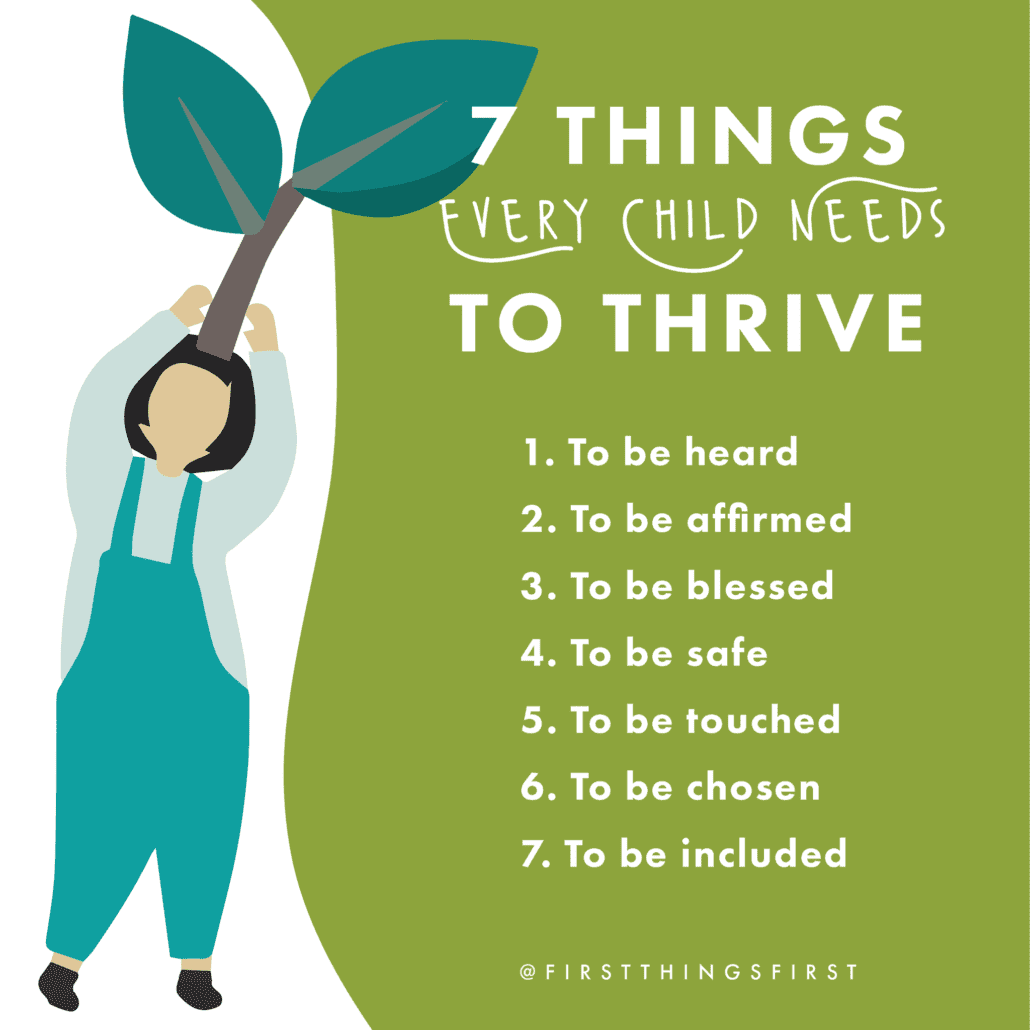
2. To be affirmed.
Your child desires for you to recognize what they do. Whether for academics, arts, or athletics, you showing up means a great deal to your child. They may win or just participate, but your acknowledgment that they did a good job can make their little hearts happy. When they complete a task or chore, saying thank you (even if they don’t do it the way that you do it) is an additional way to notice their contribution to the family.
3. To be blessed.
Your child desires to know that you love them unconditionally for who they are not for what they do or accomplish. No matter how they behave (temper tantrums), how successful they are in athletics or not, how well they do academically or not, your child needs to feel your love and support.
4. To be safe.
Your child desires to feel safe, free from extraordinary fear, worry, and anxiety. There are conditions that parents can’t control such as a global pandemic or natural disasters (tornado, hurricanes, fires). What you can do is ASSURE your child that you are right there with them. Being aware of your feelings will help you handle those of your child.
5. To be touched.
Your child needs and desires physical contact. As infants, children who don’t receive physical touch often get a diagnosis of “failure to thrive.” According to Dr. Virginia Satir, “We need four hugs a day for survival. We need eight hugs a day for maintenance. And we need twelve hugs a day for growth.”
6. To be Chosen.
Your child desires to know that you want and cherish them as a member of the family. In my house, my sons often ask, “Who is your favorite child?” The truth is each one is my favorite child. Our family would not be the same if any of them were not a part of it. Likewise, your family would not be the same if any of your children were not a part of your family.
7. To be included.
Your child desires to know that as a member of your family, they matter, belong, and have significance. Find ways (age-appropriate) to include them in decisions (what’s for dinner, family outings). Not only is their presence necessary, but their contribution to the family ideals and expectations is mandatory.
Parents want the best for their children through experiences and exposure. There will be times that you miss the mark as a parent. Your child may not make every team or production they try out for. You may get angry and raise your voice. Remember that what your child needs to thrive is for you to be an engaged (not perfect) parent who is seeking to meet the needs and desires of your child’s heart. There are probably a few things that you’re already doing, but if you see one that you’re not, choose one to focus on this week.
Other Lists Of What Children Need
Why We Need to Stop Judging Parents for Every Decision They Make (and How to Do It)
I see the mom walking down the street with her 4-year-old daughter paying more attention to her cell phone than her daughter, and I think, “Put your cell phone down and pay attention to your daughter.” I see the mom at the grocery store at 1 AM with her 2-year-old son and I think, “That’s ridiculous.” I see the 6-year-old talk disrespectfully to his parents at the soccer field and I think, “If he were my son, that’d never happen.” And let’s not mention the thoughts that have gone through my mind when I see the temper tantrum in the grocery store line next to the colorful Skittles that the child wants and can’t have.
Judging other people’s parenting can be intense and destructive to my well being—and it just plain isn’t fair to other parents. When we judge others, we’re sending the message that we’ve got all the answers. Any parent knows this just isn’t the case. Why do we judge other parents and how can we stop?
We judge for many reasons:
- We parent differently. Breastfeeding vs Bottle. Educational decisions. Kid’s use of technology. Our natural tendency is to see those who parent differently as wrong. Because if they are right, then I’m wrong. Instead of just seeing them as different. There’s usually more than just two ways of parenting.
- We develop strong opinions about our beliefs regarding what is the best way to parent. Some of those strong opinions can lead us to judge others who have different beliefs.
- Our rush to determine a person’s character. Research has shown that someone’s character is more important to us than what they know and their sociability so we rush to make a judgment on their character. We parlay our own circumstances, environment, and experiences onto parents we’re judging without considering that we’re looking at a moment in time without full context. Dr. Elizabeth Hall in Psychology Today says that we take a behavior and instead of thinking about how the situation may dictate the behavior, we attribute it all to the person’s character. For instance, we see Mom letting her 5-year-old use the cell phone and we make a snap judgment about the mom without even considering that they could be communicating with a grandparent at the moment.
When we judge we make ourselves less approachable. We also separate ourselves from the authentic parenting community. We’re less able to help others and to receive help. Even if a parent is in the wrong and could use the help, who wants to listen to someone who looks down on them or thinks they are better than they are?
How do we stop judging other parents?
1. Recognize we all make mistakes and have limitations.
We have all forgotten to pack extra diapers. We’ve all snapped at our kids because we were tired. We’re all learning as we go because no matter how many kids you have—they are all different and we’ve never raised this particular child before. We’re all flawed parents.
2. Reflect on what it’s like to be judged yourself.
You know the defensiveness, shame, and frustration you felt being judged even though you knew the person judging didn’t know your story. Remember what it’s like to feel misunderstood and inferior.
3. Remember, you never know everything about a parent’s situation.
You are judging a snapshot in time. Everyone has a story that influences their experiences. You don’t know their story. You know your story. And you don’t know the decisions you’d make if you had their story. (This is a great story to underscore this point.)
4. Limit what you consume on social media.
Information on any and every parenting decision you can think of can be Googled. (I didn’t say accurate info.) Facebook and Twitter are full of parents’ best versions of their kids. Social media feeds are designed to keep giving you what they know you’ll like and agree with, strengthening your belief that what’s right for you is right for everyone. See social media for what it is. A snapshot. Most often, a snapshot of what people who are most like you want you to see.
5. Get to know the parents when possible.
Before you judge, get to know them. This doesn’t have to take lots of time. You may find you share a lot in common. You share insecurities. You’re both doing the best you can. You both have challenges, though different, yet still challenges. You may find out that they’re working two jobs or just left the hospital visiting a sick grandmother. Care about the person.
6. Offer help when appropriate.
Keep the attitude that we’re all part of one big parenting club, doing the best we can. It’s with humility and empathy that a small gesture can calm the nerves of an overwhelmed and anxious parent. Offering to watch her grocery buggy while she tends to her little one lets a mom know you support her. Offering a tip that helped you through a tough time says no one expects you to be perfect.
We stop judging other parents by training our brains to think of how we can encourage others through the parenting journey. I used to judge (and still do if I’m honest). When I do catch myself judging another parent, I am training myself to offer encouragement when possible, to ask questions and hear their story, or simply to replay in my mind many of the mistakes I’ve made as a parent. (There’s plenty to choose from.) We do what we do because we believe it’s right. Give others the freedom to do the same.
What To Do If Your Teen Is Having Sex
You overheard something. You saw something. Maybe you had a gut feeling. So you just came out and asked your teen, “Are you having sex?” You were greeted with a “duh” face and a “yes.” You kept your cool and said, “Can we talk about this? Soon?”
Now you are processing a bunch of emotions and running scenarios through your mind.
And you’re thinking about that talk. What are you going to say? Then what?
You can get through this! Let’s take these in order:
Your Emotional Response:
This could be hitting you in a deeply personal way: Maybe because of your religious values. Maybe because you don’t want your teen to make the same mistakes you did.
Maybe because you know all the possible consequences. Let’s face it—you may have just found out that you don’t know your teen as well as you thought you did. Maybe you are running through everything you did as a parent and trying to figure out where you went wrong.
You are going to have to sort yourself out first. Feelings of guilt, anger, disappointment, fear, and confusion are totally understandable, but they are not a healthy place for you to camp out and you are going to have to let go of them if you’re going to move forward with your teen in a healthy, productive manner. Remember, your teen might be trying to process a giant payload of emotions right now and you need to be able to help them.
Your Emotions In Perspective:
The reality is that you could have been The Best Parent Ever© and your teen could still choose to have sex. (Biologically—they are ready, hormones are racing through their body, they occupy a culture preoccupied with sex, their peers might be exerting pressure on them, alcohol or drugs may have diminished their capacity to choose.)
The flip side is also true. You could be the kind of parent that doesn’t know where their teen is at 11:30 on a school night and your teen could choose a life of chastity up until their wedding day. 🔎 Teens are young adults who make choices of their own despite our best parenting efforts. Let yourself off the hook and let’s start moving forward.
The Scenarios Running Through Your Mind:
- How long has this been going on?
- Was your teen pressured into this?
- Were alcohol and/or drugs involved?
- Do they even understand “consent?”
- Are they or did they get someone pregnant?
- Do they have an STD now? They think they are invincible!
- What is the legal age of consent in our state?
- Is this relationship serious or was it just a “hook up?”
These are all legitimate questions. And you’ll get to them in time. But first and foremost, you need to be thinking about your teen—their mind, heart, body, and that talk.
“That Talk” or “Your Opportunity To Build A Deeper Relationship With Your Teen”
☆ When you feel like you have your emotions in check, your mind isn’t racing, and you can find a time and place where neither of you will be distracted or interrupted, then it’s time to talk with your teen. Remember, this is a chance to build a deeper relationship with them. Some rules: No lecturing. No interrogating. No “How could you’s?” Got ‘em?
You want to be a parent that your teen feels like they can move toward. (Literally and figuratively.) This means paying attention to your body language, the volume, and tone of your voice, reserving judgment, actively listening, communicating compassion for your teen, and having a true dialogue with them.
You need some goals.
This is not a one-time conversation, but an ongoing dialogue. Remember not to interrogate but to probe gently as you actively listen to their responses. Don’t try to cover all of this in one talk and be done with talking to your teen about sex. When it comes to sex, you want your teen to have a healthy mind, heart, and body.
You want them to understand that once sex enters the relationship everything changes and gets complicated. “Do they really like me or just like having sex?” “This was an expensive date—does it come with ‘strings’ attached?” “If it wasn’t for the sexual part of our relationship, would we still be dating?”
1. A Healthy Mind:
- What are their thoughts about having sex and how do they believe it will impact their relationship?
- Do they understand where you stand on them being sexually active and why?
- Do they understand the risks of and responsibilities that come with being sexually active?
- Have they thought toward the future and understand the impact that having many sexual partners will have on a future committed relationship?
- Do they understand how their life would change if they got someone pregnant or became pregnant?
- Do they understand consent and the legalities involved?
2. A Healthy Heart:
Do they:
- Understand the role that sex plays in a relationship?
- Know the signs of a healthy relationship?
- Recognize the signs of an unhealthy relationship?
- Know the signs of an abusive relationship?
- Have smart boundaries in a relationship? Are they strong enough to enforce those boundaries?
- Know what to do if they feel pressured to do something they don’t want to do? (Do you have a codeword or phrase that they can use in a call or text that indicates they are uncomfortable and need out of a situation?)
- Understand how to work through guilt and forgive themselves if they regret having sex?
- Have the self-awareness to recognize the signs of depression, anxiety, and stress in their life?
3. A Healthy Body:
- Do they understand they need to be tested for STDs & STIs?
(No matter how much they protest that they had “safe sex.”)
- Do they understand that they will need a pregnancy test and visit to a doctor? (Again, no matter how much they protest that they had “safe sex.”)
- Do they know how to protect themselves against pregnancy and STDs, even if you have expressed that you don’t approve of them being sexually active?
Follow-Up:
Your teen might have been in a heightened emotional state while you were having this conversation about sex. It might take a few days for them to process what was discussed. A couple of days later, you might want to ask them what thoughts or questions they have about your talk. Remember, this was not a “one and done” conversation. Keep the dialogue going by being an “askable” parent. Let them know they can talk to you about whatever, whenever.
★ Make sure your teen knows you love them no matter what.
First Things First Resources:
- Teen Sex And The Brain
- Sexting And Your Teen
- Can Your Kids Ask You About Sex?
- Talking To Your Teen About Sex
- What Parents Need To Know About Preventing Teen Pregnancy
- 10 Tips For Parents To Prevent Teen Pregnancy
Other Resources:
- GirlsHealth
- I Wanna Know
- My Life As A Teen Mom
- Your Guide to Safe & Responsible Sex
- National Campaign to Prevent Teen Pregnancy
- Your Teen Is Now Sexually Active, Now What?
- How to React if You Find Out Your Teen is Sexually Active
Image from Pexels.com
How to Help My Child Handle Anxiety
As a parent, it never ceases to amaze me that I feel a piece of the hurt that my child experiences—whether it be a skinned knee, a disappointment, or hurt feelings. I’m sure you feel the same way. And unfortunately, anxiety does not discriminate by age. Helping your 8- to 12-year-old child through anxiety is no piece of cake. Many parents are left in the dark as to how to nurture their child through worry, fear, and panic.
When your tween-ager becomes anxious, how do you help them handle their anxiety?
Worries and fears are normal for kids, whether it’s being nervous about an upcoming test, a friendship, or feeling uncertainty over a move to a new house. These feelings typically work themselves out in a short amount of time, and life moves on. However, anxiety can become problematic in tweens when it persists and interferes with everyday life.
Not all kids experience anxiety the same way, and the source of one kid’s anxiety might be different from another’s. According to the National Health Service of the UK, some children simply have a hard time with change, such as attending a different school or moving to a new town. Distressing or traumatic experiences such as a house fire, change in family structure, or the death of someone close to them can certainly spark anxiety. Also, family conflict and arguments can heighten anxiety in children, especially if they experience it often.
According to the National Institutes of Health, the CDC, and the AACAP, there are some typical signs to look for to indicate that your child may be experiencing anxiety:
- Anger or irritability.
- Constant worry, negative thoughts, the nagging thought that bad things are going to happen.
- Trouble sleeping at night.
- Bad dreams.
- Headaches or stomach aches.
- Trouble concentrating.
- Feeling tense or fidgety.
- Trouble concentrating on schoolwork or other tasks.
- Avoidance of social gatherings or everyday activities.
- Lack of confidence to try new things.
Keep in mind that many of these symptoms can be normal in 8- to 12-year-olds from time to time; all kids have a nightmare or show some fidgetiness now and then. However, if you see these symptoms crop up repeatedly, this may be an indication that your child is experiencing some anxiety and needs some help to cope.
So, what can you do as a parent to help your child during these times? Here are some steps to help your child walk through worry, fear, and anxiety.
Help your child talk through and name their feelings.

Many kids don’t know how to articulate what it is they are feeling. Putting a label on what your child is feeling gives them a certain power over their anxiety, what some psychologists call a “name it, tame it” philosophy. Tools such as the emotion wheel below can help kids choose words to describe what they’re feeling.
Another side of the “name it, tame it” idea is to help your child give a literal name to the feeling of anxiety. This helps them to call the anxiety out and put it in its place. For instance, they might say, Well, “Bruce” is showing up again, making me feel worried about this test. Bruce, you need to go away so I can get on with my class! This may feel a little “lame” to older kids, but it gives them a vocal power over their negative feelings and helps them to regulate tense emotions.
Teach them to recognize their own signs of anxiety as they begin to arise.
(Such as heart beating fast, trouble thinking straight, sweaty palms, etc.). Anxiety is usually something that shows up progressively before it reaches full tilt, sometimes described as a wave that builds up and then ebbs away. The more your child can anticipate the wave coming, the better they can head it off at the pass with some coping skills.
Teach your child some simple mindfulness and relaxation techniques for when they feel anxiety coming on.
For instance, they can take three deep breaths, inhaling through the nose on a three-count and exhaling through the mouth on a three-count. Deep breathing helps to slow a person’s heart rate and the amount of stress hormones that get squirted in the brain in a nerve-racking situation. Other very simple relaxation techniques can be found online.
Help your child talk through what can be and what can’t be controlled in a certain situation.
For example, the fact that they will be attending a new school or that they won’t know anyone the first day or so cannot be controlled. However, they can control whether they open up and get to know other students. They can control whether they ask a teacher for help with finding their way. And they can control the knowledge that they will be coming home after school and can relax better. Direct your tween to make a two-column list, spelling out what can and cannot be controlled in their situation.
Encourage your child to keep a “worry journal,” recording what it is that has them anxious and what they are feeling.
Another great version of this technique comes from Young Minds and is called the “worry box.” Kids can take a decorated box and, as they experience worry or anxiety over situations, record what they are worried about on slips of paper and put them into the box. At the end of the week, go through the slips of paper together with your child; have them determine which pieces of paper were worth worrying over (which is usually none of them), and have them tear that piece of paper up and throw it away. This is a great symbolic way of your child showing power over their anxiety.
Coach your child to eat a healthy diet and get plenty of physical activity.
(At least 60 minutes a day, according to the CDC). And be sure they get the recommended amount of sleep at night for their age. Our physical health and our mental health are connected.
Avoid “pre-purchasing” anxiety for your child.
In other words, if you are feeling anxious over a certain situation your child is facing, your child will read you and follow suit. Also, avoid persistent family arguments and unhealthy conflict in the house. An environment filled with conflict only serves to increase the anxiety your child will feel at any given time.
☆ If your child’s anxiety persists or increases despite these measures, be sure to pay a visit to their primary doctor with these concerns.
Anxiety happens, and you want your child to learn how to read their own anxiety and develop coping skills. Keep in mind that anxiety is something to be worked through. And everyone needs someone else to walk with them through it—especially children. A key concept that 8- to 12-year-olds can begin to grasp is the idea that you have the power to not let anxiety get the best of you. And kids this age can begin implementing coping tools to demonstrate that power over their anxiety.
Above all, be patient with them. Let them know you are there to walk with them without judging or shaming them for their feelings. A strong, caring relationship with your kids is the biggest weapon you can give them to build the inner strengths to handle anxiety.
Image from Pexels.com
Should We Fight In Front Of The Kids?
Let’s be honest. We probably already do fight in front of the kids. Whatever you want to call them—“polite” disagreements, heated arguments, emotional debates, full-on shouting matches—we have them. We don’t necessarily plan to; they can just happen. A calm, respectful conversation can escalate quickly to savage verbal bloodsport. And guess who is taking it all in?
There is definitely a marital dimension to how you fight, over what, how often, and how you make up. But what about the parental dimension? What about that little person at the dinner table, or playing within earshot, hearing the brawl through the wall?
We have a large body of research on how “interparental conflict” or fighting affects kids.
Here’s what we know:
- Kindergartners whose parents had harsh and frequent fights were more likely to struggle with depression, anxiety, and behavior issues by the time they were in seventh grade.
- When parents are fighting, it’s physiologically traumatic for kids. Their blood pressure increases (even in very young babies).
- If you play audio of two adults fighting who are not the parents of a child, even that has a negative effect on the child.
- Depression, anxiety, rule-breaking, and aggression can be a behavior of a child who experiences their parents disagreeing regularly.
- Arguing in front of a child can be incredibly damaging to their psyche, as it creates a sense of instability and insecurity. This can manifest as guilt and a feeling of responsibility, leading to lifelong feelings of inadequacy.
- Parents tend to have their worst fights in front of their children.
- Family discord can actually alter children’s brains and make them process emotions differently. So, kids who witness their parents arguing a lot at home may struggle in social situations and have trouble making friends.
- Regardless of what parents are fighting about, children tend to blame themselves.
- The typical married couple has about eight “disputes” a day. Children witnessed their parents’ arguments about 45 percent of the time.
Here’s the thing: kids are smarter than we realize or think they are, and their development and intelligence begin at birth. Here’s the other thing: fighting, arguing, tension, instability, and volatility all have an effect on children whether we perceive it immediately or not. Here’s yet another thing: disagreeing, arguing, and even fighting are part of marriage.
★ So, how do we as parents mitigate the negative effects of fighting in front of the kids?
Story Time. Average American Family. (Mine.)
Sitting at the dinner table, son (6th grade) says he wants to try out for the school football team.
(Seemingly benign statement.) Not an uncommon thing to talk about at dinner. My wife immediately encourages him to try out. I counter with my uncertainty about football and brain health. (Still a civil conversation.) We go back and forth a bit. (Voices get a little louder and a little more intense.) My son is chiming in here and there. (It becomes clear that my wife and I are not on the same page on this.) She’s thinking I’m being overly cautious and robbing our son of fun and character-building. I’m thinking she is being cavalier with our son’s brain and there are other ways to have fun and build character. (This could quickly get personal. And ugly.)
What happens next is so important. And it is so simple. But our emotions usually have their way with us and innocent, common, organic conversations quickly escalate into harsh and harmful fighting that hurts our kids. My wife simply says, “Why don’t we discuss this later?” Me, “Dude, your mom and I will talk this through and let you know what we decide.” Conversation changes. Dinner is enjoyed. No harm done. Our son saw us disagree, have a debate, and stay on the same team.
Here’s what else we know:
- Parents who can resolve conflicts and emerge with warm feelings toward each other instill better coping skills and emotional security in children, studies show. This requires admirable self-control, and not all marital battles can be worked out so calmly.
- Marital battles that spark uncontrolled emotional outbursts should happen in private or in the presence of a therapist, and name-calling, threats, or other forms of aggression are never okay. But seeing Mom and Dad emerge from less hard-to-control disagreements satisfied, without resentment, can yield big rewards for children, according to researchers and experts in conflict resolution.
- Parents who expressed warmth and empathy toward each other during arguments also fostered a sense of security in their children that their families would be okay, according to a two-year study of 416 U.S. families.
- The research complements findings from a 2009 study by Dr. E. Mark Cummings that children whose parents have constructive conflicts, showing support and affection for each other, and exhibit better social skills, including cooperation and empathy for peers.
- Even if parents fight sometimes, a higher ratio of positive to negative exchanges is linked to less sadness and worry in children and teens, according to a recent five-year study of 809 families. Displays of warmth and mutual support helped offset children’s fears about parental discord.
It’s not whether parents fight, but how they fight in front of the kids that matters. And how they make up.
All conflict between parents is not harmful to children, but some conflicts may be very harmful for children to observe. Children may even benefit from observing constructive conflicts. However, destructive conflicts are linked to multiple problems in children and are stressful for them to hear or witness. Click HERE for how to fight in front of your kids.
***If you or someone you know is in an abusive relationship, contact the National Hotline for Domestic Abuse. At this link, you can access a private chat with someone who can help you 24/7. If you fear your computer or device is being monitored, call the hotline 24/7 at: 1−800−799−7233. For a clear understanding of what defines an abusive relationship, click here.***
It started with a simple question from my son at the dinner table. “Can I invite a few friends to go to Six Flags Amusement Park with me for my birthday?” Would it end up as a fight in front of the kids?
Mom: That should be fun. How many friends are you thinking about?
Son: Two.
Mom: Sounds like a good idea.
Dad (Me): Hmmm. I’m not so sure that’s a good idea right now.
Mom: Really. Why not?
Dad: Have you looked at the cost for one person to go to Six Flags? Let alone 3 or 4. Have you looked at our bank account lately?
Mom: How many times does our son turn 10 years old?
At this point, we had a decision to make…
- Do we continue this disagreement that was morphing into an argument in front of our kids?
- Should we squash the conversation until we could get behind closed doors?
We both were starting to recognize that we felt strongly about our opinions. Internally, we were questioning the next step of the discussion and asking,”Should we have this fight in front of the kids?”
I’m going to jump in with how we fight, or put another way, resolve disagreements and conflict in front of our children, if that’s where you find yourself. It is inevitable that you and your spouse will have a disagreement in front of your kids. How you handle these disagreements can have a great impact on them.
If you choose to work through conflict with your spouse in front of your kids, here are a few tips:
1. Respect, Respect, Respect.
- There is never a time when it’s okay to disrespect one another’s thoughts, feelings or desires regardless of how emotional you get or how strongly you feel about a particular issue.
- It’s even worse to disrespect one another in front of your children.
- We disrespect when we belittle one another’s thoughts, are dismissive of each other’s emotions and devalue each other’s desires.
- Respecting one another is more important than coming to the “right” solution.
- Dr. Adam Grant, a psychologist at the Wharton School and New York Times best-selling author states that, “When parents disagree thoughtfully and respectfully, that sets a standard for kids to learn to do the same thing.”
- Your children are learning how to treat other people they disagree with based on what you show them.
If you realize you have disrespected your spouse, it’s important that you not only apologize to your spouse, but that you also talk with your children about it. They must understand that disrespect is not acceptable.
2. “I,” not “You.”
I could’ve said to my wife, “You don’t know how much money is in the bank.” But I could have also said, “You care more about him having fun than about us being responsible.” In that instance, I’ve attacked her and assumed what she knows or cares about. Dr. John Gottman, marriage therapist and researcher says, “When you start sentences with ‘I’ you are less likely to seem (or be!) critical, immediately putting your partner into a defensive position.” Instead of starting with “You,” I can say, “I’m concerned that paying for this trip may not leave us enough money for other necessary and important things.”
☆ Focusing on what you know, think, feel, and want as opposed to making statements about what you believe your spouse knows, thinks, feels, and wants leads to better communication and understanding during conflict.
3. Avoid statements like, “You always,” or, “You never.”
Statements like this make generalizations about a person’s character, placing the focus on them and putting them on the defensive while taking the focus away from the issue.
4. Tone of Voice and Body Language Matter… a lot.
I encourage you to stop and watch kids talk and interact sometime. Many talk with their hands, give colorful facial expressions, their tone gets high when they’re excited and loud when they’re upset. This is the lens through which your child sees your body language and hears your tone of voice. Not to mention that research says 93% of communication is made with body language and tone of voice and only 7% are the actual spoken words. Avoid eye-rolling, sighing heavily like you’re disgusted, slumping your posture like you don’t care or rolling your neck like you have a bad attitude. Your children are reading each of the cues you’re sending.
5. Be clear to your children when it’s resolved.
Your child is processing what they see and hear. If they hear the conflict and are never privy to the solution, then you’ve left their imagination to wonder. Research by Dr. Rebecca Brock, assistant professor at University of Nebraska, indicates that unresolved marital tension can lead to children experiencing anxiety, depression, and distress.
This may cause children to feel extremely insecure.
If your child sees the two of you arguing, be sure they know and see that you’ve resolved the issue. Even if it’s just to say, “I know you heard us arguing earlier. I just want you to know that we figured it out and everything is good now.” The details of the solution may not be necessary to share. But the acknowledgment that the argument is not going to tear you apart helps bring closure for the child.
How Not To Fight
- Never attack one another physically or emotionally. That’s domestic violence.
- Don’t manipulate, intimidate, or threaten your spouse. Threatening to walk out, leave the marriage, or do something that is hurtful or permanent can leave scars that wound for years.
- Never put the kids in the middle of your argument. They should not be choosing sides or used as a pawn to help you win your argument.
What Not To Fight About In Front Of The Kids
There are some things that are simply a bad idea to argue about in front of the kids.
- Sex
- In-laws
- Discipline
If you’re going to fight in front of the kids, then you should definitely make up in front of the kids. (No, not that kind of “make up.” Shame on you! 😳 ) A hug and a kiss in front of the kids is plenty. Verbally affirming your love, respect, and commitment for one another also sends the message that your commitment to one another is bigger than the disagreement. Arguing in front of your children can be damaging to them, especially when it’s not done in a healthy and productive manner.
Model Healthy Conflict Resolution.
Studies show that your children can learn healthy conflict resolution skills when you model it for them. How you treat one another, including when you disagree, provides an example for how a couple communicates respect and acceptance. You’re also modeling how to effectively deal with your emotions and appreciate others emotions. These are all skills that will definitely be useful as your child engages in relationships throughout their life.
My son did get to go to Six Flags. After listening to me and his mother talk about our thoughts and feelings regarding the gift and adding up the cost, he had a greater appreciation for his gift. Did he know that I was not the one in support of the trip? Maybe, but I don’t think it bothered him as he, I, and his other friend rode the roller coasters. He also learned that his parents can disagree, both have strong opinions, and still love, respect, and remain committed to one another.
★ What do you want your kids to learn when they see you fight?
***If you or someone you know is in an abusive relationship, contact the National Hotline for Domestic Abuse. At this link, you can access a private chat with someone who can help you 24/7. If you fear your computer or device is being monitored, call the hotline 24/7 at: 1−800−799−7233. For a clear understanding of what defines an abusive relationship, click here.***
How to Parent an Extremely Sensitive Child
If you’re the parent of a young child or toddler, you know the joys (and consequently devastation) of a helium balloon. My 4-year-old, Jackie, held tightly to the string of a balloon that had been floating around the house, left over from a surprise “just because” package from work. Her face lit up with pure delight as she ran around the house with it. I warned her not to let go of the string, because if she did, it would float to the top of the high ceilings in the living room, making it unreachable. She dismissed me with a “Yeah, yeah mom,” as kids do, and continued to play as I made lunch in the kitchen.
One minute later, there was a terrible shriek. Bone-chilling. And the weeping and wailing began. Jackie had accidentally let go of the balloon and, sure enough, it had floated up to the high ceiling, out of reach. And now the world was ending. (TBH, I may or may not have rolled my eyes.) As I stopped preparing food and prepared to go comfort Jackie, I heard her younger 2-year-old sister, Maddie, attempt to comfort her. “I’m here! I’m sorry, sissy! I’m sorry!”
Jackie’s response through screams and sobs? “No Maddie, it’s not your fault. You don’t need to apologize. THE BALLOON NEEDS TO APOLOGIZE!”
If you’re the parent of a young child or toddler, this scenario seems pretty typical, right? But what do you do when this is a daily occurrence? Or even multiple daily occurrences? What if your child cries easily and often? They have multiple meltdowns a day because they are so highly sensitive. How do you handle the crying, outbursts and tantrums and still discipline a sensitive child, without crushing their spirit?
Recognize That Emotions Are OKAY.
Many of us were taught at a young age to suppress our emotions, whether it was our parents’ intentions or not. Telling a child, “You’re fine… don’t cry…” when they’re upset minimizes their feelings. Instead of building a connection and safe space for them to process through, it actually tells them that their emotions make you feel uncomfortable, angry or annoyed and can slowly chip away at the sense of security they feel with you. We are often triggered by our children’s behavior, taking us back to how we were parented. So be intentional about allowing their big emotions and responding with connection instead of reacting as if they are wrong. Make space for them to feel, no matter if you see their emotions as logical or ludicrous. Try switching up, “You’re fine… don’t cry…” to “I can tell you are feeling ____. It’s okay to feel that way. I’m here.”
Help Them Learn Emotional Intelligence.
ABCs and 123s are great for our children to learn, but what about emotional intelligence? Children are not born knowing how to regulate their own emotions. It’s absolutely a skill that needs to be taught! So help your child learn to recognize what they are feeling by giving them the vocabulary of emotions. Talk about your own feelings, read books about naming and dealing with emotions, and above all, be there for them without judgment of their emotions. Then, help them find effective calming strategies like: Count to 10, Take Deep Breaths, Read a Book, etc. Often if your child is acting out, or “misbehaving,” it is most likely due to an underlying unmet need like being hungry, tired, or feeling disconnected. Grabbing a snack solves 97% of our household meltdowns. (Because yes, kids get HANGRY, just like Mama!)
Practice A WHOLE LOTTA Patience With Your “Orchid Child.”
Human development specialists W. Thomas Boyce and Bruce J. Ellis explained the opposite ends of the human temperament continuum using two Swedish words, Orkidebarn, which translates to “Orchid Child” and Maskrosbarn, which translates to “Dandelion Child.” Where Dandelions are known for surviving the most challenging circumstances and still thriving, Orchids require “just right” conditions to flourish and grow. Children who show more of an “Orchid child” temperament are just the same. They need more time, patience and help at learning to self-regulate their emotions. So hang in there! Be the calm in their chaos, and show empathy and compassion for their big feelings. It’ll take time, but they will learn how to process through their emotions more quickly and effectively as they mature.
Have Confidence In Disciplining Without Damage.
For many parents, the term discipline has been confused with punishment. We want to discipline (aka teach) our children in order to prepare them for the real world. However, neuroscience shows us that children’s brains are naturally impulsive and lack the self-control of adults. Many times children simply cannot (as opposed to will not) follow through with our demands because their brain doesn’t yet have a fully-developed frontal and prefrontal cortex, both of which are crucial to regulating self-control. However, parents often try to force their children to learn to obey through consequences, time outs and other methods that serve to control the behavior. And these types of discipline can absolutely get our children to conform, but that may not necessarily teach them what they truly need to be successful in life: self-control.
In order to teach self-control to our sensitive child, we need to:
- First focus on responding with connection. Get down on their level, or try to make eye contact with them. Acknowledge, name, empathize and validate the emotion they are feeling. For example: “I can see you are upset because you don’t want to stop playing. That is very difficult. I understand.”
- Then, stay calm and caring while still maintaining control of the situation. Avoid raising your voice, pointing fingers or threats. Make space for them to feel angry, upset, frustrated, sad, etc., without trying to “fix it.”
- Next, provide a simple directive on what needs to happen. The fewer words you use the better. An example may be: “It’s time to leave,” or “We are leaving now.”
- Then, firmly hold the limit you’ve set. Avoid trying to explain your reasoning or rationale at this moment. For instance, don’t say, “We have to leave right now or we’ll be late and then we’ll miss the whole appointment! Hurry up!”
- Finally, once the emotion has been regulated (through the help of naming the emotion and working through it using calming strategies), we can come back full circle to discuss step-by-step what happened, without blame or shame, and provide ways to handle a similar situation better next time. (Ask your child what they could do differently next time. If they aren’t sure, provide some options such as using a specific calming strategy and talking about what they are feeling. Be sure to end the conversation with encouragement for next time and remind them that you love them, no matter what!)
★Bottom Line: You’re NOT Doing It Wrong… It’s Just That Hard
No one has this parenting thing down to a “T.” You know, there’s no such thing as a perfect parent. A sensitive child can be extremely draining… but rest assured, you are not alone. Connection is the key to handling a highly sensitive child, or any child for that matter. You’ll just need to cultivate a bit more patience with your Orchid child. Helping your sensitive child learn how to self-regulate their big feelings will take longer, since their brain needs to be more developed (i.e., older). But give it time and you will see tremendous growth! Meanwhile, keep those tissues handy.