
Should We Fight In Front Of The Kids?
Let’s be honest. We probably already do fight in front of the kids. Whatever you want to call them—“polite” disagreements, heated arguments, emotional debates, full-on shouting matches—we have them. We don’t necessarily plan to; they can just happen. A calm, respectful conversation can escalate quickly to savage verbal bloodsport. And guess who is taking it all in?
There is definitely a marital dimension to how you fight, over what, how often, and how you make up. But what about the parental dimension? What about that little person at the dinner table, or playing within earshot, hearing the brawl through the wall?
We have a large body of research on how “interparental conflict” or fighting affects kids.
Here’s what we know:
- Kindergartners whose parents had harsh and frequent fights were more likely to struggle with depression, anxiety, and behavior issues by the time they were in seventh grade.
- When parents are fighting, it’s physiologically traumatic for kids. Their blood pressure increases (even in very young babies).
- If you play audio of two adults fighting who are not the parents of a child, even that has a negative effect on the child.
- Depression, anxiety, rule-breaking, and aggression can be a behavior of a child who experiences their parents disagreeing regularly.
- Arguing in front of a child can be incredibly damaging to their psyche, as it creates a sense of instability and insecurity. This can manifest as guilt and a feeling of responsibility, leading to lifelong feelings of inadequacy.
- Parents tend to have their worst fights in front of their children.
- Family discord can actually alter children’s brains and make them process emotions differently. So, kids who witness their parents arguing a lot at home may struggle in social situations and have trouble making friends.
- Regardless of what parents are fighting about, children tend to blame themselves.
- The typical married couple has about eight “disputes” a day. Children witnessed their parents’ arguments about 45 percent of the time.
Here’s the thing: kids are smarter than we realize or think they are, and their development and intelligence begin at birth. Here’s the other thing: fighting, arguing, tension, instability, and volatility all have an effect on children whether we perceive it immediately or not. Here’s yet another thing: disagreeing, arguing, and even fighting are part of marriage.
★ So, how do we as parents mitigate the negative effects of fighting in front of the kids?
Story Time. Average American Family. (Mine.)
Sitting at the dinner table, son (6th grade) says he wants to try out for the school football team.
(Seemingly benign statement.) Not an uncommon thing to talk about at dinner. My wife immediately encourages him to try out. I counter with my uncertainty about football and brain health. (Still a civil conversation.) We go back and forth a bit. (Voices get a little louder and a little more intense.) My son is chiming in here and there. (It becomes clear that my wife and I are not on the same page on this.) She’s thinking I’m being overly cautious and robbing our son of fun and character-building. I’m thinking she is being cavalier with our son’s brain and there are other ways to have fun and build character. (This could quickly get personal. And ugly.)
What happens next is so important. And it is so simple. But our emotions usually have their way with us and innocent, common, organic conversations quickly escalate into harsh and harmful fighting that hurts our kids. My wife simply says, “Why don’t we discuss this later?” Me, “Dude, your mom and I will talk this through and let you know what we decide.” Conversation changes. Dinner is enjoyed. No harm done. Our son saw us disagree, have a debate, and stay on the same team.
Here’s what else we know:
- Parents who can resolve conflicts and emerge with warm feelings toward each other instill better coping skills and emotional security in children, studies show. This requires admirable self-control, and not all marital battles can be worked out so calmly.
- Marital battles that spark uncontrolled emotional outbursts should happen in private or in the presence of a therapist, and name-calling, threats, or other forms of aggression are never okay. But seeing Mom and Dad emerge from less hard-to-control disagreements satisfied, without resentment, can yield big rewards for children, according to researchers and experts in conflict resolution.
- Parents who expressed warmth and empathy toward each other during arguments also fostered a sense of security in their children that their families would be okay, according to a two-year study of 416 U.S. families.
- The research complements findings from a 2009 study by Dr. E. Mark Cummings that children whose parents have constructive conflicts, showing support and affection for each other, and exhibit better social skills, including cooperation and empathy for peers.
- Even if parents fight sometimes, a higher ratio of positive to negative exchanges is linked to less sadness and worry in children and teens, according to a recent five-year study of 809 families. Displays of warmth and mutual support helped offset children’s fears about parental discord.
It’s not whether parents fight, but how they fight in front of the kids that matters. And how they make up.
All conflict between parents is not harmful to children, but some conflicts may be very harmful for children to observe. Children may even benefit from observing constructive conflicts. However, destructive conflicts are linked to multiple problems in children and are stressful for them to hear or witness. Click HERE for how to fight in front of your kids.
***If you or someone you know is in an abusive relationship, contact the National Hotline for Domestic Abuse. At this link, you can access a private chat with someone who can help you 24/7. If you fear your computer or device is being monitored, call the hotline 24/7 at: 1−800−799−7233. For a clear understanding of what defines an abusive relationship, click here.***
It started with a simple question from my son at the dinner table. “Can I invite a few friends to go to Six Flags Amusement Park with me for my birthday?” Would it end up as a fight in front of the kids?
Mom: That should be fun. How many friends are you thinking about?
Son: Two.
Mom: Sounds like a good idea.
Dad (Me): Hmmm. I’m not so sure that’s a good idea right now.
Mom: Really. Why not?
Dad: Have you looked at the cost for one person to go to Six Flags? Let alone 3 or 4. Have you looked at our bank account lately?
Mom: How many times does our son turn 10 years old?
At this point, we had a decision to make…
- Do we continue this disagreement that was morphing into an argument in front of our kids?
- Should we squash the conversation until we could get behind closed doors?
We both were starting to recognize that we felt strongly about our opinions. Internally, we were questioning the next step of the discussion and asking,”Should we have this fight in front of the kids?”
I’m going to jump in with how we fight, or put another way, resolve disagreements and conflict in front of our children, if that’s where you find yourself. It is inevitable that you and your spouse will have a disagreement in front of your kids. How you handle these disagreements can have a great impact on them.
If you choose to work through conflict with your spouse in front of your kids, here are a few tips:
1. Respect, Respect, Respect.
- There is never a time when it’s okay to disrespect one another’s thoughts, feelings or desires regardless of how emotional you get or how strongly you feel about a particular issue.
- It’s even worse to disrespect one another in front of your children.
- We disrespect when we belittle one another’s thoughts, are dismissive of each other’s emotions and devalue each other’s desires.
- Respecting one another is more important than coming to the “right” solution.
- Dr. Adam Grant, a psychologist at the Wharton School and New York Times best-selling author states that, “When parents disagree thoughtfully and respectfully, that sets a standard for kids to learn to do the same thing.”
- Your children are learning how to treat other people they disagree with based on what you show them.
If you realize you have disrespected your spouse, it’s important that you not only apologize to your spouse, but that you also talk with your children about it. They must understand that disrespect is not acceptable.
2. “I,” not “You.”
I could’ve said to my wife, “You don’t know how much money is in the bank.” But I could have also said, “You care more about him having fun than about us being responsible.” In that instance, I’ve attacked her and assumed what she knows or cares about. Dr. John Gottman, marriage therapist and researcher says, “When you start sentences with ‘I’ you are less likely to seem (or be!) critical, immediately putting your partner into a defensive position.” Instead of starting with “You,” I can say, “I’m concerned that paying for this trip may not leave us enough money for other necessary and important things.”
☆ Focusing on what you know, think, feel, and want as opposed to making statements about what you believe your spouse knows, thinks, feels, and wants leads to better communication and understanding during conflict.
3. Avoid statements like, “You always,” or, “You never.”
Statements like this make generalizations about a person’s character, placing the focus on them and putting them on the defensive while taking the focus away from the issue.
4. Tone of Voice and Body Language Matter… a lot.
I encourage you to stop and watch kids talk and interact sometime. Many talk with their hands, give colorful facial expressions, their tone gets high when they’re excited and loud when they’re upset. This is the lens through which your child sees your body language and hears your tone of voice. Not to mention that research says 93% of communication is made with body language and tone of voice and only 7% are the actual spoken words. Avoid eye-rolling, sighing heavily like you’re disgusted, slumping your posture like you don’t care or rolling your neck like you have a bad attitude. Your children are reading each of the cues you’re sending.
5. Be clear to your children when it’s resolved.
Your child is processing what they see and hear. If they hear the conflict and are never privy to the solution, then you’ve left their imagination to wonder. Research by Dr. Rebecca Brock, assistant professor at University of Nebraska, indicates that unresolved marital tension can lead to children experiencing anxiety, depression, and distress.
This may cause children to feel extremely insecure.
If your child sees the two of you arguing, be sure they know and see that you’ve resolved the issue. Even if it’s just to say, “I know you heard us arguing earlier. I just want you to know that we figured it out and everything is good now.” The details of the solution may not be necessary to share. But the acknowledgment that the argument is not going to tear you apart helps bring closure for the child.
How Not To Fight
- Never attack one another physically or emotionally. That’s domestic violence.
- Don’t manipulate, intimidate, or threaten your spouse. Threatening to walk out, leave the marriage, or do something that is hurtful or permanent can leave scars that wound for years.
- Never put the kids in the middle of your argument. They should not be choosing sides or used as a pawn to help you win your argument.
What Not To Fight About In Front Of The Kids
There are some things that are simply a bad idea to argue about in front of the kids.
- Sex
- In-laws
- Discipline
If you’re going to fight in front of the kids, then you should definitely make up in front of the kids. (No, not that kind of “make up.” Shame on you! 😳 ) A hug and a kiss in front of the kids is plenty. Verbally affirming your love, respect, and commitment for one another also sends the message that your commitment to one another is bigger than the disagreement. Arguing in front of your children can be damaging to them, especially when it’s not done in a healthy and productive manner.
Model Healthy Conflict Resolution.
Studies show that your children can learn healthy conflict resolution skills when you model it for them. How you treat one another, including when you disagree, provides an example for how a couple communicates respect and acceptance. You’re also modeling how to effectively deal with your emotions and appreciate others emotions. These are all skills that will definitely be useful as your child engages in relationships throughout their life.
My son did get to go to Six Flags. After listening to me and his mother talk about our thoughts and feelings regarding the gift and adding up the cost, he had a greater appreciation for his gift. Did he know that I was not the one in support of the trip? Maybe, but I don’t think it bothered him as he, I, and his other friend rode the roller coasters. He also learned that his parents can disagree, both have strong opinions, and still love, respect, and remain committed to one another.
★ What do you want your kids to learn when they see you fight?
***If you or someone you know is in an abusive relationship, contact the National Hotline for Domestic Abuse. At this link, you can access a private chat with someone who can help you 24/7. If you fear your computer or device is being monitored, call the hotline 24/7 at: 1−800−799−7233. For a clear understanding of what defines an abusive relationship, click here.***
How to Parent an Extremely Sensitive Child
If you’re the parent of a young child or toddler, you know the joys (and consequently devastation) of a helium balloon. My 4-year-old, Jackie, held tightly to the string of a balloon that had been floating around the house, left over from a surprise “just because” package from work. Her face lit up with pure delight as she ran around the house with it. I warned her not to let go of the string, because if she did, it would float to the top of the high ceilings in the living room, making it unreachable. She dismissed me with a “Yeah, yeah mom,” as kids do, and continued to play as I made lunch in the kitchen.
One minute later, there was a terrible shriek. Bone-chilling. And the weeping and wailing began. Jackie had accidentally let go of the balloon and, sure enough, it had floated up to the high ceiling, out of reach. And now the world was ending. (TBH, I may or may not have rolled my eyes.) As I stopped preparing food and prepared to go comfort Jackie, I heard her younger 2-year-old sister, Maddie, attempt to comfort her. “I’m here! I’m sorry, sissy! I’m sorry!”
Jackie’s response through screams and sobs? “No Maddie, it’s not your fault. You don’t need to apologize. THE BALLOON NEEDS TO APOLOGIZE!”
If you’re the parent of a young child or toddler, this scenario seems pretty typical, right? But what do you do when this is a daily occurrence? Or even multiple daily occurrences? What if your child cries easily and often? They have multiple meltdowns a day because they are so highly sensitive. How do you handle the crying, outbursts and tantrums and still discipline a sensitive child, without crushing their spirit?
Recognize That Emotions Are OKAY.
Many of us were taught at a young age to suppress our emotions, whether it was our parents’ intentions or not. Telling a child, “You’re fine… don’t cry…” when they’re upset minimizes their feelings. Instead of building a connection and safe space for them to process through, it actually tells them that their emotions make you feel uncomfortable, angry or annoyed and can slowly chip away at the sense of security they feel with you. We are often triggered by our children’s behavior, taking us back to how we were parented. So be intentional about allowing their big emotions and responding with connection instead of reacting as if they are wrong. Make space for them to feel, no matter if you see their emotions as logical or ludicrous. Try switching up, “You’re fine… don’t cry…” to “I can tell you are feeling ____. It’s okay to feel that way. I’m here.”
Help Them Learn Emotional Intelligence.
ABCs and 123s are great for our children to learn, but what about emotional intelligence? Children are not born knowing how to regulate their own emotions. It’s absolutely a skill that needs to be taught! So help your child learn to recognize what they are feeling by giving them the vocabulary of emotions. Talk about your own feelings, read books about naming and dealing with emotions, and above all, be there for them without judgment of their emotions. Then, help them find effective calming strategies like: Count to 10, Take Deep Breaths, Read a Book, etc. Often if your child is acting out, or “misbehaving,” it is most likely due to an underlying unmet need like being hungry, tired, or feeling disconnected. Grabbing a snack solves 97% of our household meltdowns. (Because yes, kids get HANGRY, just like Mama!)
Practice A WHOLE LOTTA Patience With Your “Orchid Child.”
Human development specialists W. Thomas Boyce and Bruce J. Ellis explained the opposite ends of the human temperament continuum using two Swedish words, Orkidebarn, which translates to “Orchid Child” and Maskrosbarn, which translates to “Dandelion Child.” Where Dandelions are known for surviving the most challenging circumstances and still thriving, Orchids require “just right” conditions to flourish and grow. Children who show more of an “Orchid child” temperament are just the same. They need more time, patience and help at learning to self-regulate their emotions. So hang in there! Be the calm in their chaos, and show empathy and compassion for their big feelings. It’ll take time, but they will learn how to process through their emotions more quickly and effectively as they mature.
Have Confidence In Disciplining Without Damage.
For many parents, the term discipline has been confused with punishment. We want to discipline (aka teach) our children in order to prepare them for the real world. However, neuroscience shows us that children’s brains are naturally impulsive and lack the self-control of adults. Many times children simply cannot (as opposed to will not) follow through with our demands because their brain doesn’t yet have a fully-developed frontal and prefrontal cortex, both of which are crucial to regulating self-control. However, parents often try to force their children to learn to obey through consequences, time outs and other methods that serve to control the behavior. And these types of discipline can absolutely get our children to conform, but that may not necessarily teach them what they truly need to be successful in life: self-control.
In order to teach self-control to our sensitive child, we need to:
- First focus on responding with connection. Get down on their level, or try to make eye contact with them. Acknowledge, name, empathize and validate the emotion they are feeling. For example: “I can see you are upset because you don’t want to stop playing. That is very difficult. I understand.”
- Then, stay calm and caring while still maintaining control of the situation. Avoid raising your voice, pointing fingers or threats. Make space for them to feel angry, upset, frustrated, sad, etc., without trying to “fix it.”
- Next, provide a simple directive on what needs to happen. The fewer words you use the better. An example may be: “It’s time to leave,” or “We are leaving now.”
- Then, firmly hold the limit you’ve set. Avoid trying to explain your reasoning or rationale at this moment. For instance, don’t say, “We have to leave right now or we’ll be late and then we’ll miss the whole appointment! Hurry up!”
- Finally, once the emotion has been regulated (through the help of naming the emotion and working through it using calming strategies), we can come back full circle to discuss step-by-step what happened, without blame or shame, and provide ways to handle a similar situation better next time. (Ask your child what they could do differently next time. If they aren’t sure, provide some options such as using a specific calming strategy and talking about what they are feeling. Be sure to end the conversation with encouragement for next time and remind them that you love them, no matter what!)
★Bottom Line: You’re NOT Doing It Wrong… It’s Just That Hard
No one has this parenting thing down to a “T.” You know, there’s no such thing as a perfect parent. A sensitive child can be extremely draining… but rest assured, you are not alone. Connection is the key to handling a highly sensitive child, or any child for that matter. You’ll just need to cultivate a bit more patience with your Orchid child. Helping your sensitive child learn how to self-regulate their big feelings will take longer, since their brain needs to be more developed (i.e., older). But give it time and you will see tremendous growth! Meanwhile, keep those tissues handy.
The COVID-19 pandemic has made things very uncertain right now, and your kids can sense it. The good news is, you can help your child navigate through the unknown.
As we approach the school year, many parents, perhaps like you, must make the choice of whether to have their children attend school in a face-to-face format, online, or a combination. And even if your kids do grace the halls of their school this year, things will be different, with teachers (and possibly students) wearing masks, social distancing measures, and a heavier concentration on sanitizing (to say the least).
Schools are planning the best way they know how to provide both safety and a quality education this year for kids, but let’s face it: we’ve never been in this situation before, and there’s no standard operating procedure in place for this.
All this adds up to the fact that you and your kids face a great unknown in a few short weeks. Just what will this school year be like? It’s a question of uncertainty.
As adults, we know what it is to go through those seasons where you don’t know what’s going to happen, and many of us still feel a sense of anxiety during times like these.
But for children, the uncertainty of what their school year will be like can be especially distressing. And though they may feel an extra measure of anxiety and stress from facing that unknown, you can help your child through it.
So what can you do to help your child work through this season of uncertainty?
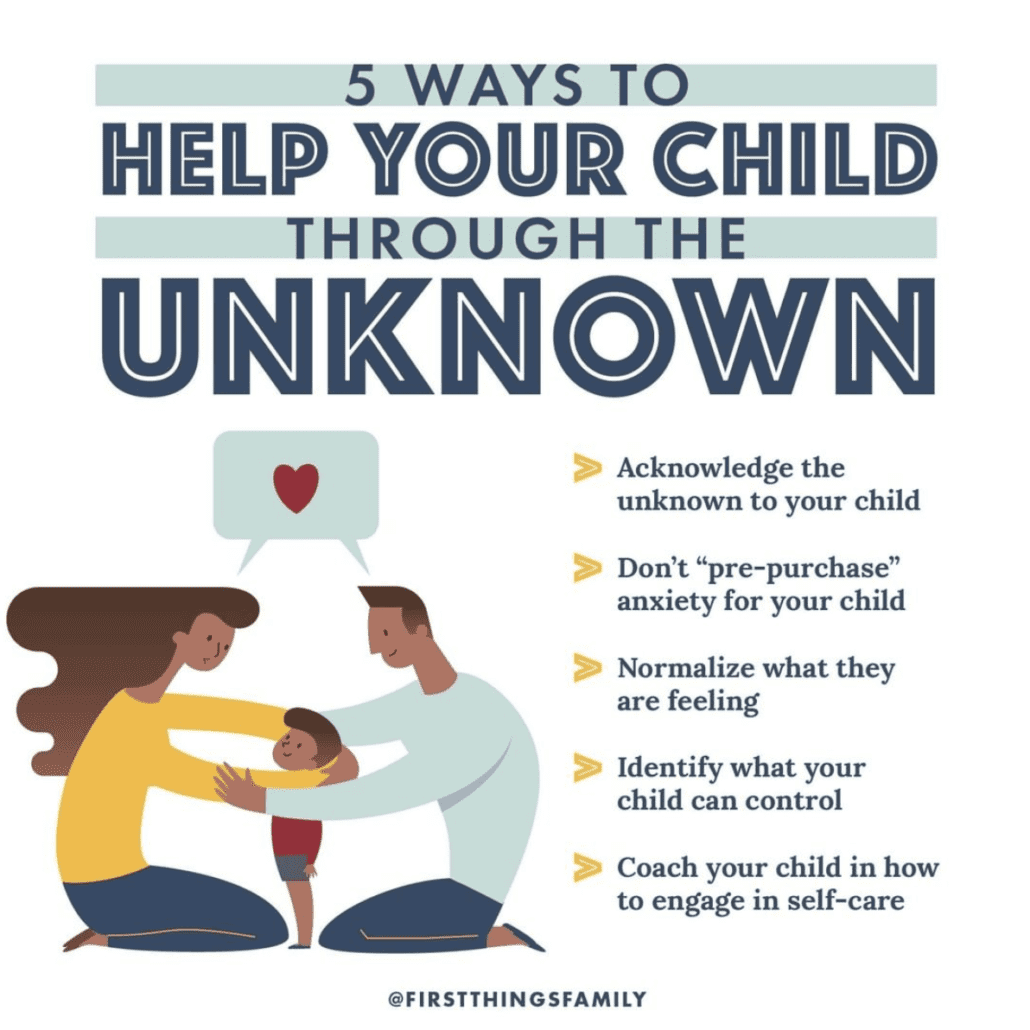
1. Acknowledge the unknown to your child.
Open up the conversation with your child about not knowing exactly how the school year is going to go. Explain to them whether there’s a decision to be made, and what that may look like in terms they can understand.
Avoid having decision-making conversations with your child present or asking them what they would choose. Chances are, they will tell you what they would prefer; however, there are factors they cannot understand, and to them, their decision-making is permanent. They need to know that the final decision comes from you, the parent. As a parent, you have to educate yourself and decide what is right for your family. Keep in mind the decision you ultimately make could change based on new information, and you’ll want to let your child know that.
★ Depending on their age, express the idea of the unknown in language that says, “Because COVID-19 is still a concern, school is going to look different this year. This is the decision I/we have made as your parent(s), because, right now, we think it’s best for our whole family. We hope things won’t change with our decision, but if they do, then we have to figure out the next best thing. But even if we don’t know what it’s going to be like, we are going to be okay, and we are going to get through this together. I’m here to help you through all of it. We aren’t just going to survive—we are going to thrive!”
2. Don’t “pre-purchase” anxiety.
After reading the first bullet point, you may be nervous that you are injecting a huge dose of shock and anxiety in your child. And of course, they might be at least somewhat apprehensive; that’s to be expected. But don’t let this shake you. Talking about it helps your child process the idea of not knowing what to expect and builds resilience to the stress of unknown situations as they grow.
The important thing to remember is to check your own anxiety at the door. Children follow the cues for anxiety, stress, and depression from their parents (that’s you), and if you are freaking out over an uncertain school year, you are “pre-purchasing” anxiety for your child. It’s okay for you to feel a certain amount of distress for your kids; just remember they are looking to you as a model for regulating emotions and handling their fear.
3. Normalize what they’re feeling.
Let them know that how they are feeling about the uncertainty of the school year is okay. You don’t want them to feel ashamed or abnormal because of any kind of anxiety or fear they may have. The key is not to fix their emotions, but to help them work through them. Encourage them to identify what they are feeling: Do you feel scared? Nervous? Angry? Keep in mind that they may not know how to articulate what they are feeling. Help them put some words to the emotions. When you can name something, then you can begin to work through it.
4. Identify what your kids can control.
Anxiety and stress often come from a feeling of losing control. So, helping your kids understand what you can control in the midst of the unknown helps to alleviate those negative emotions. For example, they can ask for help anytime. They can come and talk to you if they are feeling overwhelmed. They can stay organized with their school work. And they can take care of themselves.
★ Additionally, be sure to establish a routine at home when the school year begins. Keep regular meal times and bedtime routines. Routines and structure help give kids a sense of consistency, security, and control, especially in the midst of uncertainty.
5. Coach your kids in doing self-care.
Doing intentional things to care for themselves may be your child’s best tool to work through the fear of uncertainty. But this isn’t necessarily natural to them; you’ll have to guide them on a daily basis. Encourage them to get some kind of outside time each day. Help them to go to bed at a decent hour and get plenty of rest each night. (According to the American Academy of Pediatrics, children between the ages of 6 and 12 need 9 to 12 hours of sleep each night.) Set a limit on screen time, too. Intentional self-care helps uncertain times seem less daunting.
Times are definitely uncertain. But one thing we do know: this won’t be the only time your children face the unknown. There is a bigger picture here. Life is full of unpredictability. What we teach them now about how to handle uncertain times will go with them into adulthood. And let’s be honest: the unknown of the school year ahead is survivable. You can manage it. And your child will get through it. Helping your child through this unknown will help them strengthen their resilience and grit for a lifetime.
Feeling some disconnect? Is there underlying family tension? Is the management of household chores lacking? Are big changes coming to the family? How is everyone handling what life is throwing their way? Do we only talk to each other to discuss the next day’s plans?
Or maybe you want to prevent your household from going in 1,000 different directions and losing touch with one another.
You need a family meeting.
The Benefits of a Family Meeting:
- Pause to connect. There’s a lot that may be going on individually. Work, school, friends, extracurriculars, health, the list goes on. It’s easy to disengage and disconnect with one another even though you live in the same home.
- Be on the same page. Meetings ensure that everyone understands the direction the family is moving in. They also help to eliminate misunderstandings and miscommunication.
- Not leave anything to chance. Meetings erase the need for assumptions and statements like, “I thought you were going to do…”
- Coordinate schedules. As families move from season to season, coming together to talk about plans and schedules for an upcoming season can prevent being overextended.
- Children’s Self-Esteem. Meetings make sure that everyone in the family knows they are important. They let every family member know there’s a space for them to be heard.
- Mental and Emotional Check-In. Meetings are an opportunity to observe and share how family members are doing.
- Problem-Solving Skills. Family members learn and practice ways to solve problems together as they see what is modeled in family meetings.
- Sees interconnectedness of family. Meetings allow everyone to see how each person works with and depends on each other.
The Step-By-Step
Pre-meeting Setup
- If married, talk with your spouse about the need for a family meeting. Tell them what you’d like to discuss.
- Set a time that’s going to work for everyone. Don’t try to squeeze it in 30 minutes before a ballgame. If you have older kids, give a day or two’s notice, but not more. It helps them coordinate with their robust calendar.
- Set a place for the meeting. You may have them all in your living room. You may change it up and have it outside by a fire, at a local ice cream shop, or during a family meal.
The Family Meeting
- Introduce the reason for the meeting.
- Have a Brief Activity such as pulling a question from a question jar. There’s value in getting everyone involved, laughing, and talking at the very beginning. You can find great family questions here and here.
- Introduce topic. Be mindful of how you approach the topic. Is this a topic for discussion, disseminating information, and making decisions? Is it about solving problems or hearing everyone’s thoughts? Whatever the topic, try not to lecture.
- Leave room for questions and feedback. Be sure to give everyone an opportunity to share their feelings about the matter and its conclusion.
- End with something fun. (Game, movie, ice cream, karaoke, etc.)
The Follow-Up
- Over the next couple of days, ask family members individually what they thought of the family meeting. (They may have more thoughts they didn’t express during the meeting.)
- Proactively address any action items that result from the meeting.
Reasons to Call a Meeting
- Family Conflict. Siblings aren’t getting along (more than usual).
- Celebrate. A family or individual milestone, an accomplishment, demonstration of a family value, paying off a loan, etc. (Don’t use family meetings for birthdays or holidays.)
- Transition. New home, new job, new schools, new person moving in or coming to visit.
- Changes in family routines and schedules. New season of gymnastics, scouts, soccer, and piano lessons. Discuss meal and night routines when everyone will be getting home later.
- Check in emotionally and mentally. (Your kids may “show” more than “tell.”)
- Family values. Introducing values, noticing behavior that isn’t consistent with family values.
- Family Lifestyle Changes. Moving to healthier eating habits, money-saving practices, altering rules about electronics.
- New family initiatives. Eating meals together, being more generous as a family, implementing a movie night, game night, etc.
- Family Rally for Support/Encouragement. Supporting a family member dealing with health issues, job or school stresses, or working to accomplish a difficult task such as running a long distance race, etc.
Rules & Tips
- Be Purposeful. Have specific topics for family meetings that are important to the entire family. Do not over schedule family meetings. Some things are one-on-one conversations. Others don’t require much conversation.
- Quiet children may need a prompt to share. If someone isn’t talking at all, ask them, “What are you thinking?” or “What do you think is best?”
- Meeting Length: 20-30 minutes for families with children under 12. Can extend to 45 minutes with teens if they are engaged and are keeping the conversation going.
- Family meetings often start the conversation. Children may think about it more later and share in the days after. Be open and sensitive to opportunities to listen to their thoughts after the meeting.
- No electronics during the meeting—phones away!
- Calm tone by the parent. (Kids take their emotional cues from their parents). Display the emotions that you want your kids to have about given topics.
- Don’t use this time to single out a child’s negative behavior. (They’ll begin to dread family meetings if you do.)
- Teach and practice listening without interrupting. If you model it as a parent, you can set the tone to help your children follow the same practice.
- Don’t let the family meetings get into a rut. (Change location. Keep it fresh. Call a meeting simply to celebrate an accomplishment.)
- Look for opportunities to allow your child to lead a family meeting, too. (And discuss with them the end goal and then give them freedom to lead responsibly. Teaches them healthy communication, leadership, empathy, and problem-solving skills.)
Your family meetings may initially get resistance from your children and maybe even your spouse. That’s ok.
People often don’t see the value in them until they experience the unity, increased communication, and connectedness that result from them. The meetings can help your family navigate through challenging situations. Additionally, they can provide anticipation for celebrating unique accomplishments. They can become a family staple that provides your children with some predictability in an extremely unpredictable world.
25 Things To Do When Your Kids Say They’re Bored
I’m bored! Who’s heard that from their kids? Your children probably believe that it is your responsibility to solve any boredom issues they have.
First Rule of Parenting: Boredom in this context is a “kid” problem, not a “parent” problem.
But if they come to you as though it’s your problem to solve, then they’ve got to live with your solution, whether they like it or not. What we’ve got for you are 25 things to do when your kids say they are bored. Some of these require your involvement. Others are meant for the kids to do without you.
Do The Kids Say They Are Bored? Try these things!
Chores.
Assign them chores: clean rooms, scrub toilets, sweep floors, and fold clothes.
Read a book!
Give them a book to read and a set amount of time to read. When the time is up, they must tell you what they read about. If they are younger, like my 7-year-old, you may need to give them multiple books since their books tend to be shorter. Rule-:They must sound out any word they can’t pronounce. They can write the words they can’t pronounce on a sheet of paper and ask us the words when their time is up.
Crafts.
Use craft items and create a project.
Play/Teach them a new board game.
The more games your child knows how to play, the less likely they are to complain of boredom, especially when they have friends over.
Bake something with them.
Google a recipe for some cookies, brownies, muffins, or cupcakes, and make it together.
Start a pillow fight!
Spontaneously start a pillow fight. It will wear them out, relieve some steam, and provide a memory for the family.
Go for a bike ride.
Ride on your street or go to a local park and ride. If your young one doesn’t know how to ride, this becomes a great time for them to learn.
Build an outdoor mud kitchen.
I had no idea the amount of time my kids would spend on a little homemade pretend kitchen. They’ve made mud pies, rock burgers, dirtshakes, and even fried some clay patties.
Hike/Walk.
Take a walk around the neighborhood or find a local trail. Let the kids get a tall stick to walk with and enjoy the sights and sounds of nature.
Adventure Day.
Do something you’ve not done before. For instance, eat somewhere they’ve never eaten before. Hike at a place they’ve never hiked before. Drive somewhere you’ve never seen before. Create something you’ve never created before.
Crazy Dance Time!
Turn on their favorite music and tell them to dance ‘til they drop. The more energetic the dance, the better.
Karaoke.
You can YouTube a karaoke version of just about any song your child’s heart desires. Whether it’s Disney classics or the greatest children’s hits. Let them sing their little hearts out.
Use scrap materials throughout the home to create or build something.
Encourage your kids to use materials that would otherwise be thrown away to create or build something useful. You may want them to ask permission prior to deciding what is scrap and what is still being used.
Create your own obstacle course out of objects around the house.
This one is a house favorite. Kids will set up pillows, boxes, and stuffed animals as landmines, whatever their creative minds come up with as an obstacle course. It’s fun when there are multiple kids who will blindfold each other and lead their sibling/friend through the obstacle course.
Water fight outside!
There’s something about kids and water. Turn on the garden hose and spray ‘em. Fill up buckets and see who can pour them on each other. Get some water balloons and have a water fight. Pull out the water guns and soak each other.
Create/Write your own story.
Give them a pencil and paper or a recorder and have them create their own story. There must be a main character, a villain, a problem, an adventure, a beginning/middle/end, etc. Give rewards for creativity.
Fashion Show/Photo Shoot.
Children dress up in different clothing combinations and take pictures of them walking the runway while modeling their latest fashion trends from their closets.
Wash the car!
Take advantage of this before they get too old and start wanting payment for it. There’s something about smaller kids (under 12), cars, water, hoses, and suds that is a winning combination for a parent who needs a car wash.
Create cards to send to people.
Get a pack of small blank cards and have the kids simply write cards to let people know that they are thinking about them.
Write a handwritten letter to relatives (particularly older family members).
Write a handwritten letter to a grandparent or family friend. In the letter, include what they are learning in school, new things or activities they participate in, favorite things to watch, and something they are thankful for.
Learn the types of critters, birds, and animals outside your home.
Collect bugs, leaves, flowers, rocks, etc., and have the kids identify what species it is using the internet or a book.
Put together a puzzle!
Puzzles are a great, educational way to challenge the mind, engage your child, and continue to develop cognitive skills.
Sweep the porch, garage, or driveway.
There’s always something that can be done to help maintain the home. Give them a broom and leave them the instructions that there should be no dirt, trash, or dust left when they finish.
Zoom/Facetime/Videochat with a relative.
The kids can write out a list of questions to ask an adult relative or simply talk to someone about what is happening in their world.
Color in a coloring book!
Every home should have a coloring book and crayons to pass the time when boredom sets in.
Bonus:
Draw outside with sidewalk chalk. The only thing better than a coloring book is some concrete and sidewalk chalk to draw and color with.
Addressing the boredom issue with our children involves teaching them how to be creative and leaving space for them to be creative. There are times when it’s good for parents to take the opportunity to bond and spend time with their children. Other times, your children need to know that their boredom is not your responsibility. Don’t feel obligated to rush to eliminate their boredom every time it rears its head. But recognize that there are moments when our children help us to stay fresh, creative, and loose. And remember, conquering boredom with something fun together may create a memory that lasts forever.
Here are some other blogs about boredom:
3 WAYS TO AVOID BOREDOM IN QUARANTINE
SUMMER: SCREEN TIME OR MEMORIES
Why Do Secure Relationships Matter for Children?
Do you want to increase the likelihood that your child grows up to make emotionally healthy decisions?
Would you like to increase the likelihood that your child will perform well academically in school?
Do you want to increase the likelihood that your child will have healthy relationships?
I’m guessing your answer to each of those questions is yes. News flash. This doesn’t happen by getting little Johnny to walk by age 1, read by age 2, and play the piano by age 3.
★ A secure relationship between you and your child is one of the most significant factors contributing to your child’s development.★
Your child, even as a baby and a toddler, experiences and learns a thousand new things about their world every day. They are learning what to do when they get hurt, don’t get their way or get mistreated by someone. They’re also finding out how to handle it when they make mistakes and encounter something that’s too hard for them.
Secure relationships help children develop emotionally.
The environment that parents provide for them is significant. It helps to determine whether they will have positive growth experiences or develop unhealthy emotional coping skills. Harvard researchers tell us, “The single most common factor for children and teens who develop the capacity to overcome serious hardship is having at least one stable and committed relationship with a supportive parent, caregiver, or other adult.”
The trust they have for you as a parent and for the relationship is vital for their development.
Being available to listen, encourage and comfort them when they experience frustration and disappointment can help them learn healthy ways to cope with trauma and stress. When the positive and secure relationship of a parent is present in your child’s life, they are less likely to develop poor relationship skills and unhealthy emotional responses. Feeling secure gives them the ability to develop a true sense of self, develop emotionally, and cultivate strong relationships.
Secure relationships allow kids the freedom to be kids.
Establishing yourself as the parent who values relationships and sets and follows through on discipline, is the loving leader, and is in charge, is actually comforting for children. Children have the brain development of… you guessed it, children. When children don’t feel like their parents are in control, they struggle.
For example:
You tell your child to pick up their blocks and you leave the room. You come back in the room and they haven’t picked up their blocks. Then, you tell them, “Unfortunately, we will have to put the blocks away” because they didn’t do what you asked them to do. They then throw themselves on the floor and throw a temper tantrum. You respond by saying, “Okay, you can play with the blocks,” because you don’t want them to be upset with you. This creates confusion in the mind of the child as to who is actually leading or in charge. When parents do the parent “stuff” like set boundaries to keep kids safe and establish routines to help them grow and develop, then the security of the relationship allows kids the freedom to be kids.
Secure relationships give kids a sense of belonging.
In addition to having a true sense of self, every child wants to know they belong. A secure relationship with their parent(s) reinforces that they belong to the family and that they can’t fail bad enough to change that fact. As researcher John Bowlby has shown, a secure relationship with the parent sets children up for healthier interactions with other children, better grades, and great self-confidence as they grow and explore the world.
Secure relationships give kids the confidence to try new things, explore, and make mistakes.
Children make all kinds of mistakes. It’s how they learn. They try to pour their own cereal and milk and spill a full carton of milk on the floor. While you may be freaking out because money is tight and you really can’t afford to lose a gallon of milk on the floor, your child is doing exactly what they are supposed to do—try new things. However, what you do as a parent sends a message as to whether this relationship is safe and secure. If you scream and yell, and act like they committed an unforgivable act, then you may be sending the message that trying new things and making a mistake when you’re doing something new isn’t acceptable.
You could also be sending the message that you’re only happy with your child when they “do right,” but “I don’t really like you when you make mistakes.” That doesn’t make a child feel like their relationship with you is secure. It can make your child feel like they must earn your love and approval.
A Different Approach
However, what if you came alongside your child after they’ve spilled the milk and recognized that they were simply testing their own capabilities? They are trying to learn and do new things, and since you know that, the approach is different. Simply teaching them how to carry out the task, setting boundaries so they understand authority and permission, and helping them clean up their mess in a calm manner sets the stage for your child to feel secure in their relationship with you. They learn that their mom or dad’s love and care for them is not dependent on being the perfect child.
That relational security gives them the confidence to try something else that they couldn’t do before without fear that if they make a mistake, they may lose their parent’s love. It provides them with an assurance that the next time they experience frustration, there is someone (the parent) who can help them overcome their emotions. They also begin to recognize the need for boundaries and permission to help them not end up in situations they aren’t prepared for.
We want our children to be willing to discover new things and solve problems. We also want them to recognize and build positive relationships, and learn to deal with their emotions in a healthy way. Providing a secure relationship in the home is a great way to give your child the best opportunity to develop.
Other Related Blogs:
How do I make my child feel secure?
Is anyone else having issues with their kids and getting them on schedule or getting them to do the things around the house the first time you ask? I knew the COVID-19 pandemic would change our lives for a few weeks, but I never considered that it would stretch into the summer. As a result of the “new normal,” I have noticed changes in the behavior of my children as well. Some of those changes include:
Backtalk From My Kids
Arguments About Bedtimes, Chores, Hygiene
Too Much Screen Time (Games, Netflix, Disney+, etc.)
What is really going on? How am I contributing via my stress, anxiety, or mood? In essence, how do I stop fighting with my kids? What are the things that I can do?
1. Remember That You Are The Parent
I recognize that my responsibility to my children is to be their parent. Even though I want to develop a close relationship with my child, being the parent means that I will have to do things that are not popular. In fact, because I love my child and want a close relationship with them, as a parent, I have to make unpopular decisions. The first time that my youngest son said to me, “Mommy, you are not my friend,” I took a deep breath and replied, “You are right. I am not your friend, I AM your MOM.” I want my kids to know that they are loved, accepted, and can always come to me, but I can’t always be their “buddy.” I can’t make decisions based on a popularity contest—I have to do what’s best for them knowing that they won’t always understand that this is real love.
In that particular situation, I chose to respond versus react. Reactions are automatic, without thought and usually driven by emotions. When I respond, according to the author and licensed marriage and family therapist Hal Runkel, “I take a pause before I do something.” In other words, I think, control my emotions, and move forward as the parent.
2. Become A Student Of Your Child
Learn what your child likes and what interests them. Talk with and listen to them, find out what shows they watch, what music they like, what are they feeling (e.g., fear, concern, anger, sadness). Creating a healthy relationship with them gives you insight into their world. Remember that the pandemic and all that is going on has had an impact on your child as well. Take your child’s emotional temperature by asking questions to find out how are they are feeling and what is on their minds. They may be acting out because they feel insecure, afraid, or anxious. They may be trying to get your attention.
3. Create Structure And Boundaries And Consistently Enforce Them
It is important that our children feel a sense of routine, structure, and boundaries in the midst of all the chaos and confusion going on in the world. Structure and boundaries provide safety for children. They see and hear news about COVID-19 and racial unrest. They may feel afraid and concerned as a result. You can create structure and boundaries by: Making one-on-one time with each child to talk, Having dinner together as a family, or Family Game Night. These family interactions can develop connectedness between the members which hopefully can decrease the argumentative interactions.
Your children should have routines in the morning and evening and bedtime that place structure around their day. Give them a daily to-do list like: Brush Teeth, Eat Breakfast, Read For 20 Minutes, Exercise/Play For 1 Hour, Eat Dinner, Screen Time (as prescribed by parents), Bedtime Routine, Lights Out. Put the schedule somewhere at their eye-level. Even kids that can’t read yet can follow a list using pictures to know how to get ready for bed. These routines provide expectations for what the day will look like and there will be less to fight with your kids about.
Power struggles and arguments seem like they will always be a normal part of parenting. However, you don’t have to normalize fighting with your kids. When you recognize your role and responsibilities as a parent, it gives you a focus point. Creating a healthy parent-child relationship helps your children learn and respect boundaries. Make sure you are taking care of yourself so you can be your best self and respond, not react. One of the best lessons that I have learned on my parenting journey is, “Rules (structure) without relationship leads to rebellion.”