
How to Establish a Family Quiet Time
Some people saw How to Establish a Family Quiet Time and thought, “Yeah right. There’s just no way. You haven’t been to my house. You don’t know my kids.”
I am just one of the latest work-at-home dads who is amazed at just how much activity, noise, and energy can be expended by my co-inhabitants. Who are the co-inhabitants? Two daughters (7 & 13), 5 sons (ages 5 months – 11 yrs), 1 wife (can’t put her age, it’s a violation of the code). That’s eight other people. Noise is the default. Not having some quiet time is not an option either. Otherwise, I’m really gonna lose my mind.
I’m not going to try and convince you on the importance of quiet time. I haven’t met a parent yet who doesn’t crave it when they are home all day with their children. I’m just going to empower you to establish a quiet time.
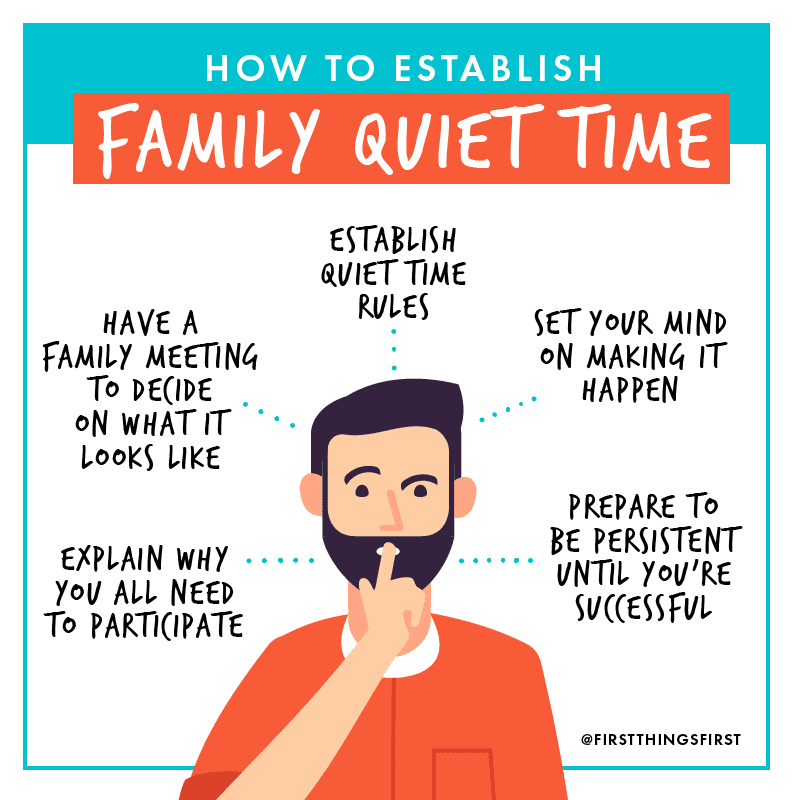
Step 1: Get Your Mind Right.
You’ve got to believe it can be done. They may resist and scream. They may dig deep into their bag of tricks to block the entry of a quiet time into your home. Don’t believe the lie. They don’t know what’s good for them. Hear the voice of the man with 7 kids: “It can be done. You can do it.” It may not be perfect the first time, but whatever you do, don’t believe the lie. Which takes us to step #2.
Step 2: Prepare To Be Persistent.
If at first you don’t succeed, try, try again. You didn’t ride your bike perfectly the first time you took off the training wheels. They don’t believe that you’re serious unless you stick with it. Kids are wired to resist anything that their parents say is good for them at first, at least it seems that way. It’s not impossible just because it didn’t work out the first time. You’re going to have to stick with it.
Step 3: Family Meeting.
Gather the troop together and tell them, “Each day, we are going to have some quiet time in this home. It helps our minds to relax and our bodies to rest. You may not think you need it, but I, as your parent need it and your body will thank you for it. There is no room for negotiation on the fact that there will be a quiet time. You may negotiate what can be done during quiet time.”
Step 4: Explain Why Their Quiet Time Is Your Productive Time.
In order to get more of the ‘me’ you like later, I’ve got to get done what I can now so that we can enjoy one another later.
Step 5: Establish Quiet Time Rules.
Acceptable activities during quiet time: Sleep, lay in bed, read, write, meditate. Prohibited activities include: Video games, calling/texting with outside people, playing with siblings. Quiet time is as much about your mind being quiet as it is simply taking a nap.
Note: Play that is not noisy and only involves one person is acceptable for my seven and up crew. For instance, my 7 year old may sit on her bed and play with her dolls for a full hour. My 9 year old may sit on his bed and build legos. My instructions to them, “I should not hear you. I should not see you. You should not need to ask me anything.” If they ask me something about the legos or the dolls, they are automatically prohibited from playing with them during quiet time.
Step 6: Establish When And How Long.
Routines and Consistency is the name of the game. If your children had quiet time at school, schedule family quiet time at a similar time. Schedule quiet time around the same time each day. In our house, our routine is lunch at 12:00, play outside til 1:30, quiet time 1:30-2:30. For our kids under 7, that normally means a nap or at least laying in the bed. The others – read, nap, write, build something. The key- they are in a space all to themselves and need no attention. (Note: You may start at 30 minutes as opposed to an hour. And no, we don’t wake the kids up after an hour if they are asleep. Are you kidding me?)
Optional: Set a timer in their room. You don’t know how many times my children have fallen asleep looking at the time countdown. I count that as a parental win. Otherwise they like to ask, “Is it time yet?”
Step 7: Set And Enforce Consequences For Quiet Time Violations.
The keys to good consequences are that you have to find out what means most to your child. Then you must be willing to enforce it the first time. This is where having your mind right and believing that it can be done is key. Suggestions: Add time—5 minutes for each violation. Eliminate dessert from dinner. Decrease screen time. Earlier bedtime.
Remember, this may be new for your child. They may not have expected this from you. They are going to test you. Your biggest weapon is enforcing the consequences while staying cool, calm and collected. If you don’t enforce the consequences quickly, then you may get frustrated when they violate the rule again and lead you to believe that it’s a hopeless cause.
Step 8: Implement.
Be firm. Follow your plan. Keep the vision of peace and quiet in front of you. Celebrate the victory, however small it may be at first. Let them know that we’ll all get better at it.
Practical Tips
- Send kids to the bathroom first!
- No eating during quiet time. May give them snacks right before quiet time, but not sugary snacks. Design your schedule for what works best. Kids always want to eat. So decide if they eat before or after and stick with it, but not during.
- Check in on them and encourage them if they are doing good. If they’re asleep, let ‘em sleep.
- Enforce consequences. That’s how they know you mean business.
- Be productive in whatever you decide to do during this time – work, yoga, emails, nap, etc. (Yes, naps are productive.)
Implementing anything new in your family can be challenging, but having a family quiet time is good for your kids and good for you! It might take some time to get it down, but it is definitely worth it!
How do I get my teen to talk to me? My first thought was to think back on all my experience parenting and working with teens. My first thoughts are frequently wrong. I realized that my 14-year-old son, Jude, was sitting right next to me. Ding, Ding, Ding! He has the best credentials to answer this question. Why not ask him? He’s the expert!
What followed was me talking with my teen about talking with my teen.
(He even grabbed my laptop at times and started typing, “You gotta tell parents this!”)
Me: Is it helpful for parents to find out what you are into and learn all about it so they can build some common ground? Like, “Is your teen into skateboarding? Learn all about skateboarding so you can talk to them! Now you can ask if they ‘push mongo’ and if they can ‘aciddrop into a melongrab.’”
Jude: (Laughing Hysterically) You don’t even know what those words mean, do you?
Me: Um, no… I Googled them.
Jude: That stuff might help. It might come off as forced and lame.
Me: Bottom line, I can’t make you talk to me, can I?
Jude: (Kinda Smugly Triumphant) Nope!
Me: (Sigh) Let me type that…
Bottom Line: You can’t make them talk. Sorry. You can’t point the remote at them and press “Unmute.” The good news, however, is that you can adopt a parental posture and create an environment where a real conversation has a much higher chance of happening.
Jude: I like the “unmute” thing!
Me: Hey, thanks; I just think…
Jude: (Interrupting) Just tell them to spend time with their kids. That’s it.
Me: You just told them.
Jude: What? Wait! Are you just typing out what I say?
Me: Yup. Keep talking… I might make it sound more adult-y and mix in some of my thoughts.
According to a real-life teenager, there is no magic formula, but here are five things for parents to think about…
1. Some teens are just quiet or go through quiet phases.
You remember being a teenager, right? Well, it’s way harder now, according to Jude. It’s more cutthroat, more emotionally charged, and more adultish—social media amplifies all that exponentially. Jude says teens genuinely feel like you just won’t get it. It’s not an insult. They often process issues internally or with their peers. Resident Teen Expert encourages you to be patient.
Big Idea: Make a standing offer to be available to talk about anything whenever they want to.
2. Spend time with them not obviously trying to force a “big” talk.
You might be dying to hear about what is going on deep inside their world and incredibly anxious to speak into it. But just offer to watch them play video games, play some Uno, (Jude: Dude. We’ve never played Uno.), or go grab a bite to eat with no agenda other than to enjoy their company. Make small talk. Don’t sweat silences.
Big Idea: Don’t force it. Spend time with them and see what happens organically. Small talk often leads to BIG TALK.
3. Don’t freak out when you hear something that rattles you.
Jude says this is “super important.” If they do open up to you, you will hear some stuff. Maybe some shocking stuff. If you freak out, it might be a loooong time before they open up to you again. Keep a good poker face. Jude: And don’t bombard them with a million questions. Don’t lecture. Me: Got it! Empathize. Probe gently. Listen, then listen some more. (Check out this article on active listening skills—especially the Six Levels of Listening.)
Big Idea: So many teens say that their parents don’t listen and just talk at them, not with them.
Me: So, how do I do with all this?
Jude: Um…
Me: Okayokayokay! I’ll work on it!
4. You might not be the person they feel comfortable talking with right now.
Jude: Some stuff I just feel better talking to Davin about. (His older brother.) As a parent, I’ve had to settle for… are they talking to someone? Someone I trust? For some topics and even some phases of teenage life, I realized my teen was more comfortable talking to Mom. I had to work to get to a place where I was just happy they had someone to talk to that I knew would basically give them the same input that I would. It might be an older sibling, their aunt, a teacher, or a coach. I know I can trust my sister, their favorite aunt, to give me a heads-up if she hears something I need to know about.
Big Idea: Encourage them to cultivate relationships with people they are comfortable talking to.
5. Talk to them. But be real. Be transparent. Be vulnerable.
This speaks for itself. Sometimes we expect our teens to give us things we aren’t willing to give them. Me: Am I real with you, Jude? Jude: Yeah. Maybe too real… Me: So that’s a compliment?
Big Idea: Make sure you are giving conversationally what you hope to get from your teen.
Me: You get the final word.
Jude: Spend time with them, listen, don’t lecture. Just tell parents to spend time with their kids.
Me: You just did again. What do you think of this blog?
Jude: This blog goes hard.
And then, on the way to school the next morning, out of nowhere…
Jude: We told them not to lecture, right?
What’s The Big Idea?
- Offer to be available to talk about anything whenever they want to. Be patient.
- Don’t force it. Spend time with them and let conversations grow organically. Small talk often leads to deeper conversations.
- Practice good listening skills. Don’t talk at them; talk with them.
- Encourage them to cultivate relationships with people they are comfortable talking to and that you can trust.
- Model the openness, vulnerability, and transparency that you are hoping to get in return.
Why You Need To Get Your Kids To Help Around The House
You’re probably less interested in the “why” of getting help around the house, and more interested in the “how” of it. I get it, but you need to understand the “why” first and believe it.
Taking care of yourself—physically and mentally—is incredibly important, especially right now. Stress, anxiety, fear, and plain old fatigue will all take their toll on you. That toll will impact you and the people that you care about. I see it in myself and in my own home. I feel fragile, a lot.
You know the deal. I’m at home, trying to put in a full day’s work and finish my projects, making sure school work gets done, keeping an eye on my at-risk mother-in-law, and generally holding down the fort—including keeping it clean and organized. Oh, and when my wife gets home, I try to have dinner ready and we try to do Family Movie Night or Game Night and keep all the sequestered happy. It is a daunting task, and I’ve never felt so exhausted. You feeling it too? It often feels like a lose-lose situation.
If I focus time on my kids and mother-in-law, I feel like a bad employee.
If I focus time on my work, I feel like a bad dad and son-in-law.
I can’t possibly do it all. I just feel stressed out and guilty.
When in the world am I supposed to take care of myself?
Start with the basics.
The house needs to be kept up and your kids need stuff to do.
Those dots connect themselves, but how do you do this without having another thing to do?
I got the ball rolling by laying out expectations in a family meeting.
I also sent out this text message in our family group text after days of exhaustion:
Hey Family! I know everyone is taking care of their own living areas but we need to work together on shared spaces like the kitchen, dining area, and living room. We are trying to stay afloat – Mom is working full time, I’m working full time from home, and Grandmom isn’t our maid. (Thanks for all you do, Grandmom!)“
Some Stuff That Needs Doing:
- Kitchen needs to be swept and mopped.
- Dining room & front door area swept and mopped.
- Living room vacuumed.
- Lawn mowed when it dries.
- General sanitizing wipe down.
- Help with cooking dinners.
- General cleaning up after yourself, especially in the kitchen.
There’s enough for everyone to do a little. Thanks in advance. Hope this isn’t received as snarky. Totally sending with a heart full of love for all of you. Just need help. You guys are my favorite! ❤
That was the text. I didn’t have high hopes. I figured a couple of kids (maybe) in drips and drabs would hopefully mark a few things off the list in the upcoming week. Maybe there would be a little less work for Grandmom and me.
Then something incredible happened.
My son, who is without a doubt the “lone wolf” of the whole crew, immediately came down and started sweeping the kitchen. What? Soon, everyone started popping out of their rooms and joined in. They cranked out a very thorough cleaning of everything. We even game-ified the cleaning by adding some rounds of Nintendo Wii in-between cleaning jobs. In a couple of hours, the house was spic & span – and get this – we all had time freed up to do our stuff. Even me!
I can’t call it a Christmas Miracle. It was like something out of some wholesome unrealistic sitcom or Disney Channel show. It worked. But let me be clear, I was fortunate this time. It usually doesn’t play out like that. But I learned some valuable info that day…
There is no way I can keep up with housework, school work, and work work AND have time and energy left for self-care plus some gas left in the tank to have a little quality time with my wife when she gets home from work. You can’t give what you don’t have.
And my kids can and will and need to help.
Let’s Break It Down
So how do I keep this ball rolling? If you break down my text, you might find some reasons why it was effective that might help you get your kids helping more around the house, have some structure in their day, and burn off some energy. Hopefully, this will lower your stress levels by freeing you up for working on work and remember, working on yourself.
Here’s what I did in my text to get my kids to help around the house:
- Started positively.
- Acknowledged what they were already doing.
- Was realistic and honest about our new situation.
- Listed very specific things that needed to get done.
- Gave them a choice of what they wanted to do.
- Thanked them in advance.
- Tried to preclude any misinterpretations.
- Affirmed my love for them and that family is the most important thing.
- And here is the kicker – I TOLD THEM I NEEDED HELP. (I didn’t suggest it. I didn’t imply it. And I didn’t say, “It would be nice.”)
I probably should have added a timeframe for the work to be done by. Missed that one.
We made it a challenge and made it fun. We worked together and multiplied our efforts.
Apply these principles in a way that works for your kids at their ages.
Just don’t try to do it all yourself. And don’t sweat it if it all doesn’t get done. It isn’t going anywhere. Take care of yourself.
I couldn’t figure out what it was at first. My first three days of work at home due to COVID-19 were really strong. I was sharing the house workload: cleaning, cooking, laundry, and the like. I was spending some quality time with the kids.
And then suddenly, it all changed. I was unmotivated to work. I was restless. The kids were no longer cute. They were obnoxious. Their questions were irritating and I couldn’t understand why they were so dependent on their parents, even the 4-year-old. Go figure. I went to Google and searched “stir-crazy defined” and found, “Stir-crazy: restless or frantic because of confinement, routine, etc.,” and “upset or angry because you have been prevented from going somewhere or doing something for a long time.” Yep. I was definitely stir-crazy. Looking back, I’m proud that I made it to Day Three of this work from home experiment.
I vowed to not let it get to that point again. Through a little research, common sense, and talking to colleagues I developed a strategy.
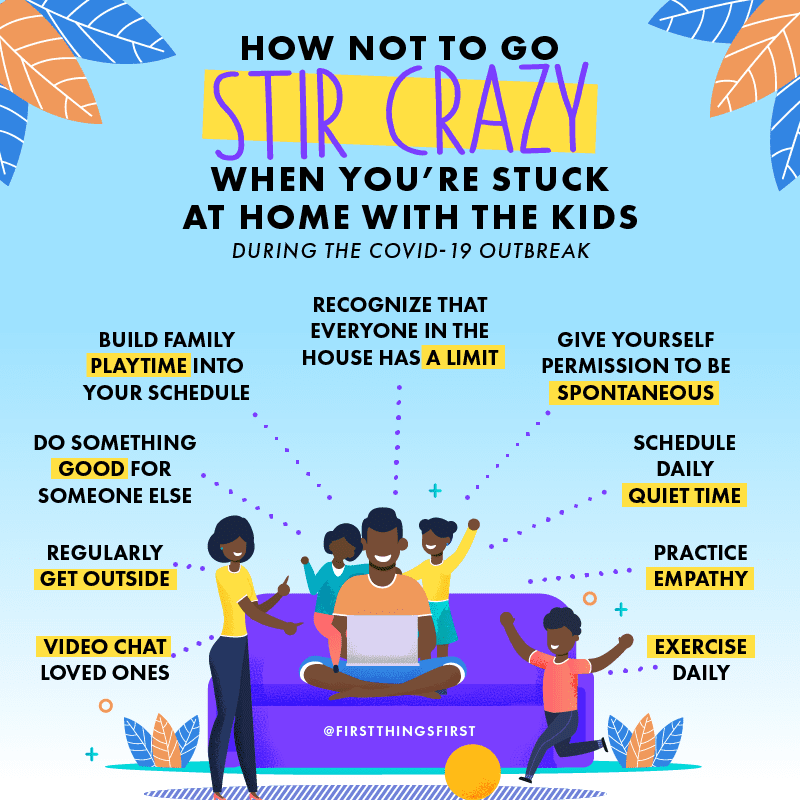
10 Ways to NOT Get Stir-Crazy:
- Recognize that everyone in the house has a limit. None of us are superhuman, though sometimes I think my wife is. Staying cooped up in the house without a real break in the midst of the current circumstances with the same people is a recipe for “stir- crazy.”
- Regularly get outside. My wife gardens. I bike alone and with my kids. Sometimes we simply sit on the porch. Others take a walk. Some of my kids throw a baseball.
- Permission to be spontaneous. Everyone in the house is granted permission to call together a spontaneous activity. Card game. Pillow fight. Dancefest. Wii 3-Point Shooting Contest (Limits may be necessary on how often and how long.)
- Build family playtime into regular schedule. If everyone knows when to look forward to scheduled playtime, then it can help everyone stay focused during the other times.
- Do something good for someone else. Check on the neighbors. Call your elderly friends and include the kids on the call. Write a family letter to someone you know that’d appreciate it.
- Schedule daily quiet, alone time. Sometimes all the noise can drive you crazy.
- Video call loved ones. Part of what makes us stir crazy with the kids is a lack of relaxed connection with the outside world. Virtual coffee dates during your mid-morning break might be in order.
- Have some empathy. If you’re trying to avoid going stir crazy, know that your children are susceptible as well. Even the most introverted of us can go stir-crazy when we feel like we are confined to one space.
- Refocus on why we are quarantined. The bigger picture is that we are trying to protect ourselves, our loved ones and our community.
- Exercise. Release those endorphins, the chemicals in your brain that can trigger positive feelings. It can help your mood.
Proactively prevent going stir-crazy by recognizing that if you don’t do anything to prevent it, then you’re inviting it. A stir-crazy parent is not a fun person to be around. When this is all said and done, I want my children to be excited to get out of the house because it’s fun and it’s natural. If I’m not proactive, my kids will scatter because Dad has gone crazy and they can’t wait to not be stuck inside with him anymore.
What are the words to describe this season of social isolation and self-quarantine during COVID-19? I can think of a few:
Frustrating. Stressful.
Extremely inconvenient.
Full of anxiety.
Ruined my plans.
What day is it again?
(I could go on…)
As I was talking with friends (six feet from my computer screen, of course) about how normal life has been turned upside down by this Global Pandemic, I was struck with an interesting thought: Social distancing has taken away all the excuses for not doing the things I’ve said I’m too busy to do.
For those who are self-quarantined, it has removed a great deal of busyness. Sure, many of us still have to work or do school from home. But chances are we haven’t been fighting traffic to get home, rushing kids to ball games, or struggling to get dinner prepared at a decent hour. This weird point in our current history has created at least some margin in our daily lives. And where there’s margin, there’s an opportunity.
I realize this calls for an intentional change in our outlook on our situation. You almost have to unnaturally choose to see the opportunities before you. But I really do think they are there.
Below are five ways—opportunities, if you will—that social distancing can increase happiness in the home.
- The opportunity to slow down. Social isolation has given us the margin of time. Even if you are working from home, or if your kids are doing school remotely, chances are you can dictate and shape your schedule more than you’ve been used to.
- Use that to your advantage. Ask yourself, what are the important things I’ve put off because I said I was too busy? Exercise. Taking a daily walk. Reading. Meaningful conversations with your spouse. Playing in the yard with your kids. Reconnecting with that old school friend. Yoga. Eating at the dinner table each night. Meditation. And don’t forget time to just sit on the front porch… and breathe.
- Make a list. Schedule it. Do it!
- The opportunity to clean the clutter. There are two sides to this. Yes, now we have some time to fix that leaky pipe, clean out the garage, and weed the garden (how convenient for the pandemic to happen during Spring cleaning!).
- But there’s also the side of cleaning up the clutter that has built up in our relationships with the people we love in our home. Maybe the busyness of your previous life has caused some disconnection between you and your family members. Now is the opportunity to engage in good, healthy, deeper conversations and times of connection.
- Our family decided to open up the box of conversation-starter questions that’s been sitting unused on our kitchen table. Every evening at dinner, we’ve had some of the funniest and most interesting talks around these questions. However you decide to clear that space, make it an intentional and daily routine.
- One word of caution: Cleaning the clutter may also mean visiting some of the issues that have been lingering between you and your spouse or your kids. This may be a good time to work things out. However, be very aware of stress levels and be strategic as to when the best times are to talk things out. It’s not a good idea to work on old issues when the anxiety is particularly high.
- The opportunity to focus on others in need. Obviously you are not alone in feeling the stress and anxiety. There are those in our neighborhoods and communities who are hurting right now. This is a great opportunity for you and your family to help ease the fears and uncertainties of others, even while you are social distancing.
- One charitable neighbor of ours set out a tub full of hand-sanitizers on the sidewalk in front of their yard for anyone who had need. My daughter (on her own) created cheerful cards to give to the neighbors. Someone else in our neighborhood organized a “bear hunt” through social media—our neighbors were invited to display teddy bears and other stuffed animals in our windows so that when kids walked by, they could “hunt” for as many bears as they could.
- Anything you can do to bring a smile and sense of cheer to those around you will most certainly bring happiness to your own home.
- The opportunity to be appreciative. When we are super-busy, it’s easy to forget to stop and remember what we should be thankful for. Practicing gratitude increases a sense of happiness and well-being in the home. No matter how much or little one has, there are always reasons to be thankful—for food on the table, the air you breathe, a roof over your heads, the people you love in your home.
- Acknowledge what you appreciate. Make it a practice at mealtime to share with each other what you are thankful for. Make a daily “gratitude list.” Thankfulness is a strong tool to temper anxiety and to boost happiness.
- The opportunity to play and be creative. At no other time in our recent history has it been so vital to inject some fun, laughter, and play into our daily lives. Now is the time for family Monopoly games, Nerf wars, movie nights, making breakfast for dinner, camping in the backyard, playing in the rain, and family dance-offs. These activities cut through the stress and provide the glue that bonds family members more closely together. Don’t let the tension of quarantine compromise the opportunity to make memories. Laugh and have some fun!
Opportunities don’t take themselves. You have to be intentional about using the margin you’ve been given as you incorporate social distancing into your life. However, the payoff for you and your family is tremendous.
Are You Setting a Good Example of Self-Care for Your Family?
I fish. It’s what I do. Some have asked me what in the world draws me to stand by a pond and throw a little feathered hook in the water time and time again, often with very few results. I fish so I can de-stress.
It’s mindless (somewhat) and I can leave all the emotion, anxiety, and uncertainties behind me for just a little while. If you fish, you understand this. I can clear my head before re-entering the real world. Fishing is my self-care.
Self-Care… It’s become a popular term that’s popped up in conversations around health, mindfulness, and stress. You do self-care when you do any kind of action deliberately in order to care for your mental, physical, or emotional health. And it’s widely thought to be effective in reducing anxiety and stress.
How apropos in our current state. At perhaps no other time in recent memory has it been so important to stay healthy. Stress and anxiety are at an all-time high. People are stuck at home. Routines are turned upside down. Family members are spending way more time with each other than they are used to.
I’d say self-care is a precious commodity right about now.
I don’t know about you, but in my house, it’s easy to give our kids a schedule that includes some healthy activities. However, it’s extremely difficult for me personally to get into a routine of self-care activities. My game is so thrown off by the stress of our circumstances. And it’s sometimes a fight just to get me away from the computer screen.
But it has to happen. As parents, we’ve got to be a good example and practice self-care right now. And here’s why:
You can’t give what you don’t have.
Meaning, if you want your kids to practice self-care, you need to self-care. You’ve got to fill your tank so you have it in you to help them fill their tanks. When you self-care, you’re better able to handle feelings of anxiety, fear, uncertainty, and stress. This is important so these emotions don’t get the best of you.
Pay attention to yourself. Keep an eye on the radar of your emotional state. Take the time to do some things each day that help you deal with all the chaos that is going on.
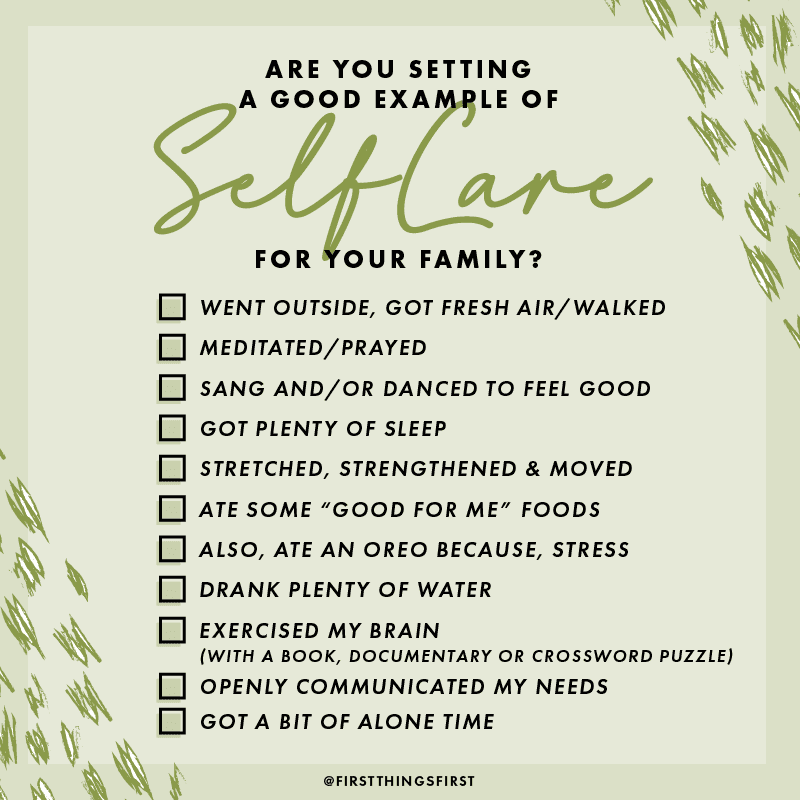
- Go for a walk. Get some fresh air. Let the sun shine on your face for a little while.
- Meditate or pray. Sing (out loud).
- Get plenty of sleep.
- Do push-ups. Or go for a run. Or practice yoga. Anything to stretch, strengthen, and move the body.
- Eat clean. Healthier food keeps your energy up. Drink plenty of water.
- But, every few days, sneak in that Oreo. Because… stress.
- Read a book. Watch a documentary. Keep your mental game strong.
- Communicate your needs to the people that love you. Let them know when you need to be alone. And let them know when you need to be with them. Get plenty of both.
These are just a small number of suggestions for self-care. Search online for other ideas and find out what feeds your health—body and soul. And then do it. Regularly.
Of course, we don’t self-care simply for our own needs. Our families are depending on us. That’s why it’s so important that we set a good example of self-care as parents.
Your moments of self-care are the teachable moments for your kids.
As parents, every little thing we do is seen. Young eyes are watching how we handle ourselves—especially in the midst of anxiety and stress. They take their emotional cues from what they see in us. “Do as I say, not as I do” is a terrible parenting style—particularly when it comes to self-care. They need to see you handling your health in a positive way.
It’s okay for your kids to know you are anxious or fearful. But it’s so much more important that they see how you handle your anxiety and fear. When they see you taking care of yourself, you are modeling that for your children. It may sound funny, but your example of self-care leaves a legacy.
Parents, take care of yourself. For your sake, and for your kids. They’re counting on you.
Let me set the scene for you. I’m working from home, sitting at my computer trying to crank out a report and meet a deadline in an hour.
The following sequence of events happens:
- My 9-year-old son goes running down the hall and slides on the floor into the door as if he were sliding into 2nd base. (I guess he misses baseball.)
- I calmly stand up and say, “Are you crazy? Don’t do that anymore.” (50○– Nice and cool.)
- Next, my 11-year-old son breaks a glass bowl in the kitchen.
- I, truly irritated, go to the kitchen to investigate and help clean up the mess. (100○– Hot, but bearable.)
- Then my 2-year-old is yelling at my 4-year-old, “Let me have it. It’s mine. Let me have it!” as tears are flowing down his face. Of course, he gets louder and louder each time.
- I put my referee suit on and very frustratingly resolve the issue. (150○– Feels like I’m in the desert with no water.)
- And then my 13-year-old daughter innocently enough walks in and asks me to set up Zoom on the iPad so she can get on a video with her friends.
- And now, I’m ready to lose it. My very first thought, (picture blood vessels bursting out of my forehead, “Leave me the -beep- alone!” (212○– I’m at my boiling point.)
I’ve gone from calm, to irritated, to frustrated, to downright angry because no one will let me get my work done. Don’t they know the pressures that we are under right now?! Don’t they know that if I don’t get these reports completed, I could be the next one to be laid off or have his salary reduced?!
There are 2 distinct doors to choose at this moment:
- Behind Door #1: Blow up and let my 13-year-old and all the other kids have it. Check out the blog, How Your Emotions Affect Your Child to learn more about what else is potentially behind door #1.
- Behind Door #2: Take a timeout.
The timeout is an extremely useful tool that has helped me with my own children. It is so important because when I reached the boiling point, my body had literally undergone a chemical transformation as adrenaline and cortisol was now rushing to my defense. I was not capable of thinking rationally because my brain was out of balance at that moment.
The timeout becomes vital to provide an opportunity to literally calm your nerves. It can be made to be real dramatic which helps to get the focus onto the issue and off the person.
Some creative ways to take a timeout and not blow up on your kids.
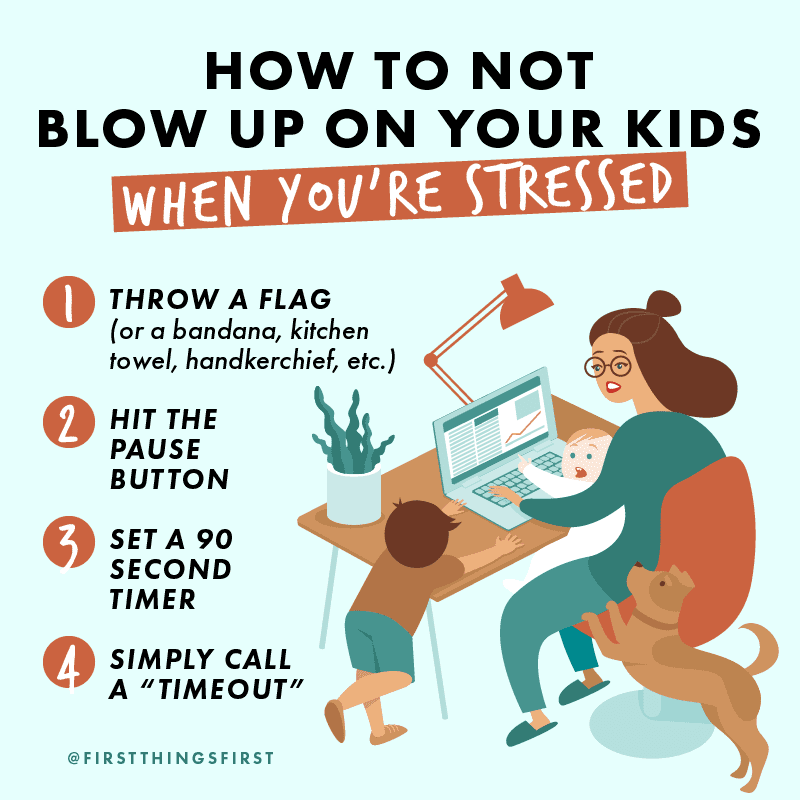
Throw a flag.
(Stole this one from the NFL) When a team commits a foul. One referee throws a flag. Then all the referees huddle to discuss the foul and make sure there’s agreement on the consequences (e.g. 15 yard penalty). Play doesn’t resume until the foul was acknowledged by the referee and the consequence was administered. And then it’s on to the next play. (The referees are always calm, direct and clear when they discuss the foul that was committed and the penalty.) If one of them has committed a foul that’s about to cause you to blow up on your kids, have a makeshift flag (i.e., bandana, handkerchief, napkin, old rag) and throw it to the spot of the foul. And if your spouse is available, discuss the foul with them. Sometimes the referee picks up the flag and says that no foul was committed. Sometimes your kids didn’t do anything wrong, the stress of life just got to you. Don’t be too proud to pick up your flag and say no foul was committed.
Hit the Pause Button.
(Thank Hal Runkel, marriage and family therapist and author of ScreamFree Parenting for this one.) When we pause, everything freezes. Time stops. We don’t yet act on the next thought that comes to mind. We’re giving ourselves time for the adrenaline to settle down. Hal Runkel says, “Kids don’t want cool parents. They want parents that keep their cool.” Hitting the pause button helps you keep your cool. Make your pause button noisy. It can be a buzzer like the one that comes with board games like Taboo or a little wheezy toy. This draws attention to the fact that there is an issue that makes me want to explode and we need to deal. These are drastic times which call for drastic measures. Let your drastic measure be hitting the pause button.
Set a 90-second timer.
Use your phone, microwave timer, watch, or just count. Did you know that we only stay mad (chemically) for 90 seconds? According to Jill Bolte Taylor, brain researcher and author of A Brain Scientist’s Personal Journey, anger triggers a chemical reaction within the brain that lasts for 90 seconds. After that, we either turn our attention elsewhere or replay the story and reignite the anger. You’re about to lose your mind at the expense of your kids. You can often sense when that 90-second count starts. Stop, take a deep breath and set a timer.
Simply call a timeout.
Form a “T” with your hands and say, “Timeout.” Doesn’t get more straightforward than that.
If you start to blow up on your kids or even get a few moments into your blow-up and then catch yourself and recognize the need for a timeout (this happens to me a lot), that’s ok. All isn’t lost.
Take a timeout the moment you recognize you need it. Take it from my experience; don’t start to blow up on your kids, realize that you’re blowing up, know that you should take a timeout, but since you’ve already started, choose to keep blowing up. Don’t do that!
If you do, you’re essentially saying, “I know that I’m not thinking rationally, that my adrenaline has thrown off my thought process, and that I’m in the middle of reacting, but I’m going to stay on that path anyway.” Pride or stubbornness should not get in the way of a timeout.
The best time to come up with a plan is before you need it.
Have an age-appropriate conversation with your kids. Discuss the timeout, its purpose and implementation. Then use it.
Not only are you protecting your children and yourself, you’re also modeling self-control and teaching them how to regulate their emotions. And in the process, you’ve put yourself in a better position to get the results you really want: a family that is considerate, loving and respectful of one another. That beats fewer broken dishes any day.
Journaling/Writing Prompts for Kids
Journaling isn’t just for school. It can help your kids in a variety of personal ways that can also help you as a parent tune into your kids. Sometimes your kids will be willing to share their thoughts with you, but they will often put something into writing that they might not say to you.
Let’s be honest — even with school and everything else that’s going on, your kids probably need some constructive things to do. Journaling can fire their imagination, improve their writing skills, and cultivate self-awareness. Plus it can be fun and give you something to start a conversation! Make it part of their daily routine — maybe the first thing they do after breakfast or the last thing they do before bed.
So, take a look around the house — is there an empty composition book or notebook you can put together? Kids love their electronic devices, but I would only use them as an absolute last resort. You can make up the topics, but try to make them as open-ended as possible or add a “Why?” at the end. Of course, keep topics appropriate for your child’s age and interests. Below are a bunch of journal topic suggestions to get you thinking! But to review just a few of the benefits of journaling for your child…
Journaling can:
- Clarify their thoughts and feelings
- Help them know themselves better
- Reduce their stress
- Give you insight into how they are dealing with our current situation.
BONUS: Here’s a great resource of journaling prompts for both you and your child to practice mindfulness. If that word sounds scary or unfamiliar, mindfulness just means that you’re practicing narrowing your focus and sharpening your attention, which is obviously so helpful for children!
Elementary School
List of things that make me happy.
I wish I knew more about __________ because….
What is something that is important to my family?
When it comes to schoolwork, what has been your favorite thing you learned?
My favorite part of last week was…
Three things I’d like to talk about.
If I could rename the colors of crayons…
What is my favorite dessert and why?
Use your creativity to describe and draw a new creature or animal.
If my dog or cat could talk, it would say things like…
I was proud when I __________
Five things I’m good at are…
If a genie granted me three wishes…
What would you choose if you were in charge of the weather?
My favorite holiday is…
Middle School
What would happen if you found gold in your backyard?
If animals could talk, what questions would you like to ask them?
Who would you be if you could have been someone in history? Why?
I taught someone how to…
You can only take 3 people with you on a trip around the world, who would you take?
If you could give any gift in the world, what would you give and to whom?
The house was so quiet, but then I heard…
If you could live anywhere in the world, where would it be?
Let’s say you received any sum of money as a gift. What would you do with it?
Did you ever catch fireflies? Crickets? Frogs? Snakes? Why/why not?
What was your most difficult or most joyous life experience?
List one of your pet peeves and write about why it annoys you.
What is something that you appreciate about your parents? Why?
Write about a window you broke or something valuable you lost.
What would happen if it suddenly started raining spaghetti and meatballs?
High School
Describe the perfect date.
What is courage? What is the most courageous thing you have done?
Describe a hero. It can be either someone you know or simply qualities of a hero.
What is your favorite activity? Who do you do it with? Why do you think you enjoy it?
Write about a good book you’ve read recently.
What will you do differently when you’re a parent? Why?
Do you spend too much time with electronic devices? Why/why not?
What do you think should have or should NOT have been invented and why?
List one major world problem and how you think we should solve it.
Do you think that there is or ever was life on another planet?
What is the most important issue facing teens your age today?
Were you ever given a responsibility that you couldn’t handle?
Describe the best concert you ever attended.
Write about a time you tried to help and ended up making things worse.
Did you ever break an important promise?
Write about moving to another city or neighborhood or house.
Did you ever meet a famous person? Interact with them on social media?
Describe a car or bicycle accident you were in.
If you could spend a day spent in another country, which would you choose? Why?
Describe a time that you outsmarted someone.
Write about going shopping for new clothes.
Did you ever turn someone in or tell on someone and feel bad about it later?
Was there a time your parents embarrassed you?
Can you remember a time you gave someone good advice? What was it?