
4 Communication Exercises For Married Couples
Healthy communication lies at the root of any successful relationship. In marriage, this is even more of a necessity. Like our muscles, our communication skills also need to be worked out. There are practices we can make part of our regular routines that will strengthen communication in our marriage. Here are four communication exercises for married couples.
Exercise #1: The Weekly Meeting
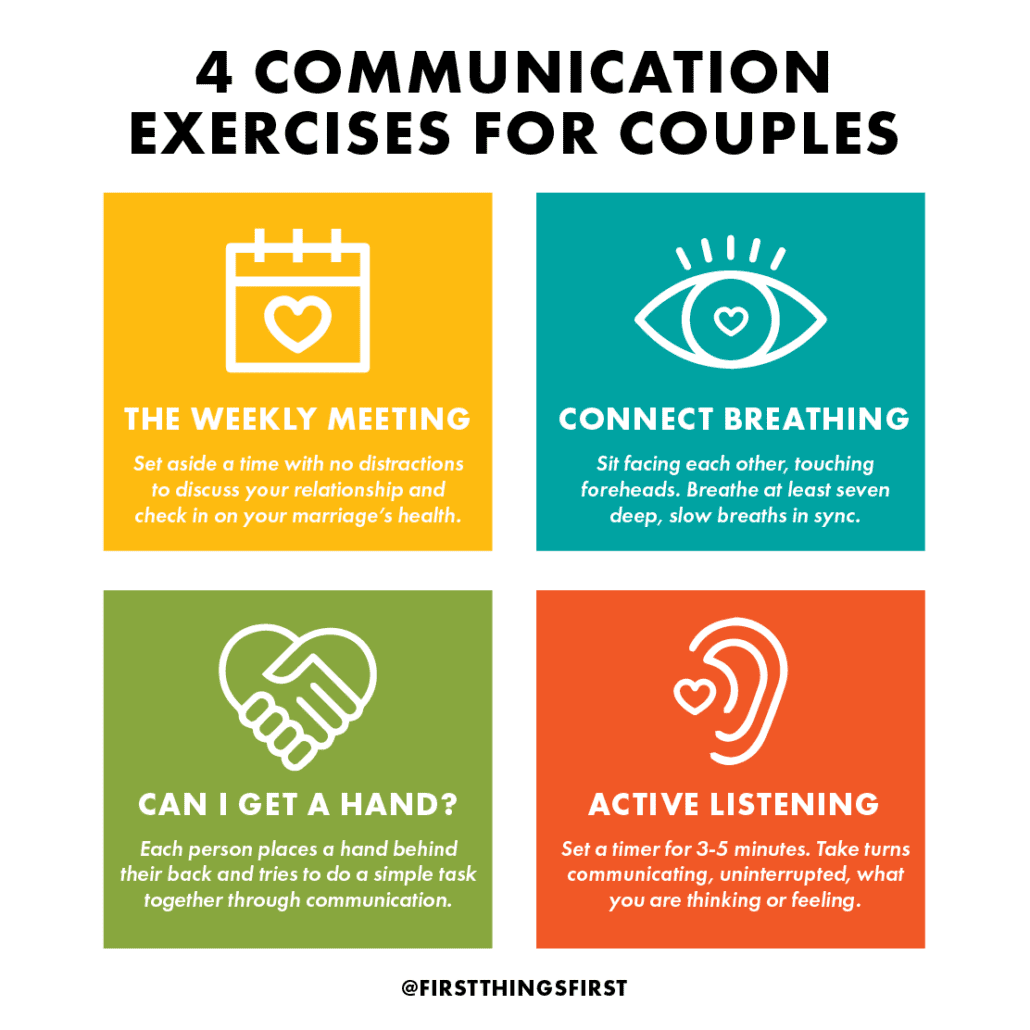
If your marriage is like mine, you’re busy. You both have schedules, and your kids have schedules… I think my kids’ schedules are often busier than mine. This exercise is excellent to carve out time to focus on your marriage intentionally.
Set aside a non-negotiable chunk of time (30 minutes is a good starting point) when you will have no distractions. No phones, no tablets, no television, no kids. This time is for you to discuss your relationship and check in on your marriage’s health.
So what do you talk about? Start here:
- How are we doing as a couple?
- Is there anything we need to finish addressing from this week?
- How can I make you feel more loved and appreciated?
You don’t have to stop here. These questions are just ideas to get you started.
As you dedicate this time each week, check out these keys to effective communication in marriage to enhance your communication.
Exercise #2: Connecting Through Breathing
The purpose of this exercise is to focus on your partner and remove distractions. To begin, sit facing each other, touching foreheads. Tilt your chins down, so you don’t bump noses.
Breathe at least seven deep breaths. Try to breathe slowly and in sync. As you get the hang of this exercise, you may choose to do more breaths or focus on breathing for a set amount of time. It’s all about connecting and focusing on one another.
When you need to slow down and refocus, this is a great practice. Once you have refocused on one another, take the time to talk about how your marriage is doing.
This exercise is ideal for clearing your minds and having a healthy conversation.

You’ve had conversations with your spouse, even arguments, and maybe straight-up fights about this issue or that problem, BUT those interactions often don’t lead to any solutions. But why is that exactly?
Join us for this 20-minute webinar to find out!
Exercise #3: Can I Get A Hand?
Often in marriage, misunderstandings come from not sharing our needs. Your spouse is not a mind reader, so it’s vital to communicate your needs clearly and effectively. This exercise will help.
In this exercise, you’ll both be working toward a common goal. Each person will place a hand behind their back, and together you’ll try to do a simple task such as buttoning a shirt, pouring a cup of coffee, or any other task around the house. Be as clear as possible in communicating with each other to accomplish the task together.
This was a pretty enlightening experience for me. We had some really good laughs AND I learned there were some things I could do to communicate more clearly with my wife.
Exercise #4: Active Listening
This exercise focuses on verbal and nonverbal communication.
Set a timer for 3-5 minutes. One spouse communicates whatever they are feeling or thinking, uninterrupted. The other spouse listens and communicates nonverbally. When the timer goes off, both of you discuss the experience.
Then switch roles and practice again.
These are just a few exercises you can practice to increase communication in your marriage. Healthy communication plays an essential role in any thriving relationship. Make exercising your communication muscles a priority in your marriage and take it to the next level.
Ready, set… time to work out!
Related:
How To Improve Bad Communication In Marriage
3 Ways Good Communication Can Enhance Sex In Marriage
4 Things Every Couple Should Know About Communication In Marriage
How To Improve Bad Communication In Marriage
Every couple experiences little instances of communication breakdown. It just happens.
Of course, the little things can gradually chip away at your connectedness in your marriage. Small drops of water from a leaky pipe over time lead to big problems.
Minor bad communication habits are like that. Not that big of a thing in the moment, but given time… you get the picture.
So with that in mind, here are four common communication habit scenarios every couple experiences. The good news is, you can fix or improve bad communication with a little intention:
Scenario 1:
Fred asks Wilma if it’d be okay to go bowling with Barney tonight. Wilma replies, “Sure, you can go if you want.” However, Wilma’s tone of voice sounds less than enthused. And her crossed arms and frown suggests she’s not as approving as her words suggest.
Wilma is sending mixed messages to Fred. Her words don’t match her non-verbal cues. She feels bad saying no, but she would really love for him to stay home and spend time with her. This leaves Fred in a no-win situation: Should he accept her verbal permission and go, or stay home because of her tone and body language?
The Fix:
Wilma needs to be honest with her feelings and maybe work out an alternative. Perhaps he can go out tonight and plan on quality time with Wilma the next evening.
If Fred senses the mixed message, he needs to politely ask his wife, “Dear, I appreciate you letting me go tonight, but your tone and crossed arms seem to be telling me something else. Am I reading you right?”
Scenario 2:
Pam has had a rough day at work; her boss just seems incompetent, and her co-workers lazy. She shares with her husband Jim that evening. Jim makes several suggestions on how to handle things. Pam walks away feeling misunderstood.
You’ve had conversations with your spouse, even arguments, and maybe straight-up fights about this issue or that problem, BUT those interactions often don’t lead to any solutions. But why is that exactly?
Join us for this 20-minute webinar to find out!
The Fix:
The issue here is Pam just wants to be heard. There are times for solutions—this isn’t one of them for Pam. It would do Jim good to gently ask Pam during the conversation, “Hon, is this one of these things where you want some help fixing this or where you just want me to listen and try to understand?” Pam would feel appreciated just being asked that.
Knowing Jim is a fix-it kinda guy, Pam could prep Jim a little and say, “I want to share what happened today, and I don’t really need anything to be fixed; I just need you to listen.”
Scenario 3:
Rachel tries to tell Ross the chores she’d like his help with this weekend. Ross is currently engaged in the game on TV. When she’s finished, Ross blankly looks up at her and says, “Huh?” Rachel walks away frustrated while Ross sits there confused.
The Fix:
Rachel should understand Ross’s mind is in the game. It’s sometimes difficult for people to switch from one “mindset” to another. Rachel might ask her husband, “Would it be okay, when you get to a pause in the game, to talk some about this weekend?“
Ross needs to consider how important this conversation is for his wife. If the topic were more urgent, he’d definitely need to put the game on hold and give his wife his full attention. In this case, he might pause the game and say something like, “Babe, I know this is important to you. Could we wait until halftime to talk, and I can give you my full attention?”
Scenario 4:
Zach assumes Kelly is taking the garbage out. He notices the can is not by the curb. He says to her, “Hey Kel, the garbage hasn’t been taken out yet.” Kelly, a little miffed, replies, “Good observation, Zach…”
Zach just wants to see the garbage get out on time. But his first whammy is that he “assumes.” Add this to the fact he expects Kelly to read his mind, and bad communication results.
The Fix:
The problem is in his approach. Zach needs to put assumptions aside and be more direct (and still respectful): “Hey Kel, were you planning to take the garbage out? I thought you said you were but wanted to be sure I heard you right.” [And if Zach were really considerate…] “If not, I can do it.” With this approach, Kelly needs to remember she and Zach are a marital team and consider where he is coming from. Without making assumptions of her own, she can politely reply with something like, “Thanks for reminding me. I’ll take care of it in just a minute.”
★ It’s the little things that count. The same can be said for improving communication in marriage. Hopefully, you can relate to at least one of these scenarios. It’s often an easy fix, but a significant one. Acknowledge these scenarios with your spouse in your own relationship. Laugh about it; say, “Yup, that’s us!” and then take the simple steps to fix the leaky pipe of bad communication. Soon the small drops will be water under the bridge.
***If you or someone you know is in an abusive relationship, contact the National Hotline for Domestic Abuse. At this link, you can access a private chat with someone who can help you 24/7. If you fear that someone is monitoring your computer or device, call the hotline 24/7 at 1−800−799−7233. For a clear understanding of what defines an abusive relationship, click here.***
Friendships are a valuable possession. Without them, you have an increased risk of loneliness. With them come connection and support. But what about when there’s a question mark as to whether the friendship is helping or hurting your marriage?
Friendships can play a crucial role in the health of your marriage. I’ve had friends support my wife and me through some extremely difficult times. I look back and wonder how different our marriage would be if not for some of those amazing relationships. On the other hand, I’ve listened to friends do and say things that can cripple or sabotage a marriage.
Just like a virus, your friends can spread their values, priorities, and attitudes. Research shows that the tighter the friend group, the more easily these things spread. This can be a positive or a negative depending on your friends.
Are friends important? Yes. Can friends influence your marriage? Studies have found that being friends with someone who gets divorced makes someone 147% more likely to get divorced themselves.
When you’re in that uncomfortable place of trying to determine if a particular friend is hurting your marriage, here are some things to consider.
- Is your friend for your marriage? Are they for marriage, in general? Some people have a sour outlook on marriage; they are generally cynical toward marriage and have difficulty believing that it won’t eventually end in pain. Does your friend encourage you to turn away from your marriage or lean into it?
- How do they talk about their own spouse? If your friend is constantly complaining about their spouse, unless you are intentional about doing something different, it becomes easy to join in. Therapist and author Michelle Weiner-Davis says the more you complain about your spouse, the less likely you want to go home and be more loving to them. And while she was specifically talking about wives, the same is certainly true the other way around.
- Are you discussing things with your friends you should be discussing with your spouse? It’s ok to bounce ideas off your friends. But this should never replace intimate or tough conversations with your spouse.
- Is your friendship helping you be a better person? Is your friendship encouraging you to be more thoughtful or selfish? Are they encouraging you to look out for you regardless of the impact on the ones you love? Yes, there are times when a friend must help you focus on yourself. Your good friends will help you be healthy, not self-centered.
- Does your friend always take your side? Friends who only tell you what you want to hear aren’t going to help your marriage. Good friends of your marriage will help you better communicate with your spouse. Instead of saying things like that, “I can’t believe your spouse would do something like that,” they ask questions like, “Have you asked your spouse about it?” They use some discernment to help you see things clearly.
- Do they respect your spouse? Your spouse may not have been who your friend would’ve picked for you. Even amid the differences, friends should learn to respect your decisions and the differences between them and your spouse. After all, you married your spouse, not your friend.
As you reflect on your friendships, it should be clear whether your friendship is supportive of you being the best version of yourself.
Not just as a spouse, but as a person. Good friends can help you see whether you’re just trippin’ or if you’re missing something important. Overall, they should help you be closer to your spouse while also helping you know if you’re losing yourself in your marriage in a negative way.
Don’t be afraid to make necessary adjustments to your relationships. As you go through different seasons of life, what you need from a friend may change. There’s nothing wrong with that. Letting some friends go can be helpful. Adjusting the amount of time you spend with friends may change. And holding tight to some friends may be imperative.
In all this, keeping your marriage as a priority is a must. A friend that helps you do that is a friend that’s helping your marriage, not hurting it. The study, “Breaking Up is Hard to Do, Unless Everyone Else is Doing it Too: Social Network Effects on Divorce in a Longitudinal Sample” did discover something extremely hopeful. “Interestingly, only outside support from friends and family predicted marital success in the time period examined.”
Related:
My Friends Are Getting Divorced and It’s Affecting My Marriage
Can A Friendship Make You Thrive?
***If you or someone you know is in an abusive relationship, contact the National Hotline for Domestic Abuse. At this link, you can access a private chat with someone who can help you 24/7. If you fear your computer or device is being monitored, call the hotline 24/7 at: 1−800−799−7233. For a clear understanding of what defines an abusive relationship, click here.***
7 Ways To Show Your Spouse You’re Thankful For Them
Thankfulness doesn’t have to be unique to Thanksgiving Day. Gratitude is key to any successful marriage, and when you show your spouse you’re thankful for them, they feel loved and appreciated. We all want to feel valued. This is foundational to a healthy, happy marriage.
But how do I show my spouse gratitude?
Here are 7 ways to show your spouse you’re thankful for them:
1. Say it often.
Two words, “thank you,” carry so much weight. Tell your spouse how much you appreciate them. Tell them often. Show appreciation for the small things as well as the big. Look for creative ways to show your gratitude for them. Write it, text it, scream it from the rooftop.
2. Leave them notes.
Nothing shows appreciation like a note. There are tons of opportunities for creativity here. Go old school and mail them a note. Utilize technology and send them a text or video. Leave a note on the bathroom mirror if you leave before they do. Find fun places to hide a handwritten note… in their lunch, their car, their underwear drawer—you know, get creative. Be fun, be sincere, be you.
3. Discover what makes them feel appreciated.
We all receive love and appreciation in different ways. Be a student of your spouse. It’s fun and informative. My wife loves when I do the laundry, the dishes, or cook. I want to make sure she knows how much I appreciate her, so I am more than happy to show her using these ways. She knows I receive love through words of affirmation. I need to hear the appreciation verbally. When we can identify and utilize these methods, each of us feels valued.
4. Give more than you take.
Marriage is a partnership. One way to show appreciation to your spouse is to look for ways to be a giver and give without expecting anything in return. My wife loves massages, and she loves it when I give her a massage with no expectations. It’s about showing gratitude and love. Do things for your spouse just because you care. I love to run, and one time my wife looked at me and said, “Babe, I’ll cut the yard, you go run.” That gesture screamed appreciation because she did something she doesn’t enjoy doing so I could do something I love to do.
5. Take them out on a date… that they’ll appreciate.
Who doesn’t love a fun date? When you’re thinking about how to show your spouse gratitude, get creative with date ideas. What are they interested in? What do they love to do? Ask yourself these questions and plan a fun date to show them how much you appreciate them.
6. Make sure they have time for themself.
We must take care of our marriage. To take care of our marriage, we have to take care of ourselves first. Show your spouse how much you appreciate them by making sure they take care of themselves. This may be a hobby, a sport, exercise, or hanging out with some friends. It’s essential to ensure both of you refill your tanks. You can only give what you have. If you are empty emotionally, you don’t have anything to share.
7. Download the “30 Days of Gratitude and Love” guide.
This guide will give you 30 simple, practical ways to demonstrate gratitude and love for your spouse.
Showing gratitude to your spouse can be a daily practice. It doesn’t have to be complicated either. Start with these seven ways and get creative. A thankful marriage is a healthy marriage. Making gratitude part of your daily practice helps guard against you believing you are the center of the universe or “drifting” into everything being all about you.
Why It’s Important To Care About Your Spouse’s Interests
You may find yourself in the spot where you and your spouse don’t have much in common in the way of interests or hobbies. Maybe you think you have nothing in common. And you may wonder, should I care about my spouse’s interests? If I don’t share my spouse’s interests, does that mean I don’t care about my spouse? Just how important is it to care about what they like to do??
Let me tell you about my situation. I fish. It’s what I do. My wife, not so much. Actually, not at all.
But I will tell you what my wife does do. She recognizes when I need to de-stress, and says, “Babe, you need to go fishing.”
Here’s my point: She does not at all share in my love of fishing. But she cares for me enough to support my love of fishing.
There are two bottom lines here. The first is, if you care about your spouse, you will naturally care about their interests. (Notice, I didn’t say you will share in them.)
Here’s why it’s essential:
- Your spouse’s interests (assuming they’re healthy interests) are what helps them be a better version of themselves. How fulfilled do you feel when you’re doing something you like? Do your interests give you a sense of meaning and identity? Of course. That’s why you take part in your interests. Your spouse feels the same way.
- Your spouse’s hobbies help them to practice self-care. Whether it’s fishing, scrapbooking, running, cooking, reading, or yard work, our interests serve to bring our stress and anxiety levels down a few notches. It’s part of how we maintain our mental health. What your mate does for fun allows them to de-stress and unwind.
- Your spouse’s interests help them to be a better spouse and parent. Add up the two previous points, and your spouse is in a better position to be what they need for your family.
The second bottom line is this: caring about your spouse’s interests doesn’t mean you have to share those interests.
There are ways to show care for your spouse and support them in their interests without feeling the need to invest waist-deep in those activities yourself.
Here are some possibilities:
- Encourage them to do what they enjoy doing in times of stress or anxiety. You know your spouse. You can tell when they need a break or just a mental health tune-up. Like anyone else, sometimes they may need a reminder that doing something they love is just what they need at that moment.
- Affirm and compliment them in their interests. When I catch a fish I’m proud of, I take a picture and send it to my wife. The truth: she couldn’t care less about how big a fish I caught. But she always compliments me on it and tells me, “Good job! Way to go! You are such a studly fisherman!” (Okay, I made that last one up, but I’m sure that’s what she’d say.) Let your spouse know you like them doing what they like doing.
- Participate as a “one-time experience.” Your spouse may feel supported if you participate once in what they like doing, understanding it’s not a regular thing. The outdoors may not be your thing, but joining your spouse on an easy hike, just this once, can show them your support. The point here isn’t that you’re going to try to love cooking, but that you love being with your spouse. And all this without the pressure of requiring yourself to take up hiking every weekend.
- Allow your spouse to be the expert. I love it when my wife asks me something about fishing because it allows me to tell her all I know about it. Truthfully, she may not remember the difference between a spinning rod and a fly rod. But she cared enough to ask me about something I love doing that I know she doesn’t love.
- Encourage growth in their interests. Part of the joy of having hobbies is they give you something to grow in knowledge and skill. It feels good to improve your ability to camp, sew, do woodworking, or paint. You are in the position to be your spouse’s biggest cheerleader with this.
You can offer lots of care and love for your spouse without feeling the need to take on a hobby you have no interest in.
I’d encourage you to share an honest conversation about the interests you share and don’t share. ✦ Don’t forget! Carve out time to do things together you both love to do. No matter what, be sure to let them know you love them loving what they love to do as well.
5 Things You Should Have In Common With Your Spouse
How much do I need to have in common with my spouse for our marriage to be healthy and happy? Do we need to like all the same things for this to work?
These are valid questions faced by many engaged or newly-married couples. We all want to be compatible with our partner, we want to share interests and likes, but do we need to have everything in common?
You should have some things in common with your spouse, but it doesn’t have to be everything. There is beauty in our differences. Marriage thrives even when we are different.
Here are some things you should have in common with your spouse:
Goals.
It is vital to have some shared goals, such as family size and career aspirations. You don’t want to get three years into marriage to find out you have different plans for children. You also don’t want your marriage to suffer because one person desires to climb the corporate ladder while the other does not. It doesn’t mean you both need to be ambitious in your career, but you need to discuss those ambitions and have a common goal that addresses what you both want. The same goes for family goals.
Values.
Values are critically important as you are establishing your marriage. When you share common values such as honesty, loyalty, transparency, faith, etc., you have a foundation upon which to build your marriage. You don’t have to share all the same values, but you need to share core values.
Don’t Take Yourself Too Seriously.
I’m gonna share a secret with you. Ready? Marriage is hard. Doing life with someone isn’t easy. Injecting humor into the relationship helps alleviate stress. Have a shared understanding of what humor is. Do you see humor as jokes, pranks, sarcasm, goofiness? Talk about what humor means to each of you and make sure you are on the same page. You don’t want one spouse’s humor to be insulting to the other. A fun marriage is a happy marriage.
Boundaries.
Boundaries are crucial to your marriage, but what are boundaries? Think of a guardrail on the highway. Why is it there? To keep you out of the ditch. Boundaries work the same way. Do you both have the same boundaries on opposite-sex friends? This will be huge for your marriage. Talk about it now. Here is a resource for you: How to Talk to Your Spouse About Opposite-Sex Friends.
Friends and Family.
Friends and family are important. Have a conversation early about this. Do each of you continue to maintain all of your friendships and habits with friends? Do you come to an agreement about how often each of you hangs out with friends? Where does family fall in your marriage? Family is important, but the family you are building is more important. Agree on some common boundaries for friends and family that keep your marriage at the forefront.
Related:
Help! My Spouse and I Have Nothing in Common
We’re Total Opposites! Can Our Relationship Work?
5 Things To Do When You Feel Disconnected From Your Spouse
You and your partner aren’t going to have everything in common, and that’s okay. Relationships can thrive in our differences. Your marriage will be fuller when you both embrace what makes you unique. You should have some things in common with your spouse, talk about these, and lay the groundwork for a happy, healthy marriage.
For more marriage resources, check out our Marriage Shop.
5 Things You Don’t Need to Have in Common With Your Spouse
When I first started dating my husband 32 years ago (but who’s counting?), the first thing I noticed about him besides his legs was how different we were from each other.
I was concerned we didn’t have many things in common. Would this be a stumbling block to our future marriage?
Now, I see the benefits. I see how not acting the same, not thinking the same, interacting with others exactly the same, or even having a whole lot in common became a strength in our marriage, not a problem. The things we didn’t have in common caused us to respect each other and support each other better. I had to stop myself from continually thinking we had to have everything in common. I realized the words from Jerry Maguire were absolutely wrong. It’s not about seeking to complete each other, but learning to complement each other despite differences.
Here are some things you and your spouse DON’T need to have in common:
1. Personality
From the very beginning of our relationship, my husband and I were and are different. He liked Lakers’ Showtime of the ’80s while I was a fan of the Bad Boys of Detroit. I loved pro football, and he was a big college football fan. I am an extreme extrovert who loves being around many people. At the same time, he is much more comfortable around a small group of close friends. Neither one of us is right or wrong. Instead, we learned to respect and embrace our differences.
2. Common Interests and Activities
Many couples struggle with the idea that they must spend “all their time together.” Yes, you and your spouse need to spend intentional quality time together. You don’t need to spend every waking moment together or have all your interests and activities in common. While you are a part of a couple, it’s vital for you as an individual to grow and develop. The key is to support your spouse in their activities. I enjoy reading. My husband—not so much. It makes me feel loved and valued when he goes to a bookstore with me while I just wander around. Or he takes care of our family while I head to a bookstore. In both cases, he is demonstrating his care and support for me and my interests.
3. Family/Cultural Background
Although my husband and I come from the same racial & ethnic background, our families are very different. My family is composed of biological family and friends that become family. His family was basically made of his immediate family, aunts, uncles, and biologically-related cousins. It doesn’t matter if you come from a single-parent family with one child or a large family with several children. You could have been born in Georgia while your spouse is from Utah. As long as you recognize and appreciate what you each bring to your relationship, it will not suffer because of your cultural differences.
4. Political Beliefs
As a young adult, I watched James Carville and Mary Matalin work for 2 different presidential campaigns. I watched how they disagreed politically yet didn’t let it negatively affect their relationship. Political beliefs are deeply felt and long-standing. Allowing your spouse to hold their opinions, which differ from yours, causes us to create spaces of patience, understanding, and civility.
5. Housekeeping and Organizational Skills
As someone who is organizationally challenged, I am grateful that my husband and I don’t have this in common. If we did, we might have ended up on “Hoarders.” (Not really…) For him, everything has a place. For me, as long as I can find it, I’m good. The key is to respect each other and not mandate your spouse to change to be exactly like you. Remember, it’s about complementing each other, not making a clone.
Related:
Help! My Spouse and I Have Nothing in Common
We’re Total Opposites! Can Our Relationship Work?
★ For a long time, I wanted him to act like me, like the same things I liked; be involved with the same activities. I thought it would make our relationship better if we liked ALL the same things. I now understand and respect our differences. The fact that we are not the same and see things differently makes us STRONGER. We lovingly and consistently challenge each other to see old things in a new and unique way.
No matter where you are in your relationship, it’s vital to love and accept your spouse for who they are without spending all of your energy worrying you don’t have things in common.
***If you or someone you know is in an abusive relationship, contact the National Hotline for Domestic Abuse. At this link, you can access a private chat with someone who can help you 24/7. If you fear your computer or device is being monitored, call the hotline 24/7 at: 1−800−799−7233. For a clear understanding of what defines an abusive relationship, click here.***
4 Things Every Couple Should Know About Communication In Marriage
“Why can’t we just talk about it?” Couples should know: Communication is essential in any relationship, but communication is at the core of marriage. Poor, unclear, or sporadic communication in marriage is its own problem, but unhealthy communication also makes it difficult to work on other marital issues like disagreements related to finances, sex, and dealing with in-laws.
Communication Is So Simple, So Why The Communication Breakdown?
Communication occurs when both spouses effectively talk and listen to each other. One spouse says what they are thinking or feeling while the other spouse not only hears but listens. No one feels the need to ramble on. Spouses take turns without interjecting or interrupting. They provide verbal and nonverbal feedback, which lets their spouse know they were heard. Sounds simple enough, right? Why is the breakdown so easy?
What Is And What Should Never Be...
Often, we care more about being right than we care about our spouse or working together to solve the problem at hand. We speak when we should be listening; we hear but don’t really listen. We’re too busy thinking of our comeback. We let things escalate. We don’t feel safe being honest. Soon, it isn’t even communication; it’s a laundry list of past hurts, raw feelings, defensiveness, pride, snark, sarcasm, raised voices, or people withdrawing altogether.
The Song Remains The Same.
How do you break this cycle? We communicate differently. Recognize how you both communicate and change the tune. You may be more assertive at speaking while having trouble listening. Your spouse may be great at listening but have difficulty sharing what they think or feel. All isn’t lost if you discover you communicate differently. It’s important to remember that communication in marriage is a skill that can grow, develop, and flourish over time. When you find your groove, it can actually build intimacy in your marriage.
Four things couples should know about communication in marriage:
1. Communication is a Process.
No matter how good you get at communicating with your spouse, you will both still occasionally miscommunicate. There will always be good times and bad times sharing. When miscommunication occurs, recognize it, acknowledge it, and hit reset. It’s not a big deal or the end of the world. Focus on the process of communicating and building a stronger connection. You’ll both feel less dazed and confused.
2. Communication is a Skill.
We often think communication is easy because we have a mouth and ears. It’s true, however; healthy communication is a skill we learn and can continue to develop.
How we learned to communicate does impact our communication in marriage. What communication patterns were you and your spouse raised with? If a lot of yelling was modeled, it could become a default communication setting. Additionally, one of you may have observed how sharing thoughts and feelings was met with criticism and sarcasm. It might be hard to say, “The way I feel…”
You can learn new ways to communicate and change the patterns that lead to miscommunication and create distance between you and your spouse.
3. Communication Takes Practice.
The average couple spends 20 minutes per week communicating. For some people, that might sound about right. Studies also showed when couples communicated with each other for just five minutes a day, they felt more connected and understood. Understand that for many spouses, communication in marriage is a significant way they seek connection. Your spouse wants to know all about you to bond with you—your day, feelings, dreams, disappointments, and goals. Their communication needs involve quality and quantity—lots of in-depth communication.
Other spouses need together-time to connect. Talking might be optional. They are content to simply be with you and enjoy your company. Being quiet doesn’t mean anything is wrong. They aren’t trying to be distant or avoid conversation. They bond by being together doing an activity.
Neither is right or wrong. Identify your individual marriage communication needs and, if necessary, meet each other halfway. Find things that are “doing” like going for walks, working in the yard, putting a puzzle together, and adding some “talking” to it. Why not both?
4. Communication: A Two-Way Street to a Whole Lotta Love.
Communication is a two-way street. Your marriage can get somewhere if you learn to stay in your lane and respect the posted signs.
Sometimes, you need to stop and yield some time just to listen. Your spouse isn’t looking for any new construction; your mate just wants to be heard.
If you take too many forks on the road and don’t observe the posted speed limit, your spouse can’t keep up and will get lost.
All drivers should use “I” statements (I think, I feel, I need). No sharp “You” turns—don’t make your spouse a defensive driver. No parking in past, settled, healed wounds. Do not enter a mindset where your spouse is your adversary. Put your phone away—no distracted driving. (Use caution if there are children at play nearby.) When you’ve reached a dead end, pick up the conversation later.
As you learn how to merge with traffic safely, you will find your relationship traveling to exciting new destinations. There will be fewer icy road conditions and dangerous curves ahead. You’ll just enjoy the ride to deeper intimacy.
10 Years Gone…
Invest in some communication tools like The Magic of Communication In Marriage E-book or others. See where they take you!
Healthy communication in marriage can spur growth and connection. It may take time. Little by little, the levee breaks, and it becomes easier to be transparent and vulnerable. You’re using communication to solve problems together instead of creating problems through poor or infrequent communication. Your marriage bond is more robust. You feel free to share thoughts and feelings. You made it a point to improve communication in your marriage, and now you are enjoying the fruits of your labor!
Related:
6 Ways Poor Communication Can Affect Your Marriage
Keys to Effective Communication in Marriage
***If you or someone you know is in an abusive relationship, contact the National Hotline for Domestic Abuse. At this link, you can access a private chat with someone who can help you 24/7. If you fear that someone is monitoring your computer or device, call the hotline 24/7 at 1−800−799−7233. For a clear understanding of what defines an abusive relationship, click here.***