
What You Need to Know: Smartphones, Teens and Depression
Panicking About Your Kids’ Phones? New Research Says Don’t is the title of an article in the New York Times.
The writer says a growing number of academicians are challenging the true impact of social media and smartphones. They’re questioning whether too much time on devices is the culprit for the dramatic increase in anxiety, depression, and other mental health issues, especially in teens.
You might want to hear what psychologist Jean Twenge has to say about it, though. Twenge is a professor of psychology at San Diego State. She’s also the author of numerous books including Generation Me and her most recent release, iGen: Why Kids are Growing Up Less Rebellious, More Tolerant, Less Happy and Completely Unprepared for Adulthood.
In a blog for the Institute for Family Studies, Twenge calls out the NYT writer on six facts that, she claims, he ignores.
Twenge contends that the NYT article grossly misrepresents the research consensus on technology and mental health because the article makes it sound as if the majority of researchers have concluded that technology use isn’t related to mental health. Twenge says that’s not the case.
“The article also misrepresents findings from a recent review of screen time and mental health studies,” writes Twenge. “The article does mention a recent review of studies on screen time and mental health by Amy Orben, who concluded that the average correlation between social media use and depressive symptoms is between .11 and .17.”
It cites this study as evidence that the link is small, but Twenge argues these are not small effects. Data from the CDC’s Youth Risk Survey of US High School students indicates that twice as many heavy users of electronic devices (5+ hours a day) compared to light users (1 hour a day) have attempted suicide* (12% vs. 6%).
Twenge states that the NYT article quotes experts who, without plausible evidence, dismiss the possibility that the rise of social media and smartphones might be behind the marked rise in teen depression, self-harm and suicide in recent years.
The article quotes Stanford Social Media Lab’s Jeff Hancock as saying, “Why else might American kids be anxious other than telephones? How about climate change? Income inequality? More student debt?”
“The problem with this argument is that none of these factors can explain the increase in teen mental health issues that began in 2012,” Twenge writes. “First, they didn’t happen at the same time. The largest increases in income inequality occurred between 1980 and 2000… Student loan debt has been stable since 2012. The number of Americans worried a fair amount or a great deal about climate change went from 73% in 2012 to 74% in 2019.”
Twenge contrasts this with 2013, the first year the majority of Americans owned a smartphone. By 2018, 95% of teens had access to a smartphone and 45% of them said they were online “almost constantly.”
“The largest increase in self-harm, self-poisoning and suicide occurred among 10- to 14-year-old girls,” Twenge writes. “Hancock would have us believe that 10- to 14-year-olds are harming themselves because they are upset over income inequality or possibly someday having to pay off student loans after college—not because they are bullied online, not because they feel constant pressure to look perfect on social media, not because they can access online sites instructing them in self-harm, and not because electronic communication has replaced in-person interaction, a basic human need.”
Twenge states that concern about climate change seems plausible, but she asks, “How many 12-year-old girls do you know who are cutting themselves because the planet is warming? It is much more likely they are concerned about self-image, social status, friendships, and family relationships—all issues that have become fraught in the age of social media.”
Twenge also notes that the rise in depression, self-harm, and suicide has been considerably larger among girls than boys.
She contends that all of the issues listed above should impact boys and girls equally. Thus, they do not explain why the rise would be larger for girls.
Technology use, however, does differ by gender. Girls spend more time on social media. This may be more toxic than gaming, which is more popular among boys.
Twenge calls out the author for combining two completely separate questions:
- whether technology use is related to depression among individuals, and
- whether the increase in smartphone and social media use is related to the generational increase in teen depression
“Even teens who don’t use technology have been affected by the shift in teen social life from in-person get-togethers to online interactions,” Twenge says. “Consider a teen who doesn’t use social media and would prefer to go out with her friend, but who will she go out with when everyone else is at home on Instagram?”
The NYT article also points to Europe as proof that smartphones are not behind the increase in teen depression. Yet the evidence shows otherwise. The study used to make the case examines adults, not teens. The World Health Organization reports increases in suicide rates around the world, with the largest increases among youth.
Here is the last point that Twenge makes. While the researchers claiming that technology use is unrelated to well-being said they had not taken any funding from the tech industry, one of them is currently employed and one was previously employed by the Oxford Internet Institute. The OII is funded by Facebook, Google, and Microsoft.
“Parents can rest assured that their instincts to protect their kids from too much screen time are not wrong,” Twenge writes.
“If kids who ate five apples a day versus one were twice as likely to attempt suicide, parents would make extremely sure their kids didn’t eat too many apples. Why should our response to technology time be any different?”
The moral of this story is, don’t believe everything you read. Check the facts for yourself. What you don’t know can hurt you and the ones you love.
*If you or someone you know is struggling with suicidal thoughts, there are a number of websites and organizations with excellent resources for you. HelpGuide is a great place to start, along with the American Foundation for Suicide Prevention at 988 or 1-800-273-TALK (8255).
Present vs. Perfect Makes For Unforgettable Moments
As a mom of two young girls, I struggle with the idea of being present vs. perfect. But I had this idea. A fun, whimsical baking sesh with my uber-helpful daughter, Jackie, baking a beautiful, homemade, delicious, vegan Frozen-themed cake for her 4th birthday party. I was determined to make it happen. I was going for “super mom” status as I prepared for a small family get together that became an elaborate Frozen-themed birthday extravaganza. I’d already sent out the FB event invite. This was Jackie’s “un-FOUR-gettable” birthday. It was too late. I had to make it unforgettable.
So the pressure was on. The ingredients splayed on the counter, complete with sifter and spatula. We went to work. Now, I have to admit, I’ve tried baking before. With okay results. Nothing too horrible. But when you’re a mom and you’re working with a limited time frame, and multiple kids running around, constantly needing something (water, milk, snack, attention!!) an easy recipe to follow suddenly becomes a daunting, time-consuming luxury you just don’t have. Or is that just me?
Either way, I welcomed Jackie’s help in combining the cake ingredients.
She helped sift the flour, held the measuring cups and poured the contents in the mixing bowl. It was a slow, imperfect process, full of spills and extra time allowing a 3 (almost 4) year-old to “do it all by my own.” There were so many moments where I had to remind myself that the time we spent together baking this cake was more important than the mess we’d have to clean up or the extra time it took with more cooks in the kitchen. Present vs. perfect.
I even had to re-envision my idea of a “fun, whimsical baking sesh.” The truth is, life is MESSY. And kids require A LOT of patience. To think we could bake a cake together in 30 minutes was downright laughable… it took roughly an hour and a half to finally pop that pan into the oven. By then my patience proved tested over and over. I revised my idea of a mother-daughter bonding time multiple times. I modified my expectations of perfection greatly.
Perfection…
It’s this elusive idea that parents know is actually impossible, yet continually strive for and are sorely disappointed when any factor detracts from their path to it (i.e. a crying child who wanted to use the small spatula, NOT the big spatula). We snap photos of a perfect smile, hoping we can mask the reality of tears, emotion, frustration, and impatience with a clever #unfourgettablebakingsesh! But the truth is, it doesn’t matter if it took more time to bake the cake, and it doesn’t matter that the cake didn’t even… ahem… turn out good (more on that later*).
What matters is that I took the time to include my daughter in helping to make her own birthday cake. It was special mother-daughter time, even if it didn’t go exactly how I wanted it to go in my head. Even though it wasn’t perfect. I was present. She was present.
The time we spent together is what made it unforgettable.
*I’ve come to accept that I’m clearly NOT a baker. I’ll gladly pay $45 for a delicious bakery cake. I’ve learned that I don’t enjoy it and I’m not good at it. And I don’t have the time, or energy, or desire to improve my baking skills. Although I followed the directions to a T… somehow the cake didn’t bake evenly and the middle ended up being a sunken pile of goo, albeit tasty goo.
Although I felt embarrassed and slightly ashamed to serve the cake at Jackie’s birthday party, I did it anyway. I warned people that the middle miiiight not have baked fully and that it wouldn’t offend me if they didn’t eat it. And while the adults all took some bites and shook their heads with a sympathetic “Mmmm hmmm” as they reached the goo-filled middle, I’m happy to report that all the kids loved it.
We sat next to each other on the hotel bed, the awkward silence between us laden with guilt, fear, confusion and trepidation. Something had transpired on the drive to our weekend getaway with my husband’s family, who had come into town for our youngest daughter’s dedication. A celebration, a joyous occasion, marked by a colicky 4-month-old, a whiny three-nager, the stress of planning an event, having in-laws in town and my recent diagnosis of Postpartum Depression. My husband was trying to support me through postpartum depression.
I experienced a wave of rage like never before on the car ride to Gatlinburg. After an incredibly stressful morning (in which we had the baby’s dedication, a big celebratory lunch right after, and then packed up and left for the trip that afternoon), I became extremely irritable and snappy with the kids and my husband. The kids cried. And my husband immediately shut down and started stonewalling. I became so overwhelmed and upset by our tension-filled car ride that I couldn’t handle it anymore. Rage took over me and I started screaming and hitting the dashboard uncontrollably. I was dry heaving and sobbing and screaming bloody murder. It scared my children, it scared my husband. It scared me.
And my poor husband had no idea what to do… so he just kept driving.
Eventually, I calmed down. He placed his hand on my thigh and a rush of relief spread through my body, accompanied by extreme guilt, shame, and so much regret. When we arrived at our hotel, we were able to sneak a few minutes to ourselves without the kids. But where do you even begin to talk about what just happened with something like that…?
He told me he had no clue how to handle my PPD symptoms, especially the rage. Should he be caring and understanding and let things slide? Hold me accountable and fight back? Should he ignore me and let me figure things out on my own? There was no easy way to navigate the minefield of my mental health. But talking about it was definitely the first step.
As we continually communicated about the journey of recovery I was on, we figured out ways he could support me that made managing my PPD much easier.
How my husband helped support me through postpartum depression:
He acknowledged what I was up against.
Having that validation was everything. He made it clear that he knew I was struggling. He also admitted not really understanding all I was dealing with. But he recognized that it was significant and difficult and that he was there for me no matter what.
He asked what I needed.
It’s not always easy to voice your needs, so when he could tell I was getting agitated or feeling “off” and he had no earthly idea how to help (because I wasn’t offering up that knowledge), he would ask. “What can I do for you right now? What do you need?”
He reassured me that I was a good mom.
In the pit of my despair, the resounding lie that I couldn’t shake was that I was a bad mom. No matter what I did or how many times I told myself it wasn’t true, hearing it from my husband made a world of difference. It was like an anesthetic for the constant pain of mommy guilt I had. And the more he said it, the better it felt.
He encouraged me to have “me” time.
Speaking of mommy guilt, it prevented me from truly feeling okay about taking care of my own needs. So when my husband not only encouraged me to do things for myself but also reassured me that he was proud of me for doing so, it gave me the confidence to believe that taking “me” time was actually a good thing.
He made an extra effort to balance responsibilities.
After excessively exclaiming, “I can’t do everything!!” my husband realized that in this season he needed to take on extra responsibilities to lighten my (over)load. He told me to write down ALL the things I needed to accomplish that were overwhelming me and then went through that list and took as many tasks off my plate as he could.
He didn’t try to “fix” it.
I’m sure I was a broken record, saying the same things, experiencing the same negative intrusive thoughts. But regardless of whether he thought I should be over this by now or if he thought he knew exactly how to fix the issue, he always, always, always made time to listen to me. He let me cry on his shoulder, vent about frustrations and troubleshoot coping strategies. He let me feel what I felt, reassured me that he loved me and that it was going to be okay.
It definitely took time to figure out what helped and what didn’t, and to be honest, my husband didn’t always do those things that helped the most. But the more we were open and honest with each other, the easier it was to maneuver the intricacies of PPD together.
***For more resources on Postpartum Mental Health, check out: Postpartum Support International. You can also call the PSI Helpline at: 1-800-944-4773 (#1 En Español or #2 English) or TEXT: 503-894-9453 (English) or 971-420-0294 (Español)***
***If you or someone you know is in an abusive relationship, contact the National Hotline for Domestic Abuse. At this link, you can access a private chat with someone who can help you 24/7. If you fear your computer or device is being monitored, call the hotline 24/7 at: 1−800−799−7233. For a clear understanding of what defines an abusive relationship, click here.***
Image from Unsplash.com
What They Don’t Tell You About Postpartum Depression
“Why are you crying?!? What do you need?!?” I pleaded with my baby to somehow answer me. But when she didn’t, my anger quickly morphed into full-on rage. I tried to calm her, every way I knew how, but with slightly more force than was necessary. I shushed her, I swaddled her, I held her on her side, I gave her a paci to suck, I swung her… all with a rigid, almost robotic motion. She screamed louder.
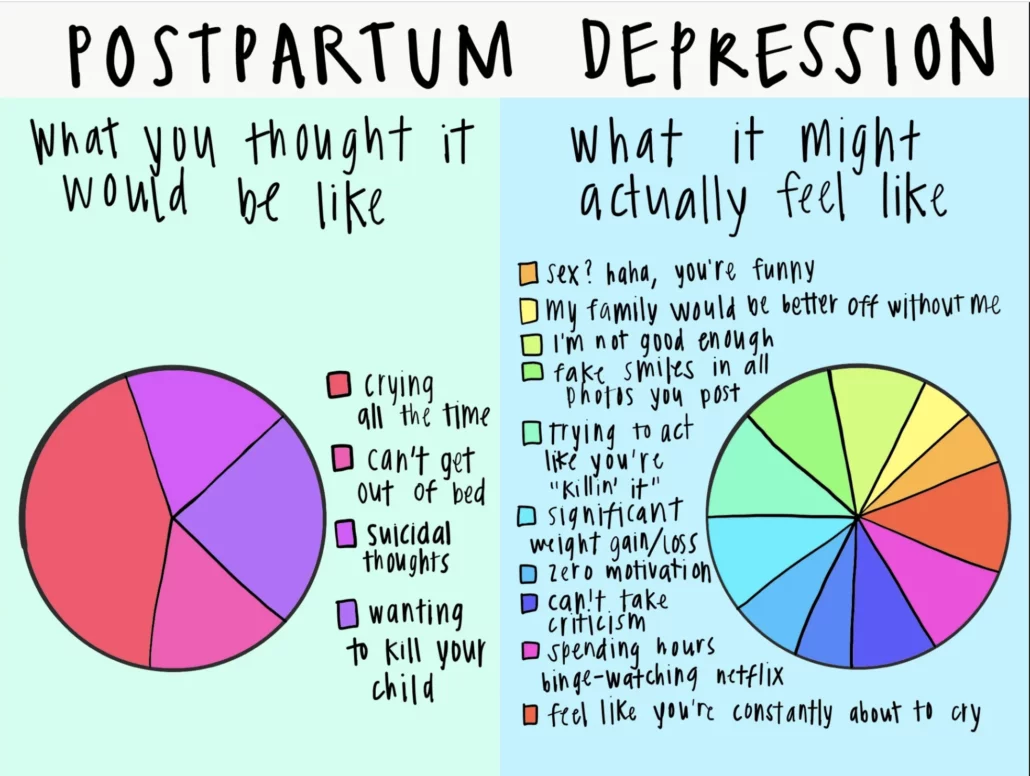
“I just checked your diaper!” I yelled. But I figured I’d check it again because we’d been at this “witching hour” for a while now. I was so beyond angry and overwhelmed that I could have thrown her across the room.
And then it hit me.
This isn’t how you treat a helpless newborn baby. This isn’t normal. A baby’s cries shouldn’t make you so angry, so full of rage. The guilt set in and after I finally got her calmed down, I collapsed into a pit of despair. I melted to the floor, a wave of intense darkness washed over me and the negative intrusive thoughts that followed marinated in my mind before I even understood what I was thinking.
You are a horrible mom. You’re not good enough. You can’t even figure out what your own child needs. You are a failure. I wanted to crawl into bed, escape everything with precious sleep. I wanted to pack my bags, get in my car and never look back. They’d be better off without you. They’d be happier.
I was paralyzed. My body so heavy, so weighed down by the enormity of the invisible load of motherhood, by sleep deprivation, by the loss of control, by a state of utter exhaustion, rage, guilt and defeat.
No one really knew what was happening with me. I hid it pretty well. I only let my rage show in the middle of the night when I was up for midnight nursing session and everyone else was sound asleep. My husband thought my increased irritability during the day was a symptom of sleep deprivation, which I’m sure it was… but it was so much more.
I actually never knew rage could be a symptom of Postpartum Depression (PPD). But after having thoughts of legitimately longing to abandon my family, I did a quick google search and discovered, sure enough, it was. (Check out this resource on postpartum rage, too!)
What They Don’t Tell You About PPD
Postpartum Depression isn’t cookie-cutter. It doesn’t always happen right after you have a baby. For me, it presented about a week after my postpartum checkup where, per the norm, they had me take the Edinburgh Postpartum Depression Scale questionnaire. I happily circled answers that made it seem like this parenting thing was a breeze. So I flew right under the radar. Maybe I was in denial, or maybe my symptoms hadn’t reared their ugly heads yet.
PPD also doesn’t always consume your every waking moment. I actually had good days. This threw me off so much. I thought PPD was supposed to consume your life 24/7. What I didn’t know is that it is totally normal to have a good week, then a bad week. Or a good two weeks and a bad weekend. Or a good day and a bad month. Symptoms fluctuate with your circumstances.
But here’s how I knew I needed help:
- I didn’t feel connected. To my baby, to my spouse, to myself. But especially to my baby. Through the endless days and nights of constantly trying to calm a screaming child, I wasn’t able to just ENJOY her. I felt so disconnected and detached from her. Instead of feeling a bond, I just felt resentment.
- I was easily irritated and angered. As I mentioned previously, my anger turned into rage as the days passed by. The littlest things would set me off like the sound of my dog’s toenails clip-clip-clipping against the hardwood floor. Or the sound of the dishwasher running while I tried to have a conversation.
- So many mood swings. One minute I felt fine, and then out of the blue, I’d be drowning in anxiety or flying off the handle with rage or sobbing uncontrollably. It started getting to the point where it interfered with my ability to function.
- I lost interest in everything. I didn’t want to do anything, with anyone, anywhere. I started feeling like nothing mattered and it would just be better to stay in, where I didn’t have to pretend to care.
- I wanted to escape. I didn’t want to be a mom anymore. I wanted to drive in a car and never return. I wanted to fall asleep and never wake up. I didn’t want to die, but I wanted to somehow leave my overwhelming life.
- I thought my own children and husband would be better off without me. This was when I KNEW something was wrong. I could justify all the other symptoms, say they weren’t that bad, that maybe I was just exhausted and it was the sleep deprivation… but thinking your family would be better off without you… That is NOT a normal thought.
Admitting the reality of the severity of my symptoms was embarrassing.
I felt so much shame and regret for all the rage I had. But luckily my husband and family were supportive. I decided it was imperative to seek professional help. However, the thought of seeing a therapist was extremely intimidating. I felt scared that they’d laugh and say, “Hunny, welcome to parenthood. Suck it up!” But, I faced that fear and after attending therapy and starting medication, my world changed. Suddenly all the obstacles that looked like insurmountable mountains, dwindled into hills that were easily scalable. Through therapy, I learned coping strategies to combat intrusive thoughts and handle my triggers. And eventually I started feeling more like myself.
NOTE:
If you feel like something just isn’t right, know that you are not alone. In fact, 1 in 7 women experience Postpartum Depression. It can affect any woman, regardless of income, age, race, culture or education. And it is NOT your fault. Please, don’t try and face it alone. Reach out to a loved one, join an online support group or schedule an appointment with a medical professional.
***For more resources on Postpartum Mental Health, check out: Postpartum Support International. You can also call the PSI Helpline at: 1-800-944-4773 (#1 En Español or #2 English) or TEXT: 503-894-9453 (English) or 971-420-0294 (Español)***
***If you or someone you know is in an abusive relationship, contact the National Hotline for Domestic Abuse. At this link, you can access a private chat with someone who can help you 24/7. If you fear your computer or device is being monitored, call the hotline 24/7 at: 1−800−799−7233. For a clear understanding of what defines an abusive relationship, click here.***
Image from Unsplash.com
Leaning Into The Stress of Parenting
I can’t believe that it is less than 90 days from Christmas! It seems like yesterday I was actually looking forward to school starting because it brought some structure back into my carefree summer lifestyle. Today, I am headlong into sports, extracurricular activities, and community service events. It’s far from carefree- it’s stressful. But that’s okay.
I feel exhausted, overwhelmed and don’t know how to get off this merry-go-round that is my life. The real dilemma for me is, do I really want to get off the merry-go-round? Should I get off? Do I know when I need to hop off? Despite all that is swirling around, I am choosing to enjoy this season in my parenting life. I realize that it will only be for a SEASON. So, how do you lean into the stress that is unavoidable?
I am the proud mother of three sons ages 21, 16 and 13. I realize that the time for me to be a Hands-On Mom is quickly coming to a close. If you are like me, living in the midst of chaos, you want to know how to keep your head above water.
Here a few tips on handling the stress of parenting:
- Plan, Plan, Plan: I am not the most organized person. I try to keep the car on the road by creating a plan. Understanding that things will probably change, I still have a calendar with everything on it color-coded. (I need the color-coding!) I include my work schedule, the boys’ school calendar, sports, meetings, extracurricular activities, and even my husband’s two work schedules.
Stress might be inevitable, but NOT having a plan dramatically increases my stress. - Learn To Say, NO: I am generally a social butterfly. I am learning to say “no” to things that are not the BEST use of my time, energy and attention. Even good things and fun things. Sometimes the answer is just, “No.” (If I say “yes,” I make sure to add it to the calendar and, yes, color-code it!)
- Empower My Children: I have to be honest and confess that, often, the reason I feel so overwhelmed is because I am continuing to do things for my sons that they can do for themselves (e.g., washing clothes.) I rationalize doing things for them by telling myself that I can do it faster and get it done correctly (e.g., not placing a red shirt in the white clothes with bleach.)
The reality is that I need to empower my children to be independent and to learn how to do certain things for themselves. And that’s less stress for me. - Follow Your Child’s Lead: If we are honest, there are activities that our children participate in that they HATE. Why do we make them do those things? We tell our kids: It looks good on your resumé. It will help you get a scholarship for college. I would have loved to have this opportunity when I was your age.
There can be a lot of truth in those statements, but what is the balance with letting our children develop their own interests? Sometimes we are stressing ourselves out as parents by rushing our kids around town to do things they don’t even enjoy. Are we really doing it for them or is it to relive our past or fulfill our own hopes and wishes? - Build Relationships: Sometimes stress is relieved in community. I am a proud Band Mom. I have created friendships with other parents whose children are in the band. We tailgate together, sit at the games together, and do the funny band dances with the band. It’s nice knowing we are in this together! (I also get to spend time with my son enjoying something that he enjoys.)
I often hear from moms dealing with an empty nest, “Enjoy your time with your kids. It flies by so fast.” They’re not wrong. In spite of this being a crazy season of life, I cherish these moments with my sons and try to handle the stress in healthy ways.
Image from Unsplash.com
I was irritated. More than irritated, I was ready to pounce at the next person who asked me a question, about anything. I was mentally and physically exhausted from putting in hour after hour at work, only to turn around and put in hour after hour at home, and I was over it. I was over my boss, over my hard work going unrecognized, over bearing the weight of the invisible mental load of motherhood and oh-so-over being told I was being too emotional about it all. In other words, I was suffering from BURNOUT.
ICYMI, “Burnout” is now an official medical diagnosis, according to the World Health Organization (WHO). No, we’re not talking about just being stressed out. WHO classifies burnout as a condition caused by “chronic workplace stress that has not been successfully managed.”
Symptoms include:
- Feelings of energy depletion or exhaustion
- Increased mental distance from one’s job or feelings of negativism or cynicism related to one’s job
- Reduced professional efficacy
Yup, I had it all. Check, check aaaaand check.
Thankfully I stumbled upon Burnout: The Secret to Unlocking the Stress Cycle by Emily Nagoski, Ph.D. and Amelia Nagoski, DMA. It opened my eyes to the science and reality of burnout and how to take care of myself by managing stress.
According to the Nagoski sisters, burnout is caused by chronic stress, not stressors. But what’s the difference? Stressors are external: to-do lists, bosses, all the challenges life throws our way. Stress is the neurological and physiological response your body has when you feel like you’re in danger (from a stressor).
For instance: Your boss called you out on missing a deadline at work. The stressor is your boss calling you out. The stress is the guilt, shame or embarrassment you felt from being called out.
The stress cycle begins when a stressor triggers our “flight or fight” response. It is literally our SURVIVAL mode. Think about it:
FLIGHT: If you were being chased by a lion, you would run to a safe place. Once you are safe, your body would relax.
FIGHT: If you were being attacked by a bear, but you were pretty sure you could fight it off and win, your body would gear up to attack. Once you had won and the danger was gone, your body would relax.
When you’ve finally reached safety and your body relaxes, the stress cycle is complete.
But what happens when the perceived threat is insurmountable? You’ll never outrun it and you’re not strong enough to fight it… so, you FREEZE.
And this, my friends, is where burnout happens. When we are stuck in a constant, never-ending state of stress, our bodies literally shut down and play dead in order to survive.
So is it possible to prevent burnout?
In order to fix or prevent burnout, we have to complete the stress cycle. That means, dealing with not only the stressor but the actual stress itself. If we hold our feelings in, power through the hard days, but never deal with the stress of the situation, then we keep the stress cycle open and ongoing, instead of closing it and allowing our bodies to relax.
Here are 7 ways to complete the stress cycle and prevent burnout:
- Physical Activity – In any and every form, physical activity is your BEST strategy to complete the stress cycle. You know the drill, 30 minutes a day. It can be anything that gets your body moving: running, swimming, dancing, kickboxing, etc.
- Controlled Breathing – Deep, slow breaths help regulate your body’s stress response. Try slowly breathing in for a count of 5, holding that breath for 5, then exhaling for a count of 10.
- Socialize – Casual, friendly interactions help signal to your body that you’re safe and that not everyone is crazy and that everything will be okay. Sigh.
- Laugh – Laughter is quite literally the best medicine! When’s the last time you laughed so hard your abs and cheeks hurt? Laughter like that can help shift your mood and increase relationship satisfaction.
- Affection – Finding a deeper connection with someone you love and trust is paramount. A hug or kiss is known to release a mix of the “feel good” chemicals: serotonin, dopamine, and oxytocin. Yes, please!
- Cry – Have you noticed how you seem to feel better after a good cry, even if nothing about the situation has changed? That’s because crying is actually dealing with the stress you are feeling.
- Be Creative – Allowing yourself to channel stress into art is a great way to complete the cycle. Any kind of creative activity will encourage you to freely express yourself and work through some of those big emotions.
You’ll be surprised at how implementing just one of these methods every day will change the way you manage your daily stress and prevent burnout from happening!
It didn’t happen overnight, but over time I was able to deal with the overwhelming amount of stress I was under. After a lot of introspection (coupled with a cry-sesh here and there), I realized that I had stopped taking care of my well being under the weight of the responsibility of taking care of all the other people in my life. So not only did I start making time for yoga, an exercise that I truly enjoyed, I also started a book club with my close friends to give me an excuse and motivation to read more and get together with good company on a monthly basis. Honestly, it took a lot of effort to change how I managed my stress, but changing my stress changed my entire life.
For more resources, see our Self-Care page here.
Image from Unsplash.com
“I hear so often that your entire life changes when you become a mother. But I just really want to know how… How exactly does it change? Like, specifically.”
As we walked down the sidewalk on a cool spring day, my best friend, who was pregnant with her first child, asked me this question.
I suddenly felt very nervous, as if I were in an interview and my answer was going to be highly scrutinized and dissected to its core. How can I possibly narrow down the specifics of a life-altering experience? I racked my brain and let out an anxious chuckle as I grasped at how to articulate all the million ways my life changed when I became a mother.
“I think the biggest thing that changed for me is… time. Before kids, I thought I was busy. I thought I had a never-ending to-do list. I thought I was overwhelmed. But I had NO idea what busy was. After kids, you literally have no time. You are working 24/7, whether it’s at a job or at home or both. You are constantly taking care of everyone else’s needs. All. The. Time. It never stops. And it’s the most exhausting and overwhelming thing you’ve ever done. You’ll sacrifice so much… but it’s so worth it because you will finally understand what unconditional love is.”
I vividly remember the moment I realized what being a mother meant.
My first daughter, Jackie, came as a happy little surprise. Although I certainly didn’t feel ready to be a parent, at the ripe age of 27, I found myself with the most precious bundle of joy. There was a flood of emotions as I navigated the waters of motherhood, especially when it came to being a working mom. My entire perspective changed one night, as I rocked and nursed my sweet baby to sleep after a long day at the office.
I realized that motherhood is a thankless job; expected; commonplace. It’s just what you do.
There are no awards given to the best mom. No “Mom-of-the-Month…” (although there should totally be!). You don’t get a raise for doing an exceptional job. No one congratulates you on calming a screaming baby or praises you for changing 50 diapers in a day. There is no recognition for how many times you woke in the middle of the night and no trophy for the fact that you are still able to run on three hours of sleep (barely). And all that hard work you pour into making and sustaining this tiny human will never get you a promotion.
But the paradox is that being a mother is actually MORE rewarding than any amount of acknowledgment you could ever receive. To experience the love a mother has for her child is beyond anything I can begin to describe. It’s supernatural. It’s divine. And that’s what keeps us going at 1 a.m., and 3 a.m., and 5 a.m. … through the blowups and blowouts, the baby blues and the bliss.
Motherhood is a thankless job that I, for one, am so very thankful to have.
Looking for more parenting resources? Click here!
Dating after divorce or death can be complicated, especially if children are involved. As people navigate the world of dating and blending families, they’ve asked Ron Deal, stepfamily expert and author of Dating and the Single Parent, the following questions plenty of times: How soon is too soon to start dating? Should I introduce this person to my children?
“On the topic of blended families, someone once said, ‘People marry and form a blended family because they fell in love with a person, but they divorce because they don’t know how to be a family,’” says Deal.
Deal believes the key to dating as a single parent is to include the children in the bigger picture.
“Certainly, it depends on the age of the children,” Deal shares. “A younger child is more open to new adults in their life, but you don’t want to introduce your 4-year-old to a person that you just started dating. You don’t even know whether you like this person. Wait until you think this relationship really has a chance of going somewhere, then you bring them into the picture with intentionality.”
For older children, elementary and beyond, Deal suggests talking with them about it first. Ask, “What if I started dating? How would you feel about that?” This way, you are putting it on their radar that this might happen.
“Once you know that the relationship has potential, it is important to create opportunities for everybody to be together and for additional conversations to take place,” Deal says.
Deal strongly encourages couples to discuss a few things before deciding to move forward with marriage, though.
Some couples decide to test the waters with the two families by living together first. This creates ambiguity for the children. When children experience this uncertainty, it creates chaos and empowers resistance. If they don’t like the idea of the families coming together, the ambiguity leads them to believe they could make the whole thing unravel.
Deal believes, more than anything, a stepfamily needs two adults who have clarity about their relationship and the family’s future. By having conversations ahead of time, you are valuing the “we,” and then the children. If you can’t come to an agreement on your parenting styles, that’s serious. Deal believes it’s just as serious as marrying someone with addiction issues. The outcome of these discussions should be part of the equation as to whether or not you plan to marry.
“At least half to two-thirds of dating couples don’t have serious conversations about how they are going to parent when they bring their two families together,” Deal says. “If your parenting styles are vastly different, this can be a dealbreaker.”
In many instances, one parent has been making all the decisions for the children. Now add a second adult into the mix who isn’t their biological parent. What will you do when your child asks to do something and your answer would typically be yes, but your new spouse doesn’t agree with that?
There’s no question that negotiating parenting and romance all at the same time is complicated. You have to manage the complex moving parts for sure. But Deal believes that if you’re going to make a mistake as a blended family couple, err on the side of protecting your marriage.
“The goal here is to protect your marriage, which is why it is so important to talk about these things prior to getting married,” Deal asserts. “Biological parents have an ultimate responsibility to and for their children, but if you make a parenting decision without consulting your spouse, it isn’t helpful to your marriage. The goal is to co-create your parenting response. You cannot have two different answers for two different sets of kids. That unravels your “us-ness” as a couple.
“It typically takes four to seven years for a stepfamily to find their rhythm,” Deal adds. “There is no rushing it. You can’t will it into being. There are certain aspects of your family that will merge faster than others. Even in the midst of figuring out how to make it work, your marriage can be thriving.”
Looking for more? Check out this article of JulieB TV on this topic!