
How to Deal with a Spouse Who Can’t Handle Conflict
Does this describe anyone you know? Avoids conflict at all costs. Hates when someone is mad at them. Shuts down when emotions get intense. I’m sorry, I didn’t mean to describe your spouse. I was describing myself. I’m the spouse who can’t handle conflict at times. Though I sometimes justify the behavior, I know it’s not healthy. I know it affects my marriage in so many negative ways.
Since your spouse and I have a lot in common, let me give you some tips on how to deal with a spouse who can’t handle conflict.
Look at yourself first.
Are you combative? Is winning the conflict more important to you than the relationship? Do you approach every small issue like it’s a big deal? You may have come from a family where everyone fussed, cussed, and discussed while your spouse may be more reserved. Create a safe, nonjudgmental space to discuss differing opinions. It’s important that both of you are heard, valued, and respected.
Tone of Voice Matters.
Yelling, screaming, and an overly aggressive tone will lead to your spouse shutting down. Express your thoughts and emotions with your words and a quieter intensity. That way, you’re better able to focus on the issue.
Ask, “When is a good time to talk about this issue?”
Some conflict-avoidant people experience anxiety just engaging in disagreements. Give your spouse the opportunity to mentally address their anxiety, get their thoughts together, and enter the conversation with a more relaxed mindset.
If your spouse says something like, “I don’t want to talk about this right now,” don’t hear that they don’t want to talk to you. Instead, keeping in mind that tone of voice matters, ask when is a good time? Your spouse will feel respected while you’re getting a commitment to address the issue.
Be Patient.
Your spouse continually has internal battles. Their desire is to engage wholeheartedly and resolve the conflict versus their tendency to shut down, become defensive, or stonewall. Where you may be much better at communicating your thoughts, emotions, and wants, your spouse may bounce back and forth from being defensive to being vulnerable. Revisiting conversations that you thought were resolved isn’t unusual when your spouse is working to do better at engaging in conflict. Be understanding if they share more of themselves in a follow-up conversation. Of course, you’d like them to have shared it the first time, but they may have been more focused on avoiding the conflict than resolving the issue the first time.
Encourage your spouse to speak first when possible.
People who avoid conflict will often change their thoughts because of what their partner has already said in an effort to keep the peace. Encouraging your spouse to speak first increases the likelihood they will express their true thoughts and desires.
Don’t talk over them or finish their statements.
This sends the message that you don’t respect their perspective or opinion. Your spouse needs to communicate their perspective and not have it done for them.
Start with “I,” not “You.”
Instead of accusing, (You always…) use an “I” statement that reflects your own feelings and subjective experiences. Avoid criticizing your partner, because fights are often not about our partners. They are usually about our feelings and expectations.
Focusing on what you know, think, feel, and want as opposed to making statements about what you believe your spouse knows, thinks, feels, and wants leads to better communication and understanding during conflict.
Together, decide on a plan to deal with conflict.
There are many techniques available. The speaker-listener technique is a good one. Learning a technique, even though it may not come naturally at first, can help you focus on the issue and the solution while ensuring that both of you feel heard.
Don’t expect change, but celebrate growth.
Your spouse will most likely never begin to lean into conflict the way you do. It may always be an effort for them to engage in disagreements. By building a track record of resolving issues, being heard, and overcoming their anxieties, they may become more willing to come to the table and work through any disagreements. Affirm and celebrate progress.
You and your spouse are wired differently for a variety of reasons. What you may think is a peaceful conversation or debate may be causing your spouse anxiety because they see it as conflict. Never forget: you’re on the same team. Conflict is inevitable within marriage. Your different personalities are meant to complement one another. It will take effort and time for both of you. Your challenges are different. Patiently loving one another and gently working together to work through the issues you’re sure to face will strengthen your relationship and pass on a healthy legacy to those you influence.
I’m 16 years into my marriage and no, I still don’t look forward to conflict. But the understanding my wife and I have for each other has helped us to tackle and resolve some large marriage and family issues TOGETHER. We’re better for it and so is our marriage.
***If you or someone you know is in an abusive relationship, contact the National Hotline for Domestic Abuse. At this link, you can access a private chat with someone who can help you 24/7. If you fear your computer or device is being monitored, call the hotline 24/7 at: 1−800−799−7233. For a clear understanding of what defines an abusive relationship, click here.***
“I don’t know if I can keep doing this (marriage) much longer.” I said this statement at one point in my marriage when things felt like they were falling apart. And my wife of sixteen years has said it, too. I’ve also spoken with plenty of couples who have said things like this at some point in their marriage.
There are some commonalities research has shown can help save your marriage when it feels like it is falling apart.
Connect regularly with people who are happily married.
Notice I didn’t say perfectly married. Look for couples who are healthy. Invite them to coffee and dessert. Talk to them. Listen to them. Watch how they interact with each other. Pick their brains. Find people who will hold you accountable, not pick sides. People outside of your marriage often will see things about you that are difficult for you to see about yourselves.
And disconnect from people who are not for your marriage.
People that will allow you to continually talk about what’s wrong with your spouse and constantly tell you that you’re better off without your spouse are not going to be helpful in saving your marriage.
Seek help.
There are experiences available for couples facing distress in their marriage. Some places offer classes; others have Intensive Experiences available (DivorceBusting.com, WinShape Intensives, Smalley Institute). First Things First also has free resources to use in the comfort of your own home. Additionally, you may want to find a good marriage counselor to help you walk through your issues. If there is one thing I have learned in my own marriage, it’s the longer you wait to ask for help, the harder it is to ask for help. Put your pride aside and ask for the help you need if you are currently struggling.
Look at Your Perception of Your Marriage.
New research indicates that how you perceive the relationship and your partner’s commitment to it is the biggest predictor of the quality of your relationship. Think through what you perceive about your spouse and their commitment level. The research says that your perception accounts for nearly 50% of your relationship satisfaction. When we focus on the negative things our spouse does, we train our brain to see the negative.
Communication.
Communication has always been the issue married couples say they struggle with the most. It can be frustrating when you feel like you’re never able to address and resolve the real issues because the two of you can’t figure out how to effectively express your thoughts, feelings, and desires. Since many of us marry someone with a different communication style, learning to speak, hear and be heard has proven to be less natural than we expected. I was married 7 years before I learned how to effectively communicate with my wife. It was a skill I had to learn. I had been repeating the same communication mistakes over and over.
★ These 7 keys to communication really helped my marriage.
Don’t be afraid to lead the dance.
Yes, it takes two people to dance, but one to lead. Michele Weiner-Davis, marriage expert and author of Divorce Busting, tells couples, “If your spouse started paying more attention to you, making suggestions about trips you could go on, new hobbies you could do together, how would you be different in return?” Most say, “I would be nicer.” Then Weiner-Davis asks people to describe the ways in which they would be nicer and encourages them to start doing that immediately. So many spouses stand around waiting for the other person to just do something. If you want things to be different, don’t be afraid to make the first move.
“Don’t wait for your partner to be more likable – you be more likable,” Weiner-Davis says. “Ask yourself in what ways have you pulled back from your relationship. Your partner’s distance might be the result of you pulling away, too.”
Practice good self-care.
Taking care of yourself can improve your marriage. Be active by pursuing interests like gardening or biking. Read some good books and practice mindfulness. By paying attention to your mental health, your perspective will often improve.
Think about your daily interactions with your spouse.
Dr. John Gottman, researcher and marriage therapist recommends a 5:1 ratio of interactions – meaning for every negative interaction you have with your spouse, you need five positive interactions to balance that one negative interaction. Expressing affection, showing appreciation, and doing small acts of kindness are positive interactions which balance the negative ones.
Talk to each other about your needs.
When we have needs and expectations that aren’t being met, resentment builds. Sometimes our partner is left to figure out the expectations because they are left unspoken. Sincere, honest communication about your needs and expectations takes the guesswork out of the marriage. And, it can shed light on expectations that just aren’t realistic at the moment.
Acknowledge what you can’t fix.
Dr. John Gottman’s research has uncovered that 69% of issues in relationships are unresolvable. It’s not necessarily a bad thing. It just is. Some common differences include disciplining children, balance between home and work, and political views. Learning to communicate and manage these differences can provide opportunities for marital growth. Besides, who wants to be married to someone who is exactly like them in every way?
Forgiveness.
It has been said that lack of forgiveness is like drinking poison and expecting the other person to die. Forgiveness is a gift you give yourself as well as your mate. The act of forgiveness does not mean you condone hurtful actions; it does mean you have made an intentional decision to move on.
Remember, you are on the same team.
At some point you began to feel like you are adversaries. Instead of attacking one another, attack the issues as two people working together on the same team. The outcome may really surprise you.
★ Saving a marriage that is falling apart is 100% possible. It will take courage, work and intentionality. Rebuilding trust, seeking to understand one another, and cultivating a culture of appreciation is a process accomplished through many small steps over time. 16 years into our marriage, we’d both tell you our feelings of despair early in the marriage were the catalyst for intentionally creating the marriage we want.
And, we are still working on it today.
***If you or someone you know is in an abusive relationship, contact the National Hotline for Domestic Abuse. At this link, you can access a private chat with someone who can help you 24/7. If you fear that someone is monitoring your computer or device, call the hotline 24/7 at: 1−800−799−7233. For a clear understanding of what defines an abusive relationship, click here.***
Image from Pexels.com
There are not many feelings worse than when someone puts you down, insults you, or invalidates you. And a put-down from your own spouse is like a straight-up punch to the psyche. It’s amazing how easy it is to hurt the ones we love the most with our words, but what do you do if you are the one on the receiving end of the verbal blows?
This issue has a certain level of complexity to it, which means we have to approach it with care. Many spouses deliver verbal shots and put-downs to their spouse, unaware of the harm it’s doing. This is Situation A.
Others are well aware and intentional with the harm. This is Situation B, and this is abuse.
Let me be clear about Situation B right off the bat: If you are experiencing an abusive situation where someone is physically harming you, you need to seek help. Use the hotline number at the bottom of this article.
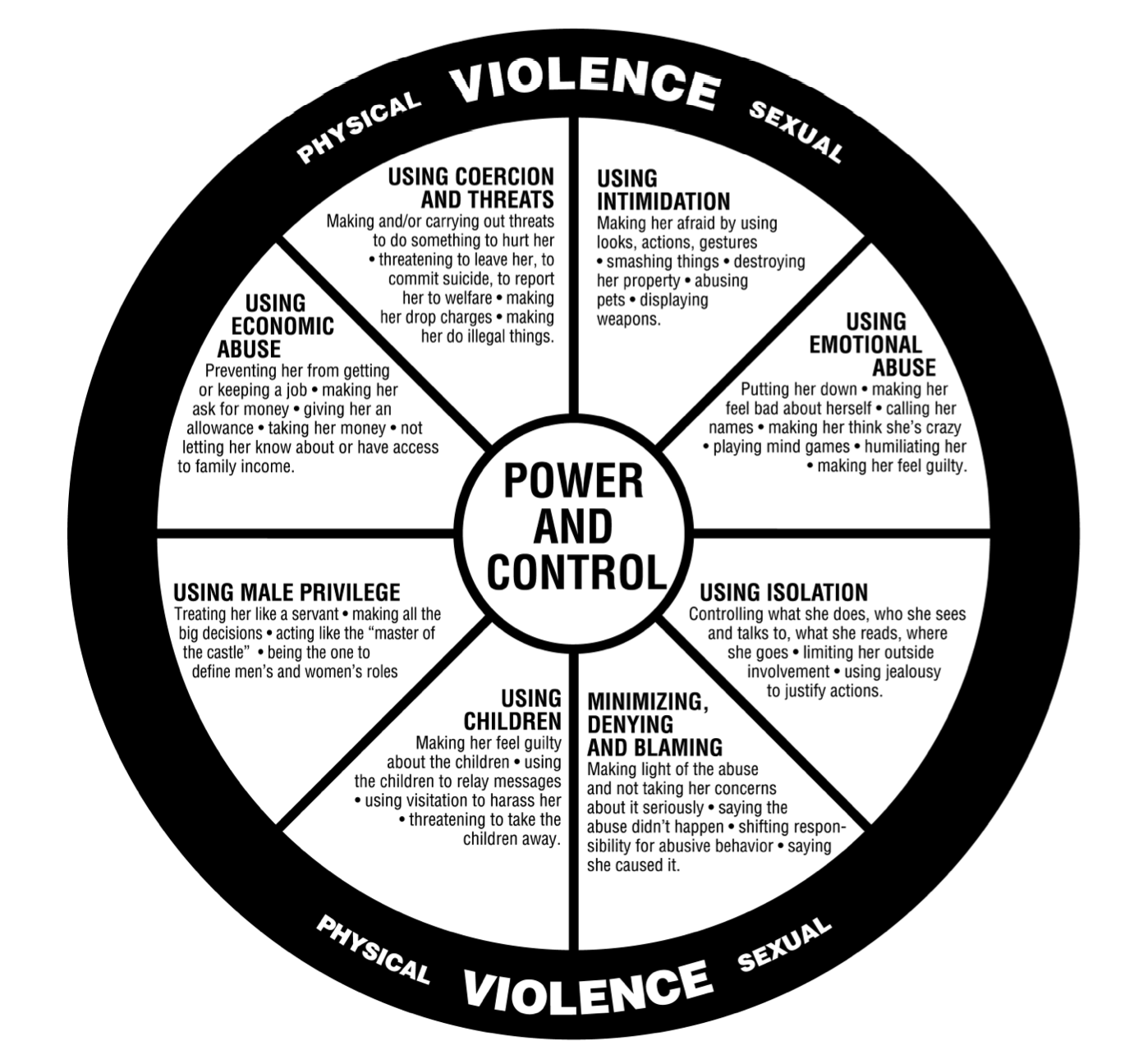
You also need to understand that certain situations of verbal/emotional put-downs may be verbal abuse, and often accompany (or are a precursor to) physical abuse. (See the Power and Control Wheel below.)
Healthline gives some red flags to the characteristics of verbal abuse:
- They insult you or attempt to humiliate you, but then they accuse you of being overly-sensitive.
- They yell or scream at you frequently.
- The person plays the victim while they try to make you feel guilty. (“I wouldn’t have to scream at you if you didn’t…”)
- They get in your personal space as an act of intimidation or try to block you from moving away.
- They gaslight you—this means they manipulate you into questioning your own version of events in order to gain more power. For example, they may convince you to doubt your memory of them saying or doing something violent or try to convince you you’re crazy.
- They hit the wall or throw things.
- They want credit for not having hit you.
Sincerely ask yourself the following questions:
- Do I believe my spouse is putting me down with the intention to harm me, wear me down, or manipulate me?
- Do I think there is a possibility the verbal attacks could lead to physical violence?
- If I were to voice my concerns for how they talk to me, is there any fear that they would react with a heated backlash?
Unless you can answer each of these questions with a confident no, these are strong indicators of verbal/emotional abuse and warning signals for possible physical abuse. Do not confront your spouse. Go somewhere safe and seek help.
Let’s talk about Situation A.
Your spouse puts you down but they are unaware of how it’s making you feel. They are being careless with the words they use toward you—perhaps in front of the kids. But despite the unintentionality of what they say, you still feel devalued. It’s time to let them know how you feel.
- Approach your spouse to talk at a strategic time. Ask them if this is a good time to talk. And if it’s not, arrange a time, preferably within the next 24 hours. Don’t bring up your feelings right after they say something hateful; your emotions will be dialed up, and you want to be calm and able to think clearly when you talk. Choose a time when neither of you are tired or in a bad mood.
- Start on a good note. Marriage researcher Dr. John Gottman suggests opening difficult conversations with a positive. Begin the conversation with something you appreciate about your spouse. Say something like, “I know that you love me and the kids and that you’d do anything for your family.” Or, “I appreciate how hard you work to provide and take care of us.”
- Be specific about what you hear and how you feel. Make good use of “I” messages. For instance, “There have been many times when I’ve felt really undervalued and unloved when you’ve said certain things to me.” Name your feelings—beforehand, jot down some specific words that describe how it feels when your spouse puts you down. If it happens in front of your kids or other people, point out that it feels embarrassing or shameful. Err on the assumption that your spouse has been unaware of how they’ve made you feel. You may have to give them an example of what they’ve said. Describe the last incident and the effect it had on you. Avoid giving a laundry list of all the past wrongs they’ve done to you, though.
- Use a code word or sign. The point of addressing this with your spouse is help them be aware that they are putting you down and the negative effect it has on your feelings. Establishing some kind of code word or a non-verbal signal can subtly express to them, “You’re being degrading and ridiculing right now, and you need to dial it down.” This is especially helpful in front of the kids or in social situations. For instance, whenever you respond with “Oh, honey…” or you nonchalantly touch your earlobe, you can discreetly and calmly express to your spouse how they’re making you feel at the moment.
- Set boundaries. Let your spouse know that if they continue to ignore warning signs and keep putting you down, you’ll simply leave the room when they say something disparaging. Don’t threaten your spouse with divorce or the withdrawal of sex (although you probably won’t exactly feel “in the mood” after being put down). You set up boundaries to protect yourself, not punish others.
- Check your own thoughts and words. I mention this last step with a great deal of care, and I encourage you to approach it with humility and thoughtfulness. I have talked with many individuals who have felt insulted by others close to them; however, sometimes there was something within their own personality that colored the situation. Many were highly sensitive to remarks that weren’t overtly insulting, but they heard them through the filter of past negative experiences.
For instance, one person interpreted an invitation to exercise together as an affront to their weight, an issue to which they felt particularly sensitive. Others that I’ve talked to were offended by another’s insults, but had no problem being equally insulting toward that person. Part of the process of working through this is to consider what may be going on inside you that could exacerbate these feelings. Ask yourself: Are the words I hear from my spouse truly insensitive put-downs, or is there something inside me that makes me overly-sensitive to their words? And, are there ways that I put my spouse down without me noticing it?
Marriage cannot thrive in an environment of disrespect and insults. And no one deserves to be put down by their spouse. The above steps are a process that may take time before you see real change. There’s a chance that other things are going on under the surface of insults and put-downs being hurled your direction. If these problems persist after taking the above steps, ask your spouse to seek help with you through couples counseling. If they resist, seek professional help on your own. ☆ Sometimes it takes one person in the marriage to lead the charge toward getting help and improving the relationship before the other catches on.
***If you or someone you know is in an abusive relationship, contact the National Hotline for Domestic Abuse. At this link, you can access a private chat with someone who can help you 24/7. If you fear that someone is monitoring your computer or device, call the hotline 24/7 at: 1−800−799−7233. For a clear understanding of what defines an abusive relationship, click here.***
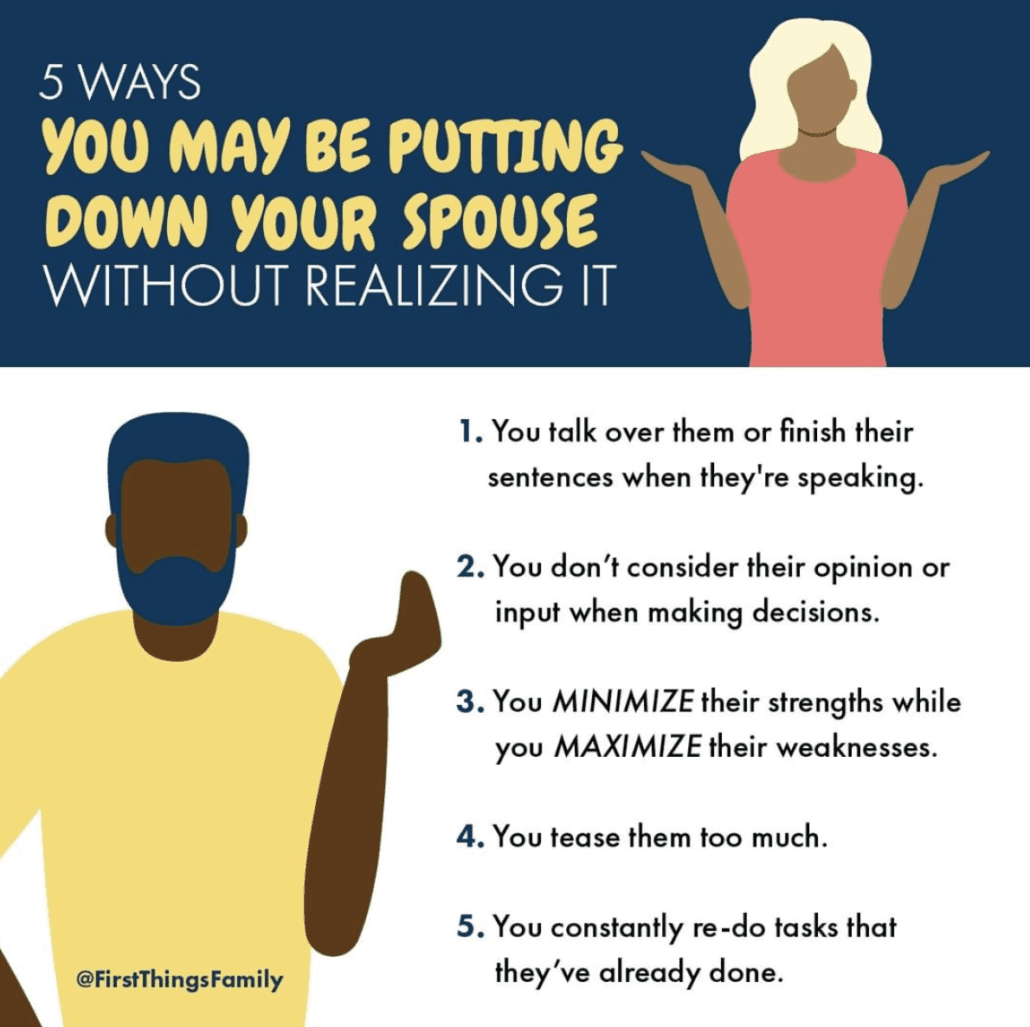
5 Ways You May Be Putting Down Your Spouse
Have you ever made a joke about your spouse and they didn’t think that it was funny?
Has your spouse ever remarked on a “weakness” of yours and you felt some way about it?
Has your spouse ever made fun of you or put you down in front of your kids?
What are some of the common ways that we unwittingly put our spouses down?
1. You talk over or finish their statements when they are speaking.
It can easily become a habit to talk over your spouse or finish their statements for them. When you do this, you are sending the message to your spouse that you don’t respect their perspective and opinion. Additionally, this can minimize them in the eyes of others (family, friends, co-workers, children).
2. You don’t consider/obtain their opinion or input when making decisions (i.e., the kids, family vacations, or future plans).
Teamwork is important in marriage. It takes both parts of the couple contributing to make it as strong as possible. When one person makes all the decisions, it can lead to a myopic view of the situation. Having differing options and opinions can strengthen a plan. Like a well-woven tapestry, considering and respecting the input from your spouse creates a better and holistic problem-solving strategy.
3. You MINIMIZE their strengths while you MAXIMIZE their weaknesses.
When couples get together, they often say, “Where I am weak, my spouse is strong and vice versa.” After a time, it can become problematic when the focus changes to, “I really can’t believe that my spouse can’t do that.” For example: you may be very strong at directions while your spouse needs GPS to go anywhere, even places that they have been many times before. Sitting in the car as they set up the GPS, you think, “OMG, I should have just driven. They never know how to get anywhere.” You then share with anyone who will listen that your spouse is seriously DIRECTIONALLY CHALLENGED. From there you only seem to notice their deficiencies rather than their strengths.
4. You tease your spouse too much.
Whether it is about their hair, nose or the way they eat spaghetti, teasing your spouse can be a way to bring humor to your relationship. However, too much of a GOOD THING can become a problem. If you seem to nit-pick everything about your spouse even with a hint of levity, they may feel undervalued. Find ways to build up your spouse, not tear them down—even in JEST.
5. You constantly re-do tasks that your spouse has already done.
For many spouses, there are two ways to do things: MY WAY (THE RIGHT WAY) and your way. Your spouse may feel belittled as you refold the towel, remake the bed or reload the dishwasher. You inadvertently are telling them that their efforts are not wanted, needed, or appreciated. Because only YOU can do it, the RIGHT WAY.
Zig Ziglar said, “The first step to solving a problem is to recognize that it does exist.” Recognizing that you may be putting down your spouse is the initial step. While your spouse does things differently than you or even parents differently than you, it is KEY to respect those differences. Making fun of them or negating the importance of your spouse in your life and in the lives of your children undermines your relationship. Remember that the two of you are a TEAM.
✦ Each of you has a role to play to make your family the BEST that it CAN BE!
***If you or someone you know is in an abusive relationship, contact the National Hotline for Domestic Abuse. At this link, you can access a private chat with someone who can help you 24/7. If you fear your computer or device is being monitored, call the hotline 24/7 at: 1−800−799−7233. For a clear understanding of what defines an abusive relationship, click here.***
Love is the most exhilarating emotion, until it’s the most frustrating because you’re dealing with COVID-19 and quarantine and you aren’t sure your spouse loves you anymore.
When you fell head over heels in love with your spouse, nobody gave you the heads up that you would endure a pandemic where you were together 24/7 for months on end.
There are no books on how to navigate the economy, homeschooling, anxiety over aging parents and kids coming home from college, politics, social injustice, and general uncertainty all at one time. These are just some of the things that have most of us on edge, much more so than usual. There’s a lot that preoccupies our thoughts and attention these days, which could easily leave someone wondering if their spouse still loves them.
Have they lost that lovin’ feeling?
First, are you questioning your spouse’s feelings for you because they are no longer doing the things they did before that made you feel loved? Have current life circumstances just gotten in the way of you feeling loved by your spouse? Or maybe you’ve spent so much time together lately that your relationship feels a bit stale or boring—like the fireworks just aren’t there?
How do you receive love?
People have various ways of expressing and receiving love. It is not unusual for love to look different in the midst of a crisis. Some people just don’t feel loveable at the moment.
Some people think saying “I love you” is enough to express their feelings and make someone feel their affection. Working hard and providing could be a way of showing love, but if that person is never home, it may not feel like love to the other spouse. Another spouse might show love by keeping the car clean and full of gas, but a clean car isn’t really a big deal to their spouse. You get the idea. My point is, how someone feels love is different from person to person.
If you are wondering if your spouse still loves you, there’s one sure way to find out: ASK!
Let’s Talk!
Find a good time to have an honest conversation with them. Let them know what their affection means to you and share that you are struggling a bit with knowing they still care. If there are ways they expressed love to you in the past that they aren’t currently doing, perhaps you could let them know you miss those things.
You also might ask if there is something bothering your spouse that the two of you need to discuss and work through. Maybe something is creating a disconnect between the two of you that you have no clue about.
Communication is the key.
If you avoid talking about how you are feeling, you could end up operating out of a lot of assumptions, none of which may be true. Your spouse may love you very much and it may surprise them that you are questioning their love for you.
Do they know what speaks love to you? Everybody has a different love language. If they ask you for specific ways they can help you feel their love, be prepared to give them some specifics.
It is totally possible that your spouse loves you deeply, but doesn’t love who they are very much at the moment. Stress and high anxiety have a way of making us feel prickly, and you know how that goes—the ones we love the most and are the closest to get the brunt of it when we are struggling.
Ask for help.
If in having the conversation with your spouse, you find that there are issues between the two of you, don’t be afraid to seek help. There are plenty of excellent counselors who can help you work through whatever has come between you.
Don’t underestimate the toll COVID-19 can be having on your marriage. There are so many things hitting on your marriage at the same time, it magnifies our feelings, our thoughts, and our responses. Now is not the time to make any hasty decisions concerning your marriage. Now is the time to be patient, keep putting one foot in front of the other, and trust that COVID-19 will not go on forever.
***If you or someone you know is in an abusive relationship, contact the National Hotline for Domestic Abuse. At this link, you can access a private chat with someone who can help you 24/7. If you fear that someone is monitoring your computer or device, call the hotline 24/7 at: 1−800−799−7233. For a clear understanding of what defines an abusive relationship, click here.***
Will My Spouse Ever Forgive Me?
“I forgive you.” You desperately want to hear those words, but I want to explain to you why you might not hear those words right away and why you don’t necessarily need to hear those words right away. And that’s totally okay. ☆ What you need right now is to begin understanding forgiveness itself, especially in a marital context.
I’m operating under the assumption that you are not seeking forgiveness for forgetting to move the laundry from the washer to the dryer, but rather for committing some big breach of trust and inflicting deep emotional hurt in your marriage partner. Whatever you did, understanding how forgiveness works is important.
Why you probably won’t hear, “I forgive you,” right away:
- Most definitions of “forgiveness” describe it as a process. Processes take time.
- Even though you might truly be sorry and even expressed your sorrow multiple times, your hurt spouse has emotional trauma to work through in order to forgive. This emotional trauma often has physical symptoms, too. None of this can be rushed.
- Your hurt spouse may need professional help to work through this process.
- Your hurt spouse may need time to see changes in your behavior, rebuild trust, understand that you are truly sorry (not just sorry you got caught), and see over time that your relationship will be different moving forward. None of this happens overnight.
You’ve got work to do in the meantime…
- You might be needed for some conversations to help process your spouse’s thoughts and feelings or answer questions. Offer to share as much information as your spouse feels the need to know. On the other hand, your spouse might need some space to internally process. Respect both.
- While it might be frustrating and take much longer than you believe it should, be willing to do what it takes to rebuild trust with your spouse, even if it doesn’t make sense to you, makes you uncomfortable, or is a blow to your pride. Transparency, vulnerability, and willingness are your best friends right now. Your phone, laptop, bank account, etc., might all need to be open books. Accounting for your time and whereabouts might be necessary now. Whatever it takes.
- Your spouse might want you to attend some couple’s therapy sessions or for you to attend some sessions on your own.
- Your task is NOT to be the perfect spouse (there’s no such thing) but it is to demonstrate that you are truly sorry, value your spouse and marriage, and prove that you are working to be trustworthy and reliable and are willing to do what it takes to honor your spouse and protect your relationship. (If you were unfaithful with someone you met at the gym, you need to be willing to gladly switch gyms or even work out at home for a while to show that your spouse comes first. Many people have found new jobs to remove themselves from a co-worker they cheated with. Yes, that is the level.)
- Empathize. Really empathize. Put yourself in your spouse’s shoes and feel what they might be feeling. (If you reach a place of, “Well, I wouldn’t expect…” stop empathizing and keep honoring.)
While you’re at it… check your backbone.
A lot of people have a wishbone where their backbone should have grown. They wish things were different, easier, that they wouldn’t have done this or that—but wishing doesn’t make it so. Marital mistakes, conflict, and difficult seasons don’t have to be terminal. In fact, they often have the opposite effect when people have some backbone and use it to lean into the hard stuff. Broken bones are stronger when they mend.
You and your marriage can grow from this!
Whatever “this” is, it’s part of your story now. In the best stories, the good guys—the heroes—have had to work to overcome something very, very difficult. You can do this, and you don’t have to do it alone. Get growing!
- Learn how to manage conflict and how to communicate your way through it.
- Find meaningful ways to say things like “Sorry” and “I forgive you” and live those words out.
- Learn that love is an action, not a feeling.
- Have friends that are for your marriage.
- Have an older couple as mentors.
- No keeping score and no looking to “even” it.
This season isn’t easy or fun, but it can bring you and your spouse closer together than ever before. Every scar tells a story. What kind of story do you want this to be?
***If you or someone you know is in an abusive relationship, contact the National Hotline for Domestic Abuse. At this link, you can access a private chat with someone who can help you 24/7. If you fear someone is monitoring your computer or device, call the hotline 24/7 at: 1−800−799−7233. For a clear understanding of what defines an abusive relationship, click here.***
We expect things to be different after marriage, and one of the more difficult changes is in our friendships, and especially our opposite-sex friends. Often, while we share similar stages of life with our friends, your marital relationship should be the primary relationship. It’s pretty likely that you and your spouse want what is in the best interest of your marriage.
Many couples bring a variety of things into the relationship—including that comfy couch from your bachelor pad or that well-worn t-shirt or sweatshirt, mismatched plates, cookware, and friends of the opposite sex. While it may be easy for you all to decide what old items to discard, it becomes much more difficult to have the conversation with your spouse about ending and/or adapting long-standing or even newly-established opposite-sex friendships. These innocent friendships often create a rift between spouses, especially when our spouse sees the relationship as no big deal but there is something in your gut that makes you super uncomfortable.
If you find that you and your spouse are having more and more unresolved discussions about these “friendships,” you may be in the “Danger Zone.” In the Danger Zone, you and your spouse may find yourself:
- Emotionally disconnected from each other
- Not communicating well
- Having unresolved conflicts
- Decreasing in physical intimacy
If you see, DANGER, DANGER, DANGER, take heed. Dr. Shirley Glass, licensed marriage and family therapist, has found that “82% of the unfaithful partners I’ve treated have had an affair with someone who was, at first, ‘just a friend.’ The new infidelity is between people who unwittingly form deep, passionate connections before realizing that they’ve crossed the line from platonic friendship into romantic love.”
How should I begin this conversation with my spouse?
Ask Questions
Internal Questions:
- Look at the person in the mirror.
- What really is bothering me? Do I feel ignored? Insecure? Disrespected? Jealous?
- Am I asking my spouse to look at their opposite-sex friendships while I have not examined my own?
- What about this relationship makes me uncomfortable?
- Does my spouse share a past romantic relationship with this friend?
- Does this remind me of something from my past relationships?
- Do I know my spouse’s friend? Are they doing things for the friend that they won’t do at home?
Relational Questions:
- What is the state of my marriage? Is it healthy? Do we laugh together? Play together? How well do we communicate? Handle conflict? How is our intimate life?
- Are we nurturing our marital relationship?
- Have we talked about boundaries? Does my spouse include me in the friendship?
- Am I invited to go hang out together with the friend?
- Are we in the “Danger Zone?”
Once you have considered the above questions, find the right time and place to begin the conversation with your spouse.
- Use “I statements” (Speak from your own point of view—“I feel, I need, I think…”)
- Be respectful
- Ask questions of your spouse
- Actively listen to them
- Being aware prevents you from approaching a slippery slope
Having this conversation is meant to create and establish relational boundaries that you both can agree on as well as be held accountable. Additionally, you should be open about how you feel about it when your spouse has opposite-sex friends, but do so in a controlled and positive way. Avoid opening an accusatory conversation because you’re feeling hurt or slighted. Choose to respond instead of react. Seek to understand your spouse and the situation first, then open the conversation as a way to strengthen your marriage.
Being aware of the danger zone, paying attention to warning signs and being respectful of your spouse’s perspective will enable you both to be on the same page and do what is best for your relationship. This does not mean that you and your spouse can never have opposite-sex friends. No matter the difficulty, talking and being open about boundaries is necessary to build a strong, lasting relationship.
***If you or someone you know is in an abusive relationship, contact the National Hotline for Domestic Abuse. At this link, you can access a private chat with someone who can help you 24/7. If you fear your computer or device is being monitored, call the hotline 24/7 at: 1−800−799−7233. For a clear understanding of what defines an abusive relationship, click here.***
What to Do When Your Spouse Isn’t Supportive
I know how you feel. I get a really big, life-goal idea in my mind about every two weeks. And when I drop my best-laid plans on my wife as if it’s a slam-dunk, somehow she just doesn’t see it the way I do. And that’s when things can blow up.
Let me suggest some things I have learned:
I have learned that letting my mind go too far down the decision-making trail before I make my spouse aware of what I’m thinking is not a good thing.
In my mind, I’ve often already walked down the road to success. I’ve already imagined how wonderful this decision will be. And I’ve already anticipated that my spouse is going to react by being completely supportive and on board. The issue lies in the already. What I often fail to do is invite my spouse with me on this road before my mind is already made up. And that’s unfair to her. It’s as if I’ve already made the decision for her.
I have learned that my spouse might have some ideas that change my direction. And that is a good thing.
When she gives me reasons as to why something may not work out the way I see it (and dang it, they’re good reasons), it feels like a total disregard for my dreams and aspirations. The truth of the matter is that my spouse (the person who I’ve partnered with to walk down this road of life, I have to remind myself) does indeed support me and wants what’s best for both of us.
And this is backed up by research. Marriage researcher and author Shaunti Feldhahn found that with couples who labeled themselves as “happy” or “mostly happy,” an extremely high number of partners said they care about their spouse, want the best for them, and are “for” their spouse, even during painful times and arguments.
✸✸ At the end of the day, decisions such as these aren’t just a me thing; it’s a we thing. And her input to this decision is extremely valuable, sometimes resulting in a better outcome than I had imagined. ✸✸
Finally, I have learned that my relationship with my spouse actually gets stronger when we struggle over a decision together.
And, the outcome of the decision normally comes out better than what I had originally anticipated. The very act of wrestling through the decision itself brings us closer together and makes us feel more valued, and solidifies us as a team.
So what do you do when you have a big idea and you want your spouse to be supportive? Here are some steps you can take:
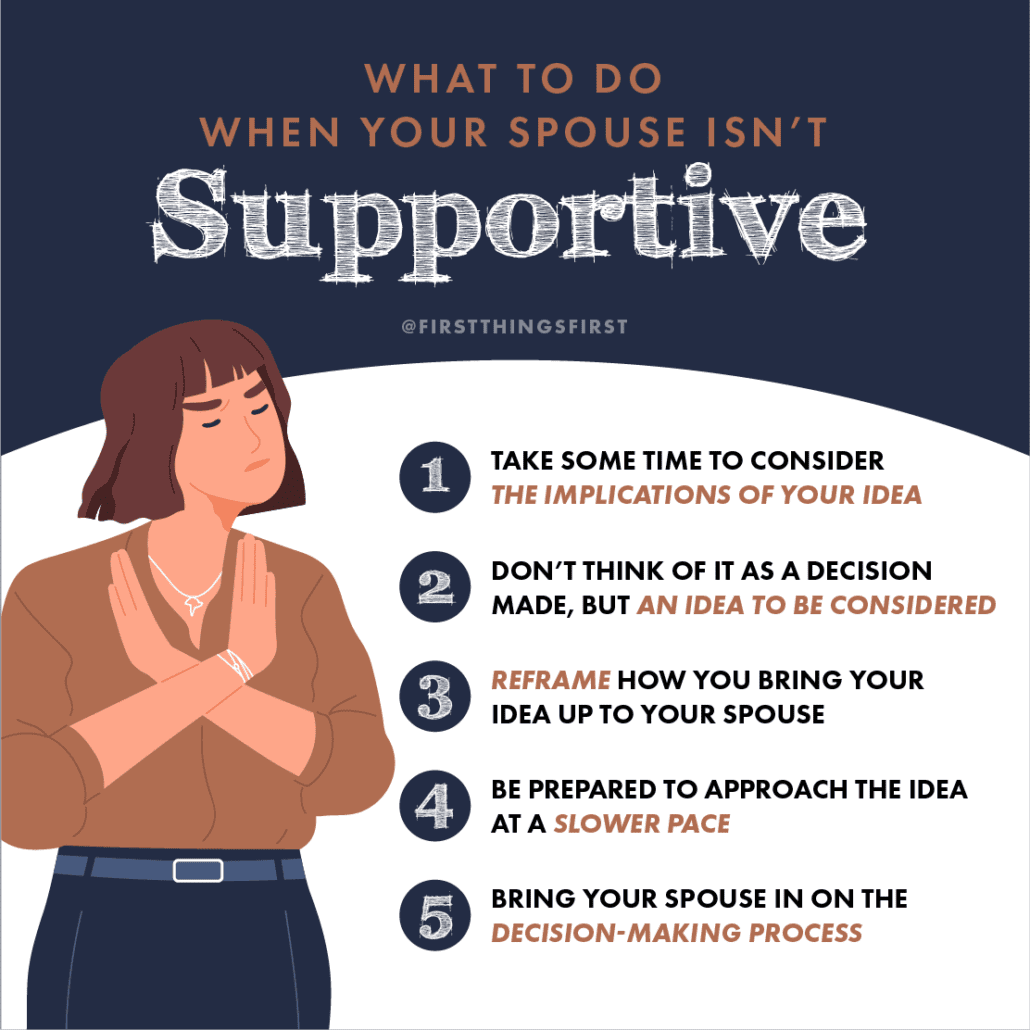
1. Take some time to consider the implications of your idea.
Remember that this decision doesn’t affect you alone. It affects both your marriage and your spouse.
2. Don’t think of it as a decision made, but an idea to be considered.
So you want to change jobs, or go vegan, or cut way back on the kids’ sports schedules? It helps you be more open to the feedback of your spouse when you label this as an idea to be explored rather than a decision that’s already iron-clad in your mind.
3. Reframe how you bring your idea up to your spouse.
“I’ve decided I want to change jobs and work from home permanently, and I’m going to start looking next week. Isn’t that exciting?” See how that sounds? Decision already made.
Notice the difference here: “I’ve been thinking of what it would look like to change jobs and work from home. I’ve been thinking about it a lot lately, and I have some ideas. I don’t know what this might look like in the end, and I’d like your help in thinking about this.“
Framing your idea so that you are open to feedback makes it more palatable, inviting, and open for discussion. And consequently, it can make a big difference in how supportive your spouse’s response is.
4. Be prepared to approach the idea at a slower pace.
When you’re excited about an idea, it’s difficult to not want to see it happen right now. But when you are bringing your spouse in on the decision-making process, be ready to take some time. It might take more than one discussion. Great decisions are rarely made in a short amount of time. Embrace the process that you and your spouse get to embark on, and allow it to make your connection to each other stronger.
5. Bring your spouse in on the decision-making process.
Invite your spouse in on the discussion. Ask them what they think, if they see better ways of approaching the idea, and what different scenarios may look like. For example, what does it look like to quit your job now versus quitting your job in one year?
Be ready to approach your idea in ways different than you originally had thought. Your spouse may take it and add caveats, as what if we did this…, or even right out reject the idea as you see it playing out. Keep in mind that you are a team and this is a decision that affects both of you.
✸✸ Relationship researchers Scott Stanley, Howard Markman, and Susan Blumberg suggest establishing some ground rules for these kinds of discussions, such as allowing one person to speak their full mind without interruption and then clarifying what you think you heard. If the discussion gets heated, take a time-out for 20 minutes and reconvene with calmer emotions. ✸✸
And if your spouse is still not supportive…
This is a very real possibility, no matter how well you’ve presented your idea. If that’s the case, take a deep breath. Understand that even though your spouse doesn’t support your idea, it doesn’t mean they don’t support you as their partner or your marriage as a whole. Circumstances also change with time. It’s possible your big life-goal idea may present itself to be a better idea in the future.
Remember that you are a TEAM.
- Don’t let this issue or idea divide you.
- Don’t think in terms of who won and who lost.
- Do not let your relationship become adversarial.
- Don’t look at your spouse as the enemy of your idea or dreams. (You might not be on the same page—yet.)
- Be on guard that anger and frustration don’t turn into bitterness or resentment—these will wreak havoc on your marriage.
And one thing you can count on: if you’ve presented your idea in a way that invited open feedback and scrutiny from your spouse, they’ll be much more likely to be supportive of the idea when that future opportunity comes about.
For more help with your marriage, click here.
***If you or someone you know is in an abusive relationship, contact the National Hotline for Domestic Abuse. At this link, you can access a private chat with someone who can help you 24/7. If you fear your computer or device is being monitored, call the hotline 24/7 at 1−800−799−7233. For a clear understanding of what defines an abusive relationship, click here.***