


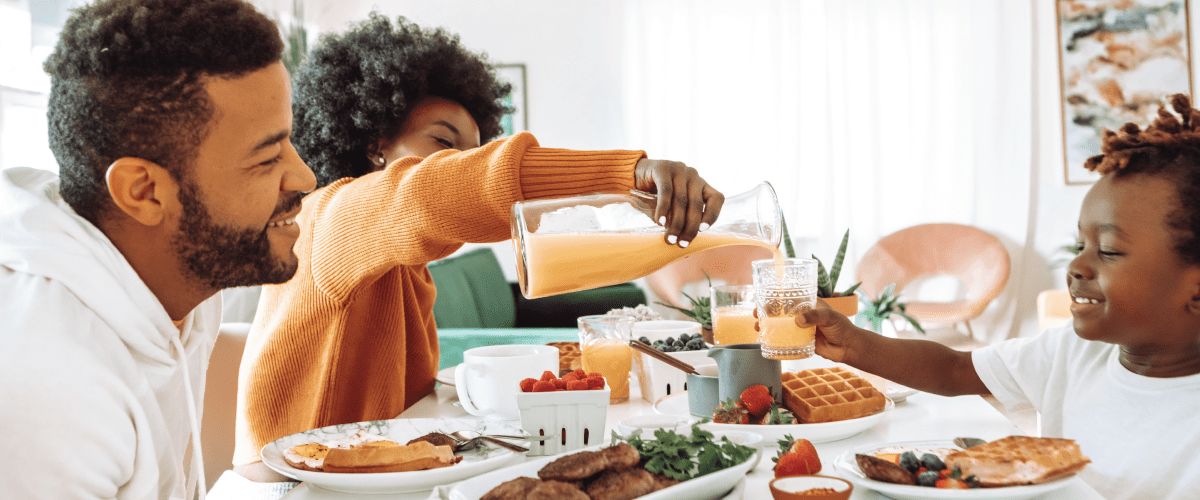
My two-year-old loves chocolate milk, especially in the morning with breakfast. Every day she asks for a big glass to drink with her fruit and toast. Most mornings I mix it up for her, but one morning we were out of chocolate syrup. Tragedy followed.
The crying and the gnashing of teeth, the wallowing on the floor and refusal to eat breakfast–it was almost enough to make me serve her a handful of chocolate chips to suffice.
But as much as I want to smooth the path, I’ve learned (sometimes the hard way) that a little discomfort is not the enemy, it’s the gym where resilience grows.
Psychologists sometimes call this the “Goldilocks zone” of challenge, not too much, not too little. Research following thousands of people over time found that those who had some adversity, not none, not a ton, ended up with better mental health and well-being. Like muscles, our coping skills strengthen when they lift manageable weight. You see it in schoolwork, too. Learning scientists talk about “desirable difficulties.” When we let kids wrestle with a problem, space out their practice, or mix up what they’re learning, it can feel harder in the moment, yet it actually leads to stronger, longer-lasting learning. Struggle today, stick tomorrow.
Pediatricians say play is the perfect training ground for this. The American Academy of Pediatrics calls developmentally appropriate play a “singular opportunity” for building social-emotional skills, self-regulation, and a healthy stress response, the heart of resilience. Play isn’t a break from learning; it is learning. And yes, a dash of “risky play” (the supervised, common-sense kind—climbing, balancing, moving a bit faster than feels comfy) can boost confidence, risk detection, physical activity, and resilience.
Bubble wrap is for packages, not childhood.
Here’s the tricky part: our help can become a handicap if we give it too fast and too often. When we rescue kids from every uncomfortable moment, tying every shoe, solving every social tangle, emailing every teacher, we may accidentally teach them, “You can’t handle this.” Studies link chronic over-involved parenting with more anxiety and less self-efficacy in kids and young adults. Even our praise can backfire. Consistent research shows that praising kids for being “so smart” can make them avoid challenges and crumble after mistakes. Praising effort, strategies, and progress nudges them to lean into hard things and try again. That’s the heartbeat of a growth mindset.
If you’re thinking, “But watching them struggle hurts,” same. Here’s a reframe that helps me at home and at work: discomfort is data. It tells us where growth is happening and what support, not rescue, our kids need. When my toddler totters up the slide, my job isn’t to shout “No!” from the bench; it’s to spot, set a boundary (“feet first”), and cheer her small wins. When my first grader melts down over a tricky word, my job isn’t to say “I’ll read it for you”; it’s “Let’s slow down, try the first sound, and check the picture.” That style fits with what brain-based parenting experts like Dr. Dan Siegel teach: co-regulate first (our calm becomes their calm), name the feeling, offer a doable next step, and let kids take the lead as they’re able. We’re not tossing them in the deep end; we’re being swim coaches in the shallow end.
Here’s a simple loop we use around our kitchen table.
- First, name the feeling: “Looks like this is frustrating.” Feelings first; logic later.
- Second, normalize the struggle: “Hard means your brain is growing.”
- Third, narrow the next step: “Let’s try just the first piece,” or “Show me two ways you might start.”
- Fourth, notice the process: “You slowed down and tried a new strategy—nice.”
- Finally, let it be a little messy. Resist the urge to fix. Sit with them—coaching, not controlling.
None of this means tossing safety out the window. Letting kids be uncomfortable is not letting them be unsafe. Helmets, seatbelts, and clear boundaries aren’t negotiable. The research on “risky play” isn’t a free-for-all; it’s a reminder that age-appropriate challenges build judgment and confidence when adults provide a safe “yes-space” and supervise with wisdom.
Now for the part we don’t say out loud: sometimes our kids’ discomfort dents our image of being a “good parent.” It stirs our anxiety. It slows the morning routine. It’s messy. But growth shows up messy and right on time. When we choose to tolerate our own discomfort by watching them wobble, try, fail, and recover, we model the exact courage we hope to see in them. And we don’t have to make grand speeches. We can practice in low-stakes moments: letting them talk to the cashier, carry the backpack, or work out a playground mix-up. Parenting author Jessica Lahey calls these the “gifts of failure,” small, safe chances to learn how to bounce back while the price tags are low.
So here’s what this looks like in real life.
When my six-year-old asks for help, I’ve started saying, “Show me what you tried first.” Then I add one hint—not the answer. When my toddler wants to climb, we make a quick “yes plan”: shoes on, rules set (“feet first, one at a time”), grown-up nearby.
If you’re anything like me, you want your kids to be capable, kind, and brave. That future doesn’t come from clearing every hurdle out of their lane. It comes from running beside them, sometimes out of breath but always cheering them on while they learn to clear those hurdles themselves.
A little discomfort, for them and for us, is a sign we’re both getting stronger.
Lauren Hall is the President and CEO of First Things First. Contact her at lauren@firstthings.org.




Thoughts? Leave a Comment