
How Do I Talk to My Teen About Their Romantic Relationships?
I was sitting at my middle school son’s football game. Some parents around me were discussing who was dating who in the school. I kept quiet during the conversation, but was anxiously waiting for them to mention my son. They did. I was astonished and a little embarrassed because I was totally unaware my son was “dating.” I knew for a fact he didn’t go anywhere with anyone. That’s what I consider “dating.” All he did was talk on his phone.
How does that constitute dating?
As soon as we left the game, I must confess I blindsided him with the question, “How is your girlfriend?” [Mom Smirk.] He gave me one of those looks only a teenager could give. “Mom, I don’t have a girlfriend.” [Teen Eye Roll.] “That’s not what I heard.” The more we went back and forth, the more frustrated he became, and the angrier I became. He was ADAMANT he didn’t have a girlfriend. Truth be told, I was confused. I soon recognized that not believing him was damaging our relationship.
How could I have prevented this from happening?
Could I have better engaged my son in a conversation about his “romantic relationship?”
How can my misstep help you?
⇨ Related: 6 Tips for Teaching Your Teen Healthy Dating Habits
Learn The Language
This is a time when the teacher becomes the student. Be humble and allow your teen to teach you the new relationship lingo. Your willingness to learn and listen shows you respect your teen’s perspective and you care about what’s going on in their world.
Recognize and Accept Things Have Changed
When your teen says things have changed, believe them. The words and labels they use—DIFFERENT. The modes of communication they use—DIFFERENT. The definition of relationships—DIFFERENT. Trying to impose the “old way” on them will be met with rolled eyes, resistance, or worse.
Be An Askable Parent When You Talk to Your Teen About Romantic Relationships
Take time to listen. Be open and genuine. You might hear some “stuff” that shocks or surprises you. You have to use your poker face. You’ll be tempted to turn a conversation into an interrogation. If your teen perceives a negative reaction from you or gets bombarded with a billion questions or a long lecture, it can cause them to stop talking and create distance.
⇨ Related: How Do I Get My Teen To Talk To Me?
Build Up Your Relationship
Cultivating and maintaining your relationship with your teen provides space for this conversation. As your teen grows, your relationship with them should grow from more directive to coaching them through life and relationships. The more you try to control or force a relationship with your teen, the more they can pull away from you.
If your teen says they are in a romantic relationship, here are some conversation starters to ask your teen:
- Are you able to be yourself in the relationship?
- Do you show respect and feel respected in your relationship?
- Do you have realistic expectations about the relationship?
- Are you feeling pressured in your relationship?
- Do you feel you have the time to devote to the relationship?
The key to guiding your teen through romantic relationships is to stop being a talkative parent and become a parent your teen wants to talk to. Keeping the lines of communication open between you and your teen builds and supports the relationship.
Sure, “dating” might look different now, but there is still no substitute for a close, healthy relationship with your teen.
Check out some other blogs on healthy dating habits here:
What to Do if Your Teen is Sexting
(Part 2) – Check out Part 1, How to Talk to Your Teen About Sexting
In part one, we talked about giving your child a smartphone and what they need to know about sexting to protect themselves. Now, regardless of how you found out, you know your teenage son or daughter is sexting. Step #1, get a hold of your own emotions – embarrassment, guilt, disappointment, shock, anger – so you can have a productive conversation with your teen. If you need to go for a walk, phone a friend, talk to your spouse – whatever. It’s completely okay to tell your teen, “We’ll discuss this tomorrow.” It’s not only okay, but it is also very wise. You have thoughts to get together.
Thought #1: What do I want to accomplish with this conversation – for my teen and for myself as a parent? Don’t rush thinking this through. Have goals.
Thought #2: This isn’t going to be a one-time talk. You want to open the door for an ongoing conversation about sexting and other difficult teen conversations – pornography, sex, drugs, alcohol, dating violence, etc. You want to be an empathetic, askable parent so your teen feels comfortable talking to you about anything.
Thought #3: Try to find a time and place that allows for private undistracted, uninterrupted conversation.
[Here’s an example of a real conversation about pornography. Notice the parent doesn’t lecture, doesn’t ask a million questions, doesn’t guilt-trip their child. The parent clearly doesn’t condone pornography but is more interested in finding out their teen’s thoughts, ideas, and beliefs. This doesn’t mean there will be no consequences. But the parent is trying to build a relationship to keep these kinds of talks going.]
Step 1
In a calm, direct voice, ask your teen about the circumstances around the sexting. Then wait and really listen to them without judgmental facial expressions or tones. Keep your mind and your body language open. You can disapprove of what your teen did but still be deeply concerned about them, validate their feelings, and the fallout of their choices.
✦A word about punishments for sexting. The normal, obvious go-to is to take their phone away. Maybe you need to in their situation. This might be their 5th offense. They may not be ready for the responsibility that comes with a smartphone. Maybe they need an off-the-shelf phone that just allows them to talk and text.
I don’t usually dabble in how parents punish their kids. Every kid and every family is different. I will say this: I’m a big fan of letting the universe handle some of the disciplining of my kids. I’m referring to natural and logical consequences. Sometimes the punishment is built into the poor choice. The choice to sext often has some built-in consequences like guilt, humiliation, a destroyed reputation, being bullied online and in real life, getting in trouble at school, the law getting involved, and on and on. You know your child better than anyone. How are they navigating these consequences? Do you need to drop the hammer on them or help them up? We’ve all done something we regretted. Making mistakes is a normal part of growing up. The important thing is to learn from it.✦
Step 2
Ask questions to dig just a little. NOTE: This is different than an interrogation. As you have a conversation, try to work in some of these questions.
- What do you get out of sexting? How does it make you feel?
- Did you feel pressured to do it?
- Did the recipient promise not to show anyone?
- What is considered “normal” about sexting among your peers?
- Have you received sexts? What did you do with them?
- Are there things on your phone you wouldn’t want me to see?
- What has been the fallout of your sexting?
- Do you think sexting is wrong? Why or why not?
Resist the urge to lecture or ask a million follow-up questions. Act comfortable and be direct. Show you’re really listening and trying to understand your teen and let them feel heard. You may not get to all this in one conversation. That’s okay. Know when to stop the conversation. You can always pick it back up. Let your teen know you love them no matter what.
Step 3
There are some things your teen needs to know about sexting. (They will roll their eyes. Ignore it.) You have a responsibility as a parent to make sure they know and understand certain things. So what are you supposed to do, whether you think your teen is sexting already or whether you’re worried they might start in the future? Believe it or not, you’re not powerless. So what can you do? Sheknows.com breaks it down.
- Talk to your teen. A scary thought for many of us, but one of those unavoidable responsibilities of parenting. Talk to them about the possible long-term consequences of getting involved in sexting. Like the fact that nude images of kids under age 18 are child pornography, which is illegal. Talk about the short-term consequences, like the whole school getting a hold of a “private” photo shared with a former boyfriend or girlfriend. Talk about self-esteem and self-respect. Consider how you might be setting yourself up for a lot of drama.
- Set rules. Do you let your kids drive drunk? Do you let them ride in the car with no seat belts? So why give them something as dangerous as a cell phone and not establish rules? Start random phone checks, and go through everything on it regularly.
- Take away the cell phone. Drastic, yes. But sometimes necessary when nothing else is working. If you truly don’t trust your child, why would you trust them with a tool they can use to bully others?
Resources:
Common Sense Media: Sexting Handbook
Amanda Todd YouTube Video (Some might find content disturbing.)
6 Things Every Teen Needs to Know About Sexting
Why Is Sexting a Problem for Teens?
The Consequences of Sexting for Teens
If you or a loved one are having suicidal thoughts, contact the National Suicide Prevention Lifeline at 988 or 1-800-273-8255 for support and assistance from a trained counselor. If you or a loved one are in immediate danger, call 911.
People have sometimes said to me, “Chris, you have two daughters. Aren’t you scared to death of when they start dating?“
I like to reply with an answer that really throws them for a spin: “Actually, I can’t WAIT for when my child dates!” (I usually either get a look like I have three heads or just a headshake-of-pity as they slowly turn and walk away with a “tsk-tsk…”).
“Why can’t you wait?” you may ask. I know when my daughters begin to date, they’ll be entering a new phase in their social and emotional development, a period in their lives that will have life-transforming experiences. What they do in their early dating lives is going to shape who they marry, if they choose that route. And that’s exciting to me. (Not to mention, I’m chomping at the bit for that first you-can’t-go-on-a-date-with-my-daughter-until-I-interrogate-you meeting. I like to call it the “First Date Inquisition.”)
Now, despite my gusto for dating, even I know there’s a healthy point for this phase to happen. Typically, when children and teens go through different stages of development, what happens in one stage plays a major role in how well they’ll get through the next. So, I want my daughters to enter into the dating stage of their lives as fully equipped and prepared as possible.
So when should I let my child date?
That’s a hard question to answer. But, given all that I just shared, I can tell you when I won’t let my kids date.
When they can’t yet articulate to me a good purpose for dating.
Let’s be honest—when my daughter walks out of the house to meet someone for a date, the first thing on her mind probably isn’t, okay, I’m doing this because… She just wants to have fun, talk to someone who is as interested in her as she is in them. However, before that day comes, I do want her to have in her head why, overall, she wants to date. Because at the end of the day, there are good reasons and bad reasons to date. I don’t know that there’s a single right answer for all families to the question, “What’s the purpose for dating?” Parents and teens need to talk together to determine some positive purposes, with parents being the voices of wisdom.
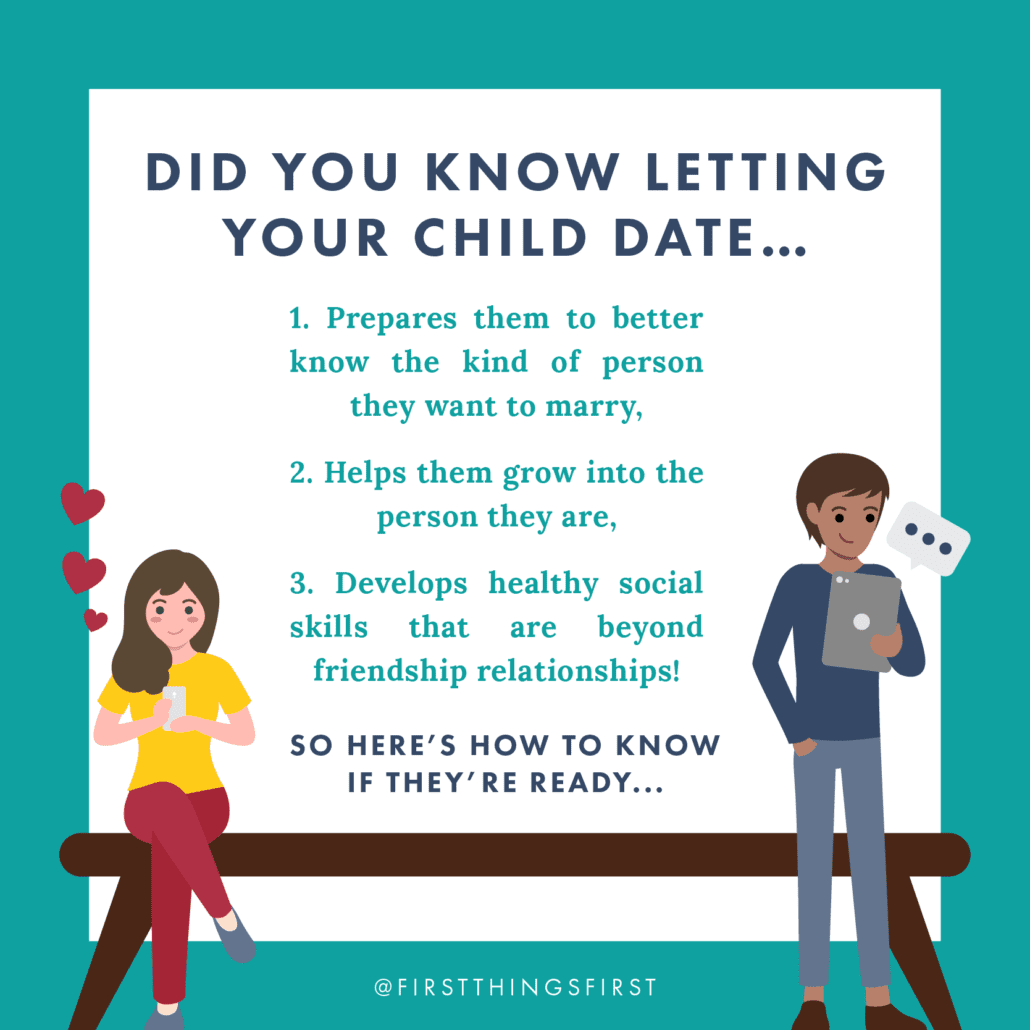
In our house, we talk about how dating:
- Prepares you to know better the kind of person you want to marry (if that’s something in the cards).
- Is something that helps a young person grow into the person they are.
- Develops healthy social skills that are beyond friendship relationships.
When they cannot yet grasp that their value doesn’t come from whether or who they date.
I want my girls to know that a romantic partner does not make them more of a person. They aren’t somehow “not enough” without a boyfriend. And that, despite what other people their age might be doing or saying, dating isn’t something you need to do because it helps you feel more accepted in your friend group. In other words, I want them to develop self-confidence and the beginnings of a firm identity beyond their dating life.
When a teen knows this, it can protect them from adolescent dating risks. Research tells us that teens who have a healthy amount of self-efficacy, or self-assurance, are less likely to experience dating violence, use drugs or alcohol on dates, or cave into sexual pressures.
If they don’t feel like they can communicate with me or their mom if something is wrong.
I’m just going to lay it out there for you: as much as it may pain you, when your kids begin dating, they will experience heartbreak, pressures, and temptation. They are going through the mental and emotional gymnastics of development. And they are going to come to points, many times, when they are stuck and need a voice of wisdom. That’s you. I want my daughters to know they can call me if they are at a place they don’t want to be and I’ll be there to get them. And I want them to feel comfortable to open up about what they are feeling or experiencing in a dating relationship. Despite popular belief, this is very possible.
If they are dealing with depression or anxiety.
The bad news is that, according to the National Institute of Mental Health, 30% of adolescents experience some kind of anxiety, and Pew research tells us that 13% of adolescents in 2017 experienced at least one major depressive episode. The good news is, the vast majority of these issues in teens are very treatable. If my daughters experience any kind of depression or anxiety, I’m confident we can work through it over time. However, I don’t want a boyfriend or an active dating life to be the coping mechanism they use to deal with these things. Bad things happen when the “other person” is made the emotional crutch.
When they can’t separate their dating life from their compassion for others.
What I mean here is sort of the reverse of the previous bullet point. Both of my daughters are very compassionate people; they’d gladly give everything they have to help someone who’s down and out. However, we’ve all seen relationships where one person stays because they feel the need to help the other deal with some issue. And this brings the fear that if you were to break it off, the other person might go off the deep end somehow. This is “martyr dating,” and it’s not healthy. I want my daughters to understand that dating is not the avenue to walk people through their problems.
A couple of caveats need to be made with the above points:
- Now, if I were to wait until my kids had all these things down in their development to let them date, well, they may be living in my house a verrrrrrry long time. Obviously, they won’t have it all together in their teen years. But the idea is to know my kids well enough to know that they are well on the road toward these developmental traits.
- These developmental lessons begin well before teens are anywhere close to dating age. As a matter of fact, they begin with a close, connected relationship between parent and child. Parents need to be in the pocket, having ongoing conversations on these ideas with their kids. This is how children build self-confidence and trust to go to their parents with problems, even when they are older. Ongoing conversations help teens cope with anxiety and other emotional issues. And it helps them come to a good understanding as to the purpose of dating.
There is no magic age a child should be allowed to date. It really depends on the child and where they are in their thinking and development. But one thing is for certain: parents need to become a student of their kids, continually learning more and more about how they’re thinking, what they’re feeling, and getting a sense of the direction of their development. This is the best way that we as parents can prepare our kids for a healthy dating life.
Image from Pexels.com
What is your teen asking you about the future? Do you have answers?
“What am I gonna do about school and soccer, Dad?” my 14-year-old son asked me. I didn’t know. I’d been asking myself the same questions for weeks and didn’t have any answers. It feels like new information comes out every day that undermines my decisions. Everything feels tentative. The future feels like a collection of shreds and patches.
The last few months have left the foreseeable teen future uncertain. Your teen may be feeling a lot of anxiety: What will school look like? Will I be able to get a part-time job, play sports, play my favorite instrument in the band? What about prom and graduation?
And don’t forget their favorite part of school—seeing their friends. There’s so much unknown for them to process.
Don’t forget, they are old enough to wonder about your adult future and the family’s future. You may feel secure about your job situation, your finances, the health of family members—and something like divorce may be totally out of the question. This doesn’t stop your teen from worrying about those things.
All of these unknowns can easily translate into anxiety, stress, and depression for your teenager. (They can for us adults, too.)
When it comes to the important things in life, we all prefer certainty to uncertainty. But our adult brains are developmentally better suited to live with some uncertainty than our teen’s brain is. Their brain is still developing and processing so many unknowns (that they are invested in) can be particularly difficult for them. How can we help them?
[Read this blog that describes what is happening to teens developmentally.]
1. Model The Behaviors And Attitudes You Want For Your Teen
- Self-Care: Tending to your physical health and emotional health.
- Mindfulness: Deep breaths. Self-awareness. Focus.
- Critical Thinking: Decisions based on the most reliable information.
- Optimism: “We are going to come out on the other side even stronger.”
- Resilience: “We are going to take it one day at a time as a family.”
- Gratitude: “We still have a lot to be thankful for…”
- Service: “How can we help others who are struggling?”
These are all things that your young adult needs to navigate uncertainties they will encounter as future adults.
2. Acknowledge When The Future Is Unknown & When You Just Don’t Know
We want to have answers for our teens and they often expect us to have them. It can be tempting to try to “fake it” or give the answer we think will make them feel better in the moment. Besides being disingenuous, in the long run, it will undermine their confidence in you. You don’t want to be seen as a source of false hope and misinformation.
It is totally appropriate (and honest) to admit it when we don’t know. Saying something like, “I don’t have enough information yet to confidently make a wise decision about that,” doesn’t undermine your trustworthiness and reliability; It enhances it. Your teen can relax (hopefully) and know that when you do make a decision it will be based on the best information and what’s best for the family.
3. Become A Student Of Your Teen
Be on the lookout for the ways your teen might be struggling with anxiety and stress and depression. A very talkative teen may become quiet. A very quiet teen might become talkative. A normally social teen may become withdrawn. A teen that normally keeps to themselves might suddenly become a social butterfly. Look for any changes in their normal behavior.
Keep in mind that sometimes teens deal with difficult emotions in unhealthy ways. Be on the lookout for outbursts, disrespect, risky, or harmful behavior. Watch their eating and sleeping habits. As you address their behavior, be sure to address what the real issue may be underneath it.
4. Be Open And Create Space For Your Teen To Express Their Anxiety
Teens will often “show” you when they are struggling before they will “tell” you they are struggling, but there are things you can do to keep the lines of communication open:
- Make sure your teen knows you have an “open door” policy and that they can talk to you about anything, anytime.
- Take advantage of car rides and other times you are alone with your teen that don’t feel like you are angling for a “big talk.” Teens often open up when you are doing something else, like cooking or watching television.
- It’s okay to ask questions like, “How are you feeling about school this year?” Then practice active listening skills.
- Don’t “freak out” at what you hear. Keep that poker face.
- Don’t ask a million questions, probe gently, empathize, and be a good listener.
5. Recognize When You Are Out Of Your Depth And Get Your Teen Help
Anxiety, stress, depression, and anger are significant and often complex problems—especially in the lives of teens. It is totally appropriate and necessary for you as a parent to recognize when you have reached the limits of how you can help your teen. Don’t stop there. Reach out for help. Contact a counselor.
The unknown is, well, unknown. It is normal to experience fear and anxiety concerning the unknown. There are lots of things that your teen cares deeply about that are just flat out up in the air at the moment. Don’t feel bad that you can’t make the unknown “knowable” for your teen. Model how to face the unknown, be there for your teen, and keep putting one foot in front of the other until the unknown becomes known.
How Do I Know if My Teen is Depressed?
Your teen has been much more quiet and withdrawn lately. They aren’t very talkative, are easily agitated and their mood has consistently been down. The big question in your mind is, “Is my teen depressed?”
The teen years are filled with highs and lows, so much so that it often feels like being on a roller coaster ride in the dark with lots of twists and turns, none of which you see coming. In a word, these years can be full of turbulence.
With all of the change going on, it is sometimes hard for parents to know if their teen is just going through a rough patch or if something bigger is going on like depression.
Approximately 1 in 5 teens from all walks of life will experience depression at some point during their teen years, which can be very scary for parents. In many instances, teens themselves don’t understand what is going on, why they feel the way they do or even how to talk about what they are experiencing.
According to the Mayo Clinic, signs and symptoms of teen depression include:
- Feelings of sadness, which can include crying spells for no apparent reason
- Frustration or feelings of anger, even over small matters
- Feeling hopeless or empty
- Irritable or annoyed mood
- Loss of interest or pleasure in usual activities
- Loss of interest in, or conflict with, family and friends
- Low self-esteem
- Feelings of worthlessness or guilt
- Fixation on past failures or exaggerated self-blame or self-criticism
- Extreme sensitivity to rejection or failure, and the need for excessive reassurance
- Trouble thinking, concentrating, making decisions and remembering things
- Ongoing sense that life and the future are grim and bleak
- Frequent thoughts of death, dying or suicide*
- Tiredness and loss of energy
- Insomnia or sleeping too much
- Changes in appetite—decreased appetite and weight loss, or increased cravings for food and weight gain
- Use of alcohol or drugs
- Agitation or restlessness—for example, pacing, hand-wringing or an inability to sit still
- Slowed thinking, speaking or body movements
- Frequent complaints of unexplained body aches and headaches, which may include frequent visits to the school nurse
- Social isolation
- Poor school performance or frequent absences from school
- Less attention to personal hygiene or appearance
- Angry outbursts, disruptive or risky behavior, or other acting-out behaviors
- Self-harm—for example, cutting, burning, or excessive piercing or tattooing
- Making a suicide plan or a suicide attempt
When a teen is depressed, they can’t “just snap out of it.” But, there are things parents can do to help kids decipher their feelings and determine the best next steps. If a significant number of symptoms are present for two weeks, this is a good indication that it is time to reach out for help from a professional.
Things You Can Do If You Believe Your Teen Might Be Struggling With Depression
It may help to open the door to constructive conversation and let them know that if they are struggling with this, they can share with you.
Listen intently.
Avoid lecturing, as in, “If you would just…” It may be hard because they can be moody, but seek to be present and listen to what is going on in their world if they are willing to share with you. If they tell you how bad things are, avoid making statements like, “I think you are blowing things out of proportion” or “It really isn’t that bad.” Remember that perception is everything and even though you may feel like their perception is not accurate, this is their reality and understanding this is the starting point for being able to help them.
One other thing that might be helpful here—sometimes teens find it easier to talk about something difficult when they are doing something. Shooting hoops, running, taking a hike, doing yard work, cooking or anything that doesn’t make them have direct eye contact with you and gives them something to do with their hands while they are trying to share with you works.
Encourage exercise, eating right, getting enough rest and being outdoors.
All of these things help to combat depression.
Acknowledge their feelings.
You don’t have to agree with them, but you do need to acknowledge them. When a teen is depressed they often feel like they are trying to slog through mud and fog. It’s hard to pinpoint feelings because everything feels “blah.” When they are able to pinpoint an emotion, validate it and work to keep the conversation going.
Avoid telling them what to do to “fix” the situation they are in.
Instead, ask them what they think they need to do. If they ask you for your thoughts, that’s the time to give some input. However, don’t give not too much because they can become overwhelmed quickly.
Work to help them avoid isolation and increase face time.
This is especially hard with COVID-19 factors at play. Be intentional about creating family time and encourage (don’t force) them to participate. Exercise with them. Look for activities they enjoy and do those things with them.
Limit screen time.
Many parents are tired of trying to take on this battle, but there is plenty of research indicating that lots of screen time can lead to depression. A recent study suggests that greater screen time—whether in the form of computers, cell phones, or tablets—may have contributed to a spike in depression and suicide-related behaviors and thoughts among American teens, particularly girls, between 2010 and 2015. Several studies show that when teens reluctantly agreed to give up screens for a week, they confessed at the end that they felt so much better without them.
Don’t be afraid to seek professional help.
As the parent, it is important to trust your gut if you feel your teen is depressed. If you don’t feel like anything you are doing is helping, seek assistance. You can go see someone or find someone for your teen to talk to. Having a depressed teen does not reflect poorly on you and your parenting skills. Adolescence is terribly complicated. Quarantine, COVID-19, no school, no summer camps or other activities has made it very hard on teens who are typically super social in nature.
Dealing with depression in your teen can be exhausting on multiple levels. Not only are you interacting with your teen and questioning whether or not you are doing the right thing, but thoughts about what you are experiencing can consume every moment of your day and sometimes the night. Walking this road can feel isolating and lonely, so it is important to surround yourself with supportive people, seek help for yourself, educate yourself and take time away to regroup.
*If you or someone you know is struggling with suicidal thoughts, there are a number of websites and organizations with excellent resources for you. HelpGuide is a great place to start, along with the American Foundation for Suicide Prevention at 988 or 1-800-273-TALK (8255).
How to Stay Positive When Everything Seems to Be Falling Apart
We were about a month into our COVID-19 quarantine when it finally happened. There had been some ups and downs, of course, but I was feeling pretty good and able to stay positive as an individual, husband, and father. My family was handling it all surprisingly well. I was getting tons of work done. I felt like I was leading the family well. Then I finally snapped.
During the month or so of quarantine, I had been straining, working from home, fearful about my wife working in the medical field, stressed about a son doing middle school online, anxious about a son doing college online, sad for two adult children out of work, worried about one adult child still working in “essential services,” and totally uneasy about my at-risk mother-in-law. ALL of this under ONE roof. (You catch all the emotions in there? I didn’t.) But we were actually navigating it fairly well and trying to stay positive – movie nights, game nights, lots of good conversations. We got this!
Then it all started to unravel. Then I unraveled. Big time.
In the span of a few days:
- My wife was filing for unemployment.
- We had a brush with a tornado that left us with a yard full of fallen trees.
- We had no power to our house for days.
- My car broke down while I was getting ice to keep food from spoiling. (It all spoiled anyway.)
- We had friends who completely lost their homes and we were heartbroken.
- We had all-new financial pressures.
Things were starting to pile up. Stress and worry were at all new levels.
I ignored it – too much to get done!
After about four days of trying to adjust to Generator Life and a bunch of new problems and expenses, I was soon trying to stay positive and hold my world together with threads and patches.
Then, in a single moment, life came undone. (Of course, it did.) The reality is, I came undone. Ironically, it was actually a relatively small thing that did it. Something so small that it would have been no big deal in any other context. Straw. Camel. Back. You know the saying.
I’ll admit it – I was lying in bed crying with the door locked, feeling fragile and helpless.
How did it get to this? I’m stronger than this! What if anyone in my family sees me like this?
If we can allow ourselves to be honest, vulnerable, transparent humans for just a second, you might be feeling it, too. You might be close to snapping. Maybe you are on the edge of being overwhelmed. You may have already broken down. Your story and circumstances might have some major things going on in them that make my little pity party look pitiful.
What do you do to stay positive when it all seems to fall apart?
Here’s what I learned after I snapped back from my snap:
- Acknowledge your emotions and share them with people that you trust. For a while, I had been suppressing or burying emotions and needs deep down, trying to play it cool, but making myself a ticking time bomb.
- Be real with your kids, your spouse, and your friends, because they have their “moments” too. Kids don’t need their parents to be perfect; they need them to be real. It’s good for them to see you work through imperfection and real-world problems.
- Guard your mindset! Be careful what you look for in life, because you’ll find it. If you look for everything that is wrong, you’ll find it and focus on it. If you look for what is going right, that’s there, too. Find it and focus on it. You can acknowledge what’s wrong and still practice gratitude for what’s right. Remember what is really important – people.
- Practice self-care. I was afraid to be honest with myself and the people around me – people that I know would help me, let me blow off steam, and help me process my emotions. It’s okay to ask for help. It’s more than okay to take care of yourself! Practice self-care. You may not be able to change your circumstances, but you can take care of yourself—physically and emotionally.
- Breathe. Think. Act. Take a moment to take some deep breaths, think about what you can and can’t control, and then respond appropriately – don’t react. Don’t make important decisions when you aren’t your best self or you’ve gone to pieces.
- Focus on helping others. This may sound counter-intuitive, but nothing feels better than helping someone with their problems. It actually makes our brain release happy chemicals and it may take your mind off your problems or even put them in perspective.
It’s okay to have a “moment”; it’s not okay to stay there. We’ve all been at a place where we felt like it was just one bad thing after the other and we’ve felt overcome by stress, anxiety, anger, or sadness. Give yourself permission to be real, but also develop a plan to stay positive the next time you feel overwhelmed and about to break down.
How do I get my teen to talk to me? My first thought was to think back on all my experience parenting and working with teens. My first thoughts are frequently wrong. I realized that my 14-year-old son, Jude, was sitting right next to me. Ding, Ding, Ding! He has the best credentials to answer this question. Why not ask him? He’s the expert!
What followed was me talking with my teen about talking with my teen.
(He even grabbed my laptop at times and started typing, “You gotta tell parents this!”)
Me: Is it helpful for parents to find out what you are into and learn all about it so they can build some common ground? Like, “Is your teen into skateboarding? Learn all about skateboarding so you can talk to them! Now you can ask if they ‘push mongo’ and if they can ‘aciddrop into a melongrab.’”
Jude: (Laughing Hysterically) You don’t even know what those words mean, do you?
Me: Um, no… I Googled them.
Jude: That stuff might help. It might come off as forced and lame.
Me: Bottom line, I can’t make you talk to me, can I?
Jude: (Kinda Smugly Triumphant) Nope!
Me: (Sigh) Let me type that…
Bottom Line: You can’t make them talk. Sorry. You can’t point the remote at them and press “Unmute.” The good news, however, is that you can adopt a parental posture and create an environment where a real conversation has a much higher chance of happening.
Jude: I like the “unmute” thing!
Me: Hey, thanks; I just think…
Jude: (Interrupting) Just tell them to spend time with their kids. That’s it.
Me: You just told them.
Jude: What? Wait! Are you just typing out what I say?
Me: Yup. Keep talking… I might make it sound more adult-y and mix in some of my thoughts.
According to a real-life teenager, there is no magic formula, but here are five things for parents to think about…
1. Some teens are just quiet or go through quiet phases.
You remember being a teenager, right? Well, it’s way harder now, according to Jude. It’s more cutthroat, more emotionally charged, and more adultish—social media amplifies all that exponentially. Jude says teens genuinely feel like you just won’t get it. It’s not an insult. They often process issues internally or with their peers. Resident Teen Expert encourages you to be patient.
Big Idea: Make a standing offer to be available to talk about anything whenever they want to.
2. Spend time with them not obviously trying to force a “big” talk.
You might be dying to hear about what is going on deep inside their world and incredibly anxious to speak into it. But just offer to watch them play video games, play some Uno, (Jude: Dude. We’ve never played Uno.), or go grab a bite to eat with no agenda other than to enjoy their company. Make small talk. Don’t sweat silences.
Big Idea: Don’t force it. Spend time with them and see what happens organically. Small talk often leads to BIG TALK.
3. Don’t freak out when you hear something that rattles you.
Jude says this is “super important.” If they do open up to you, you will hear some stuff. Maybe some shocking stuff. If you freak out, it might be a loooong time before they open up to you again. Keep a good poker face. Jude: And don’t bombard them with a million questions. Don’t lecture. Me: Got it! Empathize. Probe gently. Listen, then listen some more. (Check out this article on active listening skills—especially the Six Levels of Listening.)
Big Idea: So many teens say that their parents don’t listen and just talk at them, not with them.
Me: So, how do I do with all this?
Jude: Um…
Me: Okayokayokay! I’ll work on it!
4. You might not be the person they feel comfortable talking with right now.
Jude: Some stuff I just feel better talking to Davin about. (His older brother.) As a parent, I’ve had to settle for… are they talking to someone? Someone I trust? For some topics and even some phases of teenage life, I realized my teen was more comfortable talking to Mom. I had to work to get to a place where I was just happy they had someone to talk to that I knew would basically give them the same input that I would. It might be an older sibling, their aunt, a teacher, or a coach. I know I can trust my sister, their favorite aunt, to give me a heads-up if she hears something I need to know about.
Big Idea: Encourage them to cultivate relationships with people they are comfortable talking to.
5. Talk to them. But be real. Be transparent. Be vulnerable.
This speaks for itself. Sometimes we expect our teens to give us things we aren’t willing to give them. Me: Am I real with you, Jude? Jude: Yeah. Maybe too real… Me: So that’s a compliment?
Big Idea: Make sure you are giving conversationally what you hope to get from your teen.
Me: You get the final word.
Jude: Spend time with them, listen, don’t lecture. Just tell parents to spend time with their kids.
Me: You just did again. What do you think of this blog?
Jude: This blog goes hard.
And then, on the way to school the next morning, out of nowhere…
Jude: We told them not to lecture, right?
What’s The Big Idea?
- Offer to be available to talk about anything whenever they want to. Be patient.
- Don’t force it. Spend time with them and let conversations grow organically. Small talk often leads to deeper conversations.
- Practice good listening skills. Don’t talk at them; talk with them.
- Encourage them to cultivate relationships with people they are comfortable talking to and that you can trust.
- Model the openness, vulnerability, and transparency that you are hoping to get in return.
What You Need to Know: Smartphones, Teens and Depression
Panicking About Your Kids’ Phones? New Research Says Don’t is the title of an article in the New York Times.
The writer says a growing number of academicians are challenging the true impact of social media and smartphones. They’re questioning whether too much time on devices is the culprit for the dramatic increase in anxiety, depression, and other mental health issues, especially in teens.
You might want to hear what psychologist Jean Twenge has to say about it, though. Twenge is a professor of psychology at San Diego State. She’s also the author of numerous books including Generation Me and her most recent release, iGen: Why Kids are Growing Up Less Rebellious, More Tolerant, Less Happy and Completely Unprepared for Adulthood.
In a blog for the Institute for Family Studies, Twenge calls out the NYT writer on six facts that, she claims, he ignores.
Twenge contends that the NYT article grossly misrepresents the research consensus on technology and mental health because the article makes it sound as if the majority of researchers have concluded that technology use isn’t related to mental health. Twenge says that’s not the case.
“The article also misrepresents findings from a recent review of screen time and mental health studies,” writes Twenge. “The article does mention a recent review of studies on screen time and mental health by Amy Orben, who concluded that the average correlation between social media use and depressive symptoms is between .11 and .17.”
It cites this study as evidence that the link is small, but Twenge argues these are not small effects. Data from the CDC’s Youth Risk Survey of US High School students indicates that twice as many heavy users of electronic devices (5+ hours a day) compared to light users (1 hour a day) have attempted suicide* (12% vs. 6%).
Twenge states that the NYT article quotes experts who, without plausible evidence, dismiss the possibility that the rise of social media and smartphones might be behind the marked rise in teen depression, self-harm and suicide in recent years.
The article quotes Stanford Social Media Lab’s Jeff Hancock as saying, “Why else might American kids be anxious other than telephones? How about climate change? Income inequality? More student debt?”
“The problem with this argument is that none of these factors can explain the increase in teen mental health issues that began in 2012,” Twenge writes. “First, they didn’t happen at the same time. The largest increases in income inequality occurred between 1980 and 2000… Student loan debt has been stable since 2012. The number of Americans worried a fair amount or a great deal about climate change went from 73% in 2012 to 74% in 2019.”
Twenge contrasts this with 2013, the first year the majority of Americans owned a smartphone. By 2018, 95% of teens had access to a smartphone and 45% of them said they were online “almost constantly.”
“The largest increase in self-harm, self-poisoning and suicide occurred among 10- to 14-year-old girls,” Twenge writes. “Hancock would have us believe that 10- to 14-year-olds are harming themselves because they are upset over income inequality or possibly someday having to pay off student loans after college—not because they are bullied online, not because they feel constant pressure to look perfect on social media, not because they can access online sites instructing them in self-harm, and not because electronic communication has replaced in-person interaction, a basic human need.”
Twenge states that concern about climate change seems plausible, but she asks, “How many 12-year-old girls do you know who are cutting themselves because the planet is warming? It is much more likely they are concerned about self-image, social status, friendships, and family relationships—all issues that have become fraught in the age of social media.”
Twenge also notes that the rise in depression, self-harm, and suicide has been considerably larger among girls than boys.
She contends that all of the issues listed above should impact boys and girls equally. Thus, they do not explain why the rise would be larger for girls.
Technology use, however, does differ by gender. Girls spend more time on social media. This may be more toxic than gaming, which is more popular among boys.
Twenge calls out the author for combining two completely separate questions:
- whether technology use is related to depression among individuals, and
- whether the increase in smartphone and social media use is related to the generational increase in teen depression
“Even teens who don’t use technology have been affected by the shift in teen social life from in-person get-togethers to online interactions,” Twenge says. “Consider a teen who doesn’t use social media and would prefer to go out with her friend, but who will she go out with when everyone else is at home on Instagram?”
The NYT article also points to Europe as proof that smartphones are not behind the increase in teen depression. Yet the evidence shows otherwise. The study used to make the case examines adults, not teens. The World Health Organization reports increases in suicide rates around the world, with the largest increases among youth.
Here is the last point that Twenge makes. While the researchers claiming that technology use is unrelated to well-being said they had not taken any funding from the tech industry, one of them is currently employed and one was previously employed by the Oxford Internet Institute. The OII is funded by Facebook, Google, and Microsoft.
“Parents can rest assured that their instincts to protect their kids from too much screen time are not wrong,” Twenge writes.
“If kids who ate five apples a day versus one were twice as likely to attempt suicide, parents would make extremely sure their kids didn’t eat too many apples. Why should our response to technology time be any different?”
The moral of this story is, don’t believe everything you read. Check the facts for yourself. What you don’t know can hurt you and the ones you love.
*If you or someone you know is struggling with suicidal thoughts, there are a number of websites and organizations with excellent resources for you. HelpGuide is a great place to start, along with the American Foundation for Suicide Prevention at 988 or 1-800-273-TALK (8255).