
Tag Archive for: Relationships

5 Things Every Engaged Couple Should Know:

1. Marriage is a magnifier.

Some couples think a bad habit or irritating trait will disappear after they say, “I do…” The reality is that marriage is a magnifier – both positively and negatively. See a little bit of this trait while dating or engaged? You’ll be seeing a lot of it after you get married.

2. Money is a big part of life.

Have you had some honest communication about student loans, credit scores, spending/saving habits? Money is often the number one thing couples fight about in marriage.

3. Do they know how to “fight nice?”

How do they handle conflict, stress and anger? Life will flip you for real and you won’t always agree on how to handle it! Now what? Do they get loud? Do they withdraw? Can they disagree without it getting personal? Do they bring up past mistakes constantly? Learn how to fight nice, fight fair and argue constructively toward solutions – NOT tear down and just hurt each other. (And remember – marriage is a magnifier…)

4. Get around each other’s friends and family.

Love is blind but your uncle might be an eye-opener. He might see a quality or trait that you flat-out missed. What are their friends and family like? How do they communicate and manage conflict? Does his mom dote on him all the time because “he’s her little baby?” Is he going to be expecting that same doting treatment from you?

5. Saying, “I Don’t…”

It is better to break off an engagement than to move forward into a marriage that your heart really isn’t into, you have a bad feeling about, or all the people close to you are warning you about. It might feel too late in the game, you may have spent money, rented out space and even sent invitations, but until you say, “I do…” you can still say “I don’t…” And that may be best in some cases. Maybe you just need to date a little longer and get to know each other better. Maybe you have some real concerns that have to be addressed. Remember: Marriage is for life, “‘til death do us part…”

No matter what, these 5 things that every engaged couple should know can guide you and your potential spouse through this season of unknown, planning, and celebrations!

Looking for more engagement resources? Click here!

Image from Unsplash.com
Are you considering counseling? The Counseling Problem:

I don’t want people to know that I’m getting counseling! We can work this out ourselves! Counseling might do some good for other people, but I don’t need it.

Counseling is one of those things that sadly often gets stigmatized or viewed as good for other people. If you are brave enough to bring it up, you’ll see it is helping many of your friends work through issues in their relationships and their lives. Don’t write off counseling as a tool.

Have you ever had a friend who shared a problem with you and you were able to see the solution so clearly, you passed on some awesome advice? Problem solved!

But, when it comes to your life and your problems, that clarity is all out the window and you have no clue what to do.

Why is it sometimes so easy to see other people’s problems clearly, but our own problems feel so much more complicated? The difference between your friend’s problem and yours is that it’s difficult to see our own situations objectively (or from a third person perspective). We have all kinds of blind spots, biases, and really only have one perspective – ours.

The Counseling Solution

Our own inability to see our problems clearly is why counseling can be so helpful. There are several BIG benefits to seeking counseling or therapy, either individually or as a couple.

Benefits of Meeting with a Counselor:

  1. They help us see those things that are in our blind spots. This is often the biggest hurdle – admitting that we don’t see it all and know it all about ourselves.
  2. The counselor can help us talk about things that are difficult to talk about. They can be a safe person to talk to. They can function as a mediator and ensure that a conversation doesn’t become a confrontation.
  3. Some problems we wrestle with are flat-out complicated – they might involve chemicals in our brains or generations of our family history. We might not have the tools to tackle those issues.

Hopefully, you have some good friends that can help you can talk through problems, but don’t forget, sometimes you need to consider counseling. And, that’s totally ok.

Looking for relationship resources? Click here!

Image from Unsplash.com

There’s nothing worse than getting into the same argument, again and again and again. Amirite? The sheer repetition is enough to drive one MAD. And sadly, that tends to happen quite a bit in marriage. When we get really upset, we can go from zero to 60 in two seconds flat. We don’t want to fight. We don’t want to be angry. But WE ARE LIVID. And ya know what? We have every right to be! But.

Read more

Oh, Valentine’s Day – the one day a year it’s okay to wear pink and red together, tell total strangers you love them, and spend way too much money on chocolate.

And don’t forget about celebrating your overwhelming, joyous love for your partner! Right?

For so many couples, Valentine’s Day is more of a routine than a holiday. Get the flowers? Check. Go out for dinner? Check. Eat (all) the chocolate? Check. Then… go back to the norm the next day. But why has the “day of love” turned into one day of over-the-top, mushy-gushy effort to prove our love to our partner?

It doesn’t have to be that way. You may have heard that couples should “treat every day like it’s Valentine’s Day,” and this is not a bad idea! Now, it doesn’t have to mean that you get flowers for your spouse every day or have a fancy meal each night. It does mean that you and your partner choose to express and celebrate your love for each other every day of the year.

It will look a little different for each couple. But here are a few great ways you and your spouse can celebrate Valentine’s Day every day!

  • COMMIT TO SERVE. The humility it takes to serve one another is a great foundation in any relationship. Commit to serving your partner in their needs and wants. Maybe they need some alone time, or they want to try out a new restaurant. Be aware of ways that you can give to your partner and go for it!
  • ALWAYS FORGIVE. This is easier said than done, of course! But try letting go of previous pains or arguments and focusing on the conflict as the problem. It’s a great way to start the process of forgiveness!
  • CELEBRATE THE GOOD. Every couple is guilty of forgetting to do this. Even something as simple as writing a thank-you note to your partner is a great way to bond!
  • BE GENEROUS. This is not financial generosity, but generosity with who you are, the energy you have, and what you give to your love. A balanced relationship is not where each is giving 50%, but where both are giving 100%.
  • ENCOURAGE ONE ANOTHER. This may not happen as frequently as most couples wish, but a “thank you,” “I’m proud of you,” or “You were great when…” can totally transform a relationship.

Don’t let Valentine’s Day be the one day a year you think through how you can love your spouse the best. Choose to do at least one thing every day to put a smile on your partner’s face, and see just how far it will take you!

***If you or someone you know is in an abusive relationship, contact the National Hotline for Domestic Abuse. At this link, you can access a private chat with someone who can help you 24/7. If you fear your computer or device is being monitored, call the hotline 24/7 at: 1−800−799−7233. For a clear understanding of what defines an abusive relationship, click here.***

Opposites attract. They really do! Then you get married and often opposites repel.

When my wife and I began dating in college, we couldn’t have been more different. Ours was really a case of “opposites attract.” Frankly, the differences were enchanting, fascinating and intriguing. Then we got married. About six to eight months in, those differences were not nearly as charming anymore – they were were just different. I remember thinking, “That thing you do that when we were dating was so beguiling and fascinating? Yeah, well it’s annoying now.” And my wife was feeling the same thing with my differences…

What did we get ourselves into? The rest of our lives seems like a long time to put up with this!

Are you really opposites? Below are some questions to turn this obstacle into an opportunity:

*Is this a problem to be solved or a tension to be managed?

What kind of differences are we talking about here? Is one person laid-back and the other more assertive? That’s a tension to be managed – probably your whole life. Is one person trying to save money while the other person is blowing through it? That’s a problem that is a problem that is gonna have to be solved.

*Is one person taking the moral high ground?

I was fond of saying that all our differences were equal but some were more equal than others. My wife was more assertive, list-driven and task-oriented. I was laid-back and cared more about people. She always had “The Moral High Ground.” My wife would often say, “Well, at least I get things done!” (Aaaand you’re gonna die from a heart attack.) Try not to label the differences good & bad, right & wrong, helpful & unhelpful. They can just be different.

*Is there a duty to validate your spouse and their differences?

Do you have a chance to celebrate your spouse and the unique things that they bring to the relationship and the family? Be sincere and not condescending.

*Is there an opportunity for you to provide each other balance?

My wife and I finally learned that our differences should not be competing with each other, but rather, they could be complimenting each other.

*Is there wisdom in playing to your strengths?

Sadly, there are many “gendered” jobs around the house where we often just expect a certain partner to do it. But what if that is not their skill-set or passion? The other spouse is like, “I LOVE doing that job and I’m awesome at it!” Play to your strengths, not stereotypes.

*Is there a way for your kids to benefit from seeing your differences?

Absolutely – especially if you can show them how you work together through your differences. With an example like that, it’s more likely that your kids will be able to work well with people who are different than them. Plus, if you allow your differences to balance each other out, it’s more likely that your kid will follow suit. So, instead of constantly planning or constantly sleeping, they’ll have a deeper understanding of how to “work hard, play hard,” so to speak.

An important thing to remember is that a relationship with two people wired the exact same way comes with plenty of problems of its own.

***If you or someone you know is in an abusive relationship, contact the National Hotline for Domestic Abuse. At this link, you can access a private chat with someone who can help you 24/7. If you fear your computer or device is being monitored, call the hotline 24/7 at: 1−800−799−7233. For a clear understanding of what defines an abusive relationship, click here.***

Many people are looking to do some cleaning out at the beginning of a new year. Whether it’s a detox body cleanse or binge-watching “Tidying Up with Marie Kondo” on Netflix, people are interested in freeing themselves from toxins in their body and letting go of material things that seem to hold them back from living their best life.

A relational cleanse could also be helpful. Start by asking yourself, “What did I drag into this new year that is holding me back?” It could be things like:

  • bitterness and resentment
  • a toxic friendship
  • lies you have taken on as truth about yourself
  • childhood experiences that still haunt you
  • a lack of forgiveness of yourself and/or others
  • disappointment that weighs heavily on your heart
  • despair that things will never change
  • an addiction
  • a job you dislike, or something else.

Are there people who suck the life right out of you every time you are around them? If so, why do you choose to hang with them? How would your life be different if you moved on?

What purpose does unforgiveness, resentment and bitterness serve? Holding on to emotions may seem powerful in some way or that it is actually impacting the other person, but it’s really killing you instead. Letting go of the poison doesn’t excuse the behavior; It gives you the freedom to live.

What about disappointment and the complications of life?

Spouses walk away, jobs end, unexpected illness hits, children make poor choices, and sometimes the biggest disappointments come from the ones you care about the most. Is collecting and carrying around disappointments helping you move forward? Sometimes you look back and realize that one of your biggest disappointments taught you one of your greatest life lessons. But, if you can’t figure out how holding on to disappointments is helping you be your best you, then it’s time to let them go. Doing this might feel like letting go of a very heavy weight.

Excessive spending, gambling, alcohol, drugs, food, sex, pornography, video gaming, exercising, work and cutting are just a few of the addictions people often find themselves battling. Acknowledging that any one of these has a stranglehold on your life is the first step toward dealing with it and moving forward. Addictions are often bigger than what we can handle on our own, so don’t be afraid to seek professional help to get you moving in a healthy direction.

Oftentimes, the hardest part is recognizing that we each make a choice, consciously or not, to continue hauling stuff around that isn’t helpful or healthy for us. Making an intentional decision to stop dragging around unhealthy relational things and start tidying up your life can give you a completely different perspective on a new year and your life. Opportunity lies ahead.

In a quest to find out what makes life meaningful for Americans, the Pew Research Center conducted two separate surveys in 2017. The first asked people to write in their own words what makes their lives feel meaningful, and the second asked respondents to rate how much meaning and fulfillment they drew from different sources.

After reviewing thousands of responses from a diverse range of Americans across the country, in both instances, the most popular answer was clear and consistent: Americans were most likely to mention family when asked what makes life meaningful, and they were most likely to report that they found “a great deal” of meaning in spending time with family. 

Family was ranked first by two-thirds of respondents, career or job came in second place, followed by money. One in five cited their religious faith, friendships and hobbies, all of which came in fourth on the list.

What’s perhaps most interesting about this survey is that it mirrors the results from a study commissioned by the YMCA of the USA, Dartmouth Medical School and the Institute for American Values in 2003. Science has consistently demonstrated that people are hardwired to connect to other people, and to moral and spiritual meaning. They don’t just want these connections; they need them. 

The evidence is overwhelming. Humans desire close attachments to other people. It begins with our mothers, fathers and extended family, and then moves out to the broader community. Meeting these basic needs for connection is essential to health and to human flourishing. 

Large and growing numbers of people are suffering from a lack of meaningful connections to other human beings. This is especially true in today’s digital age. In fact, studies show loneliness is at epidemic proportions in America. However, when people model what it means to be a productive person in society, everyone benefits.

During the holidays, people often evaluate the meaning of life for them. As you gather together throughout the holidays with friends and family, don’t underestimate the power of the connections you’re making. Despite the inconveniences that may come with planning for holiday get-togethers, the time you spend with loved ones provides a type of connectedness that is irreplaceable. And it has the potential to impact future generations.

Click here to read the entire article. It originally published in the Chattanooga Times Free Press on December 16, 2018.

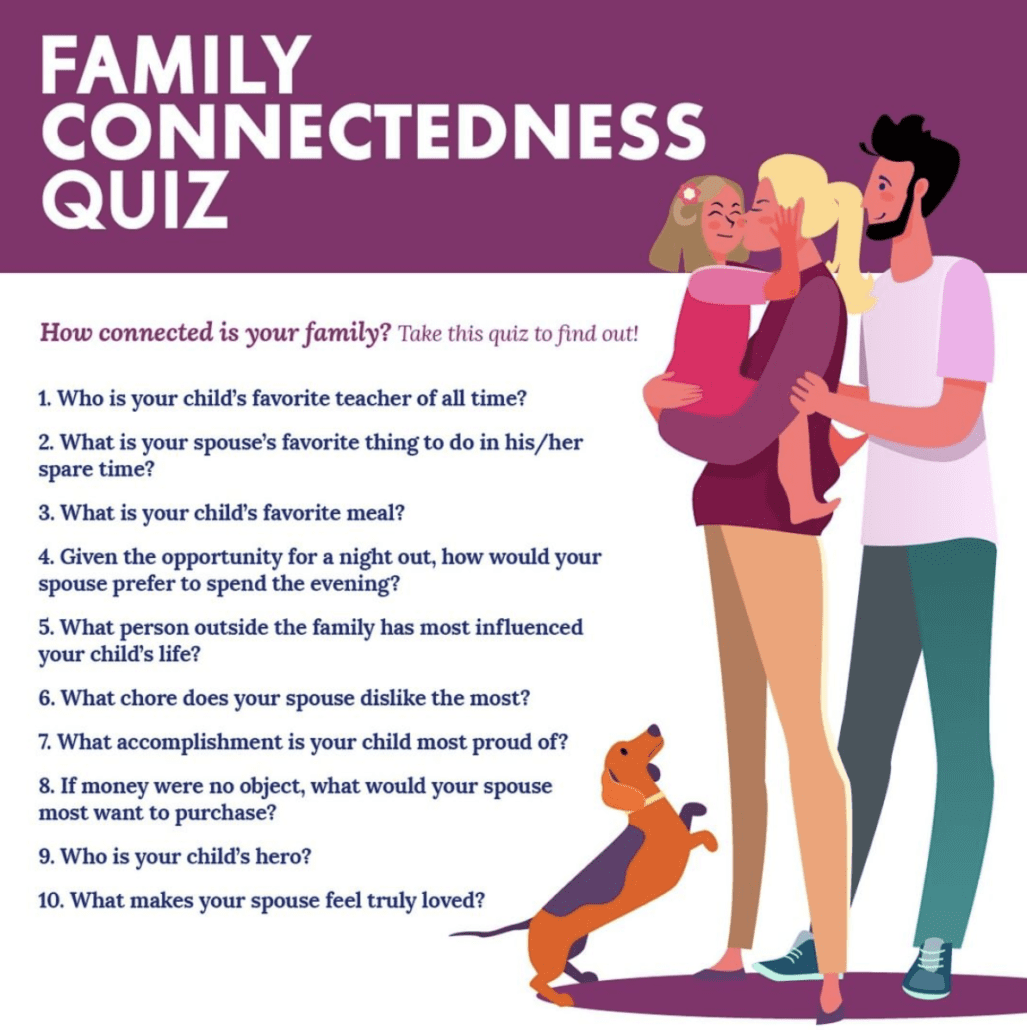
Ready to take a short family connectedness quiz?

  1. Who is your child’s favorite teacher of all time?
  2. What is your spouse’s favorite thing to do in his/her spare time?
  3. What is your child’s favorite meal?
  4. Given the opportunity for a night out, how would your spouse prefer to spend the evening?
  5. What person outside the family has most influenced your child’s life?
  6. What accomplishment is your child most proud of?
  7. If money were no object, what one thing would your spouse most want to purchase?
  8. What household chore does your spouse dislike the most?
  9. Who is your child’s hero?
  10. What makes your spouse feel truly loved?

Now, go check out your answers to see how close you were to getting them right. Being truly connected to your family is the only way to know all the answers to these questions.

“From a cultural standpoint, the connections that people have with one another and through social networks have been shown to improve the mental, physical and spiritual health of individuals,” said Christopher Brown, anthropologist and president of the National Fatherhood Initiative. “There is something that happens physiologically when people are connected, which is why people do better when they are involved in healthy relationships with others.”

One of the most powerful relationships is between a parent and child. Studies show that parents are the first and most important teachers of children. Kids thrive when they can depend on a reliable parent when they need to talk, when they want input, when they need a hug, or want assurance that life will work out.

Research from the University of Michigan found that the connectedness that takes place during frequent meal times with the family was the single strongest predictor of better achievement scores and fewer behavioral problems, even better than time spent studying or in a faith setting.

Experts agree that:

  • Conversation at the dinner table shows to increase children’s mental and verbal abilities;
  • Eating together promotes good communication, and strengthens family bonds and relationships;
  • Families who regularly eat together have more cohesion and unity; and
  • Family meals give children a sense of security.

Connections count every day of the year. If you didn’t do so well with the quiz above, this could be a great opportunity for you to re-evaluate how you connect in your home.

This article originally published in the Chattanooga Times Free Press on November 18, 2018. Click here to read the entire article.