
Help! My Husband is Boring
You probably never thought it would get to this. You always seemed to like the same shows, movies, and activities, and you spent all your free time together. Now, it feels like you NEVER do anything together, or that your husband is just boring and never WANTS to do anything with you. If you’re honest, it seems like all he does is, well, NOTHING.
You’ve got questions:
When did this happen?
How did I not notice the changes?
How am I married to such a BORING person?
Maybe these thoughts are new. Or perhaps they’ve been nagging you for a while. Either way, it’s gonna be important to get to the core of the problem.
You can work through this together! Here’s what I suggest:
Share your feelings.
If you’ve thought about how things have changed in your relationship, tell your spouse what you’re feeling. Maybe you’ve learned that your “Love Language” is quality time. If so, let him know you miss spending time with him and give him the chance to meet your needs. Demanding time with those you love can negatively impact your relationship.
Maybe one or both of you has changed. You may have a need/desire for more in your life. But if you tell him what you need, he may surprise you. And vice versa! Newsflash: your hubby can’t read your mind. You have to tell him!
Seek to understand what’s going on with your man.
Whether you’re still in the honeymoon phase or you’ve been married for some time, find out what’s happening in your husband’s world. He may be processing stress you don’t know about. Whether it’s financial stress, job, or family issues, understanding how things impact his heart and mind goes a long way. He may be trying to protect you, which may affect his willingness to be spontaneous and fancy-free. Could be your husband isn’t as boring as he seems to you right now.
Find common interests.
Spouses will sometimes “claim” to like an activity because it matters to the other spouse. They can go along for a while, but it can’t last forever. Discovering that your spouse participated in an activity that didn’t truly interest them because it mattered to you is swoon-worthy, for sure. Your task now is to find things you can both enjoy together. It doesn’t have to be fancy, but finding new common interests together can be a relationship booster!
Spend time alone so you can enjoy time together.
Many couples think they need to do everything together. On the contrary! Believe it or not, your relationship benefits when you grow as individuals, too! Everyone needs to have personal space and activities that feed them as individuals. It doesn’t necessarily mean something’s wrong if you don’t do everything together.
If you’re resistant to your spouse having some alone time, you may want to ask, “Why am I afraid that they want to spend time alone? What makes me uneasy about that?” Having space to do things they enjoy alone may increase their desire to do something with you.
Here’s an example: I enjoy shopping for a bargain. When my husband encourages me to go find some deals, I’m much more inclined to watch his favorite movie with him.
Be willing to shake it up a bit.
Marriage is a two-way street. Maybe you like to go, go, go. Your spouse may tend to chill, chill, chill. Neither is good or bad, right or wrong; the key is respecting the differences. There may be times when it’s good to run at full speed (like holidays), but once you’re done, be willing to have some chill-out time. You may have to fight your internal voice saying, “There is so much to do,” or, “This is a waste of time.” Sometimes learning to just Be (spend quiet, quality time with your spouse) rather than Do (Go, Go, Go) builds the connection between you. What can it hurt for YOU to try something new and different? The result may shock you.
Whether you see your husband as boring or not is all about YOUR PERSPECTIVE. You get to choose how you look at him. Being open to a little self-care for yourself AND your spouse can only enhance your marriage relationship. You can continue to grow, learn, and love each other better when you look for excitement in the right places.
Related blogs:
Should I Be Upset That My Husband Watches Porn?
So your husband watches porn, and you’re wondering how you should feel about it. Perhaps you’re frustrated and wondering if you have a reason to be upset. Or maybe it doesn’t bother you, and that’s what bothers you. It’s probably hard to know just what to feel or think or do with this.
Pornography can be a complicated issue in marriage. And the truth is, you could be dealing with a whole host of other emotions and thoughts about it.
First of all, it’s okay to feel these things.
I can’t tell you how you should feel (nor should I, nor should anyone).
But here’s what I can do: I can share what we know about how pornography can affect a marriage. Because I imagine that’s the one concern you probably have above all else.
With that in mind, let’s take a look at what some research tells us:
- Married couples who use porn are more likely to divorce than those who do not use it.
- Watching porn can create unrealistic pictures in people’s minds about how sexual relationships are supposed to function. This can affect relationships negatively. It can decrease the viewer’s perceptions of real-life intimacy because they compare marital sex with what’s on the screen (i.e., porn stars).
- Viewing porn can lead to sex becoming more about one’s own physical pleasure and less about the emotional aspect of sex in marriage.
- Pornography can create a vicious downward cycle; if something isn’t going well in the marriage, a person might turn to porn. But then, turning to porn can make marital problems even worse.
- Pornography consumption is linked to decreased intimacy, less satisfaction in marriage, and infidelity. Not to mention an increased appetite for porn that depicts abusive, illegal, or unsafe practices and a higher rate of addictive behavior. (Just to be clear, the research gives strong evidence that porn is, indeed, addictive. Keep reading for more on this.)
- According to the American Academy of Matrimonial Lawyers, over half of divorce cases involved “an obsessive interest in pornographic websites.”
- Viewing pornographic material increases the risk of developing sexually deviant tendencies, committing sexual offenses, and accepting rape myths.
- Evidence shows that pornography affects the brain, much like a chemical addiction. It releases endorphins that cause an increased need for more arousing and shocking material. Over time, to get the same feeling or “high,” you have to get a heavier dose. Some studies indicate the chemicals released in the brain from watching porn are two-hundred times more potent than morphine and at least as addictive as cocaine. That’s pretty powerful stuff.
- Watching porn also causes mirror neurons to fire in the brain, causing the viewer not merely to respond to the image on the screen but to put themselves in the main character’s place.
Unfortunately, these are just a few of the negative insights researchers found.
The bottom line is that pornography is easy to access and can cause severe marriage rifts. Yes, you’ll find many misconceptions out there from mainstream media about how porn isn’t all that bad. Some counselors even encourage couples to use porn in their relationships for various reasons.
I personally prefer to err on the side of good solid research, which suggests that, overall, couples should avoid porn for the sake of marital health. I encourage you and your husband to let the science and research about porn inform your feelings, reactions, and conversations about porn in your marriage.
If you’d like to learn more about porn or want more information to help you move forward together, these blogs can help you out:
- My Spouse Wants Sex More Than I Do
- 10 Things Every Married Couple Needs to Know About Sex
- How Often Should We Have Sex?
- How Porn Impacts the Brain
- 9 Warning Signs of Porn Addiction
- Resources for Dealing With Porn Addiction
***If you or someone you know is in an abusive relationship, contact the National Hotline for Domestic Abuse. At this link, you can access a private chat with someone who can help you 24/7. If you fear that someone is monitoring your computer or device, call the hotline 24/7 at 1−800−799−7233. For a clear understanding of what defines an abusive relationship, click here.***
Sources
1Perry, S. L., & Schleifer, C. (2018). Till Porn Do Us Part? A Longitudinal Examination of Pornography Use and Divorce. The Journal of Sex Research, 55(3), 284–296. https://doi.org/10.1080/00224499.2017.1317709
2Zillmann D, Bryant J. Pornography’s impact on sexual satisfaction. J Appl Social Pyschol. 1988;18(5):438-453. doi:10.1111/j.1559-1816.1988.tb00027.x
3Perry SL. Pornography and relationship quality: Establishing the dominant pattern by examining pornography use and 31 measures of relationship quality in 30 national surveys. Arch Sex Behav. 2020;49(4):1199-1213. doi:10.1007/s10508-019-01616-7
4Maas MK, Vasilenko SA, Willoughby BJ. A dyadic approach to pornography use and relationship satisfaction among heterosexual couples: The role of pornography acceptance and anxious attachment. J Sex Res. 2018;55(6):772-782. doi:10.1080/00224499.2018.1440281
5Laier, C., & Brand, M. (2016). Mood changes after watching pornography on the Internet are linked to tendencies towards Internet-pornography-viewing disorder. Addictive Behaviors Reports, 5(C), 9–13. https://doi.org/10.1016/j.abrep.2016.11.003
6Schneider, J. P. (2000). A Qualitative Study of Cybersex Participants: Gender Differences, Recovery Issues, and Implications for Therapists. Sexual Addiction & Compulsivity, 7(4), 249–278. https://doi.org/10.1080/10720160008403700
7Stack, S., Wasserman, I., & Kern, R. (2004). Adult Social Bonds and Use of Internet Pornography. Social Science Quarterly, 85(1), 75–88. https://doi.org/10.1111/j.0038-4941.2004.08501006.x
8Manning, J. C. (2006). The Impact of Internet Pornography on Marriage and the Family: A Review of the Research. Sexual Addiction & Compulsivity, 13(2-3), 131–165. https://doi.org/10.1080/10720160600870711
10Wright, P. J., Tokunaga, R. S., & Kraus, A. (2016). A Meta-Analysis of Pornography Consumption and Actual Acts of Sexual Aggression in General Population Studies. Journal of Communication, 66(1), 183–205. https://doi.org/10.1111/jcom.12201
11Allen, M., Emmers, T., Gebhardt, L., & Giery, M. A. (1995). Exposure to Pornography and Acceptance of Rape Myths. Journal of Communication, 45(1), 5–26. https://doi.org/10.1111/j.1460-2466.1995.tb00711.x
12Love, T., Laier, C., Brand, M., Hatch, L., & Hajela, R. (2015). Neuroscience of internet pornography addiction: A review and update. Behavioral Sciences, 5(3), 388-433. doi:http://dx.doi.org.proxy.lib.utc.edu/10.3390/bs5030388
13Ponseti, J., Bosinski, H. A., Wolff, S., Peller, M., Jansen, O., Mehdorn, H. M., Büchel, C., & Siebner, H. R. (2006). A functional endophenotype for sexual orientation in humans. NeuroImage (Orlando, Fla.), 33(3), 825–833. https://doi.org/10.1016/j.neuroimage.2006.08.002
https://fightthenewdrug.org/how-porn-can-change-the-brain/
I’m Trying to Save My Marriage, but My Spouse Isn’t
Each new year, people examine things they want to change or improve. Some people want to work on their marriage. That’s a worthy goal, but what if you’re one of those people who’s trying to save their marriage, and you feel like your spouse isn’t trying? That can be painful, for sure.
Marriage is two people who choose daily to walk together through life. It’s probably a good idea to find out whether you’re having a marriage problem or if you or your spouse are having individual issues that are impacting your marriage. A good marriage counselor can help with that. In either case, these steps can help you move forward.
Take time for self-reflection.
Inventory your thoughts, feelings, frustrations, challenges, areas for growth, etc.
Ask questions like:
- Why do I feel like I’m the only one trying?
- What’s making me feel dissatisfied?
- How do I want my marriage to be?
- Am I trying to change my spouse or trying to add value to my marriage?
- What can I do differently?
- How am I putting forth my best effort?
Walk a Mile in Your Spouse’s Shoes (Empathy).
Now that you’ve examined things from your perspective, put on your spouse’s shoes. Look at your marriage from their perspective. Ask them what they’re thinking and feeling. When you’re open and curious, they may be willing to share. Maybe they don’t want to add anything to your plate. Seeing through your spouse’s eyes may show you that they’re trying more than you realize.
Change the Dance (It Only Takes One).
Even though “It takes two to tango,” you can change the dance! It may be challenging, and you may be tired of taking the first step, but don’t give up! Marriage therapists say that if just one person is working to improve the marriage, there’s hope. There are many great resources out there to help. And who knows? Before you know it, you may not be dancing by yourself at all.
Connect More by Criticizing Less.
Sometimes we think we’re “helping” when we point out our spouse’s mistakes or missteps. Sure, we have good intentions, but our spouse hears criticism. They may think who they are (or their effort) isn’t good enough, so they just give up. Criticism hinders connecting. I want to challenge you to say 5 positive things for every negative thing you say. Experts say this makes a massive difference in your relationship. (Check out 30 Days of Gratitude and Love here.)
Be The Change You Want To See.
The key to being the change is your attitude/perspective. Changing may require that you do things without expecting anything in return. Or just listen. Or just put one foot in front of the other. What kind of change do you want to see? Are you connecting in a meaningful way with your spouse and creating space for things your spouse enjoys?
Mark Gungor, marriage speaker, says we should try to “outdo the dog.” Think about how your dog greets you when you come home. Your fur baby shows you they’re excited to see you and spend time with you. What if you tried this with your spouse? What could it hurt?
Nobody wants their marriage to go through changes and hard times, but it’s normal. If you’re in a challenging stage, your willingness to keep trying to save your marriage may help pave the way for your spouse to try, too.
Related resources to help you out:
- How to Find Good Relationship Advice
- Finding a Good Marriage Counselor
- How to Improve Your Marriage Without Talking About It
- How to Save a Marriage That is Falling Apart
***If you or someone you know is in an abusive relationship, contact the National Hotline for Domestic Abuse. At this link, you can access a private chat with someone who can help you 24/7. If you fear someone is monitoring your computer or device, call the hotline 24/7 at 1−800−799−7233. For a clear understanding of what defines an abusive relationship, click here.***
How to Find Common Interests With Your Spouse
There are two kinds of spouses in the world. (Ugh. I can’t stand statements like this.)
- Those who think it’s not important to share some common interests with their spouse.
- Those who think not having common interests is the end of the world. (Or marriage.)
They’re both wrong.
“I don’t think our marriage can work. I just think we have nothing in common.” Keep thinking. You probably have more in common than you think. It’s easier to develop some common interests than you think. Your differing interests are probably healthier than you think.
Developing some common interests reinforces that you are a team and keeps you connected. It builds one of the most overlooked areas in marriage—friendship. (Newlyweds: “We’re soooo in love!” 10 Years Later And Beyond: “We’re best friends.”)
For those two kinds of spouses (and everyone in between) here’s how you find those common interests.
Each of you get out a piece of paper and thoroughly answer these three questions:
- When you were a kid, what were you interested in?
- What were you interested in when you were in high school?
- What are you interested in lately?
Now compare your answers. One of you was interested in exploring as a kid. One of you was interested in camping out. Reconnect with those childhood interests as you connect with each other on a camping adventure. Be curious. Keep comparing lists. Make connections. Find the overlap.
(Can’t find a single interest that connects, overlaps, or is in common? Really? I wanna know… Email pictures of your lists to john@firstthings.org and if I can’t find some commonality, I’ll personally mail you a shiny new nickel.)
Get your pieces of paper back. List causes or issues, big and small, that you are concerned or passionate about.
Lather. Rinse. Repeat. Find something you can do about it together. It doesn’t have to be a big deal. Get creative. It might be litter. Pick a local park and get some gloves and trash bags and chit-chat as you pick up trash. Nothing brings people together like a common cause. Your marriage might spark a movement.
Take your problem to the internet like all rational people do. Try Random Thing Picker.
Let the universe intervene. Each of you puts in two or three ideas for date night. I put in: Dance Class, Cooking Class, Painting Class, Movie Night, Game Night, and to live on the edge, I put in Housework. Then click “Pick One!” Boom! Cooking Class. Sign up for a class or find one on the internet. (Spice it up by inputting things neither of you has tried before. Who knows where this will lead?)
Having problems finding common interests with your spouse? Yes, I think you can solve them with a piece of paper or a few clicks. And some time and thought. Oh, and the commitment to work on your friendship and to love your spouse because of your differences, not in spite of them. You got this!
Do I Have To Tell My Spouse Everything?
The opposite of a fact is falsehood, but the opposite of one profound truth may very well be another profound truth. -Niels Bohr
Do I have to tell my spouse everything?
Do you want your spouse to tell you everything?
It depends. It really does.
What do we know for sure?
Once you marry someone, you aren’t leading your own life anymore. You are officially in a partnership, and you need to treat it as such. It’s important to discuss and respect boundaries.
We want to be known, understood, and accepted. Viewing marriage as a lifelong commitment between two people creates a safe environment to be accurately known, completely understood, and unconditionally accepted. Striving to accomplish those things is the journey of a lifetime.
Relationships are built in good faith on a foundation of honesty, trust, and communication. If you want to have a healthy, lasting marriage, it is not wise or healthy to be doing things you aren’t comfortable sharing with your spouse. If there is something you want or need, sit down with your spouse and discuss it.
The moment you under-share, withhold relevant information, cross agreed-upon boundaries, or intentionally try to hide something, and are found out—the trust evaporates and your bond is weakened or broken. What breaks in an instant takes a long time to rebuild.
✶ I don’t know you. I don’t know your spouse and I don’t know the health of your marriage or the boundaries you have agreed to put in place to protect your relationship and make it thrive. But here are some general things to think about as you consider what needs to be shared with your spouse:
- You shouldn’t share what doesn’t belong to you. Your spouse has no claims to what friends and colleagues confide in you. “Secret” does not equal “Private.”
- There is a major difference between telling your partner everything in your past because you want to and telling your partner everything in your past because they want you to.
- You might be strong enough to share the truth, but your spouse might not be strong enough to deal with it. Sensitivity and timing are everything.
- Don’t fall into the trap of believing you only have two options: tell your spouse everything or tell your spouse nothing. There could be dozens of legitimate options in between. Be compassionately discerning.
- You need to examine your motives as to why you are sharing certain information.
- It can be a short trip from “words” to “wounds.” Choose your words carefully.
- Some of our choices bring shame, pain, and consequences to ourselves and others. Integrity doesn’t compound consequences beneath layers of lies.
“The opposite of a fact is falsehood, but the opposite of one profound truth may very well be another profound truth.” Lying, deceit, and deception are wrong, but sharing is not necessarily always caring. But don’t disconnect the profound relationship between truthfulness and love.
Related blogs:
4 THINGS EVERY COUPLE SHOULD KNOW ABOUT COMMUNICATION IN MARRIAGE
Maximize Your Marriage Series | Tips for Healthy Communication
HELP! MY SPOUSE HATES TO TALK ABOUT BOUNDARIES!
4 STEPS FOR SETTING GOOD BOUNDARIES
HOW BOUNDARIES CAN PROTECT YOUR MARRIAGE
***If you or someone you know is in an abusive relationship, contact the National Hotline for Domestic Abuse. At this link, you can access a private chat with someone who can help you 24/7. If you fear that someone is monitoring your computer or device, call the hotline 24/7 at 1−800−799−7233. For a clear understanding of what defines an abusive relationship, click here.***
I Love My Spouse, But I’m Thinking About Having an Affair
How can you love your spouse and be thinking about having an affair? Is that even possible? The whole thing is super confusing.
Well, believe it or not, there may be a logical explanation.
Esther Perel, author of Mating in Captivity, says couples need both closeness and distance to sustain a level of sexual intimacy or gratification.
Many couples have been together 24/7 with very little time apart since the pandemic began. Time apart helps create sexual energy while you think about being with your spouse later in the day.
COVID has taken away a lot of the opportunity for anticipation. With the lowered level of sexual energy, many couples are bored. And they may not feel much attraction toward each other at all.
Since our brains crave novelty and excitement, the lackluster sexual energy at home may open the door to looking elsewhere for that excitement you used to experience with your spouse.
If you love your spouse, but you’re thinking about having an affair, consider these things…
“When you are feeling some emotional impulse, as in entertaining the idea of an affair, you have an opportunity to examine the impulse rationally, says Dr. Scott Haltzman, author of The Secrets to Surviving Infidelity.
“Stop. Consider the consequences. The very same muscle you exercise when you consider the consequences of running a red light—smashing another car, getting a ticket, dying, can be exercised in this instance,” Haltzman says. “Thankfully, we don’t just live on instinct. We can think through the risks of our potential actions.”
Haltzman suggests considering all the things that could happen, such as contracting a disease and giving it to your spouse.
Plus, think about the hurt your spouse will feel when they find out.
“In my experience, most affairs are discovered,” Haltzman says. “Maybe not immediately, but at some point. You need to consider the impact on the person you have an affair with and the impact on your own body because you are keeping a secret from your spouse.”
There’s also the moral and practical issue, according to Haltzman. You made a promise to your spouse and to yourself to be faithful as one of the pillars of your marital relationship. And you promised that when nobody else was vying for your attention.
You have to guard against rationalizing your thought process.
Haltzman believes it’s possible to bring the sexual energy back into your marriage, even if you’re thinking about having an affair.
He also suggests taking the energy you were putting toward considering cheating and putting that energy back into your marriage.
Here’s how!
- Do new things together. When people are exposed to novel situations, exciting things, or new challenges together, it draws them together. New experiences with your spouse will increase your sense of attraction to each other.
- Create space and anticipation. Agree that you’ll spend the day apart—even if it’s on opposite ends of the house. Consider only communicating during the day by cellphone, so you can look forward to seeing each other at the end of the day.
- Play dress up. Staying at home all the time may lead to staying in pajamas or sweats and not caring for ourselves. Do something different. Consider what would be sexy to your spouse.
- Use your imagination for your marriage. Use your imagination to focus on and create sexual energy with your spouse instead of someone else.
- Get back to the basics. Do the things you did when you were apart and looking forward to being back together. Tease each other with text messages. Create adventure through the element of surprise. Laugh together. Write love notes and leave them in unexpected places. 😉
- Be willing to be playful. Go outside and stamp a message in the snow, go camping, or create art together. Make a funny video, create a themed date in your bathroom or somewhere else that’s fun.
While the idea of an affair may seem exhilarating, it’s a pretty risky business with potentially lasting and damaging consequences. Find out why you might be entertaining these thoughts. Then turn toward your spouse and be intentional about creating something different. These things could be the key to changing the sexual climate in your marriage.
Here are some other blogs you might find helpful:
- WHY PEOPLE REALLY HAVE AFFAIRS (IT’S NOT ALWAYS JUST ABOUT SEX)
- 3 WAYS GOOD COMMUNICATION CAN ENHANCE SEX IN MARRIAGE
- 3 WAYS TO HAVE BETTER SEX IN MARRIAGE
- HOW TO PROTECT YOUR MARRIAGE FROM AN EMOTIONAL AFFAIR
***If you or someone you know is in an abusive relationship, contact the National Hotline for Domestic Abuse. At this link, you can access a private chat with someone who can help you 24/7. If you fear that someone is monitoring your computer or device, call the hotline 24/7 at 1−800−799−7233. For a clear understanding of what defines an abusive relationship, click here.***
Why People Really Have Affairs (It’s Not Always Just About Sex)
Marital affairs are kind of like rust. On the surface, it’s apparent that a single, ugly event has happened. But underneath is a complex process of chemical reactions and driving forces that have built up over time. Affairs are complicated like that. And finding out why people really have affairs can be even more complicated.
Therapist Esther Perel describes an affair as having three essential elements:
- A secretive relationship
- An emotional connection
- A sexual chemistry
The word chemistry is used here because actual sexual activity doesn’t have to be involved to be a marital betrayal. To paraphrase Perel, the mere thought of a single kiss can be as powerful as hours of lovemaking.
It’s essential to understand emotional affairs-—when one is getting their emotional needs met by someone other than their spouse—are just as damaging to a marriage as sexual affairs. Not to mention the fact that emotional affairs often quickly escalate to sexual ones.
But what causes a spouse to stray? It’s tempting to want to peg the blame on a single factor. He just wasn’t getting enough from his wife, so we went hunting in the bars. She didn’t feel loved at home, and another man showed her attention.
Rarely do affairs boil down to one single reason. What leads up to the one-night-stand or the seductive conversations over text is usually a mix of ingredients that have been simmering for a while. To understand this, it might be more helpful to think of affairs as having contributing factors rather than reasons.
Let’s look at five of these contributing factors to help explain why people have marital affairs:
1. They let their guard down.
Good marriages do not prevent affairs. Just when you think, “I could never do that,” or “Our marriage is much too healthy for infidelity,” is when you are the most vulnerable. Anne Bercht, director of Beyond Affairs Network, writes that the keys to affair prevention are realizing your marriage is not immune because it’s good, and being informed. She says there is no such thing as affair-proofing your marriage. But “developing open, honest, respectful communication in your relationship, including the ability and commitment to give and receive constructive criticism” is a strong foundation to keep your guard up.
2. They let their marriage go out of focus.
We often become hyper-focused on work, stress, hefty schedules, or even kids. Especially kids. Life happens. It’s easy to fool ourselves and say we do this for our marriage. The problem is our marriage suffers because it’s not being focused on. It’s in these circumstances the doors to infidelity crack open. You can minimize this factor by ensuring your focus remains on your spouse.
3. They give a NOD.
Infidelity and marriage expert Scott Haltzman explains in his book, The Secrets to Surviving Infidelity, that an unfaithful partner gives a “NOD” toward an affair: Need, Opportunity, Disinhibition. The Need is something they feel is missing in their life, such as love, respect, attention, or emotional support. The Opportunity for the affair might be a business trip, an office party, the gym, or being alone with someone in your circle of friends. And the Disinhibition can be alcohol or drugs, but perhaps more often something such as resentment, depression, or a sense of entitlement.
What is interesting is the NOD can also be the key to avoiding infidelity. The more two people seek to meet each other’s needs in marriage, it minimizes the opportunities and disinhibition that leads to betrayal.
4. They were seeking something they feel they didn’t have.
Esther Perel says that affairs are less about sex and more about desire. “At the heart of an affair you will often find a longing and a yearning for an emotional connection, for novelty, for freedom, for autonomy, for sexual intensity…” The problem here is that often the other spouse doesn’t know these things are missing because they are never told. A healthy person communicates needs to their spouse.
5. They aren’t happy with themselves.
Many times, the affair is more about the unfaithful person than it is about the marriage or the other spouse. Perel, again, offers lots of wisdom here: “When we seek the gaze of another, it isn’t always our partner we are tearing away from, but the person we have ourselves become… We aren’t looking for another person as much as we are looking for another self.” Experiencing something missing from your marriage and seeing the NOD at work requires a hard inward look at yourself. It begs the question, “Am I happy with who I am? Am I about to let dissatisfaction with myself damage my marriage with this choice? “
The truth of the matter is we are all capable of having an affair. However, every spouse has the ability to say, even though I am capable, I will make the conscious choice not to walk through that door. As Anne Brecht puts it, be informed. Be aware of the contributing factors that can be at work and work to reverse those. Be open with your spouse and talk about these ideas. Together, make the conscious choice to remain steadfast in your marital relationship.
***If you or someone you know is in an abusive relationship, contact the National Hotline for Domestic Abuse. At this link, you can access a private chat with someone who can help you 24/7. If you fear that someone is monitoring your computer or device, call the hotline 24/7 at 1−800−799−7233. For a clear understanding of what defines an abusive relationship, click here.***
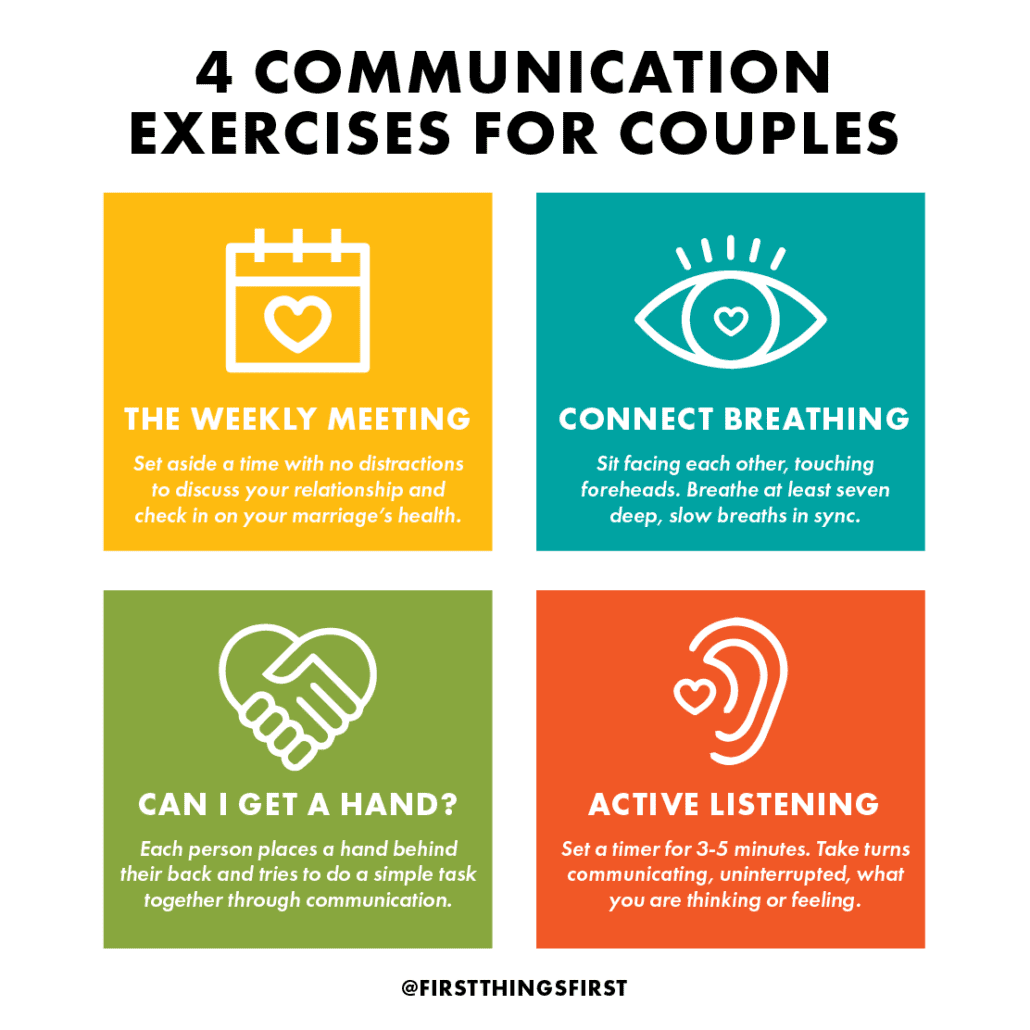
4 Communication Exercises For Married Couples
Healthy communication lies at the root of any successful relationship. In marriage, this is even more of a necessity. Like our muscles, our communication skills also need to be worked out. There are practices we can make part of our regular routines that will strengthen communication in our marriage. Here are four communication exercises for married couples.
Exercise #1: The Weekly Meeting
If your marriage is like mine, you’re busy. You both have schedules, and your kids have schedules… I think my kids’ schedules are often busier than mine. This exercise is excellent to carve out time to focus on your marriage intentionally.
Set aside a non-negotiable chunk of time (30 minutes is a good starting point) when you will have no distractions. No phones, no tablets, no television, no kids. This time is for you to discuss your relationship and check in on your marriage’s health.
So what do you talk about? Start here:
- How are we doing as a couple?
- Is there anything we need to finish addressing from this week?
- How can I make you feel more loved and appreciated?
You don’t have to stop here. These questions are just ideas to get you started.
As you dedicate this time each week, check out these keys to effective communication in marriage to enhance your communication.
Exercise #2: Connecting Through Breathing
The purpose of this exercise is to focus on your partner and remove distractions. To begin, sit facing each other, touching foreheads. Tilt your chins down, so you don’t bump noses.
Breathe at least seven deep breaths. Try to breathe slowly and in sync. As you get the hang of this exercise, you may choose to do more breaths or focus on breathing for a set amount of time. It’s all about connecting and focusing on one another.
When you need to slow down and refocus, this is a great practice. Once you have refocused on one another, take the time to talk about how your marriage is doing.
This exercise is ideal for clearing your minds and having a healthy conversation.
You’ve had conversations with your spouse, even arguments, and maybe straight-up fights about this issue or that problem, BUT those interactions often don’t lead to any solutions. But why is that exactly?
Join us for this 20-minute webinar to find out!
Exercise #3: Can I Get A Hand?
Often in marriage, misunderstandings come from not sharing our needs. Your spouse is not a mind reader, so it’s vital to communicate your needs clearly and effectively. This exercise will help.
In this exercise, you’ll both be working toward a common goal. Each person will place a hand behind their back, and together you’ll try to do a simple task such as buttoning a shirt, pouring a cup of coffee, or any other task around the house. Be as clear as possible in communicating with each other to accomplish the task together.
This was a pretty enlightening experience for me. We had some really good laughs AND I learned there were some things I could do to communicate more clearly with my wife.
Exercise #4: Active Listening
This exercise focuses on verbal and nonverbal communication.
Set a timer for 3-5 minutes. One spouse communicates whatever they are feeling or thinking, uninterrupted. The other spouse listens and communicates nonverbally. When the timer goes off, both of you discuss the experience.
Then switch roles and practice again.
These are just a few exercises you can practice to increase communication in your marriage. Healthy communication plays an essential role in any thriving relationship. Make exercising your communication muscles a priority in your marriage and take it to the next level.
Ready, set… time to work out!
Related:
How To Improve Bad Communication In Marriage
3 Ways Good Communication Can Enhance Sex In Marriage
4 Things Every Couple Should Know About Communication In Marriage