
Fun Ways for Families to Connect During the Holidays
With all of the expectations around the holidays, things can get kind of crazy. There’s bound to be disagreements about how, when or IF you do all the things. Think traditions, party plans, travel—you name it. The very time that’s supposed to bring families closer together is often filled with more fun stuff like extra stress, fighting kids, awkward extended family dynamics, and sometimes marital tension. Whew!
Sometimes the craziness gets the best of us and family members start to feel disconnected. This leads to all kinds of holiday drama—the very thing we all want to avoid.
Want to help make sure the holidays are a time where family members feel connected and close? Here are some things you can do at home, in the car, during meals, and out in the community that not only will create conversation but also laughter, insight, memories, and you guessed it, CONNECTION!
IF YOU’RE TRAVELING…
If you do decide to travel, make sure you spread the love when you’re out and about. But while you’re in the car, instead of automatically plugging into technology, what about giving your kids a limited amount of time with tech stuff? Don’t be intimidated by the pushback and don’t expect them to thank you any time soon. Get creative and offer some motivation for participation and keep them busy so you don’t hear, “They’re breathing on me!” during your hours-long trip. For example, for every 30 minutes you play the game you get X number of minutes with your screen. During the downtimes, stay safe and healthy with some of the socially-distant/safe activities on the journey:
- Categories: Pick a category (Disney movies, popular songs, flavors of soda) and take turns naming something in that category until someone is stumped. (This person loses and the winner picks the next category.)
- Going on a Picnic: This is a memory game for all ages! The first person starts a story with, “I’m going on a picnic and I’m going to bring…” and then lists an item. The next person says, “I’m going on a picnic, and I’m going to bring…” and then lists the first person’s item PLUS a new item. As the story grows and grows, each person repeats the list and adds a new item. The first person to incorrectly list all the items is out! You can keep playing until only one person remains.
- License Plate Game: Interpret the letters in each license plate you pass. For instance, TMK could stand for “Toasty Miniature Kangaroo.”
- People-watching: Watch a vehicle traveling on the road near you for a few minutes. Make up a story about the people in the car. Answer questions like: What are their names? Where did they come from? Where are they going? Why are they going there? What are they going to do when they get there? The sillier and more detailed the story is, the better!
IF YOU’RE STAYING AT HOME AS A FAMILY
- Plan a walk and play “I Spy.” When you exercise together, your brain releases endorphins that create “feel-good memories” you can all enjoy for years to come. Walk around the yard, neighborhood, park, or find a local hiking trail, but encourage the whole family to come! To keep the kids engaged for the walk (and to keep things playful for the adults), play as many rounds of “I Spy” as you can. Then keep track of who wins the most “I Spy” rounds and award them with a special treat when you get home, like hot chocolate, a cookie, or maybe watching the movie or show of their choice.
- Make something special. Baking goodies for the ones you love is fun, but baking goodies for someone in need, or someone who doesn’t expect it is even more fun. It also teaches the littlest ones in the family that holidays aren’t just about receiving, but giving! Choose one or two people, families, or organizations you’d like to delight this holiday season. Then, gather together in to bake something yummy together and share. Consider giving to an elderly neighbor, a family friend, the staff of a local nonprofit your family supports, etc.
IF YOU’RE SHARING A MEAL WITH OTHERS…
To avoid awkward silence at the dinner table with relatives or friends you may not see very often, try a few of these conversation starters:
- What is one way you have helped another person this year?
- Who is someone in your life you’re thankful for and why?
- If you could have dinner with anyone (past or present), who would it be and why?
- If you could have a superpower what would it be and how would you use it?
- What is the most beautiful place you have ever seen?
- What is the hardest thing about being your current age?
It’s possible to be in a room or a car full of people who are not interacting fully with each other, especially when routines get thrown to the side, and people are tired and cranky. When people feel disconnected and schedules are upside-down, chaos reigns. Instead of chaos, plan for what you know is coming, whether it is boredom, difficult conversations or unwanted silence. During the busiest season of the year, these tips may help lessen the drama and help you make memories with family and friends.
What to Do When You Don’t Feel Thankful on Thanksgiving
Thanksgiving is right around the corner. Maybe you just aren’t feeling thankful this year. Maybe you haven’t felt thankful for a long, long time. Let’s face it, in a lot of ways, we live in some dark times. I’m with you. There is a reason that suicides go up* during the holidays. There is a reason that this is the season for infidelity and divorce. So, what do you do if, honestly, you just don’t feel very thankful on Thanksgiving?
Don’t beat yourself up for not “feeling it” this year.
It won’t help. You already know that you don’t live in a Third World country without clean drinking water and basic infrastructure. I’m not hitting you with all that stuff. Things can be hard no matter what tax bracket you’re in. Sometimes being more affluent makes it harder to be thankful. Mo’ money, mo’ problems. You don’t have to feel bad for feeling bad. You don’t have to feel bad for not feeling thankful, either.
It might be time to take a hard look at your Thanksgiving Game Plan.
Does it involve a lot of family and travel? Tons of cooking or hosting? Seeing people that might be family, but are difficult to be around? Traditions that come with all kinds of expectations?
This might be the year to start some new Thanksgiving traditions. This might be the year that parents, in-laws, and extended family are all informed that your family will be doing something different this Thanksgiving. (Translation: We won’t be piling kids into a car, fighting traffic for hours, and showing up stressed out with a casserole.)
Try this: “This year, we are taking advantage of the Thanksgiving holiday to stay at home and rest and focus on our family. We wish all of you a wonderful, Happy Thanksgiving!”
There is nothing wrong with that! Your family should get it. Hey, they might be relieved.
Be honest.
Is what you’re referring to as “not feeling thankful” really masking a deeper issue? Is it more accurate to say that you are “unhappy?” Maybe even depressed? Anxious? Lonely? Angry? Bitter? Think of your feelings as an iceberg. Not feeling thankful might be what is showing above the surface, but the deeper issues that need to be dealt with are below the surface.
Sometimes we slap a bandaid on a superficial issue, put on our brave face, go through the motions, and never address what’s really wrong. (We might even be able to fool those close to us for a while.) This isn’t a long-term solution. What we think we are hiding below the surface eventually will “bubble up” in ways that hurt us and even cause pain to those we care about. It’s probably already happening…
Take care of yourself. Hear that? Go get the help you need. This might be the Thanksgiving that you will always be thankful for because you took your mental and emotional health seriously and made self-care a priority in your life.
Okay, you aren’t feeling thankful this Thanksgiving. Often, we look at thankfulness as a feeling and it totally can be something you feel. But sometimes thankfulness is a practice or a discipline or a habit. Thankfulness can be something we do or something we cultivate, not just something we feel. (We get into this habit of letting our feelings drive our actions– I mean we’ve all tried to explain our choices by saying, “Because I felt like it,” right?)
Catch this last thing. This is really cool and it isn’t some Yoda or Mr. Miyagi stuff, but sometimes the actions come first and then the feelings follow. Read that again.
Cultivate thankfulness even though you don’t feel it. Yet.
1. Sit down and list everything you are (or should be) thankful for. Think of different areas of your life, include all the big and all the little things. Start really basic: “I’m alive.”
2. Write a “thank you” card to someone who impacted your life and explain how they influenced you. Try to avoid electronic communication if at all possible. A handwritten note gives you more time to ponder as you write and will mean so much to whoever receives it. Write a few cards if you can. They still make stamps, right?
3. Find a way to make someone else happy this Thanksgiving. It doesn’t have to be big or showy. Often, the smaller the act of kindness, the better. It can be totally anonymous.
Listen, this might sound heartless, but you don’t feel thankful on Thanksgiving this year. So what? How can you make someone else thankful? Make it your mission. Get creative. Get a little crazy. What is a need someone has that you can meet?
Hold on, hold on. Wait a second! What is that you’re feeling? Thankful…
Looking for relationship resources? Click here!
*If you or someone you know is struggling with suicidal thoughts, there are a number of websites and organizations with excellent resources for you. HelpGuide is a great place to start, along with the American Foundation for Suicide Prevention at 988 or 1-800-273-TALK (8255).
Image from Unsplash.com
Leaning Into The Stress of Parenting
I can’t believe that it is less than 90 days from Christmas! It seems like yesterday I was actually looking forward to school starting because it brought some structure back into my carefree summer lifestyle. Today, I am headlong into sports, extracurricular activities, and community service events. It’s far from carefree- it’s stressful. But that’s okay.
I feel exhausted, overwhelmed and don’t know how to get off this merry-go-round that is my life. The real dilemma for me is, do I really want to get off the merry-go-round? Should I get off? Do I know when I need to hop off? Despite all that is swirling around, I am choosing to enjoy this season in my parenting life. I realize that it will only be for a SEASON. So, how do you lean into the stress that is unavoidable?
I am the proud mother of three sons ages 21, 16 and 13. I realize that the time for me to be a Hands-On Mom is quickly coming to a close. If you are like me, living in the midst of chaos, you want to know how to keep your head above water.
Here a few tips on handling the stress of parenting:
- Plan, Plan, Plan: I am not the most organized person. I try to keep the car on the road by creating a plan. Understanding that things will probably change, I still have a calendar with everything on it color-coded. (I need the color-coding!) I include my work schedule, the boys’ school calendar, sports, meetings, extracurricular activities, and even my husband’s two work schedules.
Stress might be inevitable, but NOT having a plan dramatically increases my stress. - Learn To Say, NO: I am generally a social butterfly. I am learning to say “no” to things that are not the BEST use of my time, energy and attention. Even good things and fun things. Sometimes the answer is just, “No.” (If I say “yes,” I make sure to add it to the calendar and, yes, color-code it!)
- Empower My Children: I have to be honest and confess that, often, the reason I feel so overwhelmed is because I am continuing to do things for my sons that they can do for themselves (e.g., washing clothes.) I rationalize doing things for them by telling myself that I can do it faster and get it done correctly (e.g., not placing a red shirt in the white clothes with bleach.)
The reality is that I need to empower my children to be independent and to learn how to do certain things for themselves. And that’s less stress for me. - Follow Your Child’s Lead: If we are honest, there are activities that our children participate in that they HATE. Why do we make them do those things? We tell our kids: It looks good on your resumé. It will help you get a scholarship for college. I would have loved to have this opportunity when I was your age.
There can be a lot of truth in those statements, but what is the balance with letting our children develop their own interests? Sometimes we are stressing ourselves out as parents by rushing our kids around town to do things they don’t even enjoy. Are we really doing it for them or is it to relive our past or fulfill our own hopes and wishes? - Build Relationships: Sometimes stress is relieved in community. I am a proud Band Mom. I have created friendships with other parents whose children are in the band. We tailgate together, sit at the games together, and do the funny band dances with the band. It’s nice knowing we are in this together! (I also get to spend time with my son enjoying something that he enjoys.)
I often hear from moms dealing with an empty nest, “Enjoy your time with your kids. It flies by so fast.” They’re not wrong. In spite of this being a crazy season of life, I cherish these moments with my sons and try to handle the stress in healthy ways.
Image from Unsplash.com
Oh, Valentine’s Day – the one day a year it’s okay to wear pink and red together, tell total strangers you love them, and spend way too much money on chocolate.
And don’t forget about celebrating your overwhelming, joyous love for your partner! Right?
For so many couples, Valentine’s Day is more of a routine than a holiday. Get the flowers? Check. Go out for dinner? Check. Eat (all) the chocolate? Check. Then… go back to the norm the next day. But why has the “day of love” turned into one day of over-the-top, mushy-gushy effort to prove our love to our partner?
It doesn’t have to be that way. You may have heard that couples should “treat every day like it’s Valentine’s Day,” and this is not a bad idea! Now, it doesn’t have to mean that you get flowers for your spouse every day or have a fancy meal each night. It does mean that you and your partner choose to express and celebrate your love for each other every day of the year.
It will look a little different for each couple. But here are a few great ways you and your spouse can celebrate Valentine’s Day every day!
- COMMIT TO SERVE. The humility it takes to serve one another is a great foundation in any relationship. Commit to serving your partner in their needs and wants. Maybe they need some alone time, or they want to try out a new restaurant. Be aware of ways that you can give to your partner and go for it!
- ALWAYS FORGIVE. This is easier said than done, of course! But try letting go of previous pains or arguments and focusing on the conflict as the problem. It’s a great way to start the process of forgiveness!
- CELEBRATE THE GOOD. Every couple is guilty of forgetting to do this. Even something as simple as writing a thank-you note to your partner is a great way to bond!
- BE GENEROUS. This is not financial generosity, but generosity with who you are, the energy you have, and what you give to your love. A balanced relationship is not where each is giving 50%, but where both are giving 100%.
- ENCOURAGE ONE ANOTHER. This may not happen as frequently as most couples wish, but a “thank you,” “I’m proud of you,” or “You were great when…” can totally transform a relationship.
Don’t let Valentine’s Day be the one day a year you think through how you can love your spouse the best. Choose to do at least one thing every day to put a smile on your partner’s face, and see just how far it will take you!
***If you or someone you know is in an abusive relationship, contact the National Hotline for Domestic Abuse. At this link, you can access a private chat with someone who can help you 24/7. If you fear your computer or device is being monitored, call the hotline 24/7 at: 1−800−799−7233. For a clear understanding of what defines an abusive relationship, click here.***
In a quest to find out what makes life meaningful for Americans, the Pew Research Center conducted two separate surveys in 2017. The first asked people to write in their own words what makes their lives feel meaningful, and the second asked respondents to rate how much meaning and fulfillment they drew from different sources.
After reviewing thousands of responses from a diverse range of Americans across the country, in both instances, the most popular answer was clear and consistent: Americans were most likely to mention family when asked what makes life meaningful, and they were most likely to report that they found “a great deal” of meaning in spending time with family.
Family was ranked first by two-thirds of respondents, career or job came in second place, followed by money. One in five cited their religious faith, friendships and hobbies, all of which came in fourth on the list.
What’s perhaps most interesting about this survey is that it mirrors the results from a study commissioned by the YMCA of the USA, Dartmouth Medical School and the Institute for American Values in 2003. Science has consistently demonstrated that people are hardwired to connect to other people, and to moral and spiritual meaning. They don’t just want these connections; they need them.
The evidence is overwhelming. Humans desire close attachments to other people. It begins with our mothers, fathers and extended family, and then moves out to the broader community. Meeting these basic needs for connection is essential to health and to human flourishing.
Large and growing numbers of people are suffering from a lack of meaningful connections to other human beings. This is especially true in today’s digital age. In fact, studies show loneliness is at epidemic proportions in America. However, when people model what it means to be a productive person in society, everyone benefits.
During the holidays, people often evaluate the meaning of life for them. As you gather together throughout the holidays with friends and family, don’t underestimate the power of the connections you’re making. Despite the inconveniences that may come with planning for holiday get-togethers, the time you spend with loved ones provides a type of connectedness that is irreplaceable. And it has the potential to impact future generations.
Click here to read the entire article. It originally published in the Chattanooga Times Free Press on December 16, 2018.
If you’ve ever been a caregiver during the holidays, you know how stressful it can be when caregiving tasks already fill your day. Heap the expectations of a joy-filled season on top of that, and there is real potential for feelings of guilt, anger, resentment and complete fatigue to take over.
Many caregivers are constantly exhausted, and sometimes just putting one foot in front of the other seems daunting. It can be tempting to hide away until after the holidays to avoid dealing with the added stress.
If you can relate, these suggestions may help you as a caregiver during the holidays.
Give yourself permission to put self-care at the top of the list.
You probably know that you can’t give what you don’t have to others, but that is just plain easier said than done. Some family and friends may have more flexibility to give you much-needed breaks to exercise, sleep, treat yourself to some time with friends or to just do nothing.
Instead of trying to do it all yourself, let someone help.
Driving to doctor visits, picking up prescriptions, changing beds, grocery shopping, fixing meals and keeping the house clean can keep you going 24/7. Friends are usually looking for ways to be helpful, especially during the holidays. It will bless you both if you take them up on their offers or ask for what you need.
Think about what makes your heart happy when it comes to celebrating the holidays.
Do those things and eliminate the rest even though you might want to do more. Instead of doing all the decorating, ask a friend if they would do it for you. Send an email instead of cards or have someone help you address envelopes. If hosting the annual holiday gathering feels like too much to handle this year, ask someone else to host. If you still want to host but want less responsibility, let others bring the food.
Take control of your mind and guard against negative self-talk.
If you typically do everything yourself, this can be a particularly complicated time of year. On one hand, you know you need help, but on the other hand, you hate to seem needy. Healthy people ask for what they need and don’t feel guilty about it.
Caring for a loved one goes on for a season, and that time period may be months or years. Whatever the time frame, most people understand how hard it is, and there are often many people in your life who are willing to help you shoulder some of the load so that in the end you don’t end up sacrificing yourself in the name of caring for the one you love.
Click here to read the entire article, which was originally published in the Chattanooga Times Free Press on December 9, 2018.
***If you or someone you know is in an abusive relationship, contact the National Hotline for Domestic Abuse. At this link, you can access a private chat with someone who can help you 24/7. If you fear your computer or device is being monitored, call the hotline 24/7 at: 1−800−799−7233. For a clear understanding of what defines an abusive relationship, click here.***
What are your goals for this season? If you want to provide a time and place where people can enjoy the holidays, relax, celebrate relationships, laugh, count their blessings, play, and help create warm memories, you may want to rethink how you’ve always done things and change things up a bit. As the old saying goes, simple is better… and it’s often a lot more fun for everyone involved.
These ideas can help you celebrate with more focus and less fuss.
- Make a list of everything you plan to do. Divide it between must-do, would like to do and not really necessary.
- See what you can mark off your list. For example, maybe you won’t send holiday cards this year. Instead of throwing a holiday party now, put it off until July.
- Let each family member choose a few of their favorite decorations to put out and leave the rest in the closet.
- Participate in alternative gift-giving. Tell everybody that all gifts have to be homemade this year. Challenge your children to be creative and let them do it themselves.
- Donate to the favorite charity of a family member or friend in their honor instead of spending hours at the mall purchasing a gift they don’t really need or want.
- Ask family members to bring a favorite dish to the family gathering instead of doing it all yourself.
The key to enjoying the holidays and feeling good about the way you spend your time and money during the holidays is to make a plan and stick to it. It is important to involve your family in the process, so share your goals with them and discuss ways you would like to simplify. Encourage them to find creative ways to celebrate. Then work your plan together.
Click here to read the entire article, which was originally published in the Chattanooga Times Free Press on November 25, 2018.
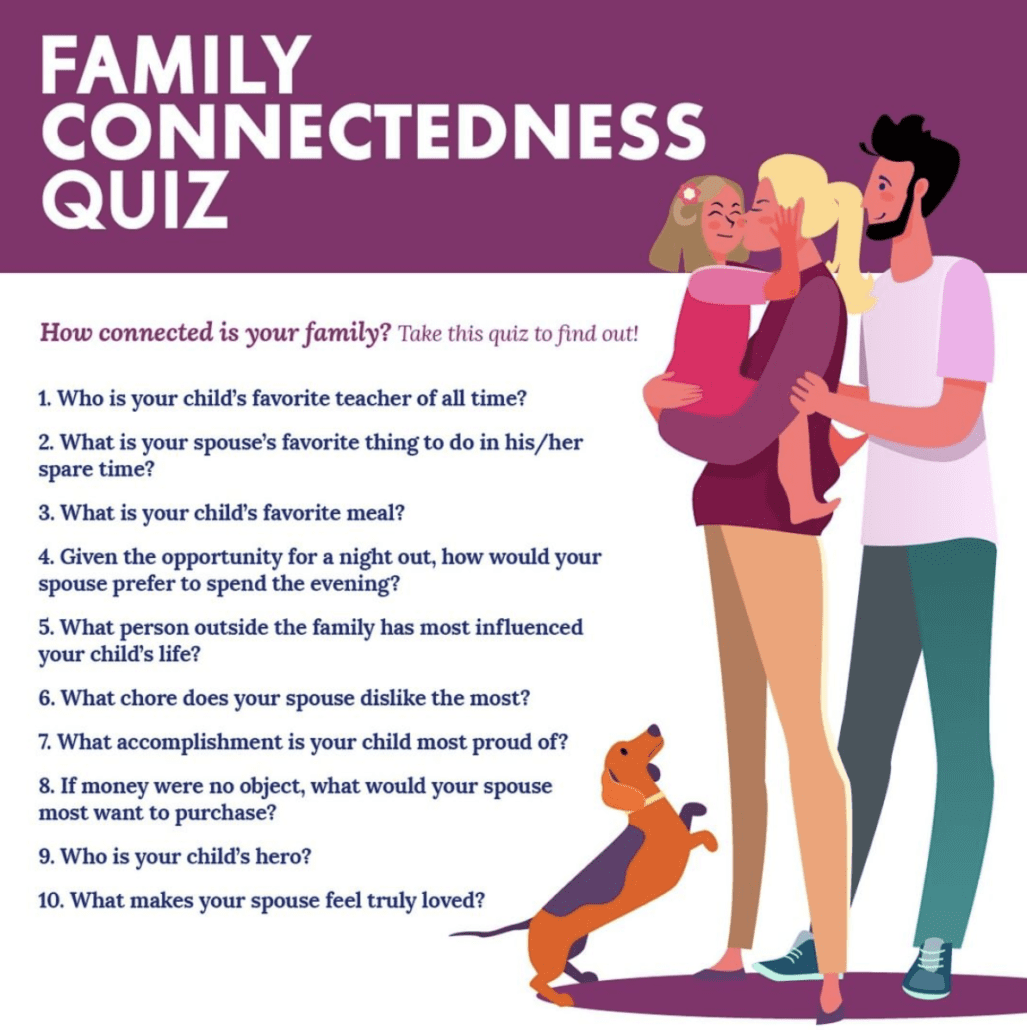
Ready to take a short family connectedness quiz?
- Who is your child’s favorite teacher of all time?
- What is your spouse’s favorite thing to do in his/her spare time?
- What is your child’s favorite meal?
- Given the opportunity for a night out, how would your spouse prefer to spend the evening?
- What person outside the family has most influenced your child’s life?
- What accomplishment is your child most proud of?
- If money were no object, what one thing would your spouse most want to purchase?
- What household chore does your spouse dislike the most?
- Who is your child’s hero?
- What makes your spouse feel truly loved?
Now, go check out your answers to see how close you were to getting them right. Being truly connected to your family is the only way to know all the answers to these questions.
“From a cultural standpoint, the connections that people have with one another and through social networks have been shown to improve the mental, physical and spiritual health of individuals,” said Christopher Brown, anthropologist and president of the National Fatherhood Initiative. “There is something that happens physiologically when people are connected, which is why people do better when they are involved in healthy relationships with others.”
One of the most powerful relationships is between a parent and child. Studies show that parents are the first and most important teachers of children. Kids thrive when they can depend on a reliable parent when they need to talk, when they want input, when they need a hug, or want assurance that life will work out.
Research from the University of Michigan found that the connectedness that takes place during frequent meal times with the family was the single strongest predictor of better achievement scores and fewer behavioral problems, even better than time spent studying or in a faith setting.
Experts agree that:
- Conversation at the dinner table shows to increase children’s mental and verbal abilities;
- Eating together promotes good communication, and strengthens family bonds and relationships;
- Families who regularly eat together have more cohesion and unity; and
- Family meals give children a sense of security.
Connections count every day of the year. If you didn’t do so well with the quiz above, this could be a great opportunity for you to re-evaluate how you connect in your home.
This article originally published in the Chattanooga Times Free Press on November 18, 2018. Click here to read the entire article.