
How to Help Your Spouse When They’re Burned Out
You may have noticed that your once ‘Energizer bunny’ spouse has no energy to do anything. Or they share they don’t feel right but can’t give any specific reasons. It seems like all at once, it ALL became too much. They have no motivation to work or deal with personal issues. They feel exhausted after sleeping all night. And they begin to question their capability to complete tasks from work or at home. Your loved one may be experiencing burnout.
Yes, burnout is a real thing. According to WHO, burnout is caused by “chronic workplace stress that has not been successfully managed.” It affects people in all areas of their lives physically, emotionally, and mentally.
If you believe your spouse is dealing with burnout, these strategies can help you as you help them.
Listen To Them
This may be one of the hardest things to do, especially if you think your spouse can accomplish anything they set their mind to do. Now, they’re questioning everything. You have to listen to them ask questions like:
- Am I a good spouse?
- Is my child getting what they need?
- Are my kids falling behind academically because I’m not a teacher?
- Am I a good parent?
- Is this my fault?
- Am I a good worker?
- Can I do my job now that it’s different from what I was hired to do?
- Am I giving time and effort to my relationship?
- Why is this so hard for me right now?
It’s not the time to try to fix it for them or ask questions. Instead, this is the time to let them dump it all out and try your best to understand. (4 Communication Exercises for Married Couples may be useful!)
Help Out As Much As You Can
Taking things off your spouse’s plate may help relieve the stress. It could be as simple as dusting around the house or taking on homework time from virtual school. If you don’t know where to start, simply ask, “How can I make what you do easier?”
Rely On Your Friends and Family (Use Your Village)
Remember—you don’t have to do everything on your own! Encouraging your spouse to spend some time with friends, family, or alone can lighten the load. Not only should your spouse spend time with friends and family—so should you. You don’t have to be the sole person to assist your spouse. In fact, if you aren’t careful about taking on too much, it may lead to your own sense of burnout.
Take Care of Yourself
While being supportive and non-judgmental of your spouse, it’s vital to take care of yourself. Try to get rest, good food and exercise, too. Find things that help you recharge your own battery.
Encourage Your Mate to Find or Rediscover Hobbies
Being creative can help their brain get out of the fight/flight cycle (more on that here). Be intentional about searching for new hobbies or finding enjoyment again in something they used to do. It could be anything from crocheting, hiking, or woodworking. You know better than anyone what they enjoy. (Read Why It’s Important to Care About Your Spouse’s Interests)
Reevaluate Your Family’s Schedule
Take some time to sit down and have a conversation about your family’s schedule. List everything for everyone, including work schedules, in-person or virtual school schedules, and other things to consider, like:
- When the kids need more hands-on help
- Mealtime
- When the kids work independently
- When you need to focus on your job (if working from home)
- Family time
Looking at the schedule with clear eyes can help you see patterns. From these patterns, you can make conscious decisions together about how to spend your time and energy.
People are experiencing burnout at all-time high levels, and it’s a tough thing to deal with. Watching your spouse struggle with burnout can make you feel helpless, but you can get through this together. It’s an opportunity to grow closer and remind yourselves that you can’t pour from an empty glass. Make time for the things that fill you up.
Related Resources:
- How Couples Can Help Each Other De-Stress and Improve Their Relationship
- Are You Setting a Good Example of Self-Care for Your Family?
- How to Stay Motivated During Marriage Challenges
***If you or someone you know is in an abusive relationship, contact the National Hotline for Domestic Abuse. At this link, you can access a private chat with someone who can help you 24/7. If you fear someone is monitoring your computer or device, call the hotline 24/7 at 1−800−799−7233. For a clear understanding of what defines an abusive relationship, click here.***
10 Things You Need to Know About Marriage
If you’re dating, in a long-term relationship, or engaged, you may be wondering what marriage is like. You probably have friends with good marriages and those who have so-so marriages. Perhaps you’ve got questions, but you don’t know exactly how to ask. Questions like: Is it hard? Is it worth it? Why get married?
Well, there’s a lot to learn! Here are 10 things you need to know about marriage that will give you some food for thought.
1. Marriage is hard work (but it’s the best kind of hard).
Marriage requires intentional time and attention from both partners. You’ll have times that seem easy and effortless. Other times require more energy.
2. Marriage takes compromise and respect on both sides.
People often say marriage is a two-way street. I like to think of it as a one-way street where you and your spouse are walking together in the same direction. Finding common ground and respect for each other, especially if you disagree on the path, is vital.
3. Marriage: You + Me = We.
Marriage is two individuals who know themselves (likes, dislikes, stressors, etc.) and continue to grow. When you grow as individuals and learn more about caring for each other, your marriage thrives.
4. Marriage requires rearranging your priorities.
Life is busy, and you’re probably juggling all kinds of priorities, including work, family, friends, community service, self-care, etc. After you get married, you may have to rearrange some of those priorities. Friends may be a little lower on your list. There are special considerations if you’re already a parent thinking about getting remarried or married for the first time. Preparing for Marriage is a great, FREE course to help you make sure you’re ready!
5. Marriage has seasons.
Marriage changes, like all relationships do. There are ups and downs, highs and lows, smooth and rough times. These seasons are natural and sometimes predictable. It doesn’t necessarily mean something’s wrong with your relationship. Seasons can be times of change and growth instead of trouble, depending on how you handle them.
6. Marriage has benefits.
Not just that one (wink, wink)! Research shows that married people are healthier, happier, and wealthier. They’re less likely to be depressed. And guess what? Healthy marriages also lead to healthier communities with better schools and lower crime rates.
7. Marriage requires skills.
For a marriage to flourish over time, you’ll need a variety of skills. Communication helps you understand your partner, know when to listen and when to speak. Problem-solving skills help you work together to manage complicated situations. If these tools aren’t your strong points, we’ve got some great resources to help you fill that toolbox! (Check out The Magic of Communication in Marriage, 5 Days to Better Communication in Your Marriage, or do a quick search for communication here.)
8. Be aware of unrealistic expectations.
Many couples enter marriage with unrealistic and/or unspoken expectations on topics like sex, money, and how they’ll spend their alone and together time. Talking with your spouse goes a long way toward minimizing issues that come from unrealistic expectations.
9. Marriage is impacted by your family.
No matter where you live, your families affect your marriage, for better or for worse. They raised you and influenced who you are. Some of the things that’ll get on your nerves will probably be habits that started in the homes you grew up in. Remember, this isn’t about blaming anyone, but it’s just so you can be AWARE.
10. Marriage is a daily choice.
After you get married, you get to choose every day to stay married. You get to show your spouse how much you value and love them daily through words and actions. Even if you have a hard day, remembering that you get to start over and choose each other again can give you hope and strength.
I hope this list does not deter you. Marriage is all of these things, but it’s so much more. Marriage is fun. It’s exciting. And it’s an opportunity to grow as a person while you’re part of a couple. More than anything, “Marriage is choosing someone, again and again, to love and to cherish with each new dawn.”
Help! My Husband is Boring
You probably never thought it would get to this. You always seemed to like the same shows, movies, and activities, and you spent all your free time together. Now, it feels like you NEVER do anything together, or that your husband is just boring and never WANTS to do anything with you. If you’re honest, it seems like all he does is, well, NOTHING.
You’ve got questions:
When did this happen?
How did I not notice the changes?
How am I married to such a BORING person?
Maybe these thoughts are new. Or perhaps they’ve been nagging you for a while. Either way, it’s gonna be important to get to the core of the problem.
You can work through this together! Here’s what I suggest:
Share your feelings.
If you’ve thought about how things have changed in your relationship, tell your spouse what you’re feeling. Maybe you’ve learned that your “Love Language” is quality time. If so, let him know you miss spending time with him and give him the chance to meet your needs. Demanding time with those you love can negatively impact your relationship.
Maybe one or both of you has changed. You may have a need/desire for more in your life. But if you tell him what you need, he may surprise you. And vice versa! Newsflash: your hubby can’t read your mind. You have to tell him!
Seek to understand what’s going on with your man.
Whether you’re still in the honeymoon phase or you’ve been married for some time, find out what’s happening in your husband’s world. He may be processing stress you don’t know about. Whether it’s financial stress, job, or family issues, understanding how things impact his heart and mind goes a long way. He may be trying to protect you, which may affect his willingness to be spontaneous and fancy-free. Could be your husband isn’t as boring as he seems to you right now.
Find common interests.
Spouses will sometimes “claim” to like an activity because it matters to the other spouse. They can go along for a while, but it can’t last forever. Discovering that your spouse participated in an activity that didn’t truly interest them because it mattered to you is swoon-worthy, for sure. Your task now is to find things you can both enjoy together. It doesn’t have to be fancy, but finding new common interests together can be a relationship booster!
Spend time alone so you can enjoy time together.
Many couples think they need to do everything together. On the contrary! Believe it or not, your relationship benefits when you grow as individuals, too! Everyone needs to have personal space and activities that feed them as individuals. It doesn’t necessarily mean something’s wrong if you don’t do everything together.
If you’re resistant to your spouse having some alone time, you may want to ask, “Why am I afraid that they want to spend time alone? What makes me uneasy about that?” Having space to do things they enjoy alone may increase their desire to do something with you.
Here’s an example: I enjoy shopping for a bargain. When my husband encourages me to go find some deals, I’m much more inclined to watch his favorite movie with him.
Be willing to shake it up a bit.
Marriage is a two-way street. Maybe you like to go, go, go. Your spouse may tend to chill, chill, chill. Neither is good or bad, right or wrong; the key is respecting the differences. There may be times when it’s good to run at full speed (like holidays), but once you’re done, be willing to have some chill-out time. You may have to fight your internal voice saying, “There is so much to do,” or, “This is a waste of time.” Sometimes learning to just Be (spend quiet, quality time with your spouse) rather than Do (Go, Go, Go) builds the connection between you. What can it hurt for YOU to try something new and different? The result may shock you.
Whether you see your husband as boring or not is all about YOUR PERSPECTIVE. You get to choose how you look at him. Being open to a little self-care for yourself AND your spouse can only enhance your marriage relationship. You can continue to grow, learn, and love each other better when you look for excitement in the right places.
Related blogs:
What 2020 Has Taught Us About Marriage
2020 is finally in the rearview mirror, so let’s all breathe a collective sigh of relief. It was a challenging year for many. But as we close out that chapter, it’s good to reflect on lessons learned. I want to focus specifically on what 2020 has taught us about marriage.
Many declared a year of vision as they launched into 2020, but maybe it turned out to be a year of clarity. It was a year filled with trials, a global pandemic, political and social unrest, just to name a few. It became a year filled with opportunities, more family time, innovation, and flexibility.
Despite all the challenges and uncertainties we faced in 2020, my marriage experienced some much-needed growth and is more joyful than before. This gives me hope.
When W. Bradford Wilcox, Wendy Wang, and Lyman Stone looked at the 2020 American Family Survey (AFS) recently, they discovered that couples are stressed out. No surprise there, right? The burdens of 2020 impacted everyone. While the AFS sheds light on this, it also reveals some good news for married couples.
Here are a few things 2020 taught us about marriage:
1. Healthy communication is a necessity.
Early on in the COVID-19 pandemic, many families found themselves at home. The bustle of a busy home 24/7 can be overwhelming. Some transitioned to work from home or lost jobs. Some found their jobs classified as essential. Each scenario brought its own stressors and hurdles. Through all of this, one need remained the same: strong communication. As couples adjusted to a new normal, there was a critical need to make sure communication happened often and well.
As we venture into 2021, let’s keep healthy communication at the center of our marriage and family. Healthy communication helps marriage thrive.
2. Marriage is about commitment and appreciation.
As a couple, you don’t have to face trials alone. Married couples can walk the road of uncertainty together hand in hand. As the pandemic began, many predicted a rise in divorce in America. The thought was that marriages wouldn’t survive if couples spent extended time together. Instead, the AFS found that divorce actually decreased in 2020. That’s great news!
More couples surveyed said their marriage grew stronger during the pandemic. They experienced a deeper commitment and appreciated their partner more. When times are tough, we turn to our loved ones for support. 2020 was proof of this. Marriage provided a supportive framework for many as the world around them closed.
In 2021, let’s continue to appreciate and commit to our partner. An appreciated spouse feels loved and respected.
3. Prioritizing sex during stressful times can keep your marriage healthy.
A common assumption when the pandemic began was a future baby boom. With more couples at home together, people assumed there would obviously be an increase in pregnancies. While we don’t know if the baby boom will happen, this survey shows that couples did prioritize sex in their marriage.
Although stress can often lead to a decrease in the frequency of sex, more couples reported they had sex more often and connected intimately due to the pandemic. A healthy sex life is one sign of a healthy marriage.
As we enter the new year, let’s continue to make sex a hot priority in our marriages.
Marriages in our nation have faced enormous challenges over the past few months. Resilience and determination have helped many cope with and overcome obstacles. The importance of healthy communication, more appreciation and commitment, and a healthy sex life are invaluable takeaways from 2020. As we move forward, let’s all take a moment and commit to making this the new normal of our marriages.
Read more about how to strengthen your marriage in these blogs:
5 SIMPLE WAYS TO STRENGTHEN YOUR MARRIAGE WHEN YOU’RE STUCK AT HOME TOGETHER
How to Find Common Interests With Your Spouse
There are two kinds of spouses in the world. (Ugh. I can’t stand statements like this.)
- Those who think it’s not important to share some common interests with their spouse.
- Those who think not having common interests is the end of the world. (Or marriage.)
They’re both wrong.
“I don’t think our marriage can work. I just think we have nothing in common.” Keep thinking. You probably have more in common than you think. It’s easier to develop some common interests than you think. Your differing interests are probably healthier than you think.
Developing some common interests reinforces that you are a team and keeps you connected. It builds one of the most overlooked areas in marriage—friendship. (Newlyweds: “We’re soooo in love!” 10 Years Later And Beyond: “We’re best friends.”)
For those two kinds of spouses (and everyone in between) here’s how you find those common interests.
Each of you get out a piece of paper and thoroughly answer these three questions:
- When you were a kid, what were you interested in?
- What were you interested in when you were in high school?
- What are you interested in lately?
Now compare your answers. One of you was interested in exploring as a kid. One of you was interested in camping out. Reconnect with those childhood interests as you connect with each other on a camping adventure. Be curious. Keep comparing lists. Make connections. Find the overlap.
(Can’t find a single interest that connects, overlaps, or is in common? Really? I wanna know… Email pictures of your lists to john@firstthings.org and if I can’t find some commonality, I’ll personally mail you a shiny new nickel.)
Get your pieces of paper back. List causes or issues, big and small, that you are concerned or passionate about.
Lather. Rinse. Repeat. Find something you can do about it together. It doesn’t have to be a big deal. Get creative. It might be litter. Pick a local park and get some gloves and trash bags and chit-chat as you pick up trash. Nothing brings people together like a common cause. Your marriage might spark a movement.
Take your problem to the internet like all rational people do. Try Random Thing Picker.
Let the universe intervene. Each of you puts in two or three ideas for date night. I put in: Dance Class, Cooking Class, Painting Class, Movie Night, Game Night, and to live on the edge, I put in Housework. Then click “Pick One!” Boom! Cooking Class. Sign up for a class or find one on the internet. (Spice it up by inputting things neither of you has tried before. Who knows where this will lead?)
Having problems finding common interests with your spouse? Yes, I think you can solve them with a piece of paper or a few clicks. And some time and thought. Oh, and the commitment to work on your friendship and to love your spouse because of your differences, not in spite of them. You got this!
Do I Have To Tell My Spouse Everything?
The opposite of a fact is falsehood, but the opposite of one profound truth may very well be another profound truth. -Niels Bohr
Do I have to tell my spouse everything?
Do you want your spouse to tell you everything?
It depends. It really does.
What do we know for sure?
Once you marry someone, you aren’t leading your own life anymore. You are officially in a partnership, and you need to treat it as such. It’s important to discuss and respect boundaries.
We want to be known, understood, and accepted. Viewing marriage as a lifelong commitment between two people creates a safe environment to be accurately known, completely understood, and unconditionally accepted. Striving to accomplish those things is the journey of a lifetime.
Relationships are built in good faith on a foundation of honesty, trust, and communication. If you want to have a healthy, lasting marriage, it is not wise or healthy to be doing things you aren’t comfortable sharing with your spouse. If there is something you want or need, sit down with your spouse and discuss it.
The moment you under-share, withhold relevant information, cross agreed-upon boundaries, or intentionally try to hide something, and are found out—the trust evaporates and your bond is weakened or broken. What breaks in an instant takes a long time to rebuild.
✶ I don’t know you. I don’t know your spouse and I don’t know the health of your marriage or the boundaries you have agreed to put in place to protect your relationship and make it thrive. But here are some general things to think about as you consider what needs to be shared with your spouse:
- You shouldn’t share what doesn’t belong to you. Your spouse has no claims to what friends and colleagues confide in you. “Secret” does not equal “Private.”
- There is a major difference between telling your partner everything in your past because you want to and telling your partner everything in your past because they want you to.
- You might be strong enough to share the truth, but your spouse might not be strong enough to deal with it. Sensitivity and timing are everything.
- Don’t fall into the trap of believing you only have two options: tell your spouse everything or tell your spouse nothing. There could be dozens of legitimate options in between. Be compassionately discerning.
- You need to examine your motives as to why you are sharing certain information.
- It can be a short trip from “words” to “wounds.” Choose your words carefully.
- Some of our choices bring shame, pain, and consequences to ourselves and others. Integrity doesn’t compound consequences beneath layers of lies.
“The opposite of a fact is falsehood, but the opposite of one profound truth may very well be another profound truth.” Lying, deceit, and deception are wrong, but sharing is not necessarily always caring. But don’t disconnect the profound relationship between truthfulness and love.
Related blogs:
4 THINGS EVERY COUPLE SHOULD KNOW ABOUT COMMUNICATION IN MARRIAGE
Maximize Your Marriage Series | Tips for Healthy Communication
HELP! MY SPOUSE HATES TO TALK ABOUT BOUNDARIES!
4 STEPS FOR SETTING GOOD BOUNDARIES
HOW BOUNDARIES CAN PROTECT YOUR MARRIAGE
***If you or someone you know is in an abusive relationship, contact the National Hotline for Domestic Abuse. At this link, you can access a private chat with someone who can help you 24/7. If you fear that someone is monitoring your computer or device, call the hotline 24/7 at 1−800−799−7233. For a clear understanding of what defines an abusive relationship, click here.***
4 Communication Exercises For Married Couples
Healthy communication lies at the root of any successful relationship. In marriage, this is even more of a necessity. Like our muscles, our communication skills also need to be worked out. There are practices we can make part of our regular routines that will strengthen communication in our marriage. Here are four communication exercises for married couples.
Exercise #1: The Weekly Meeting
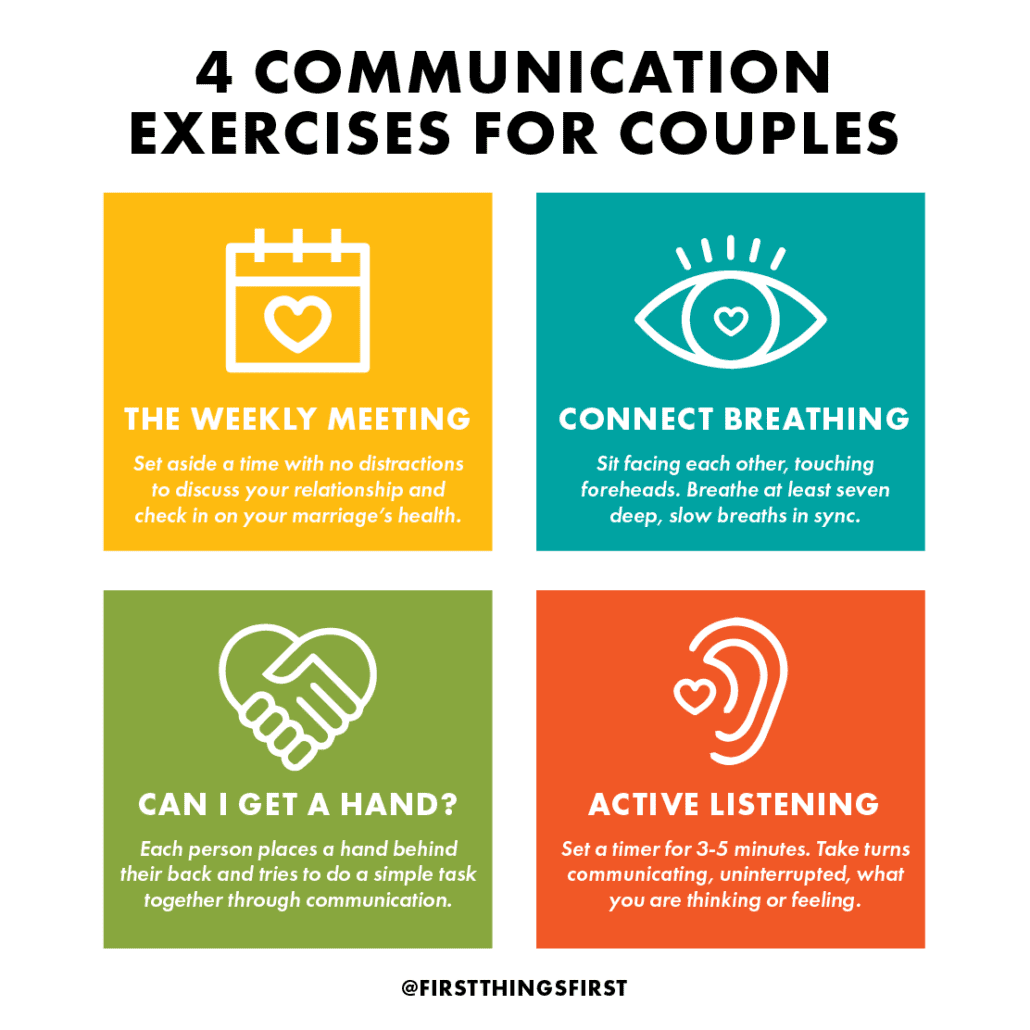
If your marriage is like mine, you’re busy. You both have schedules, and your kids have schedules… I think my kids’ schedules are often busier than mine. This exercise is excellent to carve out time to focus on your marriage intentionally.
Set aside a non-negotiable chunk of time (30 minutes is a good starting point) when you will have no distractions. No phones, no tablets, no television, no kids. This time is for you to discuss your relationship and check in on your marriage’s health.
So what do you talk about? Start here:
- How are we doing as a couple?
- Is there anything we need to finish addressing from this week?
- How can I make you feel more loved and appreciated?
You don’t have to stop here. These questions are just ideas to get you started.
As you dedicate this time each week, check out these keys to effective communication in marriage to enhance your communication.
Exercise #2: Connecting Through Breathing
The purpose of this exercise is to focus on your partner and remove distractions. To begin, sit facing each other, touching foreheads. Tilt your chins down, so you don’t bump noses.
Breathe at least seven deep breaths. Try to breathe slowly and in sync. As you get the hang of this exercise, you may choose to do more breaths or focus on breathing for a set amount of time. It’s all about connecting and focusing on one another.
When you need to slow down and refocus, this is a great practice. Once you have refocused on one another, take the time to talk about how your marriage is doing.
This exercise is ideal for clearing your minds and having a healthy conversation.

You’ve had conversations with your spouse, even arguments, and maybe straight-up fights about this issue or that problem, BUT those interactions often don’t lead to any solutions. But why is that exactly?
Join us for this 20-minute webinar to find out!
Exercise #3: Can I Get A Hand?
Often in marriage, misunderstandings come from not sharing our needs. Your spouse is not a mind reader, so it’s vital to communicate your needs clearly and effectively. This exercise will help.
In this exercise, you’ll both be working toward a common goal. Each person will place a hand behind their back, and together you’ll try to do a simple task such as buttoning a shirt, pouring a cup of coffee, or any other task around the house. Be as clear as possible in communicating with each other to accomplish the task together.
This was a pretty enlightening experience for me. We had some really good laughs AND I learned there were some things I could do to communicate more clearly with my wife.
Exercise #4: Active Listening
This exercise focuses on verbal and nonverbal communication.
Set a timer for 3-5 minutes. One spouse communicates whatever they are feeling or thinking, uninterrupted. The other spouse listens and communicates nonverbally. When the timer goes off, both of you discuss the experience.
Then switch roles and practice again.
These are just a few exercises you can practice to increase communication in your marriage. Healthy communication plays an essential role in any thriving relationship. Make exercising your communication muscles a priority in your marriage and take it to the next level.
Ready, set… time to work out!
Related:
How To Improve Bad Communication In Marriage
3 Ways Good Communication Can Enhance Sex In Marriage
4 Things Every Couple Should Know About Communication In Marriage
How To Improve Bad Communication In Marriage
Every couple experiences little instances of communication breakdown. It just happens.
Of course, the little things can gradually chip away at your connectedness in your marriage. Small drops of water from a leaky pipe over time lead to big problems.
Minor bad communication habits are like that. Not that big of a thing in the moment, but given time… you get the picture.
So with that in mind, here are four common communication habit scenarios every couple experiences. The good news is, you can fix or improve bad communication with a little intention:
Scenario 1:
Fred asks Wilma if it’d be okay to go bowling with Barney tonight. Wilma replies, “Sure, you can go if you want.” However, Wilma’s tone of voice sounds less than enthused. And her crossed arms and frown suggests she’s not as approving as her words suggest.
Wilma is sending mixed messages to Fred. Her words don’t match her non-verbal cues. She feels bad saying no, but she would really love for him to stay home and spend time with her. This leaves Fred in a no-win situation: Should he accept her verbal permission and go, or stay home because of her tone and body language?
The Fix:
Wilma needs to be honest with her feelings and maybe work out an alternative. Perhaps he can go out tonight and plan on quality time with Wilma the next evening.
If Fred senses the mixed message, he needs to politely ask his wife, “Dear, I appreciate you letting me go tonight, but your tone and crossed arms seem to be telling me something else. Am I reading you right?”
Scenario 2:
Pam has had a rough day at work; her boss just seems incompetent, and her co-workers lazy. She shares with her husband Jim that evening. Jim makes several suggestions on how to handle things. Pam walks away feeling misunderstood.
You’ve had conversations with your spouse, even arguments, and maybe straight-up fights about this issue or that problem, BUT those interactions often don’t lead to any solutions. But why is that exactly?
Join us for this 20-minute webinar to find out!
The Fix:
The issue here is Pam just wants to be heard. There are times for solutions—this isn’t one of them for Pam. It would do Jim good to gently ask Pam during the conversation, “Hon, is this one of these things where you want some help fixing this or where you just want me to listen and try to understand?” Pam would feel appreciated just being asked that.
Knowing Jim is a fix-it kinda guy, Pam could prep Jim a little and say, “I want to share what happened today, and I don’t really need anything to be fixed; I just need you to listen.”
Scenario 3:
Rachel tries to tell Ross the chores she’d like his help with this weekend. Ross is currently engaged in the game on TV. When she’s finished, Ross blankly looks up at her and says, “Huh?” Rachel walks away frustrated while Ross sits there confused.
The Fix:
Rachel should understand Ross’s mind is in the game. It’s sometimes difficult for people to switch from one “mindset” to another. Rachel might ask her husband, “Would it be okay, when you get to a pause in the game, to talk some about this weekend?“
Ross needs to consider how important this conversation is for his wife. If the topic were more urgent, he’d definitely need to put the game on hold and give his wife his full attention. In this case, he might pause the game and say something like, “Babe, I know this is important to you. Could we wait until halftime to talk, and I can give you my full attention?”
Scenario 4:
Zach assumes Kelly is taking the garbage out. He notices the can is not by the curb. He says to her, “Hey Kel, the garbage hasn’t been taken out yet.” Kelly, a little miffed, replies, “Good observation, Zach…”
Zach just wants to see the garbage get out on time. But his first whammy is that he “assumes.” Add this to the fact he expects Kelly to read his mind, and bad communication results.
The Fix:
The problem is in his approach. Zach needs to put assumptions aside and be more direct (and still respectful): “Hey Kel, were you planning to take the garbage out? I thought you said you were but wanted to be sure I heard you right.” [And if Zach were really considerate…] “If not, I can do it.” With this approach, Kelly needs to remember she and Zach are a marital team and consider where he is coming from. Without making assumptions of her own, she can politely reply with something like, “Thanks for reminding me. I’ll take care of it in just a minute.”
★ It’s the little things that count. The same can be said for improving communication in marriage. Hopefully, you can relate to at least one of these scenarios. It’s often an easy fix, but a significant one. Acknowledge these scenarios with your spouse in your own relationship. Laugh about it; say, “Yup, that’s us!” and then take the simple steps to fix the leaky pipe of bad communication. Soon the small drops will be water under the bridge.
***If you or someone you know is in an abusive relationship, contact the National Hotline for Domestic Abuse. At this link, you can access a private chat with someone who can help you 24/7. If you fear that someone is monitoring your computer or device, call the hotline 24/7 at 1−800−799−7233. For a clear understanding of what defines an abusive relationship, click here.***