

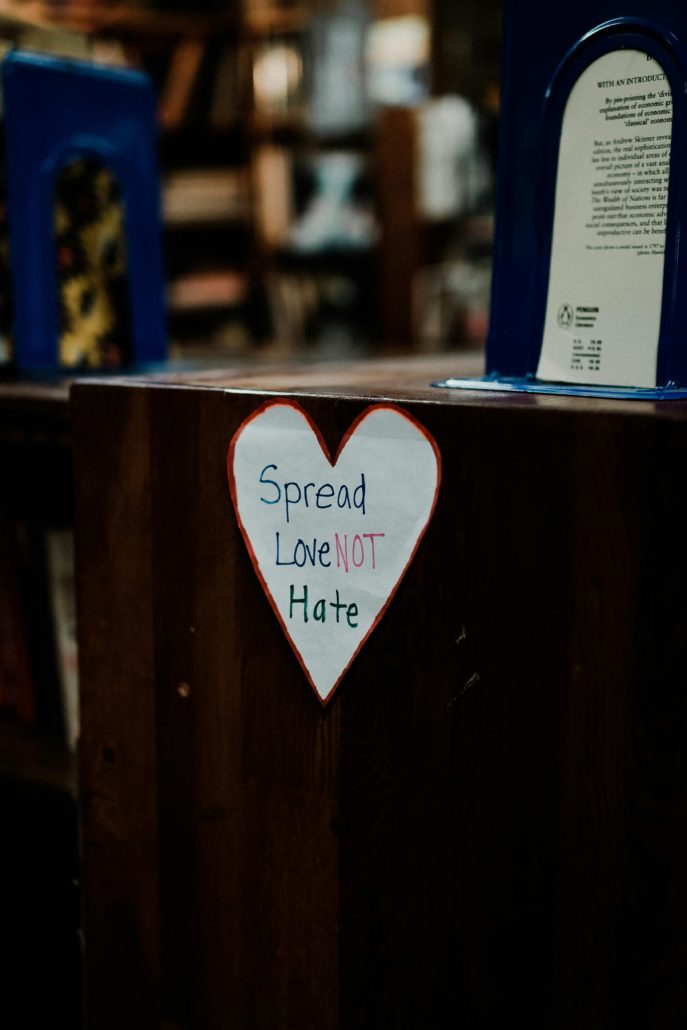
Recent events (both near and far) have led me to question one small little word with a big bite: “hate.”
My son’s school had to go into lockdown mode while we were having an outdoor celebration breakfast for his class. Nothing was going on at the school, but only a couple of blocks down the road gunshots were fired between people who were raging with hate towards each other. Out of an abundance of caution, we made our way into the cafeteria and had a giant dance party instead.
Of course the kids asked all the questions, “Why did we have to come inside?”, “Are we safe?”, “Will we ever be able to go back outside?”
But they had no idea what happened only a few streets away, and they definitely didn’t feel the hate that started the whole issue.
Where does hate begin? How do regular disagreements turn into something darker? What helps us step back from that edge?
Psychologists say hate isn’t just “really strong dislike.” It’s a hot mix of anger, contempt, and disgust that can push us toward action. One brain-imaging study in 2008 even found a distinct pattern when people looked at someone they hated. Parts of their brain tied to strong emotion and action planning lit up, as if the mind were putting the body on standby.
But the slide into hate usually starts earlier. We sort the world into “us” and “them.” Then we tell simple stories about “them.” Psychologist Nick Haslam’s review of decades of studies shows how this can turn into dehumanization, which means to treat other people as less than fully human. This makes it easier to justify harsh words or worse. We don’t notice it at first; it feels normal, and that’s the trap.
Politics turns that trap into a bear pit. A team led by Northwestern’s Eli Finkel, director of the university’s Relationship and Motivation lab, calls today’s political dynamic “political sectarianism,” othering, aversion, and moral contempt mixing into a poisonous cocktail. Their work notes that in the U.S., many of us feel more heat toward the other party than warmth for our own. That’s not just disagreement; that’s relationship acid.
Here’s a twist that sounds like every family argument ever: research from Adam Waytz and colleagues finds both sides think we act from love, while they act from hate. It’s called “motive attribution asymmetry,” and it locks conflict in place because compromise starts to feel like giving in to bad people with bad motives.
So what actually helps? First, real contact. The human kind, not the comment-section kind. Back in 2006, a massive meta-analysis of 515 studies found that contact between groups reliably reduces prejudice, especially when people work together as equals and leaders support the effort. Translation: volunteering side-by-side beats arguing on Facebook.
Second, a bigger “we.” Social psychologists Samuel Gaertner and John Dovidio show that when we recategorize from “us vs. them” to “all of us,” bias drops. In normal life that sounds like, “We’re neighbors raising kids in the same city,” before we ever talk about policy. It’s simple and surprisingly powerful.
Third, shared goals. The classic 1954 “Robbers Cave” summer-camp study split boys into rival teams and—surprise—hostility erupted. What cooled it wasn’t a lecture; it was fixing problems together (like hauling a stuck truck) that neither team could solve alone. Families can borrow this: when a fight stalls, pick a goal bigger than the argument and push the truck together.
Fourth, better conversations. “Deep canvassing” is the term to describe 10-minute, nonjudgmental, story-sharing chats. In 2016, researchers David Broockman and Joshua Kalla found these conversations produced durable attitude change on a hot-button issue. The magic wasn’t debating harder; it was listening, reflecting, and trading personal stories.
And because our media diet shapes our mood, here’s a timely note: a 2024 University of Michigan analysis warned that rage-bait politics on social media can crank up our cynicism and hostility. If your feed makes you feel permanently itchy, that’s not a character flaw, it’s a design feature. Curate accordingly.
What does all this mean for daily life? In my house, we try to “disagree like teammates.”
We name the shared goal first (“We both want kind, sturdy kids”), we assume decent motives (“You’re aiming for safety; I’m aiming for independence”), and we take a break when we start narrating the other person as the villain. It’s not perfect. But the research backs up these small habits: contact, common identity, shared goals, and decent motives interrupt the slide from conflict to contempt and from contempt to hate.
So here’s a simple play for this week. Invite one person you disagree with for coffee. Ask three sincere questions before you share your view. Tell a short story about why you care. Then look for one thing you can do together like coach a team, pick up trash on your block, help a neighbor.
It won’t fix the internet, but it can change a relationship. And relationships are where the heat cools and the future is built.
Lauren Hall is the President and CEO of First Things First. Contact her at lauren@firstthings.org.
Was This Helpful?
More stuff you'll love



5 Tips for Keeping Your Child Motivated in School
You can be their biggest encourager toward success.



Thoughts? Leave a Comment