Four months into our pregnancy, we were eager with anticipation and excitement to find out whether we were having another boy or a little girl. Our son, three at the time, was excited to find out as well. When the doctor showed us the ultrasound of our little girl, we were ecstatic, overjoyed, and couldn’t wait for the journey ahead. Secretly, thoughts raced through my mind: “How am I supposed to be a dad to a little girl?” “I never had a sister.” “What do I do?” “Is she gonna paint my nails and do my hair?” “Will we play with dolls?” Quickly my thoughts turned a corner as I thought, “What will my daughter need to hear from me, her dad?”

As a dad, I want to be my daughter’s first love. I dream (and am scared by the idea) of walking her down the aisle one day. I want to be the one she comes to when she needs help or advice. But how do I build this relationship from the start? Thankfully I had a few other girl dads in my life who gave me some wise advice. I can’t say I always live it out but I try daily. They told me to speak words of life and truth over her. Words she needs to hear from her dad. 

“I love you.”

Life isn’t going to be easy. Our daughters need to hear often the words “I love you” and she needs to hear them from her dad. I want my daughter to know I love her, not because she has done anything or because of anything she can offer me, but solely because she is mine. The world can often infer the idea that love is transactional, we are loved for what we do or what we offer. Our daughters need to know they are loved for who they are. It is important to let them know nothing they do can change the love we have for them.

“You are beautiful.”

She will hear she is beautiful many times, but she needs to hear it often from dad. There is something special when a dad says these words to his daughter. You can also add words like smart, funny, etc. The truth is you are building her confidence. Your daughter will know she is beautiful because her daddy says so. The world will try to tell her she needs to look a certain way, wear certain clothes, or buy certain products to be beautiful but if you have instilled in her from an early age the truth, that she is beautiful, it will resonate with her. Take the opportunity to tell her often.

“You have value.”

Telling my daughter she has value comes from many of the same reasons why I tell her she is beautiful. I want her to know she has value, not because of anything she has done, but because she is mine and I love her. As with beauty, the world will try to skew this one, to say value comes from what you offer or what you do. This is not the case: she has value because she is an individual. I want this to be a constant reminder in her life. Value comes not from what you do, what you offer, or who you are: you have value because you are.

“I’m always here for you.”

A girl needs someone in her corner. Someone she can confide in, share dreams with, and find safety in. Hopefully, this is her dad. The bond between a father and daughter is special. It’s hard to explain, but if you have a daughter, you know this to be true. There is nothing better than when my 4-year-old crawls in my lap, holds my face and says “Daddy, I love you.” My response is most often, “I love you too sweetie and I am always here for you.” I want her to know she can always come to me. In a few years she won’t be crawling into my lap. She may be holding my hand or just offering a hug but the truth will remain the same: I will always be here for her. 

“You can tell me anything.”

I read a story recently about a dad who wrote a note to his daughter and put it in a drawer. The note said “If you’re scared to tell me something, just bring me this note as a reminder that I’m here to support you. I won’t get mad; I will work with you on a solution.” I love this and I want this for my kids. NO MATTER WHAT, I want my daughter to know she can always come to me. She can come to me because I have told her she is loved, she has value, and I am always here for her. 

By speaking words of truth and life over our daughters, we earn the respect and the trust to be the person they can lean on. My daughter will grow up knowing no matter what she does, good or bad, her dad is right here for her to lean on and confide in. There are things all daughters need to hear from their dad. This is just a starting point. What do you want to instill in your daughter? You’ve got this, Dad!

For other ideas of how to be the best dad for your daughter, check these articles out:

Image from Freepik.com

How To Increase Communication In Your Home

Communicate like a pro with these tips.

How do you increase communication in your home and make sure everyone’s connected?

When healthy communication is happening in the family, everyone feels connected and part of the same team. All the gears are synced up, your family is firing on all cylinders and is heading in the same direction. There are regular check-ins to make sure no one drops the ball and there are no surprise projects or performances. If issues need to be addressed with the whole family, you’re able to get everyone together and effectively address them. You and your spouse have plenty of time to express needs and concerns, feel heard and also have time to chat and stay connected.  

There are two parts to getting connected and bonded together and building those strong relationships. The first is being intentional about one-on-one communication with each member of the family and the other is having good consistent communication together as a whole family. It would be nice to want this, snap your fingers and BOOM, life is golden. Unfortunately, that’s not the way it works. You’ll need to be intentional in your efforts and it will probably take some time to turn the ship. But the payoff can be life-changing for your family. This is so totally doable! You just have to tweak a few things.

1. One-On-One Communication.

Start here. Make time to hang out. Watch your kids play some video games, ask them to go run an errand with you, or take them out for ice cream. Car rides are magical communication times—the ride to school, practice, or a friend’s house—these are all primo talking opportunities. (Some family members are extroverted and will be talking your ears off. Don’t forget your quiet, introverted family members. You might have to make an extra effort to connect with them.) Some parents make the ride to school a tech-free zone to promote conversation in the car.

The basics of communication are speaking and listening, and there are ways to get better at both of them. They are learned skills you can improve on, but before we even get into that—communication usually happens organically when you are together

2. Family Communication at Home.

Same rules apply. Communication usually happens organically when you are together—it’s just a matter of how to get everyone together. I know everyone is super busy (maybe that has to be addressed) but try to carve out at least a few times a week when you eat together with phones turned off. (I’m gonna give you some conversation starters so it isn’t just awkward silence.)

Family game nights, family movie nights, family outings to a park—these usually lead to some good ole’ fashioned chit-chat. Check out this Parenting Toolkit: A Family Guide To The Best Summer Ever! It’s filled with ideas for activities and conversation-starters. Plus each activity is geared toward learning an important relationship skill. Check out other family resources HERE.

If your family is going in a lot of different directions, weekly family meetings can decrease drama and encourage open communication as you talk about the family calendar, who needs to be where, when projects are due and require parental assistance, etc. Family meetings are also a way to empower your kids and encourage open communication. Anybody can request a family meeting if there is an urgent issue they believe needs to be discussed. In general, family meetings should be fun, short, and involve everyone. You want two-way communication, not a lecture. You are looking for feedback from everyone. Follow it up with a fun activity.

How do you get better at communication in general?

Here’s the insider info to get you communicating like a pro. We covered the need to be together, but now what? (If you have teens, check this out.)

The Speaking Part of Communication in Your Home

So how was your day?

Okay.” 

[Conversation over.]

Here are five things you can ask instead of, “How was your day?” You don’t want to be a criminal interrogator; you want to be a conversation initiator. Big difference. This means open-ended questions, asking “what makes you think that?” or saying “tell me more” quite a bit. It means sometimes answering questions with questions, then listening for what is hiding underneath a question or statement and following up on it. The goal is to understand where your child is coming from. When they feel like you “get” them, they are much more likely to open up to you.

Work on being more observant. Notice I didn’t say, “private investigator.” You want to be a conversation instigator. What are your family members (including your spouse) into? What makes them light up? How do they spend their free time? Where do they put their energy? If you have younger ones, get on the floor and play with them. Step into the world of your family members with sincere questions. Then really listen.

The Listening Part of Communication in Your Home.

Be available when your family members want to talk to you. Avoid distractions and interruptions. Give your full attention. (Put yourself in their shoes. Ask clarifying questions. Ask questions that take the conversation deeper. Model the kind of communication you want to have. (Check out this article on active listening skills—especially the Six Levels of Listening.) People love talking to a good listener.

There are books filled with conversation starters and the internet is filled with lists of questions for kids of every age and for couples. Invest in a few books or click around for some lists. They’re great for road trips and pillow talk. Just when you think you know all there is to know about somebody, one of these questions will take you into new territory and they are tons of fun.

27 Family Conversation Starters

  1. If you could go anywhere on vacation, where would you go and why?
  2. If I could do one thing to be a better parent to you, what would it be?
  3. What do you worry about the most? Why?
  4. What will you do when you graduate high school?
  5. When was a time that you were kind to someone else?
  6. What is the best thing about our family?
  7. Who is someone you admire right now? Why?
  8. What is the “lesson” or “takeaway” from your favorite book or movie?  
  9. What do you think about tattoos and piercings?
  10. How common do you think cheating is at school? What do you think about cheating?
  11. What is the biggest factor in being successful at school?
  12. Is it better to be optimistic or realistic? Why?
  13. What do you like about you?
  14. Have I ever not noticed when you were sad?
  15. What makes someone popular?
  16. What is one thing you would try if you were completely fearless?
  17. How do you react when your feelings are hurt? Does it help?
  18. What do you think about the drinking age?
  19. Who gets bullied or teased at school? Why?
  20. How should someone handle it if they are bullied?
  21. What do you like best about your friends?
  22. Is there anything you don’t like about your friends?
  23. What is the hardest part about being a kid?
  24. How is love/marriage different in real life than in the movies?
  25. What is the hardest thing about being a girl? Being a boy?
  26. Do you have friends with different religious beliefs?
  27. What do you think about that? How will you know if you’ve had a successful life?

★ Good communication in your home doesn’t happen by accident. But you can absolutely increase the quality AND quantity of communication in your family. You got this!

Image from Freepik.com

I see the mom walking down the street with her 4-year-old daughter paying more attention to her cell phone than her daughter, and I think, “Put your cell phone down and pay attention to your daughter.” I see the mom at the grocery store at 1 AM with her 2-year-old son and I think, “That’s ridiculous.” I see the 6-year-old talk disrespectfully to his parents at the soccer field and I think, “If he were my son, that’d never happen.” And let’s not mention the thoughts that have gone through my mind when I see the temper tantrum in the grocery store line next to the colorful Skittles that the child wants and can’t have.

Judging other people’s parenting can be intense and destructive to my well beingand it just plain isn’t fair to other parents. When we judge others, we’re sending the message that we’ve got all the answers. Any parent knows this just isn’t the case. Why do we judge other parents and how can we stop?

We judge for many reasons:

  • We parent differently. Breastfeeding vs Bottle. Educational decisions. Kid’s use of technology. Our natural tendency is to see those who parent differently as wrong. Because if they are right, then I’m wrong. Instead of just seeing them as different. There’s usually more than just two ways of parenting. 
  • We develop strong opinions about our beliefs regarding what is the best way to parent. Some of those strong opinions can lead us to judge others who have different beliefs.
  • Our rush to determine a person’s character. Research has shown that someone’s character is more important to us than what they know and their sociability so we rush to make a judgment on their character. We parlay our own circumstances, environment, and experiences onto parents we’re judging without considering that we’re looking at a moment in time without full context. Dr. Elizabeth Hall in Psychology Today says that we take a behavior and instead of thinking about how the situation may dictate the behavior, we attribute it all to the person’s character. For instance, we see Mom letting her 5-year-old use the cell phone and we make a snap judgment about the mom without even considering that they could be communicating with a grandparent at the moment.

When we judge we make ourselves less approachable. We also separate ourselves from the authentic parenting community. We’re less able to help others and to receive help. Even if a parent is in the wrong and could use the help, who wants to listen to someone who looks down on them or thinks they are better than they are?

How do we stop judging other parents?

1. Recognize we all make mistakes and have limitations.

We have all forgotten to pack extra diapers. We’ve all snapped at our kids because we were tired. We’re all learning as we go because no matter how many kids you have—they are all different and we’ve never raised this particular child before. We’re all flawed parents.

2. Reflect on what it’s like to be judged yourself.

You know the defensiveness, shame, and frustration you felt being judged even though you knew the person judging didn’t know your story. Remember what it’s like to feel misunderstood and inferior

3. Remember, you never know everything about a parent’s situation.

You are judging a snapshot in time. Everyone has a story that influences their experiences. You don’t know their story. You know your story. And you don’t know the decisions you’d make if you had their story. (This is a great story to underscore this point.) 

4. Limit what you consume on social media.

Information on any and every parenting decision you can think of can be Googled. (I didn’t say accurate info.) Facebook and Twitter are full of parents’ best versions of their kids. Social media feeds are designed to keep giving you what they know you’ll like and agree with, strengthening your belief that what’s right for you is right for everyone. See social media for what it is. A snapshot. Most often, a snapshot of what people who are most like you want you to see. 

5. Get to know the parents when possible.

Before you judge, get to know them. This doesn’t have to take lots of time. You may find you share a lot in common. You share insecurities. You’re both doing the best you can. You both have challenges, though different, yet still challenges. You may find out that they’re working two jobs or just left the hospital visiting a sick grandmother. Care about the person.

6. Offer help when appropriate.

Keep the attitude that we’re all part of one big parenting club, doing the best we can. It’s with humility and empathy that a small gesture can calm the nerves of an overwhelmed and anxious parent. Offering to watch her grocery buggy while she tends to her little one lets a mom know you support her. Offering a tip that helped you through a tough time says no one expects you to be perfect. 

We stop judging other parents by training our brains to think of how we can encourage others through the parenting journey. I used to judge (and still do if I’m honest). When I do catch myself judging another parent, I am training myself to offer encouragement when possible, to ask questions and hear their story, or simply to replay in my mind many of the mistakes I’ve made as a parent. (There’s plenty to choose from.) We do what we do because we believe it’s right. Give others the freedom to do the same.

You overheard something. You saw something. Maybe you had a gut feeling. So you just came out and asked your teen, “Are you having sex?” You were greeted with a “duh” face and a “yes.” You kept your cool and said, “Can we talk about this? Soon?

Now you are processing a bunch of emotions and running scenarios through your mind. 

And you’re thinking about that talk. What are you going to say? Then what?

You can get through this! Let’s take these in order:

Your Emotional Response:

This could be hitting you in a deeply personal way: Maybe because of your religious values. Maybe because you don’t want your teen to make the same mistakes you did. 

Maybe because you know all the possible consequences. Let’s face it—you may have just found out that you don’t know your teen as well as you thought you did. Maybe you are running through everything you did as a parent and trying to figure out where you went wrong.

You are going to have to sort yourself out first. Feelings of guilt, anger, disappointment, fear, and confusion are totally understandable, but they are not a healthy place for you to camp out and you are going to have to let go of them if you’re going to move forward with your teen in a healthy, productive manner. Remember, your teen might be trying to process a giant payload of emotions right now and you need to be able to help them.

Your Emotions In Perspective:

The reality is that you could have been The Best Parent Ever©  and your teen could still choose to have sex. (Biologically—they are ready, hormones are racing through their body, they occupy a culture preoccupied with sex, their peers might be exerting pressure on them, alcohol or drugs may have diminished their capacity to choose.) 

The flip side is also true. You could be the kind of parent that doesn’t know where their teen is at 11:30 on a school night and your teen could choose a life of chastity up until their wedding day. 🔎 Teens are young adults who make choices of their own despite our best parenting efforts. Let yourself off the hook and let’s start moving forward.

The Scenarios Running Through Your Mind:

  • How long has this been going on?
  • Was your teen pressured into this?
  • Were alcohol and/or drugs involved?
  • Do they even understand “consent?”
  • Are they or did they get someone pregnant?
  • Do they have an STD now? They think they are invincible!
  • What is the legal age of consent in our state?
  • Is this relationship serious or was it just a “hook up?”

These are all legitimate questions. And you’ll get to them in time. But first and foremost, you need to be thinking about your teen—their mind, heart, body, and that talk.

“That Talk” or “Your Opportunity To Build A Deeper Relationship With Your Teen”

☆ When you feel like you have your emotions in check, your mind isn’t racing, and you can find a time and place where neither of you will be distracted or interrupted, then it’s time to talk with your teen. Remember, this is a chance to build a deeper relationship with them. Some rules: No lecturing. No interrogating. No “How could you’s?” Got ‘em?

You want to be a parent that your teen feels like they can move toward. (Literally and figuratively.) This means paying attention to your body language, the volume, and tone of your voice, reserving judgment, actively listening, communicating compassion for your teen, and having a true dialogue with them.

You need some goals. 

This is not a one-time conversation, but an ongoing dialogue. Remember not to interrogate but to probe gently as you actively listen to their responses. Don’t try to cover all of this in one talk and be done with talking to your teen about sex. When it comes to sex, you want your teen to have a healthy mind, heart, and body. 

You want them to understand that once sex enters the relationship everything changes and gets complicated. “Do they really like me or just like having sex?” “This was an expensive date—does it come with ‘strings’ attached?” “If it wasn’t for the sexual part of our relationship, would we still be dating?”

1. A Healthy Mind:

  • What are their thoughts about having sex and how do they believe it will impact their relationship?
  • Do they understand where you stand on them being sexually active and why?
  • Do they understand the risks of and responsibilities that come with being sexually active?
  • Have they thought toward the future and understand the impact that having many sexual partners will have on a future committed relationship?
  • Do they understand how their life would change if they got someone pregnant or became pregnant? 
  • Do they understand consent and the legalities involved?

2. A Healthy Heart:

Do they:

  • Understand the role that sex plays in a relationship?
  • Know the signs of a healthy relationship?
  • Recognize the signs of an unhealthy relationship?
  • Know the signs of an abusive relationship?
  • Have smart boundaries in a relationship? Are they strong enough to enforce those boundaries?
  • Know what to do if they feel pressured to do something they don’t want to do? (Do you have a codeword or phrase that they can use in a call or text that indicates they are uncomfortable and need out of a situation?)
  • Understand how to work through guilt and forgive themselves if they regret having sex?
  • Have the self-awareness to recognize the signs of depression, anxiety, and stress in their life?

3. A Healthy Body:

  • Do they understand they need to be tested for STDs & STIs? 

(No matter how much they protest that they had “safe sex.”)

  • Do they understand that they will need a pregnancy test and visit to a doctor? (Again, no matter how much they protest that they had “safe sex.”)
  • Do they know how to protect themselves against pregnancy and STDs, even if you have expressed that you don’t approve of them being sexually active?

Follow-Up:

Your teen might have been in a heightened emotional state while you were having this conversation about sex. It might take a few days for them to process what was discussed. A couple of days later, you might want to ask them what thoughts or questions they have about your talk. Remember, this was not a “one and done” conversation. Keep the dialogue going by being an “askable” parent. Let them know they can talk to you about whatever, whenever. 

★ Make sure your teen knows you love them no matter what. 

First Things First Resources:

Other Resources:

Image from Pexels.com

How to Help My Child Handle Anxiety

Help guide kids through worry and fear with these easy suggestions.

As a parent, it never ceases to amaze me that I feel a piece of the hurt that my child experiences—whether it be a skinned knee, a disappointment, or hurt feelings. I’m sure you feel the same way. And unfortunately, anxiety does not discriminate by age. Helping your 8- to 12-year-old child through anxiety is no piece of cake. Many parents are left in the dark as to how to nurture their child through worry, fear, and panic.  

When your tween-ager becomes anxious, how do you help them handle their anxiety? 

Worries and fears are normal for kids, whether it’s being nervous about an upcoming test, a friendship, or feeling uncertainty over a move to a new house. These feelings typically work themselves out in a short amount of time, and life moves on. However, anxiety can become problematic in tweens when it persists and interferes with everyday life. 

Not all kids experience anxiety the same way, and the source of one kid’s anxiety might be different from another’s. According to the National Health Service of the UK, some children simply have a hard time with change, such as attending a different school or moving to a new town. Distressing or traumatic experiences such as a house fire, change in family structure, or the death of someone close to them can certainly spark anxiety. Also, family conflict and arguments can heighten anxiety in children, especially if they experience it often. 

According to the National Institutes of Health, the CDC, and the AACAP, there are some typical signs to look for to indicate that your child may be experiencing anxiety:

  • Anger or irritability.
  • Constant worry, negative thoughts, the nagging thought that bad things are going to happen.
  • Trouble sleeping at night.
  • Bad dreams.
  • Headaches or stomach aches.
  • Trouble concentrating.
  • Feeling tense or fidgety.
  • Trouble concentrating on schoolwork or other tasks.
  • Avoidance of social gatherings or everyday activities.
  • Lack of confidence to try new things.

Keep in mind that many of these symptoms can be normal in 8- to 12-year-olds from time to time; all kids have a nightmare or show some fidgetiness now and then. However, if you see these symptoms crop up repeatedly, this may be an indication that your child is experiencing some anxiety and needs some help to cope. 

So, what can you do as a parent to help your child during these times? Here are some steps to help your child walk through worry, fear, and anxiety. 

Help your child talk through and name their feelings.

Emotion Wheel

Many kids don’t know how to articulate what it is they are feeling. Putting a label on what your child is feeling gives them a certain power over their anxiety, what some psychologists call a “name it, tame it” philosophy. Tools such as the emotion wheel below can help kids choose words to describe what they’re feeling.

Another side of the “name it, tame it” idea is to help your child give a literal name to the feeling of anxiety. This helps them to call the anxiety out and put it in its place. For instance, they might say, Well,Bruce” is showing up again, making me feel worried about this test. Bruce, you need to go away so I can get on with my class! This may feel a little “lame” to older kids, but it gives them a vocal power over their negative feelings and helps them to regulate tense emotions. 

Teach them to recognize their own signs of anxiety as they begin to arise.

(Such as heart beating fast, trouble thinking straight, sweaty palms, etc.). Anxiety is usually something that shows up progressively before it reaches full tilt, sometimes described as a wave that builds up and then ebbs away. The more your child can anticipate the wave coming, the better they can head it off at the pass with some coping skills. 

Teach your child some simple mindfulness and relaxation techniques for when they feel anxiety coming on.

For instance, they can take three deep breaths, inhaling through the nose on a three-count and exhaling through the mouth on a three-count. Deep breathing helps to slow a person’s heart rate and the amount of stress hormones that get squirted in the brain in a nerve-racking situation. Other very simple relaxation techniques can be found online. 

Help your child talk through what can be and what can’t be controlled in a certain situation.

For example, the fact that they will be attending a new school or that they won’t know anyone the first day or so cannot be controlled. However, they can control whether they open up and get to know other students. They can control whether they ask a teacher for help with finding their way. And they can control the knowledge that they will be coming home after school and can relax better. Direct your tween to make a two-column list, spelling out what can and cannot be controlled in their situation

Encourage your child to keep a “worry journal,” recording what it is that has them anxious and what they are feeling.

Another great version of this technique comes from Young Minds and is called the “worry box.” Kids can take a decorated box and, as they experience worry or anxiety over situations, record what they are worried about on slips of paper and put them into the box. At the end of the week, go through the slips of paper together with your child; have them determine which pieces of paper were worth worrying over (which is usually none of them), and have them tear that piece of paper up and throw it away. This is a great symbolic way of your child showing power over their anxiety

Coach your child to eat a healthy diet and get plenty of physical activity.

(At least 60 minutes a day, according to the CDC). And be sure they get the recommended amount of sleep at night for their age. Our physical health and our mental health are connected.

Avoid “pre-purchasing” anxiety for your child.

In other words, if you are feeling anxious over a certain situation your child is facing, your child will read you and follow suit. Also, avoid persistent family arguments and unhealthy conflict in the house. An environment filled with conflict only serves to increase the anxiety your child will feel at any given time. 

☆ If your child’s anxiety persists or increases despite these measures, be sure to pay a visit to their primary doctor with these concerns. 

Anxiety happens, and you want your child to learn how to read their own anxiety and develop coping skills. Keep in mind that anxiety is something to be worked through. And everyone needs someone else to walk with them through it—especially children. A key concept that 8- to 12-year-olds can begin to grasp is the idea that you have the power to not let anxiety get the best of you. And kids this age can begin implementing coping tools to demonstrate that power over their anxiety. 

Above all, be patient with them. Let them know you are there to walk with them without judging or shaming them for their feelings. A strong, caring relationship with your kids is the biggest weapon you can give them to build the inner strengths to handle anxiety. 

Image from Pexels.com

How to Be a Supportive Parent

These 4 steps are key to filling that role.

When I became a parent, I was not prepared for the “surge” of protectiveness that took over my body. I felt like it was my job to protect my child from all sorts of hurts, disappointments, fears, and sadness. I may have unknowingly included their father and other family members, too. Did they wash their hands before holding my child? Are they following my parental instructions to the letter of my law? Why is he playing so rough with them? Learning how to moderate my “Grizzly Bear Mom” tendencies helped me become a more supportive parent.  

Research has shown that being a supportive parent has far-reaching benefits for your child. Being a supportive parent helps your child be better equipped to handle stressful situations, be able to handle their own emotions, be capable of regulating their behavior, and get along with others.

Here are a few steps you can take on your journey of being a supportive parent for your child:

1. Be as empathetic as possible.

Being able to empathize with your child means you can place yourself in their shoes. And consider: How tight are the shoes? Do they have holes in the toes? Be aware of a situation they experience that mirrors one from your childhood. If your childhood experience or trauma becomes the focus, your child will feel unheard and marginalized. Now is not the time to help them learn to build tough skin. When you empathize, you become a soft place for your child to land when experiencing difficulties. 

2. Enjoy being a student of your child.

Becoming a student of your child means you enter their world. You learn about the topics they’re interested in even if it holds no interest to you. Your child may be interested in: Sports (baseball, soccer, lacrosse, football, tennis), Music (instruments, singing, producing videos), Art (drawing, painting, photography) Animé, Video Gaming, Crafting, Animals, or a myriad of other topics. Dig deeper and say things like: Tell me what you like about… The key here is to remember that your child is a separate person from you. Children feel seen and valued when parents ask about what they like.

3. Be open and askable.

For many parents, showing support means doing something (also known as having the “fixer syndrome”). Here’s the BEST thing your child needs you to do for them: Listen, Listen, Listen. Listen to understand, listen for more information, and listen to identify emotions. You can also give your child space to process what they’re feeling. As you become more open and askable, you’ll have to guard your reactions, especially when your child shares difficult situations with you such as being bullied, picked on, or teased by others. Believe it or not, your child is very aware of your feelings and will shut down if they feel like you’re upset. Probing statements like “tell me more” allow your child to share on their terms without feeling like they’re being interrogated.

4. Make time to connect.

Create intentional time where you both engage in an activity they really enjoy. Making time in your schedule to play them, watch something with them or even allow them to teach you something new will demonstrate your support to them. Children feel supported when they know they are cared for, encouraged to grow, and feel a sense of belonging in your family. 

As you work through these key steps to becoming a supportive parent, remember it’s all about process, not perfection. There will be days you’ll miss a step or two. Becoming a supportive parent is about seeking to understand your child’s world, including their feelings, fears, and frustrations without making the situation about you. When you create this connection with your child, you’re actually creating an environment of support and helping them feel like they belong. Ultimately, you’re preparing your child for LIFE.

Image from Unsplash.com

What to Do When You Catch Your Teen Looking at Porn

Thinking about these things can help with the conversation.

Guilt. Shame. Shock. Anger. Confusion. What happens now? (I’m talking about how parents often feel after they catch their teen looking at porn.) You know you are going to have to talk to your teen about porn, but you aren’t sure what you will say or how to have this conversation with your teen in a productive and healthy manner. This conversation is an excellent opportunity to develop a deeper relationship with your teen. You got this!

A few things to think about BEFORE you talk to your teen:

You control the tone of the conversation, and how you approach this conversation is significant.

Your response has the potential to communicate that sex is dirty, being curious about sex is unhealthy, and that your teen is perverted or has something wrong with them. This is NOT the conversation you want to have.

Remember—this is an opportunity. You can have a tone and approach that opens the door for future conversations and draws your teen toward you OR you can have a tone and approach that slams this important door shut and pushes your teen away. (And they won’t be talking to you about anything personal for a long, long time.)

You may have a lot of thoughts and emotions of your own to process. Take your time and make sure you are in the right frame of mind with your emotions in check

Ask yourself: What are my goals for this conversation?

If you have multiple children using multiple devices, make sure you are not jumping to conclusions about who was looking at what.

Spouses look at pornography too. This isn’t the time to play detective, but make sure you have your facts straight. Nothing feels worse than when someone accuses you of something you didn’t do.

Even if you found something on your teen’s phone, there is still the chance that they were not seeking anything explicit or pornographic.

They may have mistyped a URL, accidentally clicked an ad, or clicked on a trick link. They could have been “Cyber-Flashed.” Some popular apps like Snapchat, TikTok, and Instagram leave the door wide open for other users to send things unrequested. The apps themselves sometimes “recommend” explicit content. Facebook is notorious for individuals sending a friend request, followed by explicit material after you accept the friend request. Even a friend or sibling could have been using their phone.

[Any of these scenarios still require a conversation, but one on digital safety. This online class covers all the bases.] 

Educate yourself about pornography and its effects.

The website linked at the end will be a big help before you talk to your teen. Understand how pornography affects the brain and the chemistry of addiction.

A few things to think about AS you talk with your teen:

DO:

  • Try to find a time and place that allows for private undistracted, uninterrupted conversation. Here’s an example of a conversation.
  • Remember the Closer/Further Rule: Are my words, tone, attitude, body language more likely to cause my teen to want to move closer to me or move further away? (Literally and figuratively.) Am I exhibiting a calmness, openness, and compassion to my teen? “It’s safe to move closer to this person.
  • Be direct, matter-of-fact, and calm—“I found pornography on your phone, (or tablet, or laptop) and I’d like us to talk about it.” [Be prepared for a variety of possible reactions—guilt, shame, or embarrassment over getting caught, or even anger and resentment for feeling like their privacy has been violated.]
  • End the conversation by asking if they have any questions, reaffirming that they can always come to you to talk about anything or when they feel tempted. Ask them how you can help them and above all else, tell them you love them no matter what and are willing to walk with them down this path.

DON’T:

  • Interrogate. Gently ask questions. You probably want to know when they first saw pornography, how often they look at pornography, what they use to view pornography. Ask your teen how they feel after looking at porn. (Keep a good poker face even if you hear some things that make you uncomfortable.) You know your teen. You know how to gauge your teen’s responses.
  • Lecture. You may have your own reasons why you don’t want your teen viewing pornography. Consider the following reasons as well:
    • The brain chemistry of addiction. Watching porn releases dopamine (“feel good” chemical) and oxytocin (bonding chemical). Both play a role in addiction.
    • Because of this, viewing pornography is an escalating behavior. The viewer will feel the need to see more porn and more explicit pornography to get the same chemical “high.”
    • Porn presents a distorted view of human sexuality and creates false expectations. It also leaves out the relational intimacy that contributes to good, healthy sex.
    • Pornography affects real-life relationships. Using porn is associated with less satisfaction in relationships, less close relationships, more loneliness, and more depression (Hesse & Floyd, 2019).

A few things to think about AFTER you talk to your teen about looking at porn:

  • Follow up. Teens often freeze-up when they are uncomfortable. They may need a day or two to process your conversation. Their thoughts, feelings, and questions might take a few days to form, so it’s a good idea to follow up a couple of days later with, “Now that you’ve had some time to think about our conversation, what thoughts or questions do you have?
  • Talking to your teen about sex and looking at porn is not a one-time talk. As a parent, you want this to be an ongoing conversation. Be an “askable” parent. Cultivate a relationship with your teen where they feel comfortable talking to you about hard topics and asking you questions.
  • You may want to make some practical changes in how you use technology in your home. (Electronic devices used in common areas of the house, devices charged in your bedroom at bedtime, etc.)
  • You are the best app to protect your teen online. If you choose to install apps or programs that restrict or report content on a device remember, teens find workarounds. Ultimately, the battle against pornography is won by knowing the truth and character development. Your relationship with your teen is the first and best line of defense.
  • Fight the New Drug (This website is a gold mine for info!)

Image from AdobeStock.com

People have sometimes said to me, “Chris, you have two daughters. Aren’t you scared to death of when they start dating?

I like to reply with an answer that really throws them for a spin: “Actually, I can’t WAIT for when my child dates!” (I usually either get a look like I have three heads or just a headshake-of-pity as they slowly turn and walk away with a “tsk-tsk…”). 

“Why can’t you wait?” you may ask. I know when my daughters begin to date, they’ll be entering a new phase in their social and emotional development, a period in their lives that will have life-transforming experiences. What they do in their early dating lives is going to shape who they marry, if they choose that route. And that’s exciting to me. (Not to mention, I’m chomping at the bit for that first you-can’t-go-on-a-date-with-my-daughter-until-I-interrogate-you meeting. I like to call it the “First Date Inquisition.”) 

Now, despite my gusto for dating, even I know there’s a healthy point for this phase to happen. Typically, when children and teens go through different stages of development, what happens in one stage plays a major role in how well they’ll get through the next. So, I want my daughters to enter into the dating stage of their lives as fully equipped and prepared as possible. 

So when should I let my child date?

That’s a hard question to answer. But, given all that I just shared, I can tell you when I won’t let my kids date.

When they can’t yet articulate to me a good purpose for dating.

Let’s be honest—when my daughter walks out of the house to meet someone for a date, the first thing on her mind probably isn’t, okay, I’m doing this because… She just wants to have fun, talk to someone who is as interested in her as she is in them. However, before that day comes, I do want her to have in her head why, overall, she wants to date. Because at the end of the day, there are good reasons and bad reasons to date. I don’t know that there’s a single right answer for all families to the question, “What’s the purpose for dating?” Parents and teens need to talk together to determine some positive purposes, with parents being the voices of wisdom. 

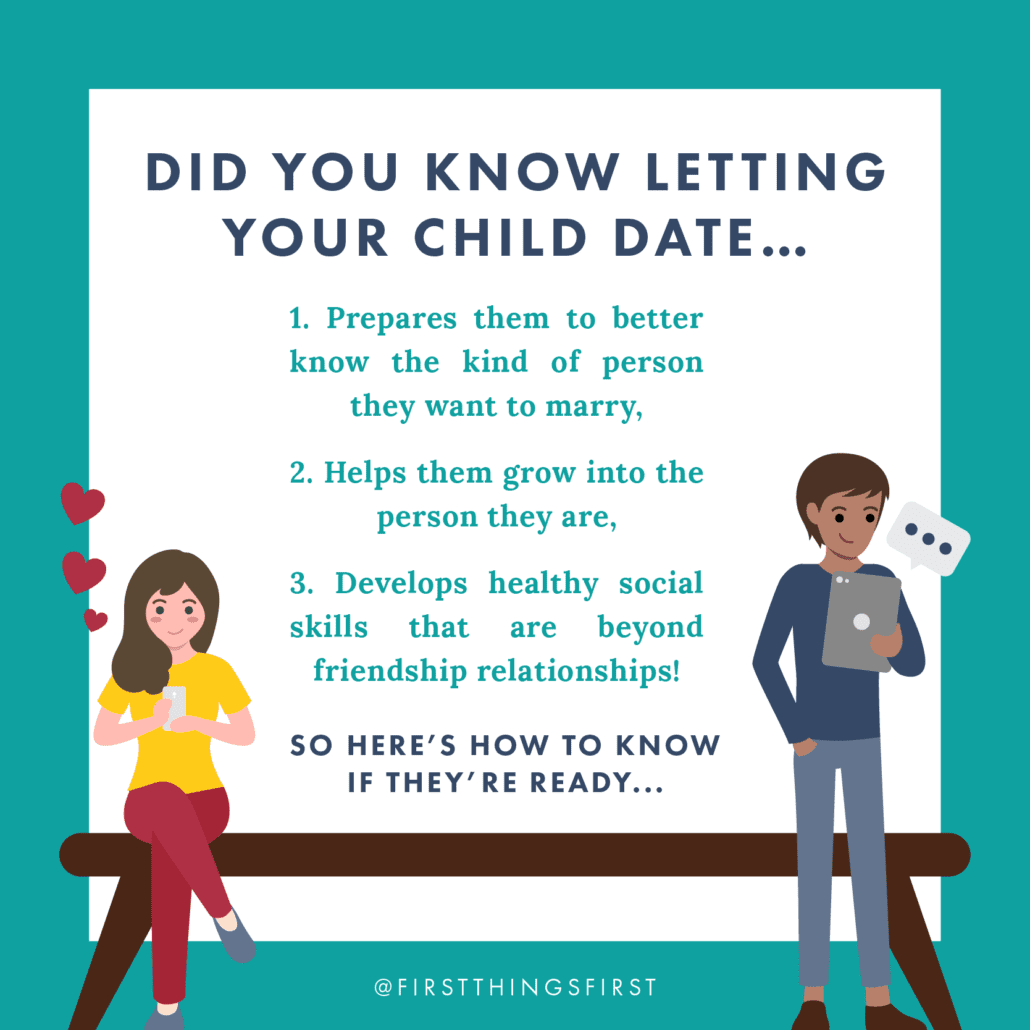
In our house, we talk about how dating:

  1. Prepares you to know better the kind of person you want to marry (if that’s something in the cards). 
  2. Is something that helps a young person grow into the person they are.
  3. Develops healthy social skills that are beyond friendship relationships. 

When they cannot yet grasp that their value doesn’t come from whether or who they date.

I want my girls to know that a romantic partner does not make them more of a person. They aren’t somehow “not enough” without a boyfriend. And that, despite what other people their age might be doing or saying, dating isn’t something you need to do because it helps you feel more accepted in your friend group. In other words, I want them to develop self-confidence and the beginnings of a firm identity beyond their dating life. 

When a teen knows this, it can protect them from adolescent dating risks. Research tells us that teens who have a healthy amount of self-efficacy, or self-assurance, are less likely to experience dating violence, use drugs or alcohol on dates, or cave into sexual pressures. 

If they don’t feel like they can communicate with me or their mom if something is wrong.

I’m just going to lay it out there for you: as much as it may pain you, when your kids begin dating, they will experience heartbreak, pressures, and temptation. They are going through the mental and emotional gymnastics of development. And they are going to come to points, many times, when they are stuck and need a voice of wisdom. That’s you. I want my daughters to know they can call me if they are at a place they don’t want to be and I’ll be there to get them. And I want them to feel comfortable to open up about what they are feeling or experiencing in a dating relationship. Despite popular belief, this is very possible

If they are dealing with depression or anxiety.

The bad news is that, according to the National Institute of Mental Health, 30% of adolescents experience some kind of anxiety, and Pew research tells us that 13% of adolescents in 2017 experienced at least one major depressive episode. The good news is, the vast majority of these issues in teens are very treatable. If my daughters experience any kind of depression or anxiety, I’m confident we can work through it over time. However, I don’t want a boyfriend or an active dating life to be the coping mechanism they use to deal with these things. Bad things happen when the “other person” is made the emotional crutch. 

When they can’t separate their dating life from their compassion for others.

What I mean here is sort of the reverse of the previous bullet point. Both of my daughters are very compassionate people; they’d gladly give everything they have to help someone who’s down and out. However, we’ve all seen relationships where one person stays because they feel the need to help the other deal with some issue. And this brings the fear that if you were to break it off, the other person might go off the deep end somehow.  This is “martyr dating,” and it’s not healthy. I want my daughters to understand that dating is not the avenue to walk people through their problems. 

A couple of caveats need to be made with the above points: 

  • Now, if I were to wait until my kids had all these things down in their development to let them date, well, they may be living in my house a verrrrrrry long time. Obviously, they won’t have it all together in their teen years. But the idea is to know my kids well enough to know that they are well on the road toward these developmental traits.
  • These developmental lessons begin well before teens are anywhere close to dating age. As a matter of fact, they begin with a close, connected relationship between parent and child. Parents need to be in the pocket, having ongoing conversations on these ideas with their kids. This is how children build self-confidence and trust to go to their parents with problems, even when they are older. Ongoing conversations help teens cope with anxiety and other emotional issues. And it helps them come to a good understanding as to the purpose of dating. 

There is no magic age a child should be allowed to date. It really depends on the child and where they are in their thinking and development. But one thing is for certain: parents need to become a student of their kids, continually learning more and more about how they’re thinking, what they’re feeling, and getting a sense of the direction of their development. This is the best way that we as parents can prepare our kids for a healthy dating life.

Image from Pexels.com