
10 Date Nights Every Couple Must Do Before Summer Ends
I value my friend who reminded me that summer doesn’t end just because we start talking about our children going back to school. In fact, we are just one month into summer! Summer means different things for different people. For some, summer is about being footloose and fancy-free. For others, summer is composed of trips to see family and friends. To me, summer is a time when my husband and I can do fun things together while our children spend quality time with their grandparents. And that means summer date nights!
Here are some fun dates that every couple must do before summer ends:
Date Nights On the Town:
- Dessert Date. (Go get ice cream or cheesecake… and feed each other!) Start off by sharing your favorite desserts during this summer date! It can be anything from ice cream, cakes, pies, cupcakes, candy or delicious juicy fresh fruit (peaches, grapes, cherries, etc.). Or take it up a notch—once you have your dessert, use a sight inhibitor (blindfold) and feed each other. You have to guess what you are eating.
- Outdoors Date. (Hike or walk in the woods, paddleboard, kayak, fish or go tubing!) Whether you like the beach or mountains, a steady lake or a flowing river, getting in the great outdoors will bring you closer to nature and to each other.
- Recreate Your First Date. Remember your first date? Think about the ambiance and the food. Try to recreate it at home.
- Town Tour Date! Learn more about your community and each other by taking part in a walking tour in your hometown or somewhere nearby. Or create your own tour. Are you sure you have explored your town and each other?
At-Home Date Nights with A Meal:
- Have A Picnic. (In your backyard or a local park!) It can be a meal out of your kitchen or purchased from a local gourmet shop. Grab what you like to eat and drink and put it in a basket. Get a blanket or old comforter, then head out to your backyard, to the beach or to a national or state park near you. Find the perfect spot and have your meal together.
- Breakfast Date. (Or dinner for breakfast… or breakfast for dinner!) Get together and create the menu for your favorite breakfast meal and have it for dinner. Or your favorite dinner and have it for breakfast. Think about it—breakfast for dinner, after DARK…
At-Home Date Nights without A Meal:
- Twinkle Twinkle Date. (You’re not too old for this one..) Awake that inner child and create a fort in your living room. You know the drill—place a blanket in the middle of the floor. Put chairs around the blanket. Use sheets or blankets to create the top covering. If you have some twinkle lights or a flashlight around, use that to light up your space. (You can play a fun questioning game like Never Have I Ever or 20 Questions to learn more about each other.)
- Virtual Summer Date. (Click on some romance! Virtual Date Night or DIY Date!) Check out some of our virtual dates where you can learn to dance Salsa and Merengue or make crêpes together. (Go to FirstThings.org or Facebook!)
- Game Night. (You don’t have to ever be board…) It’s time to dust off your favorite board or card game. Agree beforehand on what the winner gets…
- Home Concert Date! (You don’t have to go to an arena to rock out…) For this date night, create a playlist of your favorite artist or your musical memories on a music streaming platform. It can be in your living room or under the stars in your backyard. Dance the night away in the arms of your honey. (You could even watch a concert on television and pretend that you are in the front row.)
No matter what is going on in the world, couples need to spend quality time having fun with each other. Play and fun build intimacy and adventure in your relationship.
Now, go have some FUN!
Conversations Every Engaged Couple Should Have Before They Say, “I Do”
While you’re engaged, conversations tend to hover endlessly around the wedding day, and naturally so. Though working out the details and planning your celebration is exciting, having conversations about other topics is important, too.
You and your fiancé are stepping into something beautiful—a promise of commitment, a proclamation of loving each other now and falling in love over and over again, a 24/7 best friend, and a person who wants to love you at your best and through the worst. You owe it to each other to take the time to appreciate what you have and to continue the pursuit.
One way to pursue each other is to sit down and have important conversations. Continue to learn about each other, find a middle ground for things you may not have the same opinion on, and keep the door open to come back to these conversations down the road. As time goes by, things can change, and so can you.
5 Conversations Every Engaged Couple Should Have Before They Say, “I Do”
1. Talk about the importance of marriage, what it means to you both and what you hope for it to look like.
Being on the same page about why marriage is important to you helps you both take ownership of your relationship and establishes its value. When you take the time to lay out your hopes and expectations, you invite your spouse into the opportunity to make those happen. If you don’t voice what you expect from your future spouse, you’ll set them up for failure and yourself up for disappointment.
2. Do you want children?
If one of you does and the other doesn’t, this could be quite an obstacle to get over. It is important not to assume the other’s answer in this particular conversation because it intimately affects what the future looks like. Talking about this as an engaged couple is a really big deal.
3. How do you handle conflict and what rules do you want to establish on how to fight when you do?
Conflict is inescapable for any relationship, says Psychologist Dan Wile, but some of the best news is that conflict handled well actually brings you closer instead of pulling you apart. You have to find what works best for you both. For my husband and I, we have two ground rules: 1. No yelling and 2. No cussing at each other. This works for us! If we feel like we are going to start yelling, we call timeout and revisit the conversation after we have had time to process.
With more than 40 years of love and relationship research under their belt, The Gottman Institute says that whether love will last is more about how couples address their differences and support one another’s needs and dreams. Here are some steps they suggest to handle conflict better.
4. Talk through your finances.
What are your financial goals? Have you talked about a budget and about savings? This topic can take a turn for the worst pretty quickly if you don’t find a middle ground. Here’s some guidance on automating money in your marriage and saving thousands by The Gottman Institute.
5. Intimacy in your relationship.
It’s an often underrated conversation. Being intimate isn’t limited to being physical, though that is an important part. In fact, there’s emotional and spiritual intimacy, too. Each of these plays into each other and helps create a deeper bond with your partner because you are learning about them in a way that others may never experience. Spending quality time together is a great way to increase intimacy. Talk about what your dreams are, your spirituality, your feelings and what’s on your heart as well.
Get personal with your sweetheart. Start out your marriage with the muscle memory of talking through tough conversations, how you want to love each other and what’s important to you. The more you communicate, the richer the potential for a lovely life together. Now who’s ready to say I do?
Check out some other great blogs for engaged couples:
My Fiancé and I are Fighting All the Time
Fighting with your fiancé all the time, aka, the person you are planning on spending forever with, can feel just exhausting. Planning your wedding, fear of job loss, or navigating unemployment while trying to secure a future together… uncertainty can definitely stir the dust in the air. Just when you think the dust is going to settle, one of you kicks it back up again!
“I have seen far too many people fall into the trap of marrying a person thinking that they knew them, but in reality, they only knew about them,” says Dr. John Van Epp, relationship expert, and author.
So, for starters, if you find yourself in constant conflict with your fiancé, what exactly are you fighting about?
- Finances around the wedding?
- When you will actually get married?
- What the celebration will look like in the midst of “RONA?”
- One of you is messy and the other is a neat freak?
- Your mother?
- Quarantining during the Pandemic?
- The dishes in the sink overnight?
- Money in general?
Fighting about things that matter is one thing, but if you find yourself fighting with your fiancé about Every. Little. Thing, that’s a whole new ballgame.
It might be a good time to take inventory of your relationship and see if it’s unhealthy.
An important thing to consider—if you are fighting about everyday things that you will for sure continue to encounter, and you are thinking that once you marry things will simmer down and those issues won’t be such a big deal or you will be able to “work on your spouse” to get them to change… Do not be fooled. If you see things that you need to work on individually or as a couple, the chances of change happening before the wedding are far greater than after the ring is on your finger.
The hopeful news is that conflict is inescapable for any relationship. Some of the best news is that conflict handled well actually brings you closer instead of pulling you apart.
✦ You for sure are not alone in this. Psychologist Dan Wile says it best in his book After the Honeymoon: “When choosing a long-term partner, you will inevitably be choosing a particular set of unresolvable problems.” It’s true. Every couple has around 10 things they will not necessarily agree on for the duration of their marriage. Despite this, relationship expert Dr. Gottman, who has studied couples for the last 40 years, has found that about ⅓ of conflicts can be resolved with the right approach.
Even for those things that you might disagree on for forever, Gottman found that how you approach each other is the key.
Dr. Gottman’s Approach:
Step 1: Soften Your Start-Up.
Are you beginning the conversation where you left off in your head? When your fiancé gets to your apartment you say, “Why should I ever be ready on time? You’re always late.” They respond with, “I got stuck behind an accident. I’m working on my timing.” Then maybe you go on to say, “It’ll be something else next time.” Soft Start-Ups don’t include the Four Horsemen (criticism, contempt, defensiveness, and stonewalling). Instead, you and your partner start the conversation gently and with intentions of understanding each other and coming to a resolution.
Step 2: Learn to Send and Receive Repair Attempts.
“Think of a repair attempt as slamming on the brakes when you see a red light. You do this to avoid a collision that could harm your marriage,” says Kyle Benson from the Gottman Institute. In the example above, acknowledging that your fiancé is working on their time management could have de-escalated the situation. Practicing sending and receiving repair attempts can help improve the quality of your relationship.
Step 3: Soothe Yourself and Each Other.
If you know you’re too upset to have a conversation at the moment, take a 20-30 minute break. Try and “focus on the positives of your relationship by yourself.” When you’re “Flooded, ” as Dr. John Gottman refers to it, your brain is flooded with stress hormones and chemicals that make it nearly impossible for your prefrontal cortex, the part of your brain responsible for complex problem-solving, to function. As a result, you can’t physiologically function as you normally would. You can’t communicate as you normally should. Acknowledge what makes you feel flooded. Talk about the best way and time to bring up issues to each other, how your partner can soothe you and what signals you can give each other to clue the other into how you’re feeling.
Step 4: Compromise.
When you negotiate, you accept each other’s imperfections while recognizing your relationship is more important than the argument and being right.
Step 5: Address Emotional Injuries.
Sometimes how you fight is what hurts more than what you were fighting about. Be open to talking it out and processing what you two went through. Accept responsibility and learn from your fights.
Fighting with your fiancé doesn’t have to be all bad—it can be an area for growth and an opportunity to understand each other’s differences better. A great way to fight for your relationship is by preparing for marriage. Consider premarital education or counseling to set yourselves up with the tools you need to thrive in your relationship.
Some other blogs you might find helpful!
10 RULES TO “FIGHT NICE” WITH YOUR SPOUSE
TOP 10 POTENTIAL MARRIAGE PITFALLS
10 GREAT DATES BEFORE YOU SAY “I DO”
10 RED FLAGS IN A DATING RELATIONSHIP
***If you or someone you know is in an abusive relationship, contact the National Hotline for Domestic Abuse. At this link, you can access a private chat with someone who can help you 24/7. If you fear that someone is monitoring your computer or device, call the hotline 24/7 at: 1−800−799−7233. For a clear understanding of what defines an abusive relationship, click here.***
What to Do When You Disagree With the Ones You Love
It’s nothing new to disagree with the ones you love, whether it’s about current events, religion, guns, racism, politics, football or something else. In fact, chances are pretty good that you completely disagree on certain topics with someone you care deeply about. The disagreements may be so intense you wonder how you can actually co-exist.
The level of intensity might feel more so at this moment in time in our culture. In fact, many people can hardly believe that the people they love have such different perspectives from their own. The ongoing stress from trying to navigate these issues can take a massive toll on our relationships.
FOR REAL.
What do you do when you strongly disagree with the ones you love?
Although you might be tempted to confront them and tell them they are just plain wrong, you might want to reconsider. That plan probably won’t go very well for you because it’s likely your loved one will feel attacked. Nobody wants to feel attacked, right?
Instead, start by asking yourself a few questions.
What’s the goal of my conversation with this person?
Do I just want to share information?
Am I trying to understand their perspective?
Do I feel the need to convince them they are wrong?
Am I trying to prove that I have a valid point?
Do I have to WIN?
Taking the time to think about your ultimate goal can help you prepare to constructively engage with them.
It may help to remember that no matter how hard you try, you cannot change someone else or make them see something the very same way that you do. Yelling at them, belittling them, coming across as condescending, stomping out of the room or being sarcastic will only fuel the fire. And it will take you further away from your intended goal.
Plenty of married couples, extended family, siblings and roommates have vehemently disagreed about things, yet their love and respect for each other was never in question. How you have the discussion matters.
Here are some tips you can use to make your conversations productive:
- Look for things you do agree on. It is likely that you agree on far more than you disagree about.
- Kindness and respect goes a long way when trying to discuss difficult topics. Be aware of your tone of voice and body language.
- Avoid imagining how you think the conversation will go or how it has gone in the past. Playing negative scenarios in your head will actually increase your stress. It could also steer the conversation downhill straight out of the gates.
- Be prepared to genuinely listen to their perspective—even if you already believe you don’t agree with them and can’t fathom how they could believe what they believe. When people feel heard, you are more likely to keep the conversation going and avoid damaging your relationship. **PRO-TIP: Paraphrase what you hear and avoid using the word, “but.” Using “but” negates everything that the other person just said. Try using “and” instead.**
- If it feels like the conversation is becoming heated, remember that getting louder will escalate the situation for sure. Plus, it actually makes it harder to hear what is being said. If you’re struggling to think clearly or keep your cool, take a break. Say you need to go to the bathroom or you need to get a drink of water—anything to take a break in the action and allow yourselves time to breathe. Pausing is powerful.
- Avoid using “You always, you never,” and “You should.” Instead, focus on yourself and share your perspective while using “I” statements (I feel, I believe, I want, I need, etc.).
These are particularly stressful times, and when you disagree with the ones you love, IT’S HARD.
This means that many of us are experiencing extended periods of heightened anxiety and are constantly in a fight or flight mode—which is totally not normal. Fuses are shorter and we are probably more easily irritated. And, we may react more quickly, especially if we’ve been thinking or dwelling on the topic at hand. Acknowledge this and think through the fact that how we handle difficult conversations can impact the quality of our relationships.
It’s vital to remember that this is a process. If over time the conversation seems to go nowhere, you may need to set boundaries around this topic in an effort to keep from destroying the relationship. Keep in mind that if you choose to walk away from the relationship, you will no longer have the opportunity to present a different perspective.
Money-Saving Tips for Planning Your Own Wedding
Prioritizing your marriage over your wedding is a beautiful place to grow from. While you dream of, save for and plan the wedding day, it can be magical without hurting you financially. You’ll have some of the same conversations you had while planning your wedding when you talk about preparing for marriage. Those “money-saving” talks for the big day can lead you to some great ideas after the wedding.
It wouldn’t surprise me if you talked about:
- Cutting down on how often you eat/drink out
- Combining music/streaming subscriptions
- Buying used things vs. buying new
- Setting saving goals
- Packing your lunch
- Paying off debt
- Asking friends and family if they have something you need
Gottman Institute research shows that one of the biggest reasons couples fight is… money. You can avoid this by getting on the same page and goal-setting together! Talk about how you spend and how you can save as a team… you’ll align your priorities, practice making important decisions together and strengthen your relationship. It’s a win-win.
Let’s get down to business. Here are some great bits of advice to help you save money on your wedding from NerdWallet and my own wedding experience!
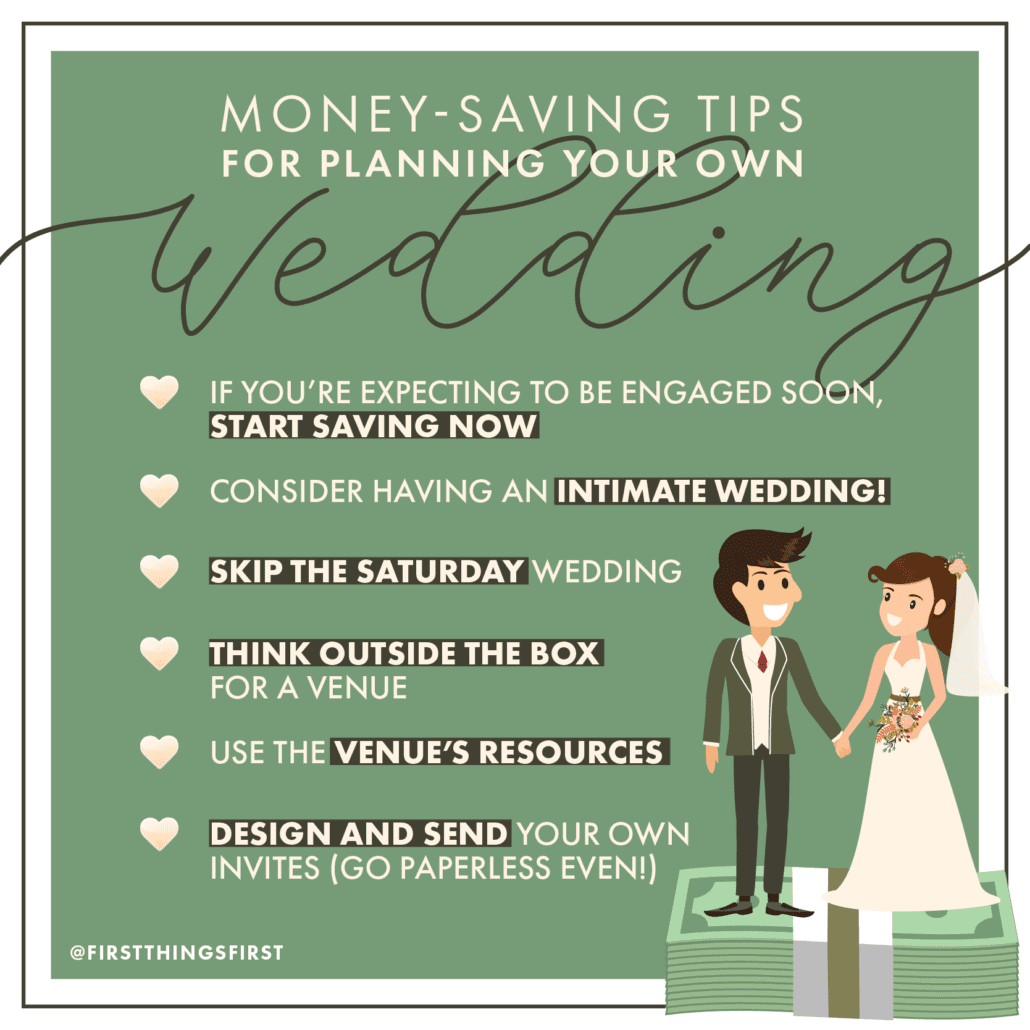
Money-Saving Tips for Planning Your Wedding:
If you think you’ll get engaged soon, start saving ASAP.
My husband and I looked at our monthly income and cost of living and found areas where we could save. Some months we saved $500 each – some $300. Figure out what works best for you. Starting a few months before the engagement allowed us to pay for things as we made decisions. And we knew we had stability from the get-go.
Consider having an intimate wedding!
COVID-19 made guests joining in over Zoom or Facebook Live sexy. You can save on food, beverages, a DJ, venue, and extra hours from photographers. You can also save on the rehearsal dinner with extended family, bridesmaids and groomsmen. That savings can go straight into investing in your marriage! Maybe you can put what you were willing to pay for a bigger wedding into an emergency or fun fund instead!
Skip the Saturday wedding.
Planning your wedding for a Sunday or weekday can save you thousands! (My husband and I saved $1.5k by having a Sunday wedding!)
Think outside the box for a venue.
Vacation home, someone else’s property, government-owned historical sites, restaurants, State Parks (so affordable), etc.
Use the venue’s resources.
Using a venue that offers chairs and tables is a huge plus! Ask what’s included.
Design and send your own invites. Go paperless for the younger friends!
Canva has tons of free designs. The two best pro-tips I can give are sending formal invites to those who aren’t as tech-savvy and emailing the rest.
Here’s part 2: Use Staples if you decide to print. Upload your design as a postcard instead of as an invitation! It cost us around $48 for 250 “Save the Dates.” Postcard postage costs less, too! We did the same things with our invitations but put them in an envelope and used the back for more info. (P.S. The average cost for stationery/postage items like those listed is over $400… I just told you a way to do both for about $100). My wedding planner book told me to budget $800?!?
Buy wholesale flowers.
Putting your own arrangements together can save $150 alone on what people charge for making bridal bouquets!
Check the sale rack and wedding dress samples first!
Your dress won’t be any less beautiful if you get a great deal.
Borrow anything you can!
Accessories, centerpieces from married friends or family, decorations… anything!
Cut down on a store-bought cake.
Trust me, you don’t need as much cake as you think. Get a nice personal cake for you and your spouse to cut into. Ask friends and family to make the rest. This worked out beautifully for us.
Limit plus-ones.
If someone isn’t seriously dating, they don’t need one! On the flip side, you don’t have to invite someone’s significant other—especially if you aren’t close to them! Offering a plus-one for an out-of-town guest to travel with is thoughtful.
Be upfront with each other while planning your wedding. Figure out your priorities. Remember, your wedding day is the beginning, but your marriage is the rest of the story. One of the best reasons to save money on your wedding is to invest it in your marriage! Enjoy this season, but anticipate the sweetness that follows. Being married is just the best!! (I’m biased, but I’d like to think I’m also honest.)
How Opposite-Sex Friendships Change After You Get Married
As a young girl, I grew up in a neighborhood that was primarily boys. So, I played football, kickball, basketball and baseball with the guys. Throughout high school and college, I always felt comfortable around guys. They were like big brothers to me. I remember one incident when I was going on a date in college. The guy came and picked me up from my dorm. As we drove off-campus, my “brothers” surrounded the car to make sure that my date knew that I was to return to campus in the same condition that I left it. I remember feeling cared for and protected by their actions. As a result, I continued to foster and build these relationships with opposite-sex friends – until I met my husband and got married.
I saw nothing wrong with having opposite-sex friendships after getting married. To me, they were purely platonic. However, my husband had concerns. After a discussion with him, I took a closer look at my past interactions with my opposite-sex friends—even the ones that I felt were like “brothers” to me.
Questions to Ask
I had to ask myself some questions about the state of these relationships and how they impacted my marriage. I found questions from Dr. Todd Linaman, therapist and executive coach, that I chose to ask myself.
- Is my spouse aware of the closeness of this relationship?
- Do I compare my spouse to my opposite-sex friend?
- Has my spouse expressed concern about this friendship?
- Have I ever ignored or resisted my spouse’s request to modify or end this relationship?
- Is there a past romantic relationship or do you fantasize about a romantic relationship with your friend?
- Is there any attraction (sexual/physical) to my opposite-sex friend?
- Would I feel uncomfortable if my spouse had a similarly close friendship with someone of the opposite sex?
If the answer is yes or even maybe, I need to reevaluate my friendships by:
- Setting Appropriate Boundaries. I recognized that spending time with, sharing experiences, disclosing thoughts and feelings are ways to build intimacy. Prior to marriage, I may have shared my time and my experiences, as well as my thoughts and feelings, with my opposite-sex friends. Now, I realize that sharing like that should be primarily with my spouse.
- Being Open To How Your Spouse Sees Things. It’s important to be open to your spouse’s concerns. Yes, this has been a long-term friendship. However, your spouse might see romantic overtures that you’re blind to. Take a moment and consider your spouse’s viewpoint. Even if you don’t agree with it, you should respect their feelings. Remember, they only want what is best for you and your relationship.
- Building A “Friendship” With My Spouse. It may be sad to lose a long-standing relationship. However, making and creating time to build a friendship with your spouse can help fill the void. Explore your hometown for adventure and experiences. Seek out new interests together. Share thoughts, goals, and dreams with your spouse.
Our friend groups went through change when we got married – including our opposite-sex friendships. I have a great deal of respect for my husband because he never demanded that I give up my friendships. He only wanted me to do what was in the best interest of our marriage. I made some intentional choices when it came to opposite-sex friendships after marriage.
Looking back, I would say I have no regrets.
***If you or someone you know is in an abusive relationship, contact the National Hotline for Domestic Abuse. At this link, you can access a private chat with someone who can help you 24/7. If you fear your computer or device is being monitored, call the hotline 24/7 at: 1−800−799−7233. For a clear understanding of what defines an abusive relationship, click here.***
Marriage is the best! But it’s not perfect. If you’re engaged, I think it’s only fair someone breaks the news to you. There are some definite misconceptions about marriage you should know before you say, “I do.”
Having recently been in your shoes (about a year ago now), I’m glad to have figured this out! My hope is that you have an amazing first year of marriage and many years to follow. A great place to start is with clearing up a few misconceptions about marriage. Whether you are finding out about or being reminded of these 5 things, I encourage you to seriously consider them.
Misconception #1. Marriage will solve whatever problems you currently have.
As amazing as that would be, a title and official seal of foreverness does not equal problem-free reality. If you know something is creating friction for you now while you’re engaged… work on it before “I do.” The hardest conversations are always worth having and though they may not feel great in the moment, they are more than likely the most important to have. (Besides, you may have the luxury of going back to your own place if you need some space. Once you’re living together you only have a few rooms to work with, and that may only be the bathroom if you’re in a one-bedroom like me!) You want to start this new chapter fresh. Lessen your baggage by bringing in more solutions than problems. You have to put in some legwork, but it’s so worth it!
Misconception #2. Your spouse will be the only emotional support system you’ll need.
Wooo–wee on this one. Let me tell you, you will be very disappointed if you fall into the trap of thinking that because you’re marrying someone to be their one and only, they’ll be the only one you need. To hold an expectation for your spouse that they are the only key to your happiness, comforting you when you’re sad, or even magically want to pick up and join you in all of your hobbies is to be disappointed. Just like you, your fiancé is human and when they become your spouse, they will be human then, too.
My dad died unexpectedly this year, one month into our marriage. I am 24, so it feels young. Though my husband was absolutely there to hold me, I needed someone to talk with to verbally process what just happened.
My husband is an internal processor and doesn’t want to say anything until he feels like he has the right words to say. Instead of putting pressure on him to try and talk to me in depth about what was going on and potentially being upset by how he handled it, I called my best girlfriend. She processes things like I do. That’s what I needed. This didn’t make my husband any less loving or capable (because goodness he is the most loving)it just gave us both the space to do what we needed. He supported me by not leaving my side and holding me while my best friend talked me through my emotions.
It’s healthy to have people you can depend on outside of your own home. Having an opportunity to navigate this so early in our marriage really got us on the right track. Even though it was a painful and tragic thing to happen, it was so good for our marriage because it reminded us that we don’t have to carry the weight of being the only source of stability for each other. It takes a village!
Misconception #3. You’ll hang out all the time because you live together.
Would be nice, but isn’t exactly as it seems. I hope I’m not breaking any hearts here—I’m just wanting to be honest with you. Though you do spend a lot of time together, it looks different than while dating. Your love life and work life are a little more separate when you aren’t married. I love the perks of coming home to my handsome man. We share bills, chores, meals over candlelight, and a bed!
Despite coming home to each other, if you both work a full-time job, that’s 40 hours a week apart (let’s set COVID-19 aside as the exception here for a moment) you aren’t together. Then you come home, if you work out after your job, have to make dinner, clean up, shower or prepare for the next day of work, you begin to notice how coming home at 5 and getting enough sleep leaves only a few hours to get everything done.
Just breathing the same air or sitting on the same couch doesn’t mean you’re really connecting. We are so guilty of being on our phones while next to each other and look up at the time and just ask where it went. We’ve gone to bed saying “I missed you today” or “I feel like we didn’t even see each other!” while being in the same house. (Let’s bring COVID-19 back for a moment because this was recent while working from home!)
Quantity of time together doesn’t equal quality. Quality time takes being intentional and showing an effort. If you are blessed enough to have the same schedule, use it to your advantage and enjoy each other and enjoy meaningful time together. There are many couples who don’t have the luxury of sharing meals together with one person working the night shift and the other the morning shift. I’m not trying to guilt trip you into hanging out… ok, maybe I am just a little, but you’ll thank me. Have a family meeting and talk about your schedule. Pencil in quality time together.
Misconception #4. The first year is the hardest year.
I’m going to be honest. Hearing people say this frustrates me. Your first year does not have to be your hardest! Take it from someone who has dealt with: losing and starting a new job, losing their father, my husband being crashed into while driving my car (that we just had fixed), my mom getting in a wreck, my husband’s trip to the ER (an expensive date for four stitches lemme tell ya), my husband getting more responsibility at work which meant more work at home, unexpected bills, family members in the hospital, COVID-19 and quarantine… I could go on. That all sounds like a recipe for conflict and stress—but it wasn’t. Each situation that went wrong was an opportunity to grow closer together.
Was it hard? Some parts, but it was also so sweet. In the midst of all of those things: we fell more in love, rescued two of the sweetest kitties, got to travel, went camping, played tons of games, experienced new things, danced in the kitchen (many times) while making dinner, laughed at each other and ourselves, came home to our best friend, spend more uninterrupted quality time with each other than ever before (thank you, quarantine), learned new things about each other, shared stories, made a lot of memories, and the list could go on.
We consciously made an effort to continue pursuing each other, assume the best of one another, have a good attitude, resolve conflict, and be romantic.
We have been together almost 8 years and this year topped them all. If you put in the work and continue to pursue each other, I bet your first year can be wonderful despite whatever life may throw at you.
Misconception #5. Your spouse will know everything you want.
So remember how I said your fiancé, once you marry them, will still be human when they become your spouse? Yeah. This remains true a few paragraphs later. Unfortunately, when you reach husband or wife status, you don’t become a mind reader! (Mind-blowing, I’m sure.) I am SO guilty of this, and I definitely have a natural ability to pick up on feelings other people don’t. (For you Enneagram people out there, I am a 2!).
I can’t tell you how many times my husband and I have had the conversation about needing to tell each other what we need and what we want. Sometimes, when we assume, we get it wrong. You know how the saying goes. Even though you two know each other better than anyone else, it’s dangerous to presume that they know what you mean without saying or explaining it. You’re going to have to keep working at communication.
This goes back to the expectations thing I mentioned before. You have to play your part in informing the other person what it is that is really on your mind and heart. Communication is king. If there’s one thing to become a pro at in marriage, it’s communicating (I’m sure you could think of a few more areas to be well-versed in).
Communicate often and clearly. Never put yourself in the position of thinking you know everything there is to know about your spouse. You’ll get bored! Being married isn’t a finish line—it’s the beginning of an ongoing process.
*Helpful hint for the ladies: they still don’t pick up on hints. Just save yourself the trouble and ask very direct questions, *wink wink.*
With these common misconceptions about marriage out in the open, I hope you have a better understanding of what not to expect. Truly, perspective and expectations are everything. You and your fiancé will navigate all of it together—you aren’t alone! As some of these things try and sneak their way into your marriage, I hope you feel equipped to kick them out! Oh, and smooch along the way… it’s good for you.
3 Things I Wish I Had Done Differently While I Was Engaged
Being engaged is like being in limbo. You’re excited to be engaged but more excited to be married. It’s a season of anticipation and possibly a lot of frustration if you aren’t careful.
My husband Tyler and I just celebrated our first wedding anniversary. I can confidently say that being married is way better than being engaged. As we reflected on our first year of marriage, we also talked about the time leading up to the wedding. We also discussed what we would’ve done differently during our engagement.
Do yourself a favor, and consider some of these tips so that you can enjoy more and be annoyed less.
1. Set Strong Boundaries ASAP
You’ll be surprised who comes out of the woodwork once you’re engaged. People you haven’t talked to in years ask when and where the wedding is (fishing for an invite). Relatives say “we’ve waited so long for this” (like they also got engaged). Plus, family members have a list of questions a few hours after a ring is on it (wanting to take control and get the ball rolling.)
Before you start trying to answer all of the questions rolling in, have an intentional conversation with your fiancé. Decide together what you’re going to say to the random friends in your DMs, to the distant relatives, and most importantly, the role you want your parents to play.
One of the best pieces of advice I can give is to delegate some of the tedious legwork to your parents or go-getter friends (bridesmaids, groomsmen) on the front end. This will give you time to think about the questions that will follow. (All the while, you still get to make them feel important and a part of what’s happening!) For example, ask your parents to start making a list of who all they think needs to be at the wedding. Of course, mention you and your fiancé have the final say, but I would really appreciate their help.
One important boundary to set for yourself is permission to say no, I don’t know, and I’m not ready for that yet. If you don’t want the help, don’t have the answer, or aren’t at that place in the planning yet, then speak up about it. You don’t have to decide on the spot to appease someone.
2. Spend Quality Time Together
Tyler and I had opposite shifts at our jobs and didn’t live together before we got married. I would go in to work as he would get home from work. Unfortunately, this left very few times (normally once a week) that we could see each other during our six-month engagement. When we did see each other, wedding planning dominated our time. We didn’t get to enjoy being engaged as much as we wanted to because we prioritized work and sleep, which hear me out, I recognize is super important. However, some sleepy workdays would’ve made a world of a difference. If a day full of yawns here and there meant we got to hang out and just do life together rather than only plan a future life together, I think our relationship quality would’ve been better. We both do.
When you’re engaged, if you’re not living together already, you are ready to. That’s a part of the excitement about getting married! So we fought against the nature of what we wanted and felt like we needed by not squeezing in more time to date each other. Plus, when you are only answering questions from family, friends, vendors, etc., it’s easy to get overwhelmed and be short with each other. I promise you won’t regret setting aside time. I suggest that you spend time together at least once a week (whether it’s in person or over FaceTime). Here’s the catch though—like a game of Taboo, you can’t bring up the wedding!
3. Have A Couples’ Shower Or Party with Close Friends
Brides get a lot of the attention during this season and on the wedding day itself. I’m not saying I didn’t love it. Looking back though, I wish I had made celebrating my man just as much a priority. At the time, he so didn’t mind. Tyler is humble and never wants to be the center of attention. In fact, it was a win-win to him that someone could throw me a bridal shower and he could get all of the gifts without the small talk.
We also thought the rehearsal dinner would be the perfect time for everyone to celebrate us together. However, we recently decided that as perfect as our rehearsal dinner was, it was hard to talk to everyone! And, we loved being celebrated together. Looking at each other from across the room and talking to our friends and family as a couple was so sweet. We’d had a taste and wanted more!!
If you have a lot of friends that live near you, I would consider doing a local Couples’ Shower, pre-wedding party, or whatever you want to call it! Embrace the joys of the engagement together.
If we had been better about those three things, we could’ve really enjoyed our engagement season for all that it was. Congratulations on your engagement!
I hope your engagement season has minimal stress and maximum joy!