
Tag Archive for: Parents

When it comes to parenting and feeling like stress is taking over their lives right now, most parents (especially those with school-age children) would probably say their stress level is at a 12 on a scale of 1-10. 

In fact, many completely identify with and find themselves crying right along with Blake McLennan from Arizona. Her parents filmed her crying and lamenting how it’s not okay that everything is closed and that she can’t have play dates with her friends, that school is not taking place and most importantly, McDonald’s has closed their playground. 

It’s true. Stress is at an all-time high and many parents are feeling its sting.

  • What should I do about childcare?
  • What’s the best decision about school?
  • How am I going to work and have the kids at home trying to do online classes?
  • Is my job on the chopping block?
  • What if one of us gets COVID-19?
  • Will my college student go back to school or are we stuck together for the semester?

So many questions and so few answers. It’s enough to make any parent ask, “Where do I go to resign because I feel like I just can’t do it anymore?” Not that you would ever do that, but this is intense. Parenting is stressful during “normal” times, but throw in a pandemic and many parents are wondering how they can continue at this level of intensity and stress.

Here’s a word of comfort for you. Parents and children have gone through pandemics and other incredibly hard things before and came out on the other side of it. You will, too!

These things may help decrease some of your stress as you trek through this and get to the other side healthy and whole. 

  • This seems like a no-brainer, but acknowledge that you are stressed out. Talk with your spouse or a good friend about all that is stressing you. Most everybody can identify with these feelings. Even though they can’t do anything to change the situation, they can listen and that is a huge help.
  • Chances are pretty great that you are a good parent, so stop telling yourself you aren’t. It just creates more stress and it probably isn’t true. Keep in mind that you are having to make hard decisions based on your own unique circumstances.
  • Stop comparing yourself and your situation with others and the choices they are making. The only person who knows what’s right for your family is you. 
  • Breathe! Seriously, to decrease your stress, make time to breathe. Incorporate these times into your day, especially when it feels like your stress is taking over. Just 60 seconds of deep breathing with your eyes closed can help reduce stress and make you less irritable with your children. 
  • Decide on a routine. Not only will this reduce your tension levels, it will reduce the stress your children feel and act out on. Morning, noon and evening routines and rituals can drastically reduce stress overload for everyone. This doesn’t have to be complex. Just little things can make a huge difference.
  • Avoid saying, “I didn’t sign up for the parenting pandemic plan. This is just too hard.” Your brain believes what you tell it. Actually thinking this thought all the time creates more stress. It is hard, but you can do it. Keep putting one foot in front of the other and give yourself and those around you some grace.
  • Be really intentional about getting enough rest, eat as healthy as possible (binge-eating actually makes you feel worse), and exercise. You may not feel like exercising, but physical activity that makes you sweat gets rid of toxins in your body and helps you think more clearly. You hear this all the time, because it’s important and it’s true, especially in times of extreme stress. Plus, you can’t be the parent you want to be if you are running on empty all the time. Believe it or not, not doing these things increases your own stress levels and the stress levels of those around you so you kinda can’t afford not to take good care of yourself. This is probably one of the most powerful tools you have to keep stress from taking over your life.
  • Journal. Putting your feelings and all the things that are troubling you down on paper can help you process what you are experiencing. It also provides another way for you to figure out exactly where your stress is coming from in order to better manage it.
  • Manage your intake of news and social media. You really might be shocked at how your anxiety levels decrease when you remove these two things from your day. Try it and see what happens.
  • When you feel yourself getting ready to lose it with your kids, consider putting everybody in quiet time (including yourself) for a few minutes so you can get your bearings. Phone a friend, put in a good movie, have a dance party or do anything that will break the cycle you are currently in and redirect everybody so you can continue moving everybody in a constructive direction.
  • Schedule time to do fun things. This is vital, especially during high-stress times. Make your own Slip ‘N Slide, play in the sprinkler with your kids, play a game of Horse, go on a hike and find a creek to play in, go blueberry picking or plant a garden. Think of play as a necessary escape from reality.

The next time you feel the stress monster creeping up your back, through your shoulders and into your head, take the reins and tame it by using these strategies. The stress will be with us for a while, but we don’t have to let it get the best of us!

Other blogs on this topic:

Dealing with Parenting Stress During COVID-19

Supporting Families During COVID-19

Parenting Stress and Depression Risks
How to Make Stress Relief a Part of Your Kids’ Lives

Image from Pexels.com

How To Make Sure Your Child Knows You Love Them

Send the message they want and need to hear.

Of course my child knows I love them!” But do they? Really? To be clear, I’m not questioning whether you love your child; I’m questioning whether your child knows that you love them. Do they know how broad, wide, and deep your love is for them? There’s more to your child feeling loved than saying, “I love you! Goodnight!” every night.

Google Autocomplete can be illuminating. For those unfamiliar with it, as you begin typing a search into Google, Google begins to finish it for you with the most popular searches put into its search engine. So, typing, “How do I get my parents to” will autocomplete with the most popular searches that begin with the same phrase. This particular example is as heartbreaking as it is illuminating. 

The number one autocomplete is: How do I get my parents to love me?

★ What would lead kids, tweens, and teens to google ways to get their parents to love them? Is there a disconnect somewhere? Are we overestimating how much affection our kids feel? Are we not communicating love in ways that resonate with our kids? Some kids don’t even think their parents like them, let alone love them. Even if you feel confident that your child knows they are loved, there’s always room to learn more ways to deepen it.

Here’s How To Make Sure Your Child Knows You Love Them

1. Understand Your Child’s Heart

  • Dr. Gary Chapman wrote a great book, The Five Love Languages of Children, that suggests we all communicate and receive love uniquely. Sometimes the way we communicate love doesn’t match up with how our kids “hear” love and we love right past them. We might be providing tons of loving, affirming words, but our child might really feel loved the most when we spend quality time with them. His website is really helpful and has great resources!
  • What do they ask of you? This can provide insights into how they receive affection. 
    • Do they ask you to come and play with them? (Love = Quality Time.) 
    • Do they ask if you think the picture they drew is pretty or if you are proud of their report card? (Love = Affirming Words.) 
    • Do they ask for help with homework or their hair? (Love = Helping Them.)
  • How do they express love and affection to you? This also provides insight into their heart and what says, “I love you” to them. 
    • Do they want to sit in your lap and give you hugs? (Love = Physical Connection.) 
    • Do they like to make things for you like drawing you a picture or bring you things like a dandelion? (Love = Gifts, Tokens of Affection.) 

2. Spend Time With Them.

  • We can kid ourselves by saying things like, “I don’t spend a lot of time with my kids, but when I do, I make it count.” It’s great to “make it count” (quality time) but our kids need “a lot” of time, too (quantity time). There really is no substitute. Kids spell “love,” T – I – M – E. 
  • Be intentional. Look for and even plan for informal time together. Get on the floor and play with their toys with them. Watch them play video games. Take them with you to run errands or hang out with you while you’re working on the car. Lots of bonding happens organically just being together.

3. Expand The Bandwidth Of Your Communication

  • Your words are powerful. Not just what you say but how you say it. Remember, your body isn’t on mute. An angry “Because I said so!” could be a calm “Here’s why this is important…” Don’t underestimate the power of your words in forming your child’s perception of how you feel about them
  • Listen. Really listen. So many kids say their parents talk at them, not with them. You can’t make your child talk to you, but you can be present and create an atmosphere and relational environment where talking is much more likely to take place. Don’t be quick to jump in with a judgment or lecture.
  • Say, “I love you.” Not just at bedtime, but say it at times when they don’t expect to hear it—when they’ve done something wrong and have to be corrected, when they are down on themselves and don’t feel lovable, random times like car rides or when they are just walking across the room. It is important that children understand that there is nothing that they can do to make you love them more or love them less.
    • Other phrases that say “I love you” without saying “I love you.”
    • I believe in you.
    • I’m proud of you.
    • I’m always here for you.
    • I was wrong. I’m sorry. Please forgive me.

Whether you know it or not, you are always sending messages revealing how you feel about your kids—and they are paying attention. Think about that for a second. If you think it’s possible that your children might wonder how much you love them, you don’t have to let them wonder. Be intentional and talk with them about it. With loving your kids, make sure it’s a show AND tell.

Image from Unsplash.com

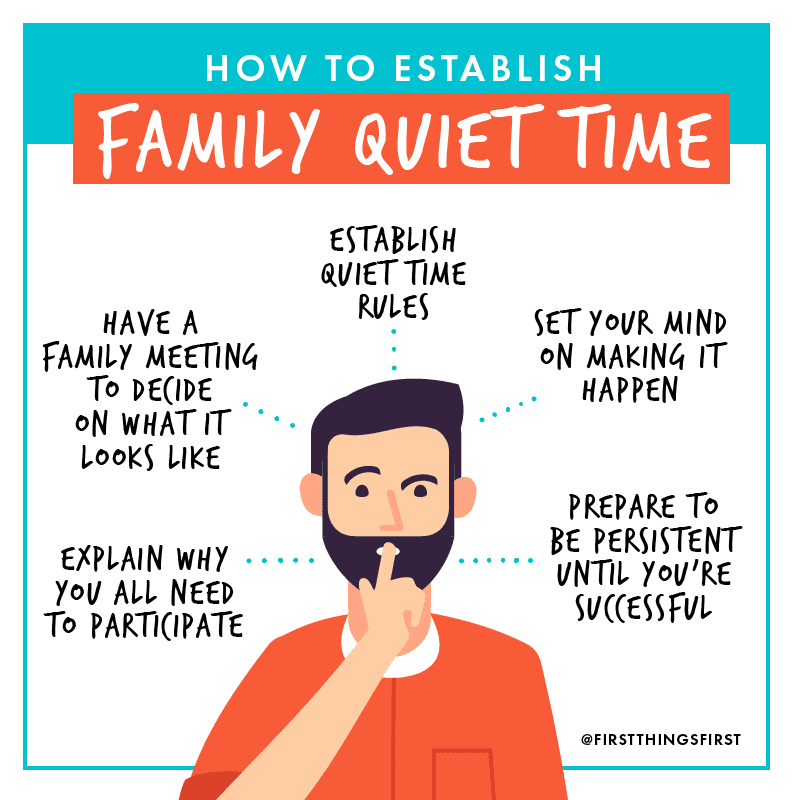
How to Establish a Family Quiet Time

Accept the challenge using these 8 steps.

Some people saw How to Establish a Family Quiet Time and thought, “Yeah right. There’s just no way. You haven’t been to my house. You don’t know my kids.” 

I am just one of the latest work-at-home dads who is amazed at just how much activity, noise, and energy can be expended by my co-inhabitants. Who are the co-inhabitants? Two daughters (7 & 13), 5 sons (ages 5 months – 11 yrs), 1 wife (can’t put her age, it’s a violation of the code). That’s eight other people. Noise is the default. Not having some quiet time is not an option either. Otherwise, I’m really gonna lose my mind.

I’m not going to try and convince you on the importance of quiet time. I haven’t met a parent yet who doesn’t crave it when they are home all day with their children. I’m just going to empower you to establish a quiet time.

Step 1: Get Your Mind Right.

You’ve got to believe it can be done. They may resist and scream. They may dig deep into their bag of tricks to block the entry of a quiet time into your home. Don’t believe the lie. They don’t know what’s good for them.  Hear the voice of the man with 7 kids: “It can be done. You can do it.” It may not be perfect the first time, but whatever you do, don’t believe the lie. Which takes us to step #2.

Step 2: Prepare To Be Persistent.

If at first you don’t succeed, try, try again. You didn’t ride your bike perfectly the first time you took off the training wheels. They don’t believe that you’re serious unless you stick with it. Kids are wired to resist anything that their parents say is good for them at first, at least it seems that way. It’s not impossible just because it didn’t work out the first time. You’re going to have to stick with it.

Step 3: Family Meeting.

Gather the troop together and tell them, “Each day, we are going to have some quiet time in this home. It helps our minds to relax and our bodies to rest. You may not think you need it, but I, as your parent need it and your body will thank you for it. There is no room for negotiation on the fact that there will be a quiet time. You may negotiate what can be done during quiet time.

Step 4: Explain Why Their Quiet Time Is Your Productive Time.

In order to get more of the ‘me’ you like later, I’ve got to get done what I can now so that we can enjoy one another later.

Step 5: Establish Quiet Time Rules.

Acceptable activities during quiet time: Sleep, lay in bed, read, write, meditate. Prohibited activities include: Video games, calling/texting with outside people, playing with siblings. Quiet time is as much about your mind being quiet as it is simply taking a nap.

Note: Play that is not noisy and only involves one person is acceptable for my seven and up crew. For instance, my 7 year old may sit on her bed and play with her dolls for a full hour. My 9 year old may sit on his bed and build legos. My instructions to them, “I should not hear you. I should not see you. You should not need to ask me anything.” If they ask me something about the legos or the dolls, they are automatically prohibited from playing with them during quiet time. 

Step 6: Establish When And How Long.

Routines and Consistency is the name of the game. If your children had quiet time at school, schedule family quiet time at a similar time. Schedule quiet time around the same time each day. In our house, our routine is lunch at 12:00, play outside til 1:30, quiet time 1:30-2:30. For our kids under 7, that normally means a nap or at least laying in the bed. The others – read, nap, write, build something. The key- they are in a space all to themselves and need no attention. (Note: You may start at 30 minutes as opposed to an hour. And no, we don’t wake the kids up after an hour if they are asleep. Are you kidding me?)

Optional: Set a timer in their room. You don’t know how many times my children have fallen asleep looking at the time countdown. I count that as a parental win. Otherwise they like to ask, “Is it time yet?”

Step 7: Set And Enforce Consequences For Quiet Time Violations.

The keys to good consequences are that you have to find out what means most to your child. Then you must be willing to enforce it the first time. This is where having your mind right and believing that it can be done is key. Suggestions: Add time—5 minutes for each violation. Eliminate dessert from dinner. Decrease screen time. Earlier bedtime. 

Remember, this may be new for your child. They may not have expected this from you. They are going to test you. Your biggest weapon is enforcing the consequences while staying cool, calm and collected. If you don’t enforce the consequences quickly, then you may get frustrated when they violate the rule again and lead you to believe that it’s a hopeless cause.

Step 8: Implement.

Be firm. Follow your plan. Keep the vision of peace and quiet in front of  you. Celebrate the victory, however small it may be at first. Let them know that we’ll all get better at it.

Practical Tips

  • Send kids to the bathroom first!
  • No eating during quiet time. May give them snacks right before quiet time, but not sugary snacks. Design your schedule for what works best. Kids always want to eat. So decide if they eat before or after and stick with it, but not during. 
  • Check in on them and encourage them if they are doing good. If they’re asleep, let ‘em sleep.
  • Enforce consequences. That’s how they know you mean business.
  • Be productive in whatever you decide to do during this time – work, yoga, emails, nap, etc. (Yes, naps are productive.)

Implementing anything new in your family can be challenging, but having a family quiet time is good for your kids and good for you! It might take some time to get it down, but it is definitely worth it!

Image from Unsplash.com

How do I get my teen to talk to me? My first thought was to think back on all my experience parenting and working with teens. My first thoughts are frequently wrong. I realized that my 14-year-old son, Jude, was sitting right next to me. Ding, Ding, Ding! He has the best credentials to answer this question. Why not ask him? He’s the expert! 

What followed was me talking with my teen about talking with my teen.

(He even grabbed my laptop at times and started typing, “You gotta tell parents this!”)

Me: Is it helpful for parents to find out what you are into and learn all about it so they can build some common ground? Like, “Is your teen into skateboarding? Learn all about skateboarding so you can talk to them! Now you can ask if they ‘push mongo’ and if they can ‘aciddrop into a melongrab.’”

Jude: (Laughing Hysterically) You don’t even know what those words mean, do you?

Me: Um, no… I Googled them.

Jude: That stuff might help. It might come off as forced and lame.

Me: Bottom line, I can’t make you talk to me, can I?

Jude: (Kinda Smugly Triumphant) Nope!

Me: (Sigh) Let me type that…

Bottom Line: You can’t make them talk. Sorry. You can’t point the remote at them and press “Unmute.” The good news, however, is that you can adopt a parental posture and create an environment where a real conversation has a much higher chance of happening. 

Jude: I like the “unmute” thing!

Me: Hey, thanks; I just think…

Jude: (Interrupting) Just tell them to spend time with their kids. That’s it.

Me: You just told them.

Jude: What? Wait! Are you just typing out what I say? 

Me: Yup. Keep talking… I might make it sound more adult-y and mix in some of my thoughts.

According to a real-life teenager, there is no magic formula, but here are five things for parents to think about…


1. Some teens are just quiet or go through quiet phases. 

You remember being a teenager, right? Well, it’s way harder now, according to Jude. It’s more cutthroat, more emotionally charged, and more adultish—social media amplifies all that exponentially. Jude says teens genuinely feel like you just won’t get it. It’s not an insult. They often process issues internally or with their peers. Resident Teen Expert encourages you to be patient. 

Big Idea: Make a standing offer to be available to talk about anything whenever they want to.

2. Spend time with them not obviously trying to force a “big” talk.

You might be dying to hear about what is going on deep inside their world and incredibly anxious to speak into it. But just offer to watch them play video games, play some Uno, (Jude: Dude. We’ve never played Uno.), or go grab a bite to eat with no agenda other than to enjoy their company. Make small talk. Don’t sweat silences. 

Big Idea: Don’t force it. Spend time with them and see what happens organically. Small talk often leads to BIG TALK.

3. Don’t freak out when you hear something that rattles you.

Jude says this is “super important.” If they do open up to you, you will hear some stuff. Maybe some shocking stuff. If you freak out, it might be a loooong time before they open up to you again. Keep a good poker face. Jude: And don’t bombard them with a million questions. Don’t lecture. Me: Got it! Empathize. Probe gently. Listen, then listen some more. (Check out this article on active listening skills—especially the Six Levels of Listening.) 

Big Idea: So many teens say that their parents don’t listen and just talk at them, not with them.

Me: So, how do I do with all this?

Jude: Um…

Me: Okayokayokay! I’ll work on it!

4. You might not be the person they feel comfortable talking with right now. 

Jude: Some stuff I just feel better talking to Davin about. (His older brother.) As a parent, I’ve had to settle for… are they talking to someone? Someone I trust? For some topics and even some phases of teenage life, I realized my teen was more comfortable talking to Mom. I had to work to get to a place where I was just happy they had someone to talk to that I knew would basically give them the same input that I would. It might be an older sibling, their aunt, a teacher, or a coach. I know I can trust my sister, their favorite aunt, to give me a heads-up if she hears something I need to know about. 

Big Idea: Encourage them to cultivate relationships with people they are comfortable talking to.

5. Talk to them. But be real. Be transparent. Be vulnerable.

This speaks for itself. Sometimes we expect our teens to give us things we aren’t willing to give them. Me: Am I real with you, Jude? Jude: Yeah. Maybe too real… Me: So that’s a compliment?

Big Idea: Make sure you are giving conversationally what you hope to get from your teen.

Me: You get the final word.

Jude: Spend time with them, listen, don’t lecture. Just tell parents to spend time with their kids.

Me: You just did again. What do you think of this blog?

Jude: This blog goes hard.

And then, on the way to school the next morning, out of nowhere…

Jude: We told them not to lecture, right?

What’s The Big Idea?

  • Offer to be available to talk about anything whenever they want to. Be patient.
  • Don’t force it. Spend time with them and let conversations grow organically. Small talk often leads to deeper conversations.
  • Practice good listening skills. Don’t talk at them; talk with them.
  • Encourage them to cultivate relationships with people they are comfortable talking to and that you can trust.
  • Model the openness, vulnerability, and transparency that you are hoping to get in return.

Image from Pexels.com

You’re probably less interested in the “why” of getting help around the house, and more interested in the “how” of it. I get it, but you need to understand the “why” first and believe it

Taking care of yourself—physically and mentally—is incredibly important, especially right now. Stress, anxiety, fear, and plain old fatigue will all take their toll on you. That toll will impact you and the people that you care about. I see it in myself and in my own home. I feel fragile, a lot.

You know the deal. I’m at home, trying to put in a full day’s work and finish my projects, making sure school work gets done, keeping an eye on my at-risk mother-in-law, and generally holding down the fort—including keeping it clean and organized. Oh, and when my wife gets home, I try to have dinner ready and we try to do Family Movie Night or Game Night and keep all the sequestered happy. It is a daunting task, and I’ve never felt so exhausted. You feeling it too? It often feels like a lose-lose situation.

If I focus time on my kids and mother-in-law, I feel like a bad employee.

If I focus time on my work, I feel like a bad dad and son-in-law.

I can’t possibly do it all. I just feel stressed out and guilty.

When in the world am I supposed to take care of myself?

Start with the basics.

The house needs to be kept up and your kids need stuff to do.

Those dots connect themselves, but how do you do this without having another thing to do?

I got the ball rolling by laying out expectations in a family meeting.

I also sent out this text message in our family group text after days of exhaustion:

Hey Family! I know everyone is taking care of their own living areas but we need to work together on shared spaces like the kitchen, dining area, and living room. We are trying to stay afloat – Mom is working full time, I’m working full time from home, and Grandmom isn’t our maid. (Thanks for all you do, Grandmom!)

Some Stuff That Needs Doing:

  • Kitchen needs to be swept and mopped.
  • Dining room & front door area swept and mopped.
  • Living room vacuumed.
  • Lawn mowed when it dries.
  • General sanitizing wipe down.
  • Help with cooking dinners.
  • General cleaning up after yourself, especially in the kitchen.

There’s enough for everyone to do a little. Thanks in advance. Hope this isn’t received as snarky. Totally sending with a heart full of love for all of you. Just need help. You guys are my favorite! ❤

That was the text. I didn’t have high hopes. I figured a couple of kids (maybe) in drips and drabs would hopefully mark a few things off the list in the upcoming week. Maybe there would be a little less work for Grandmom and me.

Then something incredible happened.

My son, who is without a doubt the “lone wolf” of the whole crew, immediately came down and started sweeping the kitchen. What? Soon, everyone started popping out of their rooms and joined in. They cranked out a very thorough cleaning of everything. We even game-ified the cleaning by adding some rounds of Nintendo Wii in-between cleaning jobs. In a couple of hours, the house was spic & span – and get this – we all had time freed up to do our stuff. Even me!

I can’t call it a Christmas Miracle. It was like something out of some wholesome unrealistic sitcom or Disney Channel show. It worked. But let me be clear, I was fortunate this time. It usually doesn’t play out like that. But I learned some valuable info that day…

There is no way I can keep up with housework, school work, and work work AND have time and energy left for self-care plus some gas left in the tank to have a little quality time with my wife when she gets home from work. You can’t give what you don’t have. 

And my kids can and will and need to help.

Let’s Break It Down

So how do I keep this ball rolling? If you break down my text, you might find some reasons why it was effective that might help you get your kids helping more around the house, have some structure in their day, and burn off some energy. Hopefully, this will lower your stress levels by freeing you up for working on work and remember, working on yourself.

Here’s what I did in my text to get my kids to help around the house:

  1. Started positively.
  2. Acknowledged what they were already doing.
  3. Was realistic and honest about our new situation.
  4. Listed very specific things that needed to get done.
  5. Gave them a choice of what they wanted to do.
  6. Thanked them in advance.
  7. Tried to preclude any misinterpretations.
  8. Affirmed my love for them and that family is the most important thing.
  9. And here is the kicker – I TOLD THEM I NEEDED HELP.  (I didn’t suggest it. I didn’t imply it. And I didn’t say, “It would be nice.”)

I probably should have added a timeframe for the work to be done by. Missed that one. 

We made it a challenge and made it fun. We worked together and multiplied our efforts.

Apply these principles in a way that works for your kids at their ages. 

Just don’t try to do it all yourself. And don’t sweat it if it all doesn’t get done. It isn’t going anywhere. Take care of yourself.

Image from Pexels.com

How can you be sure your child will know that you love them? When I was 6, I was shopping with my mom when my eyes landed on what I thought was very cool Christmas tape. I told my mom I needed that tape. She said no. So, I took matters into my own hands… and slipped two tape rolls into my jacket pocket.

When we got home, I went straight to my room and started playing with the tape. It didn’t take long for Mom to notice the silence. I vividly remember her knocking on the door and asking me what I was doing. At that moment sheer panic set in because I knew I would be in trouble. I tried to take up as much of the tape as possible before she actually opened the door.

She walked in the room, saw the tape and asked me where I got it, knowing full well where it came from. She didn’t say much more, except these words: “Get in the car.” I knew for sure I was in big trouble. I thought maybe she was taking me to the police station, but we actually returned to the store. We walked in and she asked for the manager. 

She asked me to tell him what I had done. Through tears I explained that I thought the tape was beautiful and when my mom wouldn’t buy it for me, I just took it. I told him I knew it was wrong and apologized. My mom paid him for the tape and then I paid my mom back for the tape with my measly allowance over a period of weeks.

Back then I thought my mom was the meanest mom on the planet, but I have never forgotten that day. 

Fast forward to middle school when I “knew” how smart I was. I wanted to decide for myself when to go to bed, how long I talked on the phone, what chores I would or would not do. They didn’t buy it, not for one second. Again, I knew I had the most unloving parents on the planet, because if they really loved me they would let me do what I wanted to do.

What I didn’t know then, but know now, is they really were loving me.

If you have raised children or you are in the midst of raising children, you know that they will challenge you at every turn – especially the strong-willed ones. You will hear things come out of their mouths you thought you would never hear: 

“I hate you.” 

“You’re a terrible excuse for a parent.” 

“Who died and made you the boss?” 

“Why do you have to make my life so miserable?” 

“Why couldn’t I be so and so’s child? They really know how to parent.” 

Those words can be painful and cause you to question your parenting skills and whether or not you really are loving them well. But how do your children really know that you love them? Maybe a better question is, what do children need from their parents in order to thrive?

First, children need routines, rituals, consistency and structure. 

We aren’t talking boot camp, but we are talking about a routine that children can count on – consistent rules and structure in which they can safely operate.

Kids also need loving accountability. 

I 100% knew I was going to be in trouble when my mom found out I took that tape because telling the truth and not taking things that don’t belong to us had been drilled into my head for as long as I could remember, but that didn’t stop me from doing the wrong thing. Holding me accountable, standing with me as I told the manager what I had done, and requiring me to pay her back were actually all ways of loving me. She didn’t remind me of my transgression throughout my life. In fact, I really don’t remember her bringing it up again, but I assure you, I have never stolen another thing. It was a safe place to make mistakes and to learn and grow.

Additionally, your child needs you to have the right perspective and know that you are steady. 

With age, children typically become smarter than their parents, or so they believe. There is an age and stage where you could say the sky is blue and they would tell you it’s not. They know how to navigate the latest and greatest technology and they’re growing like crazy. If you didn’t know their age, you would swear some of them were much older. As parents, remembering exactly how old they are and no matter how smart they seem, recognizing that they only know what a 12 or 14-year-old would know helps you keep perspective and stay the course as the parent.

Many tweens, when left to their own devices (literally), would play video games all night, eat whatever whenever, forget studying and blame everybody else as their life is falling apart. 

My point is this: They don’t know what they don’t know. 

It really isn’t their job to like us at this point. They are in the process of figuring out how to do life, but they aren’t quite mature enough to do it on their own. Being the parent that doesn’t get incredibly emotional, yet is steady, consistent and supportive during this maturation process is powerful and loving.

In all of these things, holding your child accountable and requiring them to be responsible for their actions is sometimes one of the most painful ways you show love. For them, it doesn’t usually feel very loving in the moment or even after the moment. Sometimes it even takes years for them to realize how loving and painful it was for you as the parent. 

As a parent, you hurt when your child hurts. But ultimately you know that letting them experience what it looks and feels like to be held accountable and take responsibility ultimately builds their self-confidence and helps them learn for the future when they are navigating life on their own.

Keep them safe. 

When your toddler wants to put their finger in an electrical socket and they throw a huge tantrum when you move them away, it wouldn’t matter how much they cried and carried on, you would be confident in your efforts to keep them safe. As they get older, they throw tantrums in different ways and sometimes we become less confident in our parenting skills and we may wonder whether or not we are loving them well. 

One of the best things you can do to make sure your child knows you love them is not to look to them for affirmation that you are loving them well, because it may not seem that way to them. Know this: The parenting journey is full of adventure and sometimes insecurity. Find some people who are ahead of you on the journey who can encourage you and support you in the good and challenging times.  

Last, but definitely not least, tell your child you love them. When things are going great, when things are hard, when they are least lovable or when all they want to do is sit in your lap, tell them you love them. 

For more parenting resources, click here.

Image from Pexels.com

7 Ways to Embrace Being a #girldad

The impact of a father is priceless.

Kobe Bryant’s untimely death brought to the forefront a great conversation about being a #girldad.

Elle Duncan from ESPN Sports Center spoke about meeting Bryant when she was eight months pregnant. He congratulated her; and when he found out she would have a girl, and he high-fived her and said, “Girls are the best!”

Bryant said that he and his wife talked about having more children, but they joked: What if they had another girl?

Duncan said, “Four girls. Are you joking? What would you think? How would you feel?”

Without hesitation, Bryant said, “I would have five more girls if I could. I’m a girl dad!”

Beyond his basketball legacy, Bryant will live in memory for enthusiastically embracing his role as a #girldad.

A healthy father-daughter relationship can give a daughter the self-confidence to deal with challenging issues. However, when fathers are not engaged, research shows that daughters struggle with abandonment issues, lack of self-esteem, feeling unworthy, and vulnerability to predators.

Girls who grow up without a healthy father-daughter relationship are at greater risk for experiencing problems in school, abusing drugs and alcohol, and participating in risky sexual behavior. In fact, adolescent girls without fathers are twice as likely to be involved in early sexual activity.

In Strong Fathers, Strong Daughters, Dr. Meg Meeker states that no matter the age of the daughter, she takes her relationship with her father to the grave.

While some dads are quick to embrace having a daughter, others struggle with the father-daughter relationship.

Here are some ways dads can embrace being a #girldad:

  • It’s no secret that girls tend to be more verbal than boys. Instead of feeling annoyed with all the chatter, take time to listen to her thoughts, feelings and dreams.
  • Find something you can learn to do together or teach her a skill.
  • Spend intentional time with her doing things she enjoys doing. Yes, tea parties, nail painting and dress-up count.
  • Daddy-daughter dates are a thing. It doesn’t have to be extravagant.
  • Encourage her uniqueness and help her know her value as a person.
  • Become involved in her education. Research suggests that daughters’ academic successes are closely related to the quality of their childhood relationship with their fathers.
  • Show that you believe in her ability to handle challenges.

The father/daughter relationship can sometimes feel very confusing, especially as your daughter enters adolescence. One minute she wants a hug from you, but the next minute she can’t stand to be in your presence. While you might feel tempted to back off, don’t. From birth to adulthood, your daughter can benefit from your healthy presence in her life. You are a #girldad.

Image from Pexels.com

Panicking About Your Kids’ Phones? New Research Says Don’t is the title of an article in the New York Times. 

The writer says a growing number of academicians are challenging the true impact of social media and smartphones. They’re questioning whether too much time on devices is the culprit for the dramatic increase in anxiety, depression, and other mental health issues, especially in teens.

You might want to hear what psychologist Jean Twenge has to say about it, though. Twenge is a professor of psychology at San Diego State. She’s also the author of numerous books including Generation Me and her most recent release, iGen: Why Kids are Growing Up Less Rebellious, More Tolerant, Less Happy and Completely Unprepared for Adulthood.

In a blog for the Institute for Family Studies, Twenge calls out the NYT writer on six facts that, she claims, he ignores. 

Twenge contends that the NYT article grossly misrepresents the research consensus on technology and mental health because the article makes it sound as if the majority of researchers have concluded that technology use isn’t related to mental health. Twenge says that’s not the case. 

“The article also misrepresents findings from a recent review of screen time and mental health studies,” writes Twenge. “The article does mention a recent review of studies on screen time and mental health by Amy Orben, who concluded that the average correlation between social media use and depressive symptoms is between .11 and .17.”

It cites this study as evidence that the link is small, but Twenge argues these are not small effects. Data from the CDC’s Youth Risk Survey of US High School students indicates that twice as many heavy users of electronic devices (5+ hours a day) compared to light users (1 hour a day) have attempted suicide* (12% vs. 6%).

Twenge states that the NYT article quotes experts who, without plausible evidence, dismiss the possibility that the rise of social media and smartphones might be behind the marked rise in teen depression, self-harm and suicide in recent years. 

The article quotes Stanford Social Media Lab’s Jeff Hancock as saying, “Why else might American kids be anxious other than telephones? How about climate change? Income inequality? More student debt?”

“The problem with this argument is that none of these factors can explain the increase in teen mental health issues that began in 2012,” Twenge writes. “First, they didn’t happen at the same time. The largest increases in income inequality occurred between 1980 and 2000… Student loan debt has been stable since 2012. The number of Americans worried a fair amount or a great deal about climate change went from 73% in 2012 to 74% in 2019.”

Twenge contrasts this with 2013, the first year the majority of Americans owned a smartphone. By 2018, 95% of teens had access to a smartphone and 45% of them said they were online “almost constantly.”

“The largest increase in self-harm, self-poisoning and suicide occurred among 10- to 14-year-old girls,” Twenge writes. “Hancock would have us believe that 10- to 14-year-olds are harming themselves because they are upset over income inequality or possibly someday having to pay off student loans after college—not because they are bullied online, not because they feel constant pressure to look perfect on social media, not because they can access online sites instructing them in self-harm, and not because electronic communication has replaced in-person interaction, a basic human need.”

Twenge states that concern about climate change seems plausible, but she asks, “How many 12-year-old girls do you know who are cutting themselves because the planet is warming? It is much more likely they are concerned about self-image, social status, friendships, and family relationships—all issues that have become fraught in the age of social media.” 

Twenge also notes that the rise in depression, self-harm, and suicide has been considerably larger among girls than boys.

She contends that all of the issues listed above should impact boys and girls equally. Thus, they do not explain why the rise would be larger for girls.

Technology use, however, does differ by gender. Girls spend more time on social media. This may be more toxic than gaming, which is more popular among boys.

Twenge calls out the author for combining two completely separate questions:

  • whether technology use is related to depression among individuals, and
  • whether the increase in smartphone and social media use is related to the generational increase in teen depression

“Even teens who don’t use technology have been affected by the shift in teen social life from in-person get-togethers to online interactions,” Twenge says. “Consider a teen who doesn’t use social media and would prefer to go out with her friend, but who will she go out with when everyone else is at home on Instagram?”

The NYT article also points to Europe as proof that smartphones are not behind the increase in teen depression. Yet the evidence shows otherwise. The study used to make the case examines adults, not teens. The World Health Organization reports increases in suicide rates around the world, with the largest increases among youth.

Here is the last point that Twenge makes. While the researchers claiming that technology use is unrelated to well-being said they had not taken any funding from the tech industry, one of them is currently employed and one was previously employed by the Oxford Internet Institute. The OII is funded by Facebook, Google, and Microsoft. 

“Parents can rest assured that their instincts to protect their kids from too much screen time are not wrong,” Twenge writes.

“If kids who ate five apples a day versus one were twice as likely to attempt suicide, parents would make extremely sure their kids didn’t eat too many apples. Why should our response to technology time be any different?”

The moral of this story is, don’t believe everything you read. Check the facts for yourself. What you don’t know can hurt you and the ones you love.

*If you or someone you know is struggling with suicidal thoughts, there are a number of websites and organizations with excellent resources for you. HelpGuide is a great place to start, along with the American Foundation for Suicide Prevention at 988 or 1-800-273-TALK (8255).

Image from Unsplash.com