
6 Fun Ways to Strengthen Your Relationship with Your Toddler
That little ball of energy you call your toddler is so cute when they’re little. The mess on their face after eating spaghetti is adorable. The way they want to cuddle with you right after you’ve disciplined them just melts your heart. During these early years, you can lay a firm foundation for having a strong relationship with your child for years to come. Here are just a few fun and easy things you can do to help your child feel safe, happy, and secure with you—the love of their life.
1. Shower With Love.
Sounds like it could be exhausting. It’s not. My 2-year-old loves to stand on my feet as we walk from his room to the dinner table. My 4-year-old loves for me to blow real loud kisses on his cheek. Harvard researcher and founder of The Basics, Ronald Ferguson says the simplest way to show love to your child is through simple acts of affection. Be free and fun with your affection toward both your boys and your girls. Sing to your child in your loudest, most out-of-tune voice declaring your love for her. They’ll know you not only love them, but you like them. After all, it’s difficult to have a strong relationship with someone who you’re not sure likes you.
2. Play, Play, Play.
You don’t have to play all day. Stephanie M. Wagner, Ph.D., Clinical Assistant Professor in the NYU Department of Child and Adolescent Psychiatry suggests, “Spending a few minutes in a special time playing with your young child will help both of you feel good about each other.” Regularly spending some time in free, exciting, adventurous play can do the trick. They’re toddlers, so keep it simple. Throw, roll, or kick soft balls. Build stuff using blocks, couch cushions, boxes, or whatever’s handy. Pull out the washable paint and use paintbrushes or just use your hands to create a masterpiece. Play hide and seek. You’re showing them that having fun is a good thing. You’re satisfying their curiosity and you’re helping them to associate laughter, smiles, and fun with the parent/child relationship.
3. Make Adventures Through Stories.
Reading and telling stories creates bonds and builds imagination. When storytelling with your toddler, sometimes use books with words, other times, pictures are plenty. Use your imagination to tell a story based on the pictures. And other times, no book is needed, sit them on your lap and make up a story. Have them guess what’s going to happen next. The places you’ll go together on the imagination train will have the two of you seated together on memory lane forever. It’s a great way to end the day or make dinner time with your toddler fly by.
4. Create Family Traditions.
A tradition can simply be something your family does regularly. Taco Tuesdays. Friday night movie night. Saturday morning crazy breakfast. I mean fun time. Sunday trip to Grandma’s. October pumpkin patch visits. First day of summer water bash. Children like the consistency and predictability parents and traditions provide. Traditions will help your child feel a sense of belonging to the family unit as they look forward to the various customs you observe in your home. The holidays are good for traditions. However, the most memorable traditions are often ones you create as a family.
5. Make Music. Dance To The Music.
Children love to sing and for you to sing to them. ABCs. Nursery Rhymes. Age-appropriate songs on your playlist. And of course, songs you make up. Sing and dance in the bathtub, in the kitchen, while getting dressed, doing their hair, and while driving them around town. Eventually, you’ll hear your child singing after you lay them down to sleep, while they’re playing with toys, and funny enough, while they are handling their business in the bathroom. They’ll be using those vocal cords to fill the house with a joyful noise.
6. Talk On Their Level.
Toddlers can have some really fascinating thoughts and conversations about the world around them. Just remember they have the mind of a toddler and not an adult. Strong relationships generally have strong communication. Ask them questions about the cartoon they’re watching, the games they’re playing, the visits to family and friends’ homes, and the books you read together. While in the grocery store get their thoughts on food to buy. Ask them to point out their favorite colors to you in the store. For a toddler, talking is a new and fun addition to their life. By asking them questions and listening to what they have to say, you’re teaching them their thoughts and feelings matter. That may pay dividends as they progress through adolescence.
Making memories, creating bonds, having fun, and creating a safe and secure environment will help your child see you as the trusted, loving parent they can depend on. You’ll be cultivating many of the necessary skills for strong relationships including communication, friendliness, and dependability. Incorporating these six things into the natural flow of your life will pay dividends for years to come—for you and your child.
How To Encourage Your Child’s Strengths
She’s never going to want to run ever again. I told myself this watching my then-10-year-old daughter run in her first elementary school track meet, lagging behind the faster runners, red-faced, and breathing heavily. She wasn’t last, but she certainly wasn’t first. My heart sank for her. As she (finally) crossed the finish line and I went to meet her, nothing could have made me guess what would happen next.
The girl loved it. She went on and on about the strategy her coach told her to use, the fact that she had passed another runner (albeit the one that came in last place), and how she felt herself “kick it in” on the last leg. Well, I’ll be darned.
Fast forward three years later. (Warning: total dad-brag about to happen…) Today I watched my daughter run in the second cross country meet of her 8th-grade year… as a member of the varsity high school team. She came in 8th place overall. And afterward, she went on and on about her strategy, passing the girl in front of her (actually, several girls), and “kicking it in” over the last hill. She’s found something she loves.
It’s so amazing to see your kid discover and develop their strengths. And although I can’t take much of the credit (because let’s face it—I’m not about to run three miles in the hot August sun in the middle of a field), I’d like to think that my wife and I did something right to help her develop her love of running.
Have you seen that spark in your child’s eyes when they’ve found something they’re strong in?
Whether it’s an external activity like running or painting, or an internal quality such as compassion for others, you can use some definite strategies to encourage your child’s strengths.
Encourage experimentation.
Kids in that 8 to 12-year-old range are in a stage where they are naturally “trying on” pieces of themselves. They aren’t quite sure if they’re into competitive sports, artistic activities, problem-solving tasks, specific topics of study, or a combination of these! In our house, we’ve always had a philosophy of “if it piques your interest, let’s just try it.” There were definitely activities that were off the table; neither of my daughters had any kind of an interest in softball or basketball, so we didn’t push it. But if there was any hint of I wonder what that would be like, we did what we could to find short-term opportunities to try it on for size. (We prompted our runner-daughter to attend a week-long cross country camp the summer after her 5th-grade year, where she fell in love with the sport, and the rest is *current* history!)
Here’s another approach: a friend of mine has a rule with his family where each of his children is to be involved in one artistic activity and one physical activity. This is a brilliant idea to encourage your children to discover and build on those strengths.
Throw them in the deep end of the pool.
After falling in love with cross country at summer camp, it was a no-brainer for my daughter to want to run on the middle school team the following year. My response to her: Okay, but if you’re going to commit, you’re going to commit. What are you going to do to prepare yourself for the upcoming season? The result: several days a week over the summer, she ran as far as she could while I biked beside her (Did I mention I don’t run??).
When your child has found that thing they are interested in, encourage them to dive in headfirst and soak up every ounce of experience they can with it. Coach them and encourage them in experiencing both the joy as well as the gritty work that comes with their strengths. (Running is fun when the conditions are right, but you have to be willing to run in the rain and the cold if you want to get better.) Obviously, approach this with a strong dose of grace. But help them see the value in improving upon what they are passionate about.
Ask lots of questions.
A surefire way to encourage your child in their strengths and interests is to show interest yourself. Assume the role of the complete novice and allow them to be the expert. There have been so many conversations about running simply sparked by my asking a “dumb” question. (So, when you’re in a race, are you allowed to elbow people? And off we go on a great discussion on cross country rules…)
Don’t forget to ask questions like, “Are you sure you still enjoy this?” Just because a your child is good at something doesn’t mean they enjoy it or can’t get “burned out” on it. Sometimes parents try to live out their dreams through their children. Just because you were a great swimmer, and maybe your child is too, it doesn’t mean they share your passion for it. They might hate it. Ask questions to make sure your child isn’t participating in something because they know it makes YOU happy.
Help them find other sources of inspiration for their strengths, especially things to read.
Kids will naturally eat up any kind of extra bits of media and information on the strengths they are passionate about. Art, books, hiking magazines, cooking tutorial videos, photography blogs… all these are great resources to “pass along” to your child who wants to go waist-deep into their strengths. For her birthday a couple of years ago, I bought my daughter a subscription to a women’s running magazine. And now, I am receiving a constant education on the value of spiked running shoes, how to train for marathons, and what you should eat before a race (evidently chocolate cake doesn’t make the list).
Help them find a community that will encourage them in their strengths.
It’s one thing to encourage your kids from the home front to pursue and strengthen their interest. But your encouragement receives an extra boost when you help them find other kids—just like them—who are passionate about the same thing. And let’s face it: not every interest has a ready-made team waiting for them (like, say, cross country). But nowadays, if you look hard enough (like internet searches of what’s in your community), you can usually find a common interest group with just about any activity. And if you can’t, talk with your child about starting a group yourselves. There may be a huge number of kids ready to come out of the woodwork to share their passion for bead art, geocaching, or videocasting with others… just like them.
Help them and encourage them to match their strengths to goals, projects, and experiences.
In his (excellent) book, Artificial Maturity, Tim Elmore says that directing kids’ strengths toward real-life ventures helps them form a clear sense of identity and prepares them for life as an adult. You can’t go wrong with that. And besides, giving your child a sense of mission with their strengths puts meaning behind their interests.
For example (warning: another dad-brag is coming your way…), my younger daughter discovered an interest in videocasting. She formed her own YouTube channel, recorded herself hosting topics from craft projects to how to clean your room to fun family activities. Then she edits and puts the videos out there for family members and close friends to view. (I have had the distinct honor of guest-starring in a number of her productions.)
Again, I can’t take all the credit, but we’ve tried to encourage her as best we can and help her think how she can use this interest to help other people.
As a new 6th-grader in middle school, she has built upon those strengths and has now transitioned to hosting her own podcast, using her school’s recording equipment to interview teachers in her school about their experiences as young people and making it available to the students. (Seriously, I’m totally humbled by my kids. At their age, I was content just reaching the next level of Pac-Man.)
One last thing about encouraging your child’s strengths…
At times I have done the above very well with my kids, and other times… not so well. But I have found that encouraging my kid’s strengths has actually afforded me opportunities to connect with them and have a deeper relationship with them. The conversations that have resulted have been invaluable. And I wouldn’t trade the experience of riding my bike (what felt like) hundreds of miles beside my oldest daughter running or hamming it up on video with my younger daughter for anything. And I’m pretty confident they won’t forget those times either. Value those times and soak it up. It’s amazing to see your kids grow.
Image from Pexels.com
How a Parent’s Emotions Can Affect Their Child
I woke up late because I forgot to set my alarm, so I hurried to the shower and got dressed. Then I rushed to my son’s room to get him up and ready for the day. On my way to the room, I’m greeted by a BIG smile and my son saying, “MOMMY, look! I helped you. I got dressed and ‘made’ my breakfast.” He was dressed like a bag of skittles. He had on a purple shirt, lime green shorts, red socks and his blue shoes. Breakfast consisted of a peanut butter and jelly sandwich with a glass of milk. Actually, only half of the peanut butter and jelly made it to the bread. The other was spread on the table, and none of the milk made the glass. It was in a puddle in the middle of the kitchen.
I was experiencing a variety of emotions including feeling stressed, bothered, frustrated and angry.
My son watched what was going on on my face and waited for my response. What could I say or do? I could yell out of frustration and anger. Or say, “YOU made such a MESS! I don’t have time to clean this up. We are GONNA be late! What are you WEARING?” Or, I could laugh, open my arms, and say, “OMG! Thank you for helping Mommy this morning. I was running behind. I appreciate you dressing yourself and eating your breakfast.”
No matter the response I chose, one thing is for sure: my response will have an impact on my child.
Here’s 3 ways your emotions can affect your child:
1. The way you behave when you experience an emotion teaches your child about that emotion and how to respond to it.
Emotions are not good or bad; it’s what you do with the emotion that will be either positive or negative. Your child needs to see you express a variety of emotions from anger, sadness, stress, anxiety, joy, elation, frustration, disappointment, pride, boredom, tired, scared, and nervous.
2. Your child is watching to see what you do or how you react to a given situation.
There may be times when you struggle with a work assignment, and you feel frustrated and annoyed. Saying to your child, “Mommy had a HARD DAY at work and I need you to complete your homework or chores the first time that I ask you.” You are modeling for your child that having a bad part of the day doesn’t have to ruin the whole day.
3. Children recognize fake and faux emotions.
If you’re actually sad, but try to fake happiness for the sake of your child, you’re doing them a disservice. Because your child can see that you’re sad, they may actually believe that it is because of them you are SAD. As you experience emotions, have an age-appropriate conversation with them. You are teaching them how to deal with emotions which is a skill that has long-lasting effects.
If you have younger children, they are not immune to the effect of your emotions. They are often unable to verbalize their negative feelings so they display them by acting out. They may revert to a younger stage like sucking their thumb or having bathroom accidents. You may also notice them not wanting you out of their sight or being extremely weepy.
As a child, you may have learned lessons from Mr. Rogers’ Neighborhood.
These are a few poignant words he has to say about feelings. “There’s no ‘should’ or ‘should not’ when it comes to having feelings. They’re part of who we are and their origins are beyond our control. When we can believe that, we may find it easier to make constructive choices about what to do with those feelings.”
As a parent, you have the opportunity to teach your children that having a variety of emotions is normal and natural. How you either react or respond is the lesson they learn. Because your child has been watching you over time, it may be a shock how accurate they are in interpreting your emotions. Whether you are happy, excited, angry, or frustrated, your child is aware. Your increased awareness of that fact helps to create a calm, peaceful and stress free environment for them to grow and develop.
Image from Pexels.com
4 Ways To Be A More Present Parent
Does it feel like you’re at war with the clock? Like you don’t have enough time to do all the things on your to-do list? Struggle with finding time for yourself? Feel disconnected from your kids?
If you answer any of these questions with a “yes,” welcome to parenthood! Being a parent is one of the most difficult, yet rewarding jobs. You have so many things on your to-do list. Often, we are spouses, employees, caregivers, dietitians, Uber drivers, and teachers for our children “going” to school digitally. With so much on our plate, we become overwhelmed and stressed. This easily can turn into not being really present. We feel disconnected from our children, ourselves, and from our lives.
How do you reconnect and become a more present and “in the moment” parent with your kids?
1. Put down your phone.
It’s so easy for us to be engrossed in our technology (i.e., social media). When you do, it’s easy to see other people’s photos, videos, homes, and compare them to yours. You may ask yourself: “Why doesn’t my house look like theirs? Why doesn’t my family look this happy? What am I doing wrong?”
The average adult spends 11 hours per day in front of some type of screen while they check their phone every 10 minutes. When you put down your phone, it allows your attention and focus to be placed on what is important to you (your children). It allows you to prioritize time with your children, your family, your spouse, and even yourself. I encourage you to take an honest look at how much time you spend on social media (IG, FB, Pinterest, etc.). Once you have that amount of time calculated, invest that time in doing something that brings value to your life.
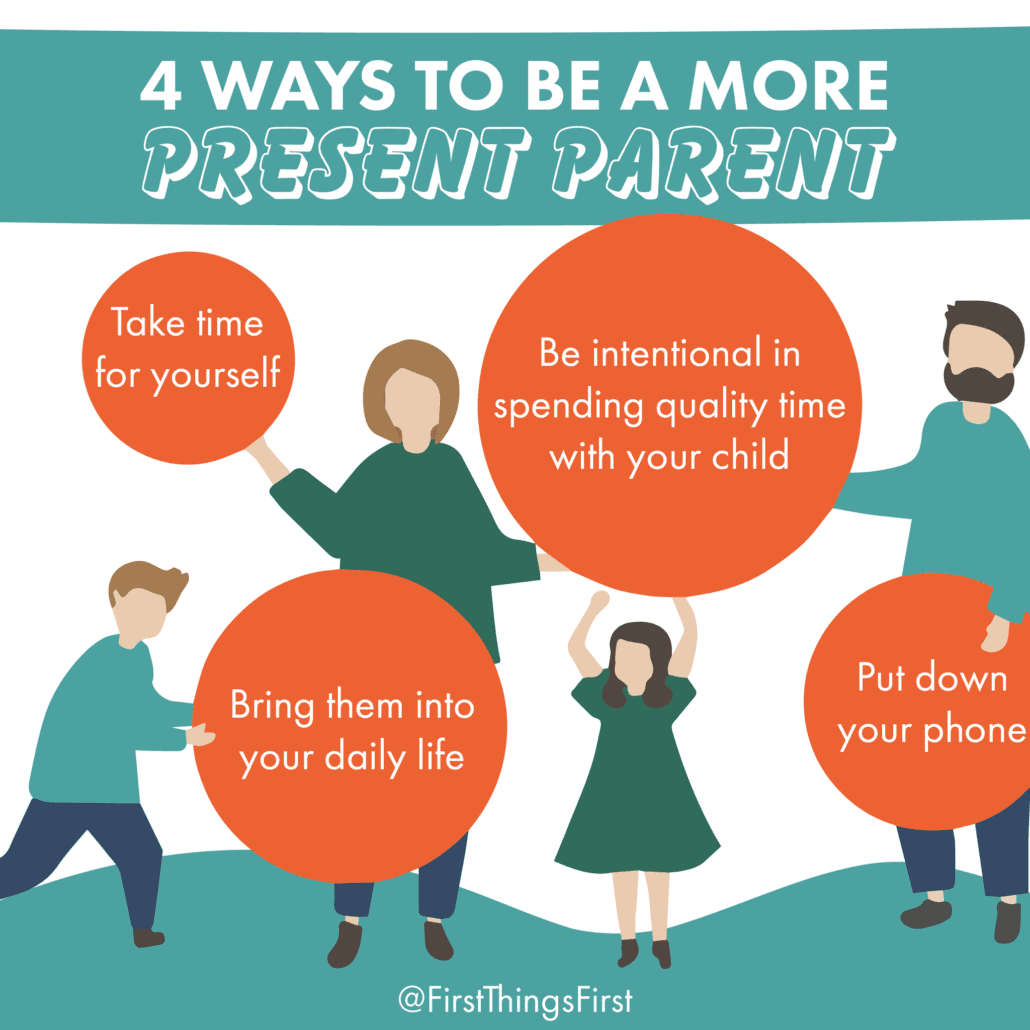
2. Be intentional in spending quality time with your child.
Whether it is when they wake up or during your bedtime routine, create space for intentional and focused time with your child. Quality time doesn’t have to be a big planned activity. It’s really the little sweet moments that matter like telling your child you love them, placing a note in their lunch box, playing with them, or reading to them. As they grow, allow them to read to you, have a snack together, tell silly jokes. It can be easy to start with 5 to 10 minutes, then work up from there. When you are intentional with spending quality time with your child it increases the bond between the two of you.
Things You Can Do First Thing In The Morning To Be a More Present Parent:
- Lovingly rouse them from sleep.
- Wake them by singing a good morning song.
- Cuddle in the bed with them.
- Ask them what are they looking forward to today.
Things You Can Do At Bedtime To Be a More Present Parent:
- Read them a book.
- Ask them about the highs and lows of their day.
- Give them backrubs and back scratches.
- Snuggle up with them.
Your child will begin to look forward to and anticipate the time that you will spend together. Try for quantity time and quality time and mind your mindset while you are with your child. Make sure all of you is present.
3. Take time for yourself.
If your tank is empty you have nothing to give and won’t be present. As parents, we have been told that our lives should revolve around our kids. Parents feel like it is selfish to take care of themselves. It’s really not. When you take care of yourself, you are creating greater capacity to give your energy to be with your child. Taking time to get enough sleep, eating right, exercising (running, yoga, biking, walking, hiking), or writing in a journal, all help put you in the right frame of mind to be an engaged and present parent.
4. Bring them into your daily life.
There are many parts of our lives that we can incorporate our children into.
Exercise: If you walk, run, or bike, get a baby carrier and take them with you. Put them in their stroller for a walk around the neighborhood or park. All the while, talk to them about what they see: the tall trees, the falling leaves, insects, and animals.
Cooking: Set up a small table for your child with child-sized utensils. Allow them to play with pots you’re not using. If your child is an infant, place them in their seat where they can see you. Cook while having a running conversation with your child. Talk to them about what you are doing. Ask them questions about their thoughts and feelings.
Work: If you are having to work from home with a young child, create a “workspace” for your new “assistant.” Give them paper, crayons, and washable markers as supplies.
Household Chores: Your child can sort clothes by color to place in the washing machine, take clothes out of the dryer, and carry clothes to the correct room. Give your child the responsibility to feed and water the family pets.
If you’ve been beating yourself up as a busy parent, STOP.
Kids aren’t looking for perfect parents; they are looking for present parents. Don’t allow the stress of “Am I doing enough?” hamper you from enjoying what you are doing. Spending quality time being present with your child should trump your feelings of guilt and stress about not spending enough time with a child.
In reality, working moms today are actually spending more time with their children than stay-at-home moms did in the 1970s. Father-child quality time together has almost tripled in that same time period. Please give yourself a break. Make the most of all the moments you have with your child. You can do it!
Is My Stress Level Affecting My Child?
Walk into a crowded room and ask for a show of hands from anyone who has not felt stressed-out in the past six months. If you find a hand-raiser, pull them aside, and ask their secret. My bet is not one hand will be raised. Truth is, we all experience stress at varying degrees, and many times it overwhelms and overtakes us. As parents, we have to ask the question, “Is my stress level affecting my child?”
The short answer is, yes… but there’s more to the story than that. Bear with me here.
LET’S EXPLORE STRESS
Most people think stress is bad, and we should do everything we can to eliminate it from our lives. The less stress, the better. I admit: I’ve thought this for many years. However, that’s not entirely true.
Let’s flip the script somewhat: Stress actually plays an important role in our lives. By definition, stress is the normal reaction the brain and body has when change occurs. You know about change: the boss assigns another project, the overdue bill arrives in the mail, the in-laws announce they’re coming for dinner (not that this would ever stress me out personally… in case anyone asks).
And we experience responses to stress in different ways: increased heart rate, heavier breathing, cloudy thinking, jitteriness, headaches, stomachaches… the list goes on.
Nevertheless, stress is vital. Without it, we couldn’t avoid dangerous situations, meet deadlines, or have a competitive edge.
- Our eyes wouldn’t dilate for a wider sight range to look for danger.
- Your breathing wouldn’t speed up, carrying oxygen to the brain for sharper mental acuity.
- And your heart rate wouldn’t increase, giving you a boost of energy to meet a particular challenge.
These are all good things. But here’s the kicker: our brains and bodies are only meant to experience these bouts of “good” stress for short periods of time, enough to work through whatever change is going on. Stress turns “bad” when we camp out in these responses for a prolonged period of time.
Our brains and bodies aren’t designed to handle this well. Matter of fact, our brain can actually restructure itself and function in a chronic state of stress. (Doesn’t that sound wonderful?) Have you ever met someone who seems on edge, stressed out, ready to snap? More than likely their brain has trained itself to stay in that “fight or flight” mode. And this has some terrible effects on body, mind, emotions, and relationships.
What this all boils down to is not whether or not you have stress (nor necessarily the level of stress, although that plays a part of it), but what you’re doing with your stress.
So back to the kids. Is your stress level affecting your child? Of course it does—and how it affects them depends on what you’re doing with the stress.
THE EFFECT OF PARENTAL STRESS ON CHILDREN
Ellen Galinsky, author of Mind In the Making and researcher at the Families and Work Institute, has shown that parental stress (or more accurately, parental distress) spills over onto our children. Galinsky’s research indicates children almost have a sixth sense when it comes to detecting parental distress. Maybe you’ve experienced this with your own kiddos. They pick up on the tension in your facial expressions and the worrisome tone of your voice. And the worst part is, children mimic your tension and behavior. If you are freaking out, even just on the inside, they are more prone to play monkey-see-monkey-do.
To further the point, University of Maryland researcher Nathan Fox and his colleagues looked into how parenting styles affect how children regulate emotions and deal with stress. An interesting finding of his showed that one of the least helpful characteristics were parents who are alarmists. These are parents who see danger everywhere and predict the worst-case scenarios in their minds. They make regular use of the phrases “You are going to hurt yourself” or “Be careful!” or “Please don’t fall!” These parents have worry written all over their faces and wear their distress like a bright orange caution vest for their children to see.
The big takeaway point here for parents is not Don’t Get Stressed; rather, parents need to model how to handle stress in healthy ways. In Galinsky’s words, “…you matter—and that includes how you convey stressful situations to your child.”
SO WHAT’S A (STRESSED) PARENT TO DO?
- Keep in the forefront of your parenting mind that the idea is not to eliminate stress, either from our own lives or that of our kids, but to learn to deal with distress in a healthy way. It’s very tempting to want to shield our children from the stressors of the world, but those stressors serve to bolster your child’s development. Megan Gunnar, researcher at the University of Minnesota and considered to be the foremost authority on stress and coping in children, says, “A childhood that had no stress in it would not prepare you for adulthood. If you never allow your child[ren] to exceed what they can do, how are they going to learn to manage adult life—where a lot of it is managing more than you thought you could manage?”
- Model healthy ways to cope with your own distress. One of Nathan Fox’s latest studies found that when parents have someone to turn to for support during stressful times, it has a positive effect on their children’s social development. The big lesson is, have a healthy support system available for you. And be sure to practice self-care. When you regularly do intentional acts of taking care of your mental, physical, and emotional health, not only are you mounting fortifications to guard against distress, you are also showing your kids how to build those same guardrails.
- When you are having a bad day when distress might be getting the best of you, use this as a learning opportunity for your children. Say something to your kids like, “Today doesn’t feel like a good day for me. Sometimes mommies and daddies have bad days when they feel worried about certain things. That’s okay—I know that everything is going to work out and that I don’t have to feel this way all the time. Here’s how I’m going to help myself feel better today…” And then, share with them how you’re going to work through the stress you’re feeling. Voila!—a stellar teachable moment.
- On stressful days, let your kids know that it isn’t their fault. Since children often do have that “sixth sense” to indicate when you’re feeling stressed out, it can be easy for them to feel responsible for it. Ensure them that sometimes bad days happen to both children and adults, it’s nothing they said or did, and we all have the power to overcome the feeling of being fearful, worried, or anxious.
One final thought:
If you’re married, do everything you can to handle marital conflict in a healthy, respectful way. We know from research that when handled poorly, parental conflict, is emotionally and physiologically traumatic for kids. John Medina, a developmental molecular biologist and researcher, tells us that even kids as young as six months can detect when unhealthy conflict is happening, and it has a negative impact on development. For some great information on how to handle marital conflict in healthy ways, take a look at this blog, this one, and this one, too.
So, does your stress level affect your child or not? Well, yes. But maybe the real question is, does how you handle stress have an effect on your kids? It certainly does, and the effect can be either positive or negative depending on how you’re handling it. Times of stress, those inevitable changes you experience that cause your brains and bodies to respond in certain ways present opportunities to teach your children valuable lessons for adulthood. Show your children the power they have to control stress rather than have stress control them. And it begins with you.
Image from Pexels.com
7 Tips For Getting Over A Bad Day With Your Kid
A few years ago I was walking through the grocery store when I encountered a mom and her toddler who was giving her a run for her money. As we were both walking down the aisle, I could hear her whispering, “You can do it, Susan! Hang in there. Just a few more minutes.”
At first I thought she was talking to her daughter, but then I realized she was encouraging herself in the midst of a hard moment with her child. I thought to myself, “You go girl!” I can remember plenty of hard moments, and just plain bad days with my daughter that I didn’t handle well. Even into a new day I found myself struggling to get over the bad day we had the day before.
Fortunately, I had some moms in my life who were further down the road in their parenting than I was. They didn’t judge me, which I am very thankful for. They did take me under their wing and offer some wise words to help me get over the bad days. Now, I’m passing their wisdom along to you, with a little of my own.
Realize that it’s not usually about you.
Believe me, I know it’s hard not to. When they act a fool in the checkout line or look straight at you and do exactly what you asked them not to do, it’s a challenge to remind yourself: it really isn’t about you. However, if you can train yourself to do this, it will be helpful.
Avoid beating yourself up.
We all have bad days, kids and parents alike. When your child is especially challenging, it can bring out the absolutely worst in us and it just goes downhill from there. The natural tendency hours later or the next day is to say, “If only I had…” or to question your ability to be a good parent. None of this is helpful to you or your child.
Acknowledge your emotions.
Listen, parenting isn’t a walk in the park. Tell me something I don’t know, right? Some stages are more challenging than others. I remember calling a friend after a particularly bad day with my daughter. I was crying, actually sobbing and I said, “I’m an utter and complete failure at parenting.” She point blankly said, “No, you are not a failure. You just haven’t figured out what works yet with your daughter.” Then she talked me down off the ledge.
There literally may be days where you are asking, “Where do I go to resign?” because you are angry, resentful, hopeless, and exhausted. Believe it or not, it’s very helpful to say those things out loud or to write them on a piece of paper.
Look for underlying issues.
For example, COVID-19 quarantine has had all of us out of sync from our normal routines. As adults, we can talk about how much we don’t like not knowing what tomorrow will bring. But for a child, especially a young child, while they pick up on your stress and anxiety, they aren’t able to verbalize it, so they act it out. Hence your very own child creating their own version of “Alexander and the Terrible, Horrible, No Good, Very Bad Day.” A death in the family, something happening to your dog, overhearing you fighting with your spouse—any number of things can bring on a bad day.
Seek to restore the relationship.
Once you have taken a moment (or a few hours) to calm down, find your child and apologize straight up. Don’t add on, “but if you had done what mommy asked…” Just apologize. “I’m sorry. Please forgive me.” You might say, “If that happens again, let’s do things differently,” and calmly talk through a better way to handle the behavior or the day. All of this models behavior you want your child to learn and the skills they need for healthy relationships.
Spend some time together doing something fun.
After apologizing and spending a little time talking about what happened, find a way to spend some calm, easygoing time together. Take a walk, play with blocks, read a book (The Color Monster: A Story about Emotions is a great read), play “I Spy” or make cookies together.
Never underestimate the power of a hug.
Adults and children alike need them, especially after a bad day. Even if you aren’t completely over the bad day, you still want to avoid withholding hugs. Loving, physical touch can be as healing as spoken words.
There will be days when you don’t like your child’s behavior or your own for that matter. However, don’t confuse not liking their behavior with not liking or loving them. Our children need to know that even on their very best or worst day, there isn’t anything they could do that would make us love them more or less.
For the most part, I am on the other side of the bad days. In the midst of them, I often questioned my Fit Mom Card, and I had a hard time believing there were better days ahead. In case nobody else is saying it to you—you are a good mom. Even on your worst day, you’re a good mom. Stop telling yourself otherwise. It’s a wild ride. We all have moments we want to forget. It is unlikely your child will hold your bad days against you, especially if you put into practice what we have talked about.
Image from FreePik.com
How To Increase Communication In Your Home
How do you increase communication in your home and make sure everyone’s connected?
When healthy communication is happening in the family, everyone feels connected and part of the same team. All the gears are synced up, your family is firing on all cylinders and is heading in the same direction. There are regular check-ins to make sure no one drops the ball and there are no surprise projects or performances. If issues need to be addressed with the whole family, you’re able to get everyone together and effectively address them. You and your spouse have plenty of time to express needs and concerns, feel heard and also have time to chat and stay connected.
There are two parts to getting connected and bonded together and building those strong relationships. The first is being intentional about one-on-one communication with each member of the family and the other is having good consistent communication together as a whole family. It would be nice to want this, snap your fingers and BOOM, life is golden. Unfortunately, that’s not the way it works. You’ll need to be intentional in your efforts and it will probably take some time to turn the ship. But the payoff can be life-changing for your family. This is so totally doable! You just have to tweak a few things.
1. One-On-One Communication.
Start here. Make time to hang out. Watch your kids play some video games, ask them to go run an errand with you, or take them out for ice cream. Car rides are magical communication times—the ride to school, practice, or a friend’s house—these are all primo talking opportunities. (Some family members are extroverted and will be talking your ears off. Don’t forget your quiet, introverted family members. You might have to make an extra effort to connect with them.) Some parents make the ride to school a tech-free zone to promote conversation in the car.
The basics of communication are speaking and listening, and there are ways to get better at both of them. They are learned skills you can improve on, but before we even get into that—communication usually happens organically when you are together.
2. Family Communication at Home.
Same rules apply. Communication usually happens organically when you are together—it’s just a matter of how to get everyone together. I know everyone is super busy (maybe that has to be addressed) but try to carve out at least a few times a week when you eat together with phones turned off. (I’m gonna give you some conversation starters so it isn’t just awkward silence.)
Family game nights, family movie nights, family outings to a park—these usually lead to some good ole’ fashioned chit-chat. Check out this Parenting Toolkit: A Family Guide To The Best Summer Ever! It’s filled with ideas for activities and conversation-starters. Plus each activity is geared toward learning an important relationship skill. Check out other family resources HERE.
If your family is going in a lot of different directions, weekly family meetings can decrease drama and encourage open communication as you talk about the family calendar, who needs to be where, when projects are due and require parental assistance, etc. Family meetings are also a way to empower your kids and encourage open communication. Anybody can request a family meeting if there is an urgent issue they believe needs to be discussed. In general, family meetings should be fun, short, and involve everyone. You want two-way communication, not a lecture. You are looking for feedback from everyone. Follow it up with a fun activity.
How do you get better at communication in general?
Here’s the insider info to get you communicating like a pro. We covered the need to be together, but now what? (If you have teens, check this out.)
The Speaking Part of Communication in Your Home
“So how was your day?”
“Okay.”
[Conversation over.]Here are five things you can ask instead of, “How was your day?” You don’t want to be a criminal interrogator; you want to be a conversation initiator. Big difference. This means open-ended questions, asking “what makes you think that?” or saying “tell me more” quite a bit. It means sometimes answering questions with questions, then listening for what is hiding underneath a question or statement and following up on it. The goal is to understand where your child is coming from. When they feel like you “get” them, they are much more likely to open up to you.
Work on being more observant. Notice I didn’t say, “private investigator.” You want to be a conversation instigator. What are your family members (including your spouse) into? What makes them light up? How do they spend their free time? Where do they put their energy? If you have younger ones, get on the floor and play with them. Step into the world of your family members with sincere questions. Then really listen.
The Listening Part of Communication in Your Home.
Be available when your family members want to talk to you. Avoid distractions and interruptions. Give your full attention. (Put yourself in their shoes. Ask clarifying questions. Ask questions that take the conversation deeper. Model the kind of communication you want to have. (Check out this article on active listening skills—especially the Six Levels of Listening.) People love talking to a good listener.
There are books filled with conversation starters and the internet is filled with lists of questions for kids of every age and for couples. Invest in a few books or click around for some lists. They’re great for road trips and pillow talk. Just when you think you know all there is to know about somebody, one of these questions will take you into new territory and they are tons of fun.
27 Family Conversation Starters
- If you could go anywhere on vacation, where would you go and why?
- If I could do one thing to be a better parent to you, what would it be?
- What do you worry about the most? Why?
- What will you do when you graduate high school?
- When was a time that you were kind to someone else?
- What is the best thing about our family?
- Who is someone you admire right now? Why?
- What is the “lesson” or “takeaway” from your favorite book or movie?
- What do you think about tattoos and piercings?
- How common do you think cheating is at school? What do you think about cheating?
- What is the biggest factor in being successful at school?
- Is it better to be optimistic or realistic? Why?
- What do you like about you?
- Have I ever not noticed when you were sad?
- What makes someone popular?
- What is one thing you would try if you were completely fearless?
- How do you react when your feelings are hurt? Does it help?
- What do you think about the drinking age?
- Who gets bullied or teased at school? Why?
- How should someone handle it if they are bullied?
- What do you like best about your friends?
- Is there anything you don’t like about your friends?
- What is the hardest part about being a kid?
- How is love/marriage different in real life than in the movies?
- What is the hardest thing about being a girl? Being a boy?
- Do you have friends with different religious beliefs?
- What do you think about that? How will you know if you’ve had a successful life?
★ Good communication in your home doesn’t happen by accident. But you can absolutely increase the quality AND quantity of communication in your family. You got this!
Image from Freepik.com
How to Parent an Extremely Sensitive Child
If you’re the parent of a young child or toddler, you know the joys (and consequently devastation) of a helium balloon. My 4-year-old, Jackie, held tightly to the string of a balloon that had been floating around the house, left over from a surprise “just because” package from work. Her face lit up with pure delight as she ran around the house with it. I warned her not to let go of the string, because if she did, it would float to the top of the high ceilings in the living room, making it unreachable. She dismissed me with a “Yeah, yeah mom,” as kids do, and continued to play as I made lunch in the kitchen.
One minute later, there was a terrible shriek. Bone-chilling. And the weeping and wailing began. Jackie had accidentally let go of the balloon and, sure enough, it had floated up to the high ceiling, out of reach. And now the world was ending. (TBH, I may or may not have rolled my eyes.) As I stopped preparing food and prepared to go comfort Jackie, I heard her younger 2-year-old sister, Maddie, attempt to comfort her. “I’m here! I’m sorry, sissy! I’m sorry!”
Jackie’s response through screams and sobs? “No Maddie, it’s not your fault. You don’t need to apologize. THE BALLOON NEEDS TO APOLOGIZE!”
If you’re the parent of a young child or toddler, this scenario seems pretty typical, right? But what do you do when this is a daily occurrence? Or even multiple daily occurrences? What if your child cries easily and often? They have multiple meltdowns a day because they are so highly sensitive. How do you handle the crying, outbursts and tantrums and still discipline a sensitive child, without crushing their spirit?
Recognize That Emotions Are OKAY.
Many of us were taught at a young age to suppress our emotions, whether it was our parents’ intentions or not. Telling a child, “You’re fine… don’t cry…” when they’re upset minimizes their feelings. Instead of building a connection and safe space for them to process through, it actually tells them that their emotions make you feel uncomfortable, angry or annoyed and can slowly chip away at the sense of security they feel with you. We are often triggered by our children’s behavior, taking us back to how we were parented. So be intentional about allowing their big emotions and responding with connection instead of reacting as if they are wrong. Make space for them to feel, no matter if you see their emotions as logical or ludicrous. Try switching up, “You’re fine… don’t cry…” to “I can tell you are feeling ____. It’s okay to feel that way. I’m here.”
Help Them Learn Emotional Intelligence.
ABCs and 123s are great for our children to learn, but what about emotional intelligence? Children are not born knowing how to regulate their own emotions. It’s absolutely a skill that needs to be taught! So help your child learn to recognize what they are feeling by giving them the vocabulary of emotions. Talk about your own feelings, read books about naming and dealing with emotions, and above all, be there for them without judgment of their emotions. Then, help them find effective calming strategies like: Count to 10, Take Deep Breaths, Read a Book, etc. Often if your child is acting out, or “misbehaving,” it is most likely due to an underlying unmet need like being hungry, tired, or feeling disconnected. Grabbing a snack solves 97% of our household meltdowns. (Because yes, kids get HANGRY, just like Mama!)
Practice A WHOLE LOTTA Patience With Your “Orchid Child.”
Human development specialists W. Thomas Boyce and Bruce J. Ellis explained the opposite ends of the human temperament continuum using two Swedish words, Orkidebarn, which translates to “Orchid Child” and Maskrosbarn, which translates to “Dandelion Child.” Where Dandelions are known for surviving the most challenging circumstances and still thriving, Orchids require “just right” conditions to flourish and grow. Children who show more of an “Orchid child” temperament are just the same. They need more time, patience and help at learning to self-regulate their emotions. So hang in there! Be the calm in their chaos, and show empathy and compassion for their big feelings. It’ll take time, but they will learn how to process through their emotions more quickly and effectively as they mature.
Have Confidence In Disciplining Without Damage.
For many parents, the term discipline has been confused with punishment. We want to discipline (aka teach) our children in order to prepare them for the real world. However, neuroscience shows us that children’s brains are naturally impulsive and lack the self-control of adults. Many times children simply cannot (as opposed to will not) follow through with our demands because their brain doesn’t yet have a fully-developed frontal and prefrontal cortex, both of which are crucial to regulating self-control. However, parents often try to force their children to learn to obey through consequences, time outs and other methods that serve to control the behavior. And these types of discipline can absolutely get our children to conform, but that may not necessarily teach them what they truly need to be successful in life: self-control.
In order to teach self-control to our sensitive child, we need to:
- First focus on responding with connection. Get down on their level, or try to make eye contact with them. Acknowledge, name, empathize and validate the emotion they are feeling. For example: “I can see you are upset because you don’t want to stop playing. That is very difficult. I understand.”
- Then, stay calm and caring while still maintaining control of the situation. Avoid raising your voice, pointing fingers or threats. Make space for them to feel angry, upset, frustrated, sad, etc., without trying to “fix it.”
- Next, provide a simple directive on what needs to happen. The fewer words you use the better. An example may be: “It’s time to leave,” or “We are leaving now.”
- Then, firmly hold the limit you’ve set. Avoid trying to explain your reasoning or rationale at this moment. For instance, don’t say, “We have to leave right now or we’ll be late and then we’ll miss the whole appointment! Hurry up!”
- Finally, once the emotion has been regulated (through the help of naming the emotion and working through it using calming strategies), we can come back full circle to discuss step-by-step what happened, without blame or shame, and provide ways to handle a similar situation better next time. (Ask your child what they could do differently next time. If they aren’t sure, provide some options such as using a specific calming strategy and talking about what they are feeling. Be sure to end the conversation with encouragement for next time and remind them that you love them, no matter what!)
★Bottom Line: You’re NOT Doing It Wrong… It’s Just That Hard
No one has this parenting thing down to a “T.” You know, there’s no such thing as a perfect parent. A sensitive child can be extremely draining… but rest assured, you are not alone. Connection is the key to handling a highly sensitive child, or any child for that matter. You’ll just need to cultivate a bit more patience with your Orchid child. Helping your sensitive child learn how to self-regulate their big feelings will take longer, since their brain needs to be more developed (i.e., older). But give it time and you will see tremendous growth! Meanwhile, keep those tissues handy.