
When Motherhood Isn’t What You Thought It Would Be
“Why am I so bad at this?”
“I don’t know if I can do this.”
“Why don’t I feel that overwhelming loving feeling toward her? Is there something wrong with me?”
These are the thoughts that raced through my mind as I was sobbing at 2 a.m., trying to rock my 4-week-old baby girl back to sleep.
I’ve always wanted to be a mom. As a kid, if you had asked me what I wanted to be when I grew up, I would have answered, “a mom.” In friend groups, I’ve always been the “mom” to everyone. When I thought about motherhood, I felt totally confident and prepared to become a mother.
But the day she was born, all those things I thought would come naturally never came. And even now, 3 months into it, I’m still struggling with those late-night thoughts.
Let me clarify something before you get any further — I’m not here to give you any advice. I can’t share a list of steps to help you out of these feelings because I’m still in it myself. And I don’t have it figured out (not even close), but I can offer you this: You’re not alone. I see you.
And I see you questioning yourself and your baby, wondering if you’ll make it through this in one piece, struggling to understand how different motherhood is than how you thought it would be. And I’ve realized, for me at least, that these feelings aren’t just rooted in sadness or sleep deprivation, but grief.
Grieving What Used to Be and Accepting the New
After my husband, my daughter, and I survived those first 3 weeks of postpartum and the fog *somewhat* lifted, I had this unshakeable feeling that the Caroline I had known 3 weeks earlier was gone. The super type-A, confident, reliable person I had been was just upheaved, and a new life — a new person — had just begun. And while I was told to enjoy it, to celebrate having “mother” as my number one descriptor, and to lean into this person I was becoming, I couldn’t do it. I liked the person I used to be and the life I had before motherhood. I didn’t want anything to change. But it had to.
I’ve grieved things as they used to be. I can no longer be on-call for everyone’s every need. I can’t go out with friends at the drop of a hat. No more snuggling on the couch every night with my husband and our dog. Heck, even the clothes I wore no longer fit, and they probably never will. Now, everything revolves around a feeding and sleeping schedule. I have to look for childcare, turn down calls and visits, and set firm boundaries with friends and family.
Maybe you’ve changed careers, or maybe you’ve given up your job to stay home with your baby. And maybe you’ve felt ostracized by family and friends because of this transition into motherhood. Regardless of what your life as a mom looks like, we all have to mourn the life we had before our little ones came into our lives. For good and not so good, things will never be the same.
Grieving Who I Thought I Would Be
There is this second aspect of grief that has taken me nearly 3 months to understand. It’s this feeling that I’m not the kind of mom I always thought I would be. My whole life, I envisioned this fun, adventurous mom dancing in the kitchen with her kids. But when my daughter was born and struggled to eat and refused to sleep, I thought I would lose my mind. That vision of the energetic mom quickly disappeared, and what felt like a shell of a person took her place.
For over two months, there was rarely a day without a breakdown from me, my husband, and our baby. It has been hard to bond with and love on my daughter and nearly impossible to feel close to my husband. At times I’ve felt like I just can’t do it anymore.
*I want to take a second here to say something that needs to be said. Since the very beginning, I’ve been in conversations with my doctor to monitor Postpartum Depression and Postpartum Anxiety symptoms. Since 1 in 7 women experience PPD, I was very aware that this was a possibility for me. It is always a good idea to talk to your doctor if you’re experiencing symptoms or have any concerns. For more resources on Postpartum Mental Health, check out: Postpartum Support International. You can also call the PSI Helpline at 1-800-944-4773 (#1 En Español or #2 English) or TEXT: 503-894-9453 (English) or 971-420-0294 (Español).*
I’ve felt stuck in a never-ending cycle of trying to force myself into who I am “supposed to be,” then breaking down when that pressure is too much for me to handle. After the first 10 weeks of this, I gave up. I stopped trying to force that image on myself and started trying to accept the mother I am right now. This doesn’t mean I can’t learn and grow as my baby girl learns and grows — that will always be my goal.
But I want you to hear this: It’s ok to rest in who you are right now. Take the pressure off yourself to be the mom you feel like you’re supposed to be. Ignore the people who tell you to enjoy every moment, because not every moment is enjoyable. If no one else has, I want to tell you that it’s ok to need a break, to ask for help before you get desperate, and to be honest when people ask, “Don’t you just love being a mom??”
I know it gets better. But until it does, I don’t want to pretend that I’m loving this stage. People give new moms an unrealistic expectation to immediately bond with their baby, to be joyful about the many challenges of motherhood, and to appreciate all the fleeting stages their child will go through.
But what happens when none of that feels possible? Most new moms are left to wonder if there’s something wrong with them. But I firmly believe that these feelings of grief are ok to process through. I’m content with where I am right now. But I’m also looking forward to growing into the mother I know I can be. And I’m ready to take this journey one baby step at a time.
Other Resources:
What They Don’t Tell You About Postpartum Depression
6 Ways A Husband Can Support His Wife Through Postpartum Depression
Five Strategies to Help Your Teen Deal with Post-Pandemic Anxiety
Teens experienced a lot of stress during the first round of the COVID-19 pandemic. They switched to virtual learning. They were isolated from friends. Sports got canceled. Celebrations were delayed or just didn’t happen. All these things had a significant impact.1 We thought it would all be over by now. And it looks like it is all on the verge of happening again. And it looks like it is all on the verge of happening again.
After COVID seemed to come to an end, many teens started experiencing symptoms of what scientists and doctors are calling “post-pandemic anxiety syndrome.” Yep, it’s a thing.
This syndrome is marked by an overwhelming sense of worry during this post-pandemic/repeat period. For some, the anxiety may stem from a lingering uncertainty about safety. Is the virus still a threat? Are we sure I can take this mask off? Am I still in danger? Should I put the mask back on?
For others, the cause of anxiety seems to be a product of flip-flop thinking. We know that our brains can train themselves to think in a certain way.2 Your teen has had over a year to adjust to new and sudden precautions, rules of social distancing, and risk management during extreme uncertainty.
As if that’s not stressful enough, now we’re experiencing an almost equally instantaneous shift back to pre-pandemic life while there’s so much uncertainty about the variants. Take off the masks, go back to the ball fields, get ready for school. Some teens are celebrating. But for many, the anxiety increases.3
If your teen is showing some signs of post-pandemic anxiety, you can help them. Try these strategies to help them deal with what they may be experiencing.
1. Keep the dialogue open.
2. Normalize their feelings.
Your teen may feel weird or abnormal because of their anxiety. They might think that no one could possibly understand what they’re feeling. Reassure them that our whole world has been through a lot, and those anxious feelings are normal. There’s nothing wrong with them; they’re not “less than” because of their worry. Remind them that it’s how we go about coping with anxiety that is important.
3. Coach them to get plenty of sleep.
In general, teens typically get less sleep than they need for proper health and development. But a healthy amount of rest is vital for coping with anxiety. Evidence is strong that sleep deprivation negatively affects mental health.4 The CDC recommends 13 to 18-year-olds should get 8-10 hours of sleep a night for optimal health.5 Encourage your teen to hit the hay at a decent hour so they can take care of themselves.
4. Avoid making your own diagnosis.
You’re worried about your kid, and that’s completely understandable. You can see signs and symptoms of anxiety or stress. But professionals are trained to translate these signs into what precisely the problem is — not us. You want to be careful not to jump to “anxiety disorders,” “depression,” or other conditions in a knee-jerk reaction, especially to your teen. They can easily feel labeled. They may also interpret the label as an identity that can’t be fixed (e.g., I have an anxiety disorder; it’s who I am). This is obviously detrimental to how they feel about themselves, and it can magnify the troublesome feelings they are having.
5. Consider getting help from a professional counselor.
If the signs you see are persistent or worsen, it might indicate that you need to seek a therapist for your teen. Keep in mind that it might not be a popular choice in your teen’s eyes. But often, intense feelings of anxiety and worry are so much that we need more advanced tools to cope with them. That’s where a counselor is beneficial.
One last thought from one parent of a teen to another:
There is always hope in conquering mental health challenges. Anxiety is manageable. And your teen stands the greatest chance of overcoming post-pandemic anxiety when they know you’re cheering them on.
Sources:
1Freed GL, Singer DC, Gebremariam A, Schultz SL, Clark SJ. How the pandemic has impacted teen mental health. C.S. Mott Children’s Hospital National Poll on Children’s Health, University of Michigan. Vol 38, Issue 2, March 2021. Available at: https://mottpoll.org/reports/how-pandemic-has-impacted-teen-mental-health.
2Berg, S. (2021, June 11). What doctors wish patients knew about post-COVID anxiety. American Medical Association. https://www.ama-assn.org/delivering-care/public-health/what-doctors-wish-patients-knew-about-post-covid-anxiety
3Hunter, R. G., & McEwen, B. S. (2013). Stress and anxiety across the lifespan: structural plasticity and epigenetic regulation. Epigenomics, 5(2), 177–194. https://doi.org/10.2217/epi.13.8
4Talbot, L. S., McGlinchey, E. L., Kaplan, K. A., Dahl, R. E., & Harvey, A. G. (2010). Sleep Deprivation in Adolescents and Adults: Changes in Affect. Emotion (Washington, D.C.), 10(6), 831–841. https://doi.org/10.1037/a0020138
5Sleep in middle and high school students. (2020, September 10). Centers for Disease Control and Prevention. Retrieved from https://www.cdc.gov/healthyschools/features/students-sleep.htm
7 Strategies to Help Your Child Deal With Post-Pandemic Anxiety
Children, like adults, were struck with a sudden bombshell when COVID-19 arrived on the scene. Everything changed abruptly. Think about it. One day, they’re at school and seeing their friends. The next day, they’re home for an extended period. They’re isolated. Their world changed: masks, loneliness, increased family time, canceled activities, etc. The structure, predictability, and consistency kids need to thrive: gone. That’s a tough experience for a child to live through. It was even hard for adults.
As kids come out of the pandemic, it’s no wonder that so many are experiencing anxiety. Recent studies suggest the pandemic may be having a more adverse effect on adolescents than on adults.1 According to Dr. Bradley S. Jerson,2 your child may be dealing with post-pandemic anxiety if they are…
- Spending a lot more time alone
- Sleeping a lot more or less
- Withdrawing from family or friends
- Not interested in their favorite activities
- Having changes in their overall mood
- More irritated or angry
- Stuck on negative thoughts
- Hopeless about the future
As their parent, you want to help them manage their anxiety and adjust to normalcy.
These strategies can help your child deal with post-pandemic anxiety.
1. Be aware of your own mental health.
The Child Mind Institute states “that dealing with your own anxiety can be the most powerful way to make sure your kids feel secure.”3 Your children take a lot of their cues from you. So do whatever is necessary for you to be in a good space mentally. Practicing good self-care will equip you to help your child.
2. Give your child space and freedom to talk through their emotions.
What young child can do that by themselves? Not many. Try to ask questions in a gentle, non-judgmental way. Try, “What do you feel when we make plans to go to the supermarket or back to school?” This lets them know that whatever they’re feeling is acceptable and even normal. Studies show that after an event like a pandemic, mental health issues such as anxiety are common.4 Child expert Dr. Gene Beresin recommends that parents consistently listen and validate their child’s thoughts and emotions. This can help them transition to post-pandemic life.5
3. Create some routines, predictability, and consistency.
Children thrive when they know what’s coming. And it helps them adjust and know who to turn to for the things they can’t foresee. Morning or nighttime routines are helpful. Picking them up from school at a consistent time is also good. Several studies have shown that eating family meals together is beneficial for kids’ mental state.
4. Ease them back into their norms when possible .
Dr. Jill Ehrenreich-May and Dominique A. Phillips recommend taking smaller, manageable steps to move forward.6 Instead of going to an indoor birthday party, have your child choose a friend for an outdoor play date. Pick people and places that are most comfortable for your child, and use those spaces to help them overcome the paralyzing effects of their post-pandemic anxiety.
5. Talk them through what’s being done to keep them safe.
Young children look to their parents for security, safety, and protection. Asking your child what would make them feel safe can help them address their anxiety. Explaining what makes a situation safe helps build their trust in you as their parent to protect them.
6. Get support for your child.
If your child continues to struggle, talk to their pediatrician, a school counselor, or find a therapist. Don’t hesitate to ask your child if they’ve had thoughts of self-harm. **If they have, call or text the National Suicide Prevention Hotline at 988 or 1-800-273-8255 (24/7).**
7. Celebrate the positives.
Dr. Jerry Bubrick, a clinical psychologist at the Child Mind Institute, encourages parents to look for anything positive they can celebrate.7 Sometimes, we spend so much time focusing on what our kids won’t do. Instead, highlight the good stuff they’re doing: the family time you’re spending together, the books they’re reading. This can help shift their mentality and calm their uneasiness.
Each child responds differently to change. Your love, compassion, and care in walking them through their challenges are often the most crucial ingredients to helping your child deal with change, fear, uncertainty, and post-pandemic anxiety. You got this!
Sources:
1 The psychiatric sequelae of the COVID-19 pandemic in adolescents, adults, and health care workers.
3 The Child Mind Institute Anxiety and Coping With the Coronavirus
4 Life in a post-pandemic world: What to expect of anxiety-related conditions and their treatment
7 Jerry Bubrick, PhD, a clinical psychologist at the Child Mind Institute
How to Help Your Spouse With Post-Pandemic Anxiety
Let me state the obvious and say it’s been a rough year or so. With the outbreak of the COVID-19 pandemic, reality has come the closest it’s ever been to a sci-fi novel. And it’s literally messed with our heads. Society as a whole experienced a significant uptick in relationship and mental health issues.
And let me just speak for us all when I say thank goodness we seem to be on the downswing of it all. (Of course, we’re not entirely over the hill — many are still dealing with health concerns.)
Despite this downswing, fear and anxiety are still lingering in the air. Many are experiencing what scientists call “post-pandemic anxiety syndrome.” It’s a condition marked by continual worry about re-entering life in the post-pandemic era.
Signs1 of this syndrome tend to mimic other mental health issues like anxiety and post-traumatic stress syndrome. They include:
- Increased stress
- Excessive worry
- Difficulty returning to a full engagement with society
- Avoiding work or social interactions
- Constantly checking symptoms despite not being in a high-risk scenario
- Perceived threats that aren’t necessarily there
Some of these symptoms are pretty normal after a global pandemic. Most of us experienced at least one of these at some time or another. But for those who cope in a healthy way, these signs should gradually taper off.
However, symptoms that persist or get worse might indicate a bigger problem.
So how do you help your spouse with post-pandemic anxiety?
There are two important things you can do right now.
1. Exercise a great deal of empathy and understanding.
You may not have the same anxiety your spouse does. You may even wonder what all the fuss is about. But it will help if you understand that’s not their reality.
Consider this: We now know that our brain can train itself to think toward a certain way over time.2
We’ve had over a year for our brains to adjust to new and sudden precautions, rules of social distancing, and risk management during extreme uncertainty. That’s stressful.
And now, we’re experiencing an almost equally instantaneous shift back to pre-pandemic life. For many, that’s stress multiplied.
Knowing this, put yourself in your partner’s shoes. Let him or her know you’re there, walking with them through this. Allow them to vent and share feelings, no matter how irrational it sounds to you.
Anxiety isn’t something that can just be quickly “fixed.” It’s a process that takes time. So you’ll have to be patient.
2. Encourage your spouse to seek out a professional counselor that works well with them.
A counselor can provide useful coping tools and help your spouse monitor their progress. It may even be a good idea to attend counseling together because anxiety affects your marriage3,4. You may also need to learn new skills to support your spouse. Couples therapy is very effective for treating a variety of mental health issues, including anxiety5.
Your number one goal in marriage is to show unconditional love and support for your spouse, for better or worse. And that takes a great deal of understanding. You may not know the particular skills they need to cope and overcome the anxiety, and that’s okay. (That’s one reason a professional counselor is so important.) But the greatest presence they have is you. Let them know you’re on their side and you’re not going anywhere. Post-pandemic anxiety is real, and it’s scary for those going through it, but it’s no match for the support and understanding you can give your spouse.
Sources:
1Nikčević, A. V., & Spada, M. M. (2020). The COVID-19 anxiety syndrome scale: Development and psychometric properties. Psychiatry Research, 292, 113322. https://doi.org/10.1016/j.psychres.2020.113322
2Hunter, R. G., & McEwen, B. S. (2013). Stress and anxiety across the lifespan: structural plasticity and epigenetic regulation. Epigenomics, 5(2), 177–194. https://doi.org/10.2217/epi.13.8
3Zaider, T. I., Heimberg, R. G., & Iida, M. (2010). Anxiety disorders and intimate relationships: a study of daily processes in couples. Journal of abnormal psychology, 119(1), 163–173. https://doi.org/10.1037/a0018473
4Darcy, K., Davila, J., & Beck, J. G. (2005). Is Social Anxiety Associated With Both Interpersonal Avoidance and Interpersonal Dependence? Cognitive Therapy and Research, 29(2), 171–186. https://doi.org/10.1007/s10608-005-3163-4
5Lebow, J. L., Chambers, A. L., Christensen, A., & Johnson, S. M. (2012). Research on the Treatment of Couple Distress. Journal of Marital and Family Therapy, 38(1), 145-68. doi:http://dx.doi.org.proxy.lib.utc.edu/10.1111/j.1752-0606.2011.00249.x
What to Do When You Feel Disrespected in Marriage
*This article does not refer to verbally or emotionally abusive behaviors. If you think you are a victim of marital abuse, immediately seek help from a local agency or call the National Domestic Abuse Hotline at 1.800.799.7233.
No one deserves to be disrespected.
And it feels awful when someone disrespects you, especially the person you love the most.
The bad news is we know that contempt and criticism increase the likelihood of marriages going sour. A marriage simply cannot thrive in an environment of disrespect. (Communication Killers has more on this.)
But there’s good news. Disrespectful behavior can change. Marriage can get stronger. And you can feel better about your spouse’s behavior.
And here’s where we start.
As I wrote in 4 Reasons Why Respect Matters in Marriage, respect is how you show genuine appreciation for another person. Respect is an action, not just a feeling. It’s a declaration of value for someone. We show respect by how we behave toward our mate.
Before declaring your freedom from disrespect, it’s crucial to stop and reflect on what’s going on. Examining what you’re feeling helps you approach the problem in a healthier way.
I find it helpful to dissect the disrespect.
Separate the disrespectful behavior and the feeling it produced. I know you feel disrespected. But for a moment, view disrespect as merely your spouse’s behavior.
Consider: I was disrespected when my spouse did or said…
And then dig deeper: Their behavior made me feel… (angry, upset, incompetent, hurt, sad… but don’t use the word “disrespected.”)
Separating the disrespectful thing they did from what you feel helps in a couple of ways. First, it helps you consider your spouse’s intention.
People show disrespect for several reasons:
- They’re trying to cover insecurities.
- They don’t realize how their behavior affects others.
- They let their anger get the best of them.
- They’re just being a jerk on purpose.
Now, I can work with the first three reasons. They don’t excuse the disrespect, but those obstacles have concrete solutions. And they give insight into my spouse’s intentions.
The fourth reason, well, is a little more complicated. But I’m gonna make a huge assumption that you didn’t look deep into your spouse’s eyes on your wedding day, knowing they were a big jerk.
And if you did (I’m not gonna judge), or if something happened and they just turned jerky one day, seeking help from a professional may be the best approach.
Separating disrespectful behavior and the way it makes you feel also helps you examine yourself more closely. When you’ve been disrespected, it’s essential to call out the emotions. What I mean is, label them. Give your feelings a name: anger, frustration, sadness, incompetency. You can deal better with what you can name.
Finally, separating disrespectful behavior and the resulting feelings helps you consider other important questions:
- What specifically was the disrespectful behavior that occurred?
- Is the disrespect a one-time thing, or has it been repetitive?
- Does my spouse know they’re being disrespectful? Do they see how it affects me?
- Is my spouse being intentionally disrespectful? Is it on purpose?
- How sensitive am I usually to what others do or say? Does this paint how I see my spouse’s behavior?
- Is there something else going on in my own life that could affect how strongly I feel toward my spouse’s disrespectful behavior?
Let’s think about one more thing: It’s entirely possible for a person’s insecurities to cause them to take another’s well-meaning words or actions as a sign of disrespect. We all have to stop and ask ourselves, when we feel disrespected, “Is there something inside causing us to perceive disrespect in something well-intentioned?”
No one deserves to be disrespected, and it can be painful. But if you feel that your spouse disrespects you, you need a healthy approach to deal with it. Listening to each other, along with good reflection, determines a healthy approach. And this can lead to a better conversation with your spouse, so you can work through this together.
***If you or someone you know is in an abusive relationship, contact the National Hotline for Domestic Abuse. At this link, you can access a private chat with someone who can help you 24/7. If you fear someone is monitoring your computer or device, call the hotline 24/7 at 1−800−799−7233. For a clear understanding of what defines an abusive relationship, click here.***
Related blogs:
How to Protect Your Family’s Mental Health
Nothing seems normal these days. Many people say, “I just keep pinching myself thinking I’ll wake up and this nightmare will be over.” Sometimes life can take a real toll on everyone – both physically and mentally. As you continue to navigate through these times, there are ways you can be intentional about protecting your family’s mental health.
For starters, it’s important to continually remind ourselves that when we’re going through something that’s very unusual, we remain in a heightened state of anxiety and stress that impacts our mental and physical health.
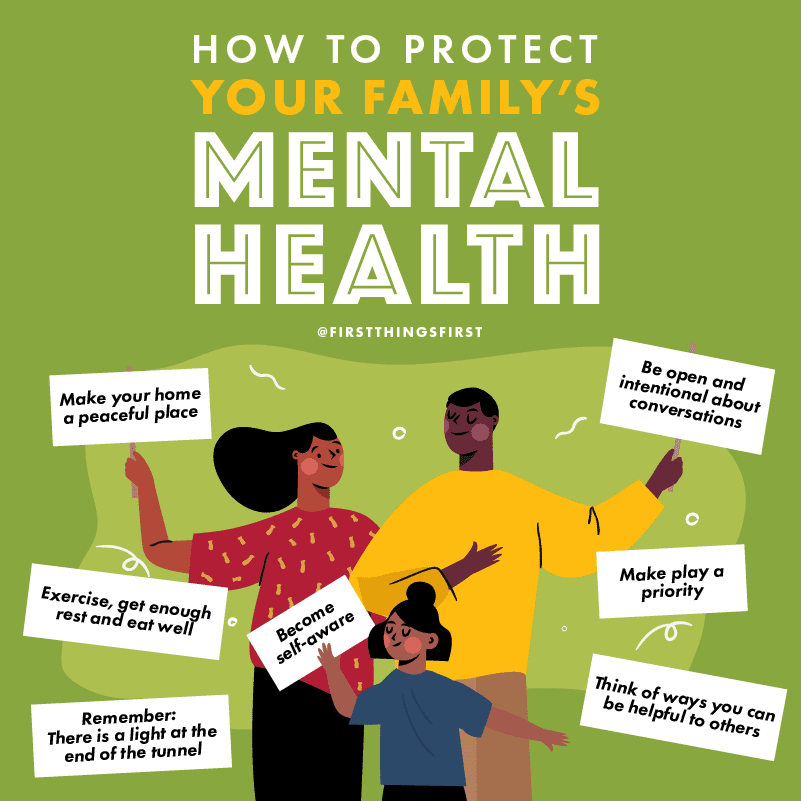
One thing that can help you regain your footing is to establish routines, rituals, and structure.
In times of high anxiety and stress, the consistency of routines and structure is soothing to everyone.
Make your home a peaceful place—a refuge from all the craziness going on in the world.
Spend some time thinking about things you can do to create calm. Play calming music, light a lavender candle and let the sunlight in. Encourage your children to find a comfy spot where they can read or play with their toys.
Be self-aware.
Your children are like sponges. Whether you notice it or not, they’re watching your every move, your facial expressions and even listening to your conversations that don’t include them. They’re quick to pick up and take on your stress and anxiety. Have adult conversations out of the hearing range of your children. Be proactive in dealing with your emotions.
Be open and intentional about having conversations about things that are going on in your world.
Ask your children to tell you what they know or have heard. Use their information as a platform to affirm accurate information and correct inaccurate details. Assure them that your job is to make sure they are cared for and protected and you are doing that.
Exercise, getting enough rest and eating right are three essentials for protecting your family’s mental health.
This is like the trifecta right here! Walk as a family and insist that people get the rest they need. Involve everyone in creating fun, healthy meals.
Limit the amount of time you and your family members watch the news.
This one action can dramatically decrease the anxiety, stress, anger, fear and drama in your home. Mentally and emotionally, our brains and bodies aren’t meant to live in a constant state of stress, but that’s exactly what happens when we watch news nonstop.
Think of ways you can be helpful to others.
During difficult times, it’s easy to become focused on yourself and all that’s wrong with the world. A great way to combat this as a family is to look for ways to help others. Deliver food, do yard work, run errands, bake bread or cookies and share them with your neighbors. (Let your kids do a ring and run when they deliver. It can be your secret!)
Make play a priority.
Seriously. Play releases all the feel-good hormones that promote an overall sense of well-being. Heaven knows we could all use a triple dose of that right now. Ride bikes, go for a hike, play hide and seek, tag, kick the can, four square, hopscotch, double dutch jump rope or any other active game you can think of. Just get moving!
Remind yourself and your family members – there is light at the end of the tunnel.
This is hard and there are parts of dealing with life right now that are not fun, but together as a family, you can do hard things. When one person’s having a hard day, other family members can be encouraging and affirming to help them get through it. Having healthy relationships with each other is one of the best ways to protect your family’s mental health.
When parents model and lead using these strategies, children learn how to navigate through hard times in healthy ways. It shows you believe they have what it takes to keep going even when things get really challenging. This builds self-confidence and helps them learn how to think and be creative in the midst of change.
A side note: if you feel like members of your family aren’t handling all that is going on well, don’t hesitate to seek help. Talk with their pediatrician and/or a counselor to seek guidance on other ways you can help them.
If you or someone you know is struggling and you need immediate assistance, you can find 24-hour help here:
Substance Abuse and Mental Health Services Hotline: 800-662-HELP (4357)
National Suicide Prevention Lifeline: 988 or 800-273-TALK (8255)
Photo by Elly Fairytale from Pexels
Sometimes life just seems to be getting harder. For many, most days feel like slogging through thick fog and it’s really hard to see the road ahead.
Perhaps you or someone you know is really struggling at the moment and you’re wondering if the sadness is due to a single life circumstance or if something bigger is going on like depression or some other mental health issue.
First, let me just say, you’re not alone! We’re living in a moment in time where everything—marriage, parenting, work, socializing with friends, even the most normal things—seem more difficult than they should be for many people.
Second, regardless of whether you or someone you care about is sad or dealing with something else, the good news is, help is available.
Sad? Depressed? How do you know the difference?
Glad you asked!
Feeling sad and down about things like job loss, finances, marital issues, a child giving you a run for your money, or a breakup is normal for a period of time. But, when you:
- Can’t seem to shake those feelings and you begin to feel hopeless and desperate;
- It feels impossible to think clearly;
- Making a decision seems out of your reach;
- Work is consistently challenging;
- Things that used to bring you joy in life don’t anymore;
- Food doesn’t interest you or you are eating way more than normal; and
- You’re either not sleeping enough or you are sleeping all the time and still feel like you don’t get enough rest.
These are like blinking caution lights warning you something is not right. There are some things you might be able to do to help move you to a different place, though.
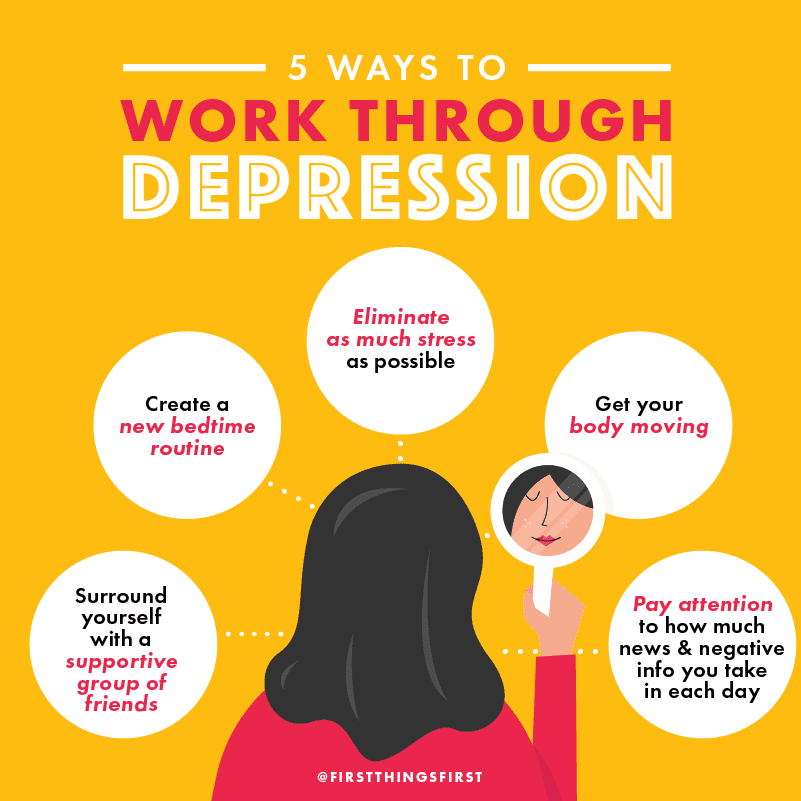
Here Are 5 Ways to Work Through Depression
1. Surround yourself with a supportive group of friends.
Not necessarily people who are experiencing the same thing you are, but people who seem to be mentally and emotionally healthy right now. Ask them to walk this road with you and help hold you accountable for changes you’re trying to make.
2. Create a new bedtime routine.
Lying in bed watching television or scrolling through social media doesn’t count as rest. Stop all screen time at least an hour before you plan to get some shut-eye. If silence makes it hard for you to sleep, download a white noise app or purchase a white noise machine. Maybe you could try a simple fan in your room. Don’t use your bed for anything other than sleeping… and well, those things that you typically do in bed (like sex). Otherwise, keep your bedroom as kind of a safe place where your body knows it’s time to relax and rest.
3. Get moving.
Exercise has been shown to be one of the BEST ways to combat depression. According to the Mayo Clinic, regular exercise releases feel-good hormones that can make you feel better about yourself. It also can help you get out of the negative thought cycle that feeds depression. Exercising on the regular can give you more confidence, it’s something you can do with others and it is a super positive way to cope with and manage depression. Don’t forget, being outside, getting enough vitamin D, drinking plenty of water, and fueling your body with healthy foods are all powerful weapons for fighting depression.
4. Pay attention to how much news and negative information you take in every day.
Remember, the motto for the newsroom is, “If it leads, it bleeds.” Their whole goal is to be sensational to draw you in. The more you are drawn in, the more it will affect you. It’s a vicious cycle. Your brain doesn’t know it’s the fifth time you’ve seen information about the plane crash, murder, latest political blunder, or car wreck. All of this impacts you mentally and physically whether you realize it or not. Put a time limit on how much news you watch. The same applies to social media.
5. Eliminate as much stress as possible.
Think through all you have on your plate. Is there anything you can let go of for a while to reduce the stress in your life? If you can’t let go of certain activities, can you ask others to help you?
In addition to doing all of these things, be bold and ask for professional help. Plenty of counselors are providing telecounseling and Zoom sessions right now. If you don’t know where to look for help, the Substance Abuse and Mental Health Services Administration hotline is 1-800-662-4357.
If you’re worried about someone you care about, don’t be afraid to step up and say, “I see you. How can I help?” Guiding them through all the above is a great place to start if they’re open to your support.
Photo by Inzmam Khan from Pexels
How Do I Know if My Teen is Depressed?
Your teen has been much more quiet and withdrawn lately. They aren’t very talkative, are easily agitated and their mood has consistently been down. The big question in your mind is, “Is my teen depressed?”
The teen years are filled with highs and lows, so much so that it often feels like being on a roller coaster ride in the dark with lots of twists and turns, none of which you see coming. In a word, these years can be full of turbulence.
With all of the change going on, it is sometimes hard for parents to know if their teen is just going through a rough patch or if something bigger is going on like depression.
Approximately 1 in 5 teens from all walks of life will experience depression at some point during their teen years, which can be very scary for parents. In many instances, teens themselves don’t understand what is going on, why they feel the way they do or even how to talk about what they are experiencing.
According to the Mayo Clinic, signs and symptoms of teen depression include:
- Feelings of sadness, which can include crying spells for no apparent reason
- Frustration or feelings of anger, even over small matters
- Feeling hopeless or empty
- Irritable or annoyed mood
- Loss of interest or pleasure in usual activities
- Loss of interest in, or conflict with, family and friends
- Low self-esteem
- Feelings of worthlessness or guilt
- Fixation on past failures or exaggerated self-blame or self-criticism
- Extreme sensitivity to rejection or failure, and the need for excessive reassurance
- Trouble thinking, concentrating, making decisions and remembering things
- Ongoing sense that life and the future are grim and bleak
- Frequent thoughts of death, dying or suicide*
- Tiredness and loss of energy
- Insomnia or sleeping too much
- Changes in appetite—decreased appetite and weight loss, or increased cravings for food and weight gain
- Use of alcohol or drugs
- Agitation or restlessness—for example, pacing, hand-wringing or an inability to sit still
- Slowed thinking, speaking or body movements
- Frequent complaints of unexplained body aches and headaches, which may include frequent visits to the school nurse
- Social isolation
- Poor school performance or frequent absences from school
- Less attention to personal hygiene or appearance
- Angry outbursts, disruptive or risky behavior, or other acting-out behaviors
- Self-harm—for example, cutting, burning, or excessive piercing or tattooing
- Making a suicide plan or a suicide attempt
When a teen is depressed, they can’t “just snap out of it.” But, there are things parents can do to help kids decipher their feelings and determine the best next steps. If a significant number of symptoms are present for two weeks, this is a good indication that it is time to reach out for help from a professional.
Things You Can Do If You Believe Your Teen Might Be Struggling With Depression
It may help to open the door to constructive conversation and let them know that if they are struggling with this, they can share with you.
Listen intently.
Avoid lecturing, as in, “If you would just…” It may be hard because they can be moody, but seek to be present and listen to what is going on in their world if they are willing to share with you. If they tell you how bad things are, avoid making statements like, “I think you are blowing things out of proportion” or “It really isn’t that bad.” Remember that perception is everything and even though you may feel like their perception is not accurate, this is their reality and understanding this is the starting point for being able to help them.
One other thing that might be helpful here—sometimes teens find it easier to talk about something difficult when they are doing something. Shooting hoops, running, taking a hike, doing yard work, cooking or anything that doesn’t make them have direct eye contact with you and gives them something to do with their hands while they are trying to share with you works.
Encourage exercise, eating right, getting enough rest and being outdoors.
All of these things help to combat depression.
Acknowledge their feelings.
You don’t have to agree with them, but you do need to acknowledge them. When a teen is depressed they often feel like they are trying to slog through mud and fog. It’s hard to pinpoint feelings because everything feels “blah.” When they are able to pinpoint an emotion, validate it and work to keep the conversation going.
Avoid telling them what to do to “fix” the situation they are in.
Instead, ask them what they think they need to do. If they ask you for your thoughts, that’s the time to give some input. However, don’t give not too much because they can become overwhelmed quickly.
Work to help them avoid isolation and increase face time.
This is especially hard with COVID-19 factors at play. Be intentional about creating family time and encourage (don’t force) them to participate. Exercise with them. Look for activities they enjoy and do those things with them.
Limit screen time.
Many parents are tired of trying to take on this battle, but there is plenty of research indicating that lots of screen time can lead to depression. A recent study suggests that greater screen time—whether in the form of computers, cell phones, or tablets—may have contributed to a spike in depression and suicide-related behaviors and thoughts among American teens, particularly girls, between 2010 and 2015. Several studies show that when teens reluctantly agreed to give up screens for a week, they confessed at the end that they felt so much better without them.
Don’t be afraid to seek professional help.
As the parent, it is important to trust your gut if you feel your teen is depressed. If you don’t feel like anything you are doing is helping, seek assistance. You can go see someone or find someone for your teen to talk to. Having a depressed teen does not reflect poorly on you and your parenting skills. Adolescence is terribly complicated. Quarantine, COVID-19, no school, no summer camps or other activities has made it very hard on teens who are typically super social in nature.
Dealing with depression in your teen can be exhausting on multiple levels. Not only are you interacting with your teen and questioning whether or not you are doing the right thing, but thoughts about what you are experiencing can consume every moment of your day and sometimes the night. Walking this road can feel isolating and lonely, so it is important to surround yourself with supportive people, seek help for yourself, educate yourself and take time away to regroup.
*If you or someone you know is struggling with suicidal thoughts, there are a number of websites and organizations with excellent resources for you. HelpGuide is a great place to start, along with the American Foundation for Suicide Prevention at 988 or 1-800-273-TALK (8255).