
5 Things All Teens Need From Their Parents (From Parents Of Teenagers)
The best advice is always in the comment section. It’s an adage that’s proven right over and over. Doesn’t even matter what kind of publication. So, I’m reading an article online by a national beacon of journalism about the things teens need most from their parents.
Couldn’t wait to get to the comment section!
Having raised four teens and enjoying my last, I’m always looking for some pointers. I’ve been teaching in high schools for 25 years, so I read the article with a ton of curiosity. I’m no expert. Every one of my teens has been different and challenging in their own way.
But make no mistake, Beacon of Journalism, they’re not rocket science…
The article divides the teenage years into very neat 2-year increments. It gives some reasonably decent, general thoughts on each two-year period. Turns out, wait for it, teens need coaching, support, good examples, and most of all, understanding. Fair enough. Many teens don’t get those things at home.
This is all based on the latest brain-scanning technology and the latest research, including longitudinal studies. (Studying the same subjects over a period of time, as opposed to research that studies a group once. Think video over a snapshot.) These studies are “…changing scientists’ views on the role parents play in helping children navigate a volatile decade.”
Question: How were parents raising their children before brain scans and longitudinal studies and scientists told us how to parent and what things teens need from us?
Remember, the best advice is always in the comment section. The comment section may not be full of scientists, but it is filled with parents with actual experience with teens. No brain scans. Not a scientist or a longitudinal study in sight.
★ Could we learn some of the things teens from actual parents of teens in the comments?
Here Are Five Gems (Plus a Bonus Funny)
- 99% of successful parenting is being there. Really being there.
- Don’t rob them of the struggle. Teach them hard work and discipline.
- As the parent of two now mature and successful daughters, I believe that other than showing unconditional love, one of the best teachers is to let them screw up and learn the hard way what works and what doesn’t.
- I have been trying to mentor a teen whose parents did nothing for him but put clothes on his back and shoes on his feet. He is 20 years old operating on animal instincts. If character is not taught, many of the other attributes are useless. He is hurting badly from absentee parents who never taught him character or anything else.
- Understanding is overrated. As an adult, do you whine to the IRS to “understand” the tax code? Teens need healthy and firm boundaries. And then held accountable to those boundaries. To give them too much in the way of material things or too much of anything is to create whining, spoiled babies. They need to be required to contribute to the family in terms of household duties so they feel valued. And you always show them love when you take away their devices for non-compliance.
Not bad advice at all. Just like parents don’t want to wonder where their teens are, no teen should have to wonder if they are loved. Didn’t even have to plug in my brain scanner. Thanks, parents.
✦ Here’s a bonus funny:
When I was a teenager, my parents moved a lot, but I always found them.
What Your Child Really Wants for Christmas
Here we are at Christmas, supposedly “the most wonderful time of the year.” Children are wide-eyed in anticipation. They’re excitedly telling their parents what they want Santa to bring them. On the other hand, parents may be reeling from stress with too many unanswered questions.
Let’s don’t even talk about finances. Or the pressure to make sure everything is in stock and ordered early enough to arrive on time.
Give Something Different
Can we press the pause button for a minute? I think it might help to take a step back, breathe, and think about a few things. There are lots of voices telling your children what they should ask for this Christmas. While some of those Christmas gifts may be awesome, what your child really wants for Christmas and what you actually end up giving them this Christmas may be two very different lists. And for good reason.
I’ve been down the road of being really proud of myself for getting some of those begged-for items, only to see them sitting in the corner a few weeks into the new year.
After several years, it occurred to me: Maybe those things aren’t really the best Christmas gifts I could give my child. That sent me down the trail of thinking about what I could give her that wouldn’t break, sit abandoned in the corner, or be returned to the store. Challenge accepted.
Give Something Meaningful
Here are some of the things we gave her through the years instead.
- Coupon book. We made a coupon book with 20 or so different coupons for things like an ice cream date, getting out of a chore for a day, making a favorite dinner, popcorn and movie night, dessert before dinner, staying up past bedtime, and extra video game time.
- Membership or passes to a children’s museum, aquarium, zoo, rock-climbing, zip-lining, or other attraction to stimulate both the brain and body.
- Vision book. We asked people who knew our daughter well – teachers, friends, coaches, grandparents, neighbors – to write her a short note. In it, they wrote about the qualities they saw in her and words of encouragement. I put all of the messages in a scrapbook and gave it to her. She’s all grown up, but that book is still with her.
- Scavenger hunts and experiences. A wrapped box under the tree with a clue in it that led to the next clue somewhere around the house… which after numerous clues would lead to the gift. One year it was tickets to a concert we attended as a family. Another year, it was a weekend daddy-daughter trip. The goal was to create lasting memories instead of temporary excitement. We still talk about those experiences today.
Back to hitting the pause button. After a few Christmases, I realized that each year around September, I started feeling significant stress about Christmas – shopping, finances, and attitude over buying the wrong gifts. I actually began to dread what was my favorite time of the year. Something had to give. That’s when we decided to do things differently.
Give Something That Lasts
In the end, not giving our daughter all the stuff on her list might have been one of the best Christmas gifts we gave her as her parents. You can’t buy the conversations and laughter around those memories. And they are there forever.
They won’t ever put this on their Christmas list, but what children really want for Christmas is to know their parents love them. Don’t expect a huge thank you for not getting everything on their Christmas list. That won’t happen for a long time – maybe never. But, coming up with creative ways to celebrate your child, creating memories with them, and showing them your unconditional love truly will be priceless. You’ll never regret giving them that. And you don’t have to break the budget, wait for it to arrive in the mail, or get it at the mall.
How to Raise a Generous Child
A while back, 23-year-old Alonzo Johnson made the news for helping an elderly gentleman down an escalator. When asked about what happened, he said his mother raised him to be nice and kind.
“It’s really the way I was brought up and raised,” he said. Johnson went on to say that all the attention was very humbling.
The woman who witnessed the act posted it on social media. She ended her post by saying, “Whoever this young man is, YOUR FAMILY RAISED YOU RIGHT! THANK YOU! So, please look for the silver linings – as I was so fortunate to witness this evening.”
Most parents would hope their children would do the same thing if they found themselves in that situation, but who wants to leave it to chance?
There’s a good reason for teaching children how to be generous. Multiple studies found that generous people tend to be happier and are more likely to be healthier, friendlier, smarter, and stronger.
Wondering exactly how to raise a generous child?
You can raise your child to be generous and cultivate generosity by putting these practices in place all year long.
- Read “The Giving Tree” together.
- Model generosity. Let your children see you being generous throughout the year. It doesn’t have to be huge. Get extra canned goods while grocery shopping and take the children with you to drop them off. Walk together as a family for a worthy cause or bake cookies and take them to your closest fire station or police precinct.
- Make it a part of your family’s DNA. Talk about what generosity looks like. Help them see the need and possibilities. Encourage them to help you make a family generosity plan.
- Have a “Giving” jar. Once you have made your plan, let your children decorate a jar for collecting money throughout the year. Decide on a specific time when you will take the jar and be generous.
- Expose your children to worlds beyond their own. Take your children with you to volunteer in places where they can meet the needs of others. All it requires is the gift of your time. You don’t have to have a lot of money to share your time.
- Host Birthday Parties for a Cause. Many young people are asking for donations like dog food for the animal shelter, canned goods for a food bank, or blankets for a homeless shelter instead of birthday presents.
- Make Blessing bags. As a family, you can put together blessing bags for the homeless and include things like socks, snacks, washcloth or wipes, lotion, shampoo, a package of tissues, a small bottle of hand sanitizer, conditioner, body wash, toothbrush, toothpaste, deodorant and a bottle of water. You might want to add other things as you see fit.
- Acknowledge when you see your children being generous. One way to encourage generosity is to call it out when you see it. Let your children know you noticed what they did. Ask them how it felt and what they learned from the experience.
Although the topic of how to raise a generous child seems to get a lot of play during the holidays, learning to be generous is a year-round effort. Generous children often become generous adults who give back to their community. Help your child discover that generosity is a gift you give to others as well as yourself.
5 Ways To Help Your Child Be More Confident
The goal of parenting is to raise competent and self-reliant adults. You may be shocked because parents often think about raising “their” children. In reality, you’re raising someone’s future spouse, someone’s prospective employee, and someone’s future parent. For your future adult to be successful, things like communication, conflict management, and interpersonal skills are necessary. Additionally, being self-aware and confident is vital.
For your child to have confidence, it’s important for them to appreciate or value their own ability to complete a task. They build confidence by doing something or even attempting to do something they have never done before, not by just your words complimenting their ability.
So how do I help develop a confident child? What are the ways to help my child be more confident?
Here are 5 ways to help your child be more confident.
1. Teach them to learn new skills.
To build confidence, your child has to learn new skills. We have to actually teach them the skills. You can’t make the assumption they can or will learn by you telling them. I remember several times being frustrated with my son when I asked him to clean his room. Of course, we differed on what “clean” meant. At the point of frustration, I thought about how I wanted him to learn how to clean his room, so we used this process.
- I do. You watch. Modeling.
- We do it together. Collaboration.
- You do. I watch. Oversight.
- You do it and make it your own. Confidence!
The goal of this process is for your child to develop their skills over time. This is not an overnight or one-day process. You have to be fine that it takes as long as it takes. You have to “get over” the fact they don’t do it exactly as you would. You’ve provided your child with a process to acquire new skills that will benefit their future. It’s about their self-confidence. Get over that it doesn’t have to look exactly like yours.
2. Help them find their interests.
Give your child opportunities to try a variety of activities (not all are at the same time of course). Encourage your child to participate in academic, athletic, and artistic activities to find what they enjoy most. Once they find their passion, embrace and encourage their strengths.
3. Effort matters, so don’t quit.
As your child builds confidence, it’s not about perfection. The effort really does matter. Not effort for a participation trophy, but giving the effort to try something new and out of their comfort zone. Discourage quitting as an option because it takes time to learn something new. Your child is developing a growth mindset as well as building their confidence amid struggle.
4. Let them fail.
It’s natural for parents to want their children to succeed at everything they try. Failing doesn’t make your child a failure. You learn more from failure than from success. Encourage them to do hard things and let them fail.
I believe Thomas Edison said it best: “I haven’t failed. I just learned 10,000 ways that didn’t work.” Or I think Albert Einstein said it well: “Failure is success in progress.”
5. Model confidence for them.
You have to remember your child is always watching you. As you embrace new tasks and challenges, you’re providing a model for your child. First, learning never ends. Also, you get to show your child how you learn and continue to build your own confidence.
Related:
7 Crippling Parenting Behaviors That Keep Children From Growing Into Leaders.
How Do I Get My Kid Into Harvard?
How To Raise A Resilient Child
Raising a confident child is raising a future adult who will be the best version of themselves. They recognize that confidence is not just something they can have in the activities they attempt, but it is who they are as a person. You see, confidence leads to more confidence – even in things your child is unfamiliar with. Confidence leads to competence.
I Feel Like I’m In A Constant Power Struggle With My Child!
“NO!” Do you remember how you felt the first time your child dead-eyed defied you? As a parent of very strong-willed sons, I remember the first time my oldest said, “NO!” when I asked him to pick up his toys in the living room. I was so taken aback I said to myself, “I must have misheard him.” I repeated, “Please pick up your toys.” He matter-of-factly repeated, “NO.”
As a parent, I had just entered the Wild West. Gone was my compliant, sweet child. He was replaced with this toddler-gunslinger who shot down everything I said.
How do I make sure I keep my sheriff’s badge during a power struggle with my child?
Remember, you are in charge.
As a parent, you have the authority in your home. You wear the badge. Remember, you also have the life experience and emotional control that your child doesn’t have. Engaging in a “power struggle” with a child gives the power to the one who can least handle it. To remain in charge, you have to keep your cool. Take a few deep breaths and relax that trigger finger.
No one knows how to push your buttons like your child. It may feel like they are trying to wrestle control from you. (And they are.) But they are also trying to become their own little person. This is an ongoing and sometimes painfully frustrating process, but keep in mind, you are laying the foundation for those tween and teen years when the stakes are much higher.
Choose your battles wisely.
Everything is not a big deal. Stop. Say that with me. Everything is not a big deal. Keeping your child safe and healthy as they grow is the priority. Worrying that their clothes are not color-coordinated is just wasted worry. A friend of mine created stickers that said, “She dressed herself.” She placed them on her child’s back so she wouldn’t feel judged as a terrible parent whose child didn’t have on a matching outfit. (But why are we even worrying about what other parents think about us?) Ask yourself, “Is my child safe, healthy, and happy? Then, is this the hill I want to die on?“
Give your child choices.
The non-negotiable might be getting dressed, but you can say, “Would you like to wear this outfit or this one?” You just shifted the issue from “getting dressed vs. staying in jammies” to “this outfit vs. this outfit.” Your child gets to exert their little will, but only within the options you gave them.
As your child grows, they are trying to figure out who they are. Allow them to make age-appropriate choices and decisions. You end up with a win-win situation. Your child feels empowered, and the job gets done with little to no conflict. You’re running this town, but the on-the-job stress is manageable.
Be specific and make it fun!
You have to be specific when giving your child a task. They might not be ready to process, “Clean your room.” Break the job down into smaller tasks. Pick up all your books and place them on your bookshelf and report back to me when you’re done. Make chores a game when you can. Use a hula-hoop and place it on their floor; then grab a kitchen timer. Let’s see how fast you can put away everything in the hoop! Then move the hoop to another section of their floor. Can you beat your last time? You no longer have a power struggle with your child. Instead, you have created a fun game!
Don’t be afraid to deputize the universe.
You read that right. Use natural and logical consequences with your child. Let the universe do the heavy lifting. Consider the following:
Parent: Hey, it’s chilly out. You might want to put a hat on.
Child: No, it’ll mess up my hair. I don’t want to.
Parent: Okay, that’s your choice.
✦ Now, one of two things is gonna happen, but neither involves a power struggle with your child. Either your child will be chilly and will want a hat next time, or your child will be completely comfortable without a cap. Either way, you get to sit back and watch your child interact with the universe and learn a life lesson. You avoided conflict with your child. You were the guide to the side, letting your child learn about choices and consequences while the stakes were small.
This “growing-up” process for your child may feel like a roller coaster for you. The ups, downs, and loopty-loops can take your breath away and stress you out. That badge is a privilege and a responsibility. If you are upset and yelling—you’re losing. As the parent, you are the law in these here parts.
How to Deal With Your College Student Coming Home for an Extended Break
Do you remember your first trip home from college? My mother picked me up from the airport and immediately took me to my favorite hometown restaurant. When we got home, we sat in the kitchen and talked for hours about my time away at school.
She was curious and asked about the new things I experienced and wanted to know all about my new friends. It was a special time I will never forget because she made me feel heard, loved, valued, and was genuinely interested in my life at school. With my son, I wanted to recreate what my mom did for me. Of course, it didn’t go as planned. Instead of downloading with me, he wanted to spend time with his friends. During the break, I was determined to recreate this moment for us.
You may be feeling anxious and excited to see your college student. This may be their first time home since you took them to college. It would help everyone in the family to consider how things have changed in that time. Your college student has experienced some new independence while the family at home has created a new “normal.”
Here are a few things to think about for your college student’s extended break at home:
Make Your Home A Haven.
Because your student has traveled some uncharted waters on a college campus, allow them time to decompress and de-stress. They may have experienced stress and anxiety. Have their favorite snacks at home. Cook or have their favorite meal. Host a socially-distanced gathering for them with their closest friends.
Spend Time With Your College Student.
Go to your favorite restaurant or coffee shop and have conversations with your college student about their time at school (friends, activities, etc.). It tells them you’re interested in their life and want to know what’s going on with them. You may also want to talk about your expectations for them while they’re home.
Remember, They’re Not In High School Anymore.
It will be very understandable to revert to treating your college student exactly the way you did while they were in high school. But they have lived “on their own” for the past few months. Respect is essential, and it goes both ways. They need to respect the rules and expectations you set for them while at home. As parents, respecting them as an emerging adult shows you recognize how they handled life at school and are maturing.
Set Clear Expectations.
It’s important to be clear about your expectations for when your student is at home.
Is curfew the same?
Use of the car?
How will they help around the house? Cook, clean, drive siblings?
Another key to communicate with your student is the example and impact they have on younger siblings while they’re home. Remind them to be a good big brother or sister.
Encourage Them To Find Constructive Things To Do.
Those first few days may be filled with lots of R & R for your student, which is normal. They need to recover from the stress they experienced at school. However, only sleeping, hanging out, or gaming the entire break is not an option. Many businesses are looking for workers, and finding places where they can volunteer can benefit a great organization and your student, too.
Creating a plan decreases the likelihood of misunderstanding, disappointment, and miscommunication. It allows everyone in the family to enjoy the extended break you have with your college student at home. Time isn’t a commodity simply to be spent; it is to be invested.
Related:
A Parent’s Guide To Mental Health For College Students During COVID-19
4 Tips for Handling the College-to-Home Transition
★ Do you have a tip to make the transition from college to home easier for the whole family? Leave it in the comments below!
5 Things I Wish I’d Known Before I Became A Dad
“Honey, the test was positive.” When you find out you’re about to be a dad, the lack of experience can strike fear into even the most confident man. There are a few things I’ve learned after playing a part in bringing seven kids into this world that would’ve been helpful to know on the front end. [You read that right. Seven.]
Things I wish I’d known before I became a dad…
1. I didn’t have to be a hero for my kid to think I am a hero.
Your kids think you’re great, not because you’re the biggest, strongest, smartest, most powerful person in the world. They just think you are. You’re their hero because you’re Dad. You don’t have to become a great musician, make a lot of money, or be able to show them amazing tricks. Being the person who spends time with them, provides, and takes care of them cements your hero status in their eyes.
2. My words carried more weight than a giant boulder damming up a mountain stream.
Your words will build up or tear down your child. Even babies respond to their parents’ voices. Talking and reading to them as infants, teaching them as toddlers, and affirming them as adolescents—your words make an impact. The more “I love you’s,” I’m proud of you’s,” and “I’m thankful to be your dad” they hear, the more validated they’ll feel.
3. I didn’t have to know how to be a good dad before I became one.
Being a good dad is definitely something that can happen through on the job training. Even if your dad wasn’t around for you, you’re still able to be a good dad to your child. Changing diapers, building Legos, and listening to your daughter talk about her day are all skills that can be learned once your child is born. While good examples help (and every dad should seek out other dads they can talk to and get advice from), previous experience is not a requirement for you to fill the position of a good dad.
4. My kids would be giant sponges.
They watch you and they listen to you. They absorb what they see and hear. Then they follow your lead. If you fuss a lot, then they’ll fuss a lot when they’re playing with their toys. If you’re gentle, they’ll be gentle. “Do as I say and not as I do,” doesn’t work with your little ones. If you want to raise a future adult who respects others and has good relationships, be that adult.
5. Tapping into my inner child can make it easier for my kids to respect my authority.
Dads have a reputation for being playful, silly, and adventurous. There’s an essential place for this in fatherhood. It gives you parenting cred with your kids. When your kids know you like them and enjoy being around them, it will be easier for your child to respect and obey you.
Whether you knew it or not, you have everything you need to be a good dad. Be present. Pay attention to your child. Don’t let fear of failure prevent you from diving in. On the job training will help you learn everything you need to know about being a dad. And your biggest influence will also be your biggest fan—your child.
Tips For A First-Time Dad
So you’re a new dad. Congrats!! This is an exciting time. Did you get your how-to manual full of explanations and instructions? You didn’t? Hmmm, wonder what happened there? Oh wait, that doesn’t exist. If only kids came with instruction manuals. (Even if they did, would you even read it? I probably wouldn’t. Maybe that’s why the shelves I put up are crooked…)
So here you are asking the questions: What do I do now? What do I need to know? All valid questions. (We don’t want our kids to end up like those shelves!)
It’s ok, Dad—I got you! Here are some first-time dad tips as you begin this journey.
You don’t have to know everything.
It’s ok not to know everything. (Here’s a little secret, Mom doesn’t either.) Parenting is all about learning; each day brings new challenges, new adventures, new lessons. You have a partner in this so walk the road together. Embrace the journey and give yourself (and mom) lots of grace because neither of you knows it all.
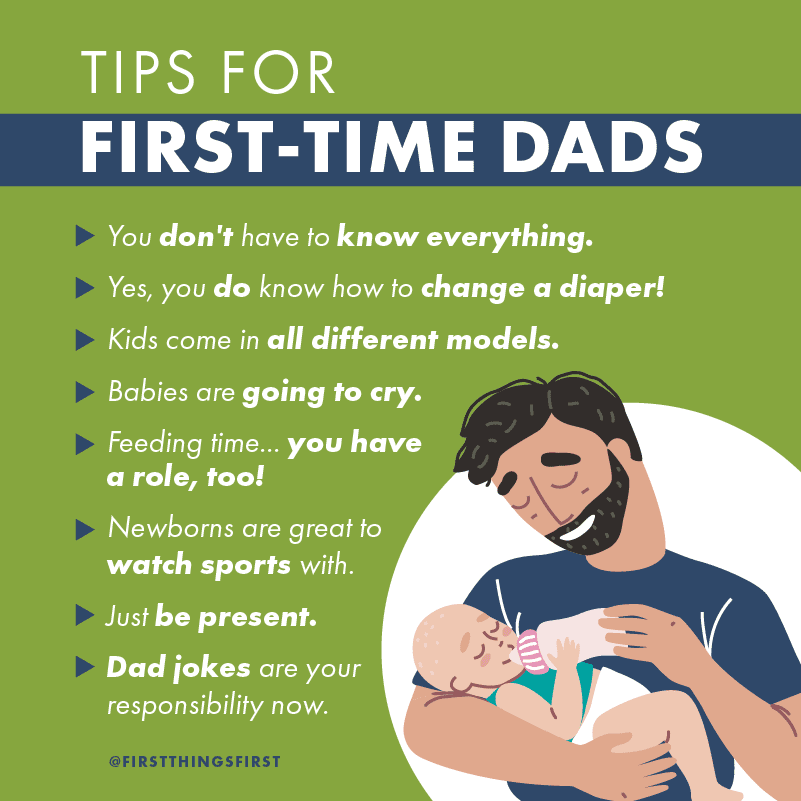
Kids come in different models.
All children are different. All deliveries are different. Your experience won’t look like mine or your buddy’s, and that’s ok. Embrace this time, ask lots of questions, and seek counsel from dads who have newborns. (I highly recommend talking to those dads; dads who have been in the game for a while may have forgotten those first weeks and months… sleepless nights are a real thing.)
Be present.
You’re not going to know everything it takes to be a dad, but one of the most important aspects is to be present and involved. Take every opportunity to hold your newborn, swaddle, feed, talk, and read to them. This all strengthens the bond between you. (And Mom will be impressed!)
Diaper duty… you got this.
The first time I changed a diaper was the day my son was born. My philosophy was that if a kid was gonna pee on me, it’d better be one I helped create. Change lots of diapers! Changing diapers is a dirty business (often literally), but it’s nothing to fear and creates an awesome opportunity to bond with your newborn. Talk to your baby and make goofy faces at them while changing their diaper.
Feeding time… you have a role, too!
Be part of feedings. If mom is breastfeeding, you’re on diaper duty… there are those diapers again. Our routine for nighttime feedings was my wife fed and I changed the diaper. We’d alternate rocking our son for a bit. Here’s a Hero Tip: If you’re bottle-feeding, own those night feedings. This is as much about mom as the baby. She will love the time to rest. Hero Status: Unlocked.
Babies are gonna cry… that doesn’t mean you should!
Babies cry, and that’s ok. What you’ll learn is that they have different cries for different reasons. You will get to know these. Make mental notes as to what sounds mean what.
Newborns are great to watch sports with.
Make your newborn part of what you love to do. My son watched tons of baseball and Moto GP races when he was little. We also took him to car shows, baseball games, and boat races. He doesn’t remember, but I can show him he was included in what I loved.
Dad jokes… everyone else is welcome.
You are a dad now, so you have a responsibility to share dad jokes every opportunity you can. Brush up on those skills, watch some YouTube videos, and be prepared for lots of eye rolls.
You’ve got this, Dad. You’ll have lots of questions, and you will learn a lot in the coming weeks and months. That’s ok—fatherhood is a journey… embrace it.