
Does My Wife Love Me?
The COVID-19 pandemic has put stress and strain on all facets of our lives, perhaps none as significantly as marriages. Chances are you’re reading this because you’ve felt this rift in your relationship with your wife, and you may be wondering, has she lost that loving feeling? And if so, what do I do?
Hope is not lost, gentlemen. Below, I offer you some ideas on how to think and what to do when you’re asking, “Does my wife love me?“
Ask yourself, what do I mean by the word “love?”
Are you wondering if she isn’t committed to your marriage anymore? Or does her not loving you mean she’s acting irritable, disrespectful, or mean toward you? Or does it mean she seems distant and non-engaging? These are all very different iterations of what it may mean to feel unloved. Nail down what it is about “love” that she doesn’t seem to be delivering at the moment as you perceive it.
Then ask, “What are the observable characteristics I’ve seen that makes me think this way?“
When you’re in the same room, does she clam up and avoid talking to you? Does she not seem as interested in sex and continually reject your advances? When you try to talk about anything, does she respond negatively or withdraw? These are all observable behaviors you can see in your spouse. However, one word of caution: as you take note of the things you see, you are not stockpiling ammunition to bring down on your spouse later on. You aren’t building your argument to prove that your wife doesn’t love you.
Rather, the purpose for noticing these behaviors is two-fold: first, it helps you consider the next bullet point below. And secondly, when it does come time to talk with your wife about your concerns (which is addressed later on), it is easier to explain to your spouse things that you “see” rather than things that you “feel.”
Consider other factors outside of yourself that may be causing what you observe in your wife.
It’s very easy to think the issue is with you when you feel as though your wife isn’t being as loving toward you as before. But before we jump to conclusions and become defensive, we need to consider whether you see your wife acting the way she does for entirely different reasons.
If she has been experiencing the stress, strain, and anxiety of everything going on in her world, she may not be withdrawing from you; she may just be withdrawing.
In the words of Billy Joel, “Tell her about it.”
Bring your concerns up to her. Be sure to pick a time and place where you can focus and the air isn’t thick with tension. Ask her if this is a good time to talk or whether another time would be better.
Be gentle and kind in your words, and avoid placing blame or assuming motives. Tell her what you observe, and use “I” statements. For example, I am concerned for our relationship. When we are in the same room, I see us not talking as much as we used to, and I feel like you’re avoiding eye contact with me. I just want to be sure I’m not doing anything that you see is a problem, or if the problem may be something else.
And then… listen. Just listen. Ask questions. Become a passionate detective with the goal to learn and understand. And I can’t stress this enough: avoid coming off defensively. Here’s the thing: the problem may be something you’re doing or not doing. And now you’ve given her the platform to voice her issue. Hear her concern, listen to understand rather than rebut, and make it your goal to come to a resolution with her rather than to defend yourself.
Memorize these words: How Can I Help?
If your wife indicates that you are indeed doing something (or not doing something) that is contributing to the problem, the next step is to understand what you can do differently to make your relationship stronger.
However, it might be that those other factors mentioned above are at play. If that is the case, your job is to support. And not for the sake of “gaining her love back,” but so that your wife can be the best version of herself she can.
Keep in mind the way you can help may simply be to be present and to listen. Guys can be fixers. We like to fix problems. Sometimes, our wives don’t want things fixed as much as they want to be understood. (I know—this seems counterintuitive to most husbands. But if we can learn this one little lesson, it changes the landscape of our marriage so much more for the better.)
Lead the dance.
The thing is, even if the issue isn’t you, and you do listen and help your wife to feel understood about what she’s feeling, there’s a possibility that she’s not going to pop back immediately into full-on lovey-dovey mode. Things like this take time to process and work through. Take the initiative and show her how much you love her. Speak her love language. Write her love notes, send her flowers, be extra diligent with laundry and cleaning, take the kids away from her for a while so she can rest—anything that helps her to feel loved and supported. When we lead the dance and take initiative without her having to ask, more often than not our spouse will get excited about dancing again.
Don’t be afraid to seek help.
If you’re still questioning your wife’s love, problems persist or you find difficulty in reaching a resolution, consider seeing a marriage counselor together. And again, you might have to be the one to lead the dance and bring this up to your wife.
Fellow husbands, we are in challenging times. Our marriages are being challenged. And it may seem like your wife just isn’t that into you anymore. But hope is rarely lost. You have within your power the tools to contribute positively to your marriage, even when your spouse doesn’t seem to show the love.
***If you or someone you know is in an abusive relationship, contact the National Hotline for Domestic Abuse. At this link, you can access a private chat with someone who can help you 24/7. If you fear that someone is monitoring your computer or device, call the hotline 24/7 at: 1−800−799−7233. For a clear understanding of what defines an abusive relationship, click here.***
We expect things to be different after marriage, and one of the more difficult changes is in our friendships, and especially our opposite-sex friends. Often, while we share similar stages of life with our friends, your marital relationship should be the primary relationship. It’s pretty likely that you and your spouse want what is in the best interest of your marriage.
Many couples bring a variety of things into the relationship—including that comfy couch from your bachelor pad or that well-worn t-shirt or sweatshirt, mismatched plates, cookware, and friends of the opposite sex. While it may be easy for you all to decide what old items to discard, it becomes much more difficult to have the conversation with your spouse about ending and/or adapting long-standing or even newly-established opposite-sex friendships. These innocent friendships often create a rift between spouses, especially when our spouse sees the relationship as no big deal but there is something in your gut that makes you super uncomfortable.
If you find that you and your spouse are having more and more unresolved discussions about these “friendships,” you may be in the “Danger Zone.” In the Danger Zone, you and your spouse may find yourself:
- Emotionally disconnected from each other
- Not communicating well
- Having unresolved conflicts
- Decreasing in physical intimacy
If you see, DANGER, DANGER, DANGER, take heed. Dr. Shirley Glass, licensed marriage and family therapist, has found that “82% of the unfaithful partners I’ve treated have had an affair with someone who was, at first, ‘just a friend.’ The new infidelity is between people who unwittingly form deep, passionate connections before realizing that they’ve crossed the line from platonic friendship into romantic love.”
How should I begin this conversation with my spouse?
Ask Questions
Internal Questions:
- Look at the person in the mirror.
- What really is bothering me? Do I feel ignored? Insecure? Disrespected? Jealous?
- Am I asking my spouse to look at their opposite-sex friendships while I have not examined my own?
- What about this relationship makes me uncomfortable?
- Does my spouse share a past romantic relationship with this friend?
- Does this remind me of something from my past relationships?
- Do I know my spouse’s friend? Are they doing things for the friend that they won’t do at home?
Relational Questions:
- What is the state of my marriage? Is it healthy? Do we laugh together? Play together? How well do we communicate? Handle conflict? How is our intimate life?
- Are we nurturing our marital relationship?
- Have we talked about boundaries? Does my spouse include me in the friendship?
- Am I invited to go hang out together with the friend?
- Are we in the “Danger Zone?”
Once you have considered the above questions, find the right time and place to begin the conversation with your spouse.
- Use “I statements” (Speak from your own point of view—“I feel, I need, I think…”)
- Be respectful
- Ask questions of your spouse
- Actively listen to them
- Being aware prevents you from approaching a slippery slope
Having this conversation is meant to create and establish relational boundaries that you both can agree on as well as be held accountable. Additionally, you should be open about how you feel about it when your spouse has opposite-sex friends, but do so in a controlled and positive way. Avoid opening an accusatory conversation because you’re feeling hurt or slighted. Choose to respond instead of react. Seek to understand your spouse and the situation first, then open the conversation as a way to strengthen your marriage.
Being aware of the danger zone, paying attention to warning signs and being respectful of your spouse’s perspective will enable you both to be on the same page and do what is best for your relationship. This does not mean that you and your spouse can never have opposite-sex friends. No matter the difficulty, talking and being open about boundaries is necessary to build a strong, lasting relationship.
***If you or someone you know is in an abusive relationship, contact the National Hotline for Domestic Abuse. At this link, you can access a private chat with someone who can help you 24/7. If you fear your computer or device is being monitored, call the hotline 24/7 at: 1−800−799−7233. For a clear understanding of what defines an abusive relationship, click here.***
What to Do When Your Spouse Isn’t Supportive
I know how you feel. I get a really big, life-goal idea in my mind about every two weeks. And when I drop my best-laid plans on my wife as if it’s a slam-dunk, somehow she just doesn’t see it the way I do. And that’s when things can blow up.
Let me suggest some things I have learned:
I have learned that letting my mind go too far down the decision-making trail before I make my spouse aware of what I’m thinking is not a good thing.
In my mind, I’ve often already walked down the road to success. I’ve already imagined how wonderful this decision will be. And I’ve already anticipated that my spouse is going to react by being completely supportive and on board. The issue lies in the already. What I often fail to do is invite my spouse with me on this road before my mind is already made up. And that’s unfair to her. It’s as if I’ve already made the decision for her.
I have learned that my spouse might have some ideas that change my direction. And that is a good thing.
When she gives me reasons as to why something may not work out the way I see it (and dang it, they’re good reasons), it feels like a total disregard for my dreams and aspirations. The truth of the matter is that my spouse (the person who I’ve partnered with to walk down this road of life, I have to remind myself) does indeed support me and wants what’s best for both of us.
And this is backed up by research. Marriage researcher and author Shaunti Feldhahn found that with couples who labeled themselves as “happy” or “mostly happy,” an extremely high number of partners said they care about their spouse, want the best for them, and are “for” their spouse, even during painful times and arguments.
✸✸ At the end of the day, decisions such as these aren’t just a me thing; it’s a we thing. And her input to this decision is extremely valuable, sometimes resulting in a better outcome than I had imagined. ✸✸
Finally, I have learned that my relationship with my spouse actually gets stronger when we struggle over a decision together.
And, the outcome of the decision normally comes out better than what I had originally anticipated. The very act of wrestling through the decision itself brings us closer together and makes us feel more valued, and solidifies us as a team.
So what do you do when you have a big idea and you want your spouse to be supportive? Here are some steps you can take:
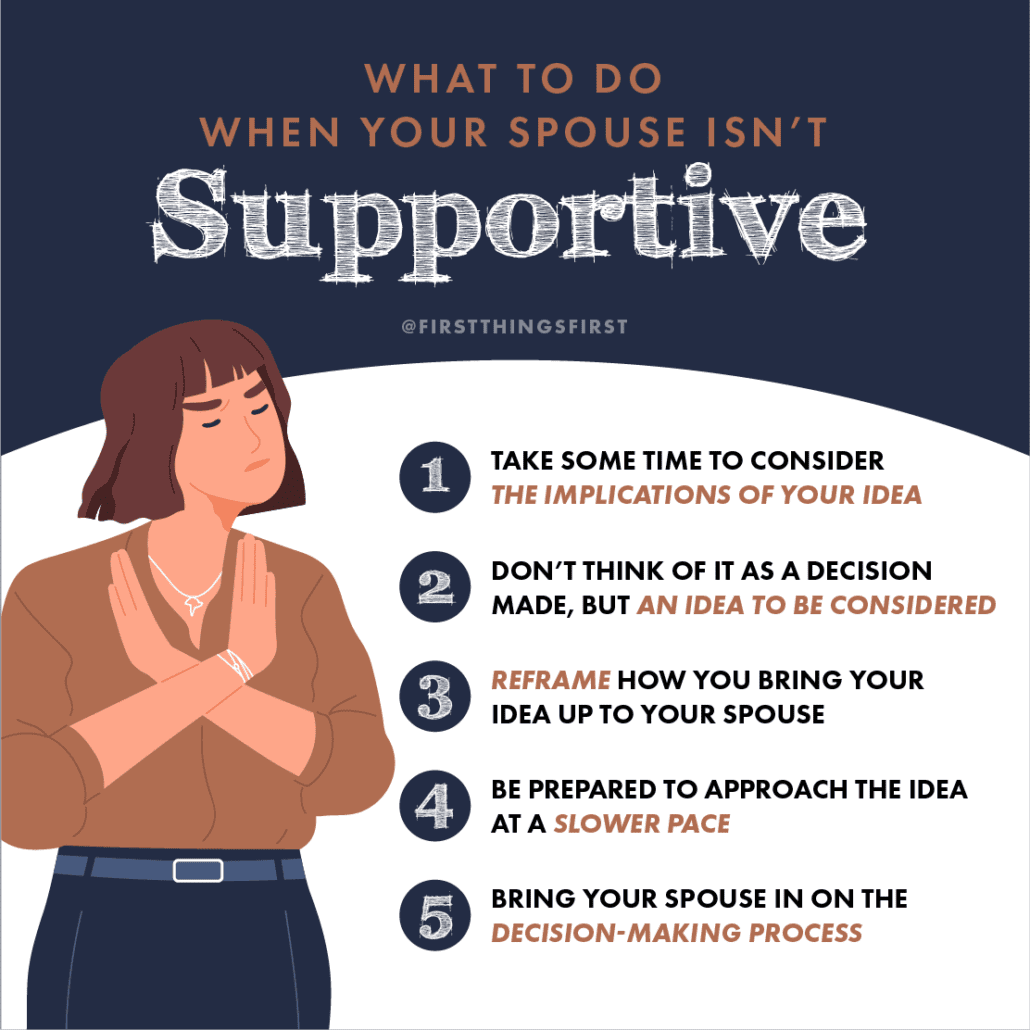
1. Take some time to consider the implications of your idea.
Remember that this decision doesn’t affect you alone. It affects both your marriage and your spouse.
2. Don’t think of it as a decision made, but an idea to be considered.
So you want to change jobs, or go vegan, or cut way back on the kids’ sports schedules? It helps you be more open to the feedback of your spouse when you label this as an idea to be explored rather than a decision that’s already iron-clad in your mind.
3. Reframe how you bring your idea up to your spouse.
“I’ve decided I want to change jobs and work from home permanently, and I’m going to start looking next week. Isn’t that exciting?” See how that sounds? Decision already made.
Notice the difference here: “I’ve been thinking of what it would look like to change jobs and work from home. I’ve been thinking about it a lot lately, and I have some ideas. I don’t know what this might look like in the end, and I’d like your help in thinking about this.“
Framing your idea so that you are open to feedback makes it more palatable, inviting, and open for discussion. And consequently, it can make a big difference in how supportive your spouse’s response is.
4. Be prepared to approach the idea at a slower pace.
When you’re excited about an idea, it’s difficult to not want to see it happen right now. But when you are bringing your spouse in on the decision-making process, be ready to take some time. It might take more than one discussion. Great decisions are rarely made in a short amount of time. Embrace the process that you and your spouse get to embark on, and allow it to make your connection to each other stronger.
5. Bring your spouse in on the decision-making process.
Invite your spouse in on the discussion. Ask them what they think, if they see better ways of approaching the idea, and what different scenarios may look like. For example, what does it look like to quit your job now versus quitting your job in one year?
Be ready to approach your idea in ways different than you originally had thought. Your spouse may take it and add caveats, as what if we did this…, or even right out reject the idea as you see it playing out. Keep in mind that you are a team and this is a decision that affects both of you.
✸✸ Relationship researchers Scott Stanley, Howard Markman, and Susan Blumberg suggest establishing some ground rules for these kinds of discussions, such as allowing one person to speak their full mind without interruption and then clarifying what you think you heard. If the discussion gets heated, take a time-out for 20 minutes and reconvene with calmer emotions. ✸✸
And if your spouse is still not supportive…
This is a very real possibility, no matter how well you’ve presented your idea. If that’s the case, take a deep breath. Understand that even though your spouse doesn’t support your idea, it doesn’t mean they don’t support you as their partner or your marriage as a whole. Circumstances also change with time. It’s possible your big life-goal idea may present itself to be a better idea in the future.
Remember that you are a TEAM.
- Don’t let this issue or idea divide you.
- Don’t think in terms of who won and who lost.
- Do not let your relationship become adversarial.
- Don’t look at your spouse as the enemy of your idea or dreams. (You might not be on the same page—yet.)
- Be on guard that anger and frustration don’t turn into bitterness or resentment—these will wreak havoc on your marriage.
And one thing you can count on: if you’ve presented your idea in a way that invited open feedback and scrutiny from your spouse, they’ll be much more likely to be supportive of the idea when that future opportunity comes about.
For more help with your marriage, click here.
***If you or someone you know is in an abusive relationship, contact the National Hotline for Domestic Abuse. At this link, you can access a private chat with someone who can help you 24/7. If you fear your computer or device is being monitored, call the hotline 24/7 at 1−800−799−7233. For a clear understanding of what defines an abusive relationship, click here.***
The 3 Most Important Things You Should Do for Your Spouse
What if you could do just three things that would revamp, recharge, and revitalize your marriage? Just three things. Your marriage is worth that!
When I was a kid, I had this toy car that resembled the black-and-red van from the iconic television show, The A-Team. (For you younger generations, you can ask Siri or Alexa or the Google or whatever you kids are into these days about that).
In order for the car to roll across the floor on its own, you had to rev it up several times along the ground before you let it go. And if you revved it up enough, watch out! You could pop wheelies, jump ramps, and all kinds of other tricks that were reminiscent of the fancy driving of A-Team member B.A. Baracus (again, ask the Google).
★ In our work with couples, we’ve been asked many questions such as: How can we keep the communication going in our marriage? How do we re-spark intimacy? How can we feel like we did when we first met? ★
In essence, the questions boiled down to this: How can you keep your marriage revved up and rolling full speed?
There are probably as many ways to answer this as there are the number of times A-Team leader Hannibal said, “I love it when a plan comes together…”(the answer is, a lot…Google, man, Google). However, without a doubt, there are three important things you should do for your spouse that will impact so many other aspects of your relationship. And even if you focus on just these three, they will have your marriage flying higher than Murdock’s helicopter (that’s A-Team-speak for “It’ll be awesome”).
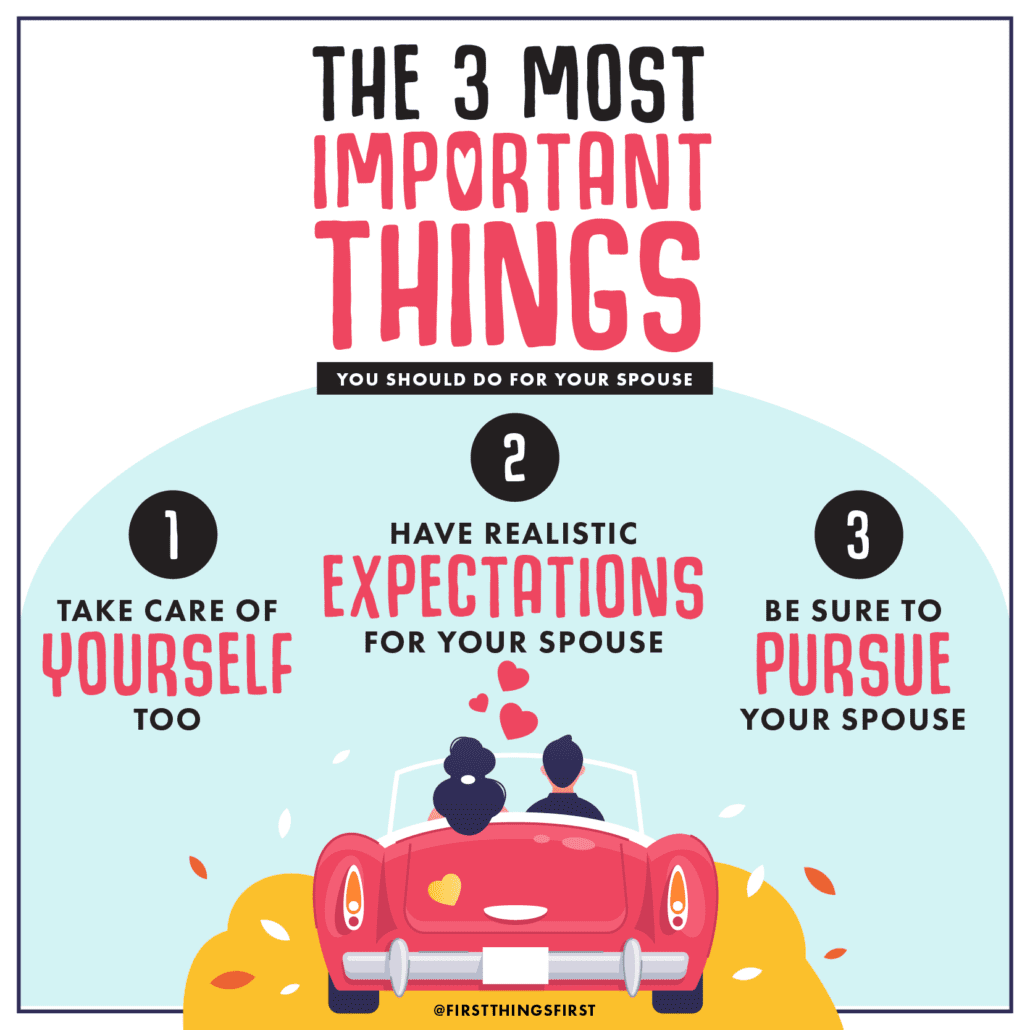
Key #1: Take care of yourself.
Right off the bat, this sounds counterintuitive and possibly even a little selfish, self-centered, and self-seeking.
But here’s the thing—if you pay only a small amount of attention to your physical, emotional, and mental health, there’s not much of your self left to give to the one you love the most.
I’ve experienced this in my own marriage. In the past, I felt so wrapped up in my job (for the sake of providing for my family, of course, or so I told myself), rattled by stress and constrained by deadlines, that all I had to offer my wife when I got home at night was the leftovers of my being. I was tired. My body was in poor health. And my mind was spent. I wanted to connect with my wife, but the wheels had fallen off the A-Team van.
So, self-care is actually one of the most selfless gifts you can give to your spouse. Give a little to your self, and you’ll find you have so much more to give to your spouse. And then, watch things rev up and the wheelies fly!
Key #2: Have realistic expectations for your spouse.
Having expectations of your spouse is normal. But there is a fine line between great expectations that make a marriage great and unrealistic expectations that make a marriage unrealistic.
The bottom line is this: It’s unrealistic to see your spouse as the be-all-end-all for your happiness. Everyone wants to see their spouse happy, but happiness can’t be induced by another person. Putting that kind of pressure on your mate sets them up to fail at something they weren’t meant to do and can cause all kinds of tension and conflict.
Dr. Gary Chapman calls these kinds of expectations “If Onlys.” If only my spouse would work less… cook more… watch more of “The A-Team”—then I’d be happier.
Unrealistic expectations can be counteracted with creating spoken, shared expectations that are truly realistic and healthy. Marriage researcher Dr. John Gottman lists several expectations that healthy couples have in their relationship:
- Be good friends.
- Trust one another.
- Be fully committed to each other.
- Have a satisfying sex life.
- Manage conflict constructively.
- Watch lots of “The A-Team” together. (Okay, I made this one up. But you never know what this may do for your relationship!)
Key #3: Pursue your spouse!
I don’t mean in a creepy, follow-them-to-work, stalker kind of way.
Let’s put it this way: Remember that feeling you had in the first couple of years in your relationship? When you were setting up that big surprise romantic date? When you were anticipating giving them that special gift you had been hiding? How talking to your spouse late into the night vitalized your feelings for them?
There’s a good reason you had these feelings. Research indicates that the newness of romantic attraction causes a neurochemical called phenylethylamine (PEA) to squirt through your brain, causing feelings of heightened romance, physical attraction, and physical and emotional energy. And, it motivated you to keep on pursuing your spouse!
But, the research also says that this chemical is only active in your brains in the first one or two years of marriage. After that, it takes more work to rev things up.
The great news is that it’s not rocket science, and it doesn’t take an insurmountable amount of effort to keep the wheels rolling and get the PEA squirting again. Regularly pursue conversation and have a curiosity about your spouse. Pursue romance and new experiences. Pursue laughter, fun and connection, too. Continue to be curious about their dreams, likes, dislikes, and goals. You get the picture.
Gifts That Keep On Giving
Finally, remember that self-care, realistic expectations, and the pursuit of your spouse are three gifts you can give to the one you love the most that keep on giving. Write these down somewhere you will see them. Talk about them with your spouse. Make them a regular part of your daily rhythm and practice. Watch your marriage rev up, make tracks, burn rubber, and hammer down.
And for Pete’s sake, go Google The A-Team. You’ll thank me later.
Other blogs to check out:
My Marriage Doesn’t Make Me Happy
Are You Setting A Good Example Of Self-Care For Your Family?
***If you or someone you know is in an abusive relationship, contact the National Hotline for Domestic Abuse. At this link, you can access a private chat with someone who can help you 24/7. If you fear that someone is monitoring your computer or device, call the hotline 24/7 at: 1−800−799−7233. For a clear understanding of what defines an abusive relationship, click here.***
How To Help Your Spouse Deal With Anxiety
For me, it often happens in the evening (though not always). It feels like a sudden Visitor at your door who comes in unannounced and spreads an uncomfortable, heavy, warm, wet blanket over you, gradually but quickly covering your whole body, and I feel it mainly in my chest. As soon as I feel myself covered, I’m very aware of the sense of unexplained dread that’s overcome me. Often my vision narrows and it’s difficult to concentrate on what people are saying. I can feel my heart pounding. My breathing is shallow. And it’s hard not to just sit there, paralyzed, and feel intense fear for something that I don’t know how to define.
Sometimes it takes a long while for the feeling to gradually dissipate. Other times, it just sort of leaves quickly, like it wanted to slip quietly out the back door without anyone noticing. It’s exhausting. And the most frustrating part, every time, is the nonsensical, illogical way the Visitor just comes and goes, without any sort of reason, at least none that I can think of.
Anxiety attacks are a beast, and I’ve experienced them for years. Every time I’ve had to deal with anxiety, my wife, Kristin, has been there right beside me, walking the road. She can tell when the Visitor is at the door because she can hear me trying to catch my breath.
Feeling anxious?
She’ll gently ask me this, and I never find it threatening nor snarky. This is in large part due to the fact that we’ve had some very open and real discussions about what I experience. What I appreciate the most is her understanding, even though she hasn’t felt what I feel when I have these attacks.
If you are married to someone who struggles with anxiety, you may feel powerless to help them. Kristin and I want to offer you some tools and concepts to help you be a support for the one you love most when anxiety comes bursting through the door.
What Is Anxiety Exactly?
It helps to have a basic understanding of anxiety itself. Anxiety is actually a natural, normal process the brain goes through to help a person cope with stress. It causes an apprehension or fear of something to come, and this typically serves to protect a person from harm and danger.
However, this process is only made to come and go as needed. It’s not meant to pop up without warning and interfere with everyday life.
This unhealthy anxiety is ambiguous; it can feel differently depending on the person feeling it, and it reveals itself in a variety of ways. Many (like myself) feel panic attacks with no apparent reason. Others may experience a phobia of certain objects or activities. Some have an irrational fear of social situations or worry about their health.
Researchers can’t pinpoint an exact cause of this kind of anxiety. A mix of genetics, environmental factors, and brain chemistry seems to be likely, but this doesn’t exactly narrow it down. Therefore, there are a variety of ways professionals treat anxiety, from coping exercises such as deep breathing and other lifestyle changes to therapy and medication. (The Gottman Institute offers a great article here about using mindfulness to deal with difficult emotions like anxiety.)
This all can seem very complex to you, the spouse, who sees how anxiety is plaguing the one you love. And you might be wondering, what in the world could I ever do to help?
What Spouses Can Do
In fact, you are not powerless to help your spouse who has anxiety. Anxiety isn’t exactly something you can “fix,” but it can be managed. And as someone dealing with anxiety, a supportive spouse is the most important person to have in your corner.
Here are some thoughts on how to help your spouse deal with anxiety:
- Understand that your spouse doesn’t know why they struggle with anxiety. Even if they know what triggers it, such as work deadlines or having to engage with a particular person, the feeling itself just seems irrational. Even more elusive is how to get rid of that feeling. It’d be easy to put the blame of the anxiety on the person feeling it or to say, just stop feeling that way, but this is no help. As a person who experiences this, I can tell you that if I knew what it was I was doing that caused a panic attack, I’d immediately change course. And I appreciate my wife understanding this.
- Be present. One of the worst feelings—over and above the anxiety itself—is watching a person leave the room because they don’t know how to help. My wife’s presence is comforting and reassuring, even if neither one of us knows how to “stop the feeling.” Sometimes Kristin, if she is doubting what she should do, will say, I’m going to stay here with you until you tell me you want to be alone. And I can honestly say I have never asked to be alone during a panic attack.
- Gently direct toward some healthy coping strategies (and away from unhealthy ones). Again, my wife is good at this (she’s had lots of practice). When I feel an attack coming on, she will gently and respectfully steer me in another direction, maybe to watch a TV show with her or to take a walk. She understands the need to redirect my focus. Other good coping strategies include self-care, meditation, deep breathing exercises, physical exercise, eating a healthy diet, aromatherapy (such as using candles, oil, or incense), and spending time outdoors in nature.
- Talking it out helps. When I feel the pressure of anxiety coming on, Kristin will often ask me if I know where it might be stemming from. Sometimes, as we talk, we can identify some possible triggers, such as an impending work deadline or an inevitable difficult conversation I need to have with another person. My wife is really good at helping me think out what’s the worst that can come out of this situation? When I verbalize with her that the worst-case scenario isn’t all that bad, it helps to alleviate the anxiety. At other times, Kristin is also very good at reading when talking may not be very productive. This is usually when I’m in full-on panic mode and I can’t think straight enough to make conversation. In this case, she helps me with other coping strategies.
- Encourage rest. Exhaustion and fatigue are bullies to anxiety management. Getting to bed early or taking a short power nap in the afternoon helps me (I avoid long naps because it interferes with my sleep at night). I appreciate it when Kristin guides me to make rest a priority.
- If anxiety persists despite using coping strategies, it might be good to encourage your spouse to seek professional help through their physician or a counselor.
There are times when I have felt very inadequate because I didn’t know how to fix what I was experiencing. It’s easy to feel that something is “wrong” with you. And even more so, I’ve wondered just when my wife was finally going to be over me and this “problem.”
Kristin is very quick to put me in my place (in a good way). She assures me that nothing is “wrong” with me, that she doesn’t judge or think negatively of me because of my anxiety, and that she’ll be there no matter what to help me however she can. Without that, no coping exercise, medication, or therapy session would be nearly as effective.
You are in the prime position to be the main support for your spouse struggling with anxiety. You don’t have to “do” anything about it. Simply walk the road with them. Be in their corner. Encourage them. Be understanding. And be assured that your support means the world.
***If you or someone you know is in an abusive relationship, contact the National Hotline for Domestic Abuse. At this link, you can access a private chat with someone who can help you 24/7. If you fear your computer or device is being monitored, call the hotline 24/7 at: 1−800−799−7233. For a clear understanding of what defines an abusive relationship click here.***
I’m Bored With My Spouse!
It’s your dining room table, you and your spouse are having dinner. And it happens. You realize that you can’t think of anything else to say. It hits you — I’m bored with my spouse.
How did this happen to us? We were the fun couple. Conversation was always easy for us. We enjoyed a lot of the same things. How and why did things change for us?
For many couples, the beginning of the relationship is full of fun and excitement. You enjoyed activities full of wonder and adventure. Now things have changed. Before jumping to any conclusions, this might just be a new season in your relationship. You’re chomping at the bit to go out and try something new, while your spouse seemingly sits there like a bump on a log. What do you do now?
If you are feeling or have felt this way, here are some things you need to consider.
1. Is your spouse okay?
Often, losing interest in activities that used to be fun and bring someone joy is a symptom of an underlying physical or mental health problem. Being listless and restless, just wanting to lay around, not feeling like doing anything — especially if this has been going on for more than two weeks — can be a sign of a physical or mental health problem. Be supportive. Encourage your spouse to get a physical.
2. Your boredom is ultimately something you need to address.
There is a big difference between, “I’m bored.” and “My spouse is boring.” It could also be that BOTH statements are about you. If you look up the multiple definitions of boredom like I did, here’s what you may find. Being bored is “feeling weary because one is unoccupied or lacks interest in one’s current activity.” Another definition of boredom is “an emotional or psychological state when an individual is left without anything in particular to do or is not interested in their surroundings or feels that a day or period is dull or tedious.” You will notice (in both definitions) that the onus is on the individual and not anyone else, including your spouse.
It may be helpful to seek out ways to engage with your spouse.
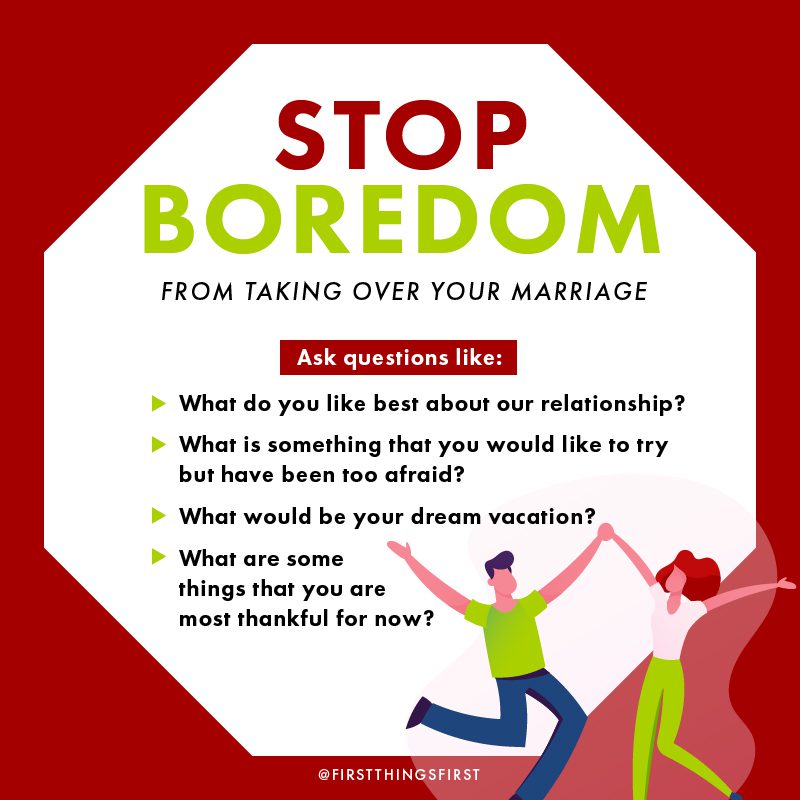
3. Get curious about your spouse. Ask questions like:
- What do you like best about our relationship?
- Is there something that you would like to try but have been too afraid to?
- What would be your dream vacation?
- What are some things that you are most thankful for now?
- What’s something new we could try together?
- What fun things did you do as a kid? As a teenager?
4. Give yourself and your spouse permission to have some time ALONE.
You BOTH might need some alone time. This is normal and healthy. The idea is to do something that refreshes and recharges your batteries and something that promotes growth, so that when you do spend time together, it’s more interesting and fulfilling. Your relationship involves two unique individuals. You and your spouse want to bring your best selves into the relationship.
Find ways to nurture yourself, then you can nurture your relationship.
Boredom is a tricky thing. On the one hand, it’s normal for boredom to pop up here and there. Don’t overreact to it, just find some creative ways to get out of the rut. On the other hand, prolonged boredom can signal something deeper is at work. Don’t hesitate to call in the pros.
Other helpful blogs:
3 Great Dates To Enhance Communication In Your Marriage
Help! My Spouse And I Have Nothing In Common
How To Find Common Interests With Your Spouse
Why It’s Important To Care About Your Spouse’s Interests
***If you or someone you know is in an abusive relationship, contact the National Hotline for Domestic Abuse. At this link, you can access a private chat with someone who can help you 24/7. If you fear your computer or device is being monitored, call the hotline 24/7 at: 1−800−799−7233. For a clear understanding of what defines an abusive relationship, click here.***
Help! My Spouse and I Can’t Stop Fighting!
Marriage is two individuals doing life as a team. You and your spouse will always have some differing perspectives, needs, priorities, habits, and let’s say – idiosyncrasies – that make you both unique. This means ongoing work on communication skills, learning how to handle disagreements and conflict, and doing the intentional stuff that keeps you connected and your relationship healthy.
Sprinkle in anxiety, stress, anger, and sadness, or maybe uncertainty about the future and tight finances. As a result, marriage can go from difficult to disastrous. Real quick. Heavy emotions or difficult circumstances can take a toll on your marriage. Everything gets magnified and intensified. This can lead to constant fighting.
Tensions, disagreements, arguments, and even some fighting should be expected in marriage, period. But they can be framed in a way that drives you toward each other – not apart.
1. Stop fights before they start.
If the best fight is the one that actually draws you together and strengthens your relationship, then the second-best fight is the one that never happens.
Understand Your Current Situation.
Acknowledge that you or your spouse may be experiencing high levels of fear, anxiety, and stress. This produces what marriage expert, Dr. John Gottman, refers to as “Flooding,” which is when the brain is flooded with stress hormones and chemicals that make it nearly impossible for the prefrontal cortex (the part of the brain responsible for complex problem solving) to function. When you or your spouse are in “Fight, Flight, or Freeze” mode, you can’t physiologically function as you normally would. You can’t communicate as you normally should. This isn’t a fault in you or your spouse – this is your body’s nervous system. Hopefully, just knowing this promotes grace, empathy, and patience.
Practice Self-Care.
Be at your best when things are going sideways in your marriage. You each still need your space and need to take care of yourselves and find healthy ways to manage and process the stress you are feeling. Stay connected to your friends and the people that encourage you. It’s okay for you to sit in another room and watch television alone. It’s okay for your spouse to go for a walk without you. If you are both working on being the best versions of yourselves, you’ll both be in a better place when you are together.
Set Up Schedules and Routines.
This will make expectations clear, give your day predictability, and give you stability. Are one or both of you working from home? When and where in your house or apartment will work be done? Do you have children? Designate when you will take turns watching them so the other can work or get some alone time. Who is doing what chores around the house? Divide housework equally and play to your strengths.
Choose A Specific Time Each Day To “Check In” With Each Other.
This isn’t fight time. This is when you ask each other how you are feeling physically and emotionally. This is a time to share needs and ask how you can be helping each other. Take turns speaking and listening. It doesn’t have to be a long or formal time, just consistent.
2. Fight nice.
It may sound strange, but when you aren’t fighting, take some time to discuss and establish some “ground rules” for how you will handle tensions, disagreements, and problems. No bringing up the past. No interrupting. And no raising your voices. How will you call a “timeout?” What is the time limit? How will you signal that the “fight” is over? Use this blog to guide you.
Schedule Your “Fights.”
Set a time once or twice a week (max) when each of you gets to air out one (and only one) criticism while the other is only allowed to listen. Avoid words like, “always” or “never” and try to frame it as an “I” statement. “I get frustrated when it feels like you are being distant,” or “I need more help with putting the kids to bed,” or “I would appreciate it if you didn’t raise your voice at me.”
Respond, Don’t React.
You are both going to hear some hard things, especially if you can’t stop fighting. It is important not to escalate the conversation with the volume or tone of your voice, your body language, or your words themselves. Don’t react by letting emotions take control. As you actively listen, respond calmly, compassionately, and empathetically.
3. Reconnect.
It’s not all about not fighting. Make sure you are doing things that help you connect, have fun together, deepen intimacy, create some romance, and deepen your relationship.
Plan Some Fun!
Be intentional and schedule some fun things you can do together. Have a formal, in-home date night. Dress up and make a special dinner. Do something fun and silly like build a blanket fort and watch a movie. Go for a walk together. Have a game night. Don’t try to do any heavy relationship work during this time, just enjoy each other’s company. Generally, men bond shoulder to shoulder by doing things together, and women bond face to face, through conversation. So, make sure you are doing a little of both. Don’t forget why you married your spouse in the first place.
Figure Out What Says “I Love You” To Your Spouse.
Not everyone communicates “I love you” the same way and not everyone hears “I love you” the same way. Some people need quality time together. Some people need words that affirm them. Dr. Gary Chapman dives into this in The Five Love Languages: The Secret To Love That Lasts. You can also go to his website, take a free quiz, and find resources that will help you communicate love more effectively to each other.
What About Sex?
What about it?! Sex is one of the most powerful ways to stay connected! Understand the dynamics of sex – generally, women need to feel connected to have sex and men need to have sex to feel connected. Not a problem! This is the perfect example of how two people have to work to make the marriage work.
Mindset is everything.
When you’re fighting all the time, it’s easy to begin seeing your spouse as an adversary, and then your relationship becomes a contest of winning and losing. Ultimately, you need to remember that your spouse isn’t the enemy; the problem is the enemy. Then you can fight for your spouse and for your marriage.
Don’t be afraid to call in the pros.
Sometimes the problems run deep. One or both of you could have blind spots. You’re too close to the situation and might need a third party who can be objective and see what you’re missing. Get the help you need!
***If you or someone you know is in an abusive relationship, contact the National Hotline for Domestic Abuse. At this link, you can access a private chat with someone who can help you 24/7. If you fear your computer or device is being monitored, call the hotline 24/7 at 1−800−799−7233. For a clear understanding of what defines an abusive relationship, click here.***
How to Not Blow Up on Your Spouse When They’re Getting on Your Nerves
My husband and I were having a conversation about navigating work, caring for family, grocery shopping and the like. In the midst of trying to figure it all out and all the “what ifs,” I kind of lost it. Actually, not kind of—I lost my cool. My husband just stared at me. It took a minute (or 10) for me to get myself back together.
Actually, I took our dog on a walk and thought about what had just happened. We aren’t normally snippy with each other.
Let’s just put it out there: Life is super stressful and unbelievably complicated lately. We’re all probably feeling some level of fear about the future. It’s in these very moments that we need to be on guard and very self-aware in an effort to avoid hurting ourselves and those we love.
If you’re wondering how to know whether you’re on edge or not, keep an eye out for these things. The signs could be any or all of the following:
- You’re not sleeping.
- You are indulging more than normal in __________ (eating, sleeping, drinking, online shopping, as in retail therapy).
- You’re quiet and withdrawn when you are normally not that way.
- You feel like you’re going to blow up if your spouse leaves their dishes in the sink one. more. time.
All of these are telltale signs that you may be in the danger zone. So, what can you do so you won’t blow up on your spouse?
Your first line of defense is to communicate.
Talk with your spouse or someone who is part of your support system. The opportunity to have someone listen to your fears, frustrations and needs, even if they can do nothing to fix it, can help relieve some of the tension you feel.
Create a communication plan.
Sit down with your spouse and discuss how you will intentionally check in with each other to know how to best support one another. Don’t assume your spouse knows what you need.
Meditate or pray.
Practicing deep breathing, meditation/mindfulness, as well as praying can help relieve some of the pressure you are feeling.
Take a time out for yourself.
Sometimes we just need to time ourselves out for a few minutes. Sit in the bathroom, your bedroom, the balcony, your front porch or some other spot that will allow you to have a few moments of silence to recalibrate. It can be helpful to have regularly-scheduled times when everybody goes to a specific space. That way, everyone in the family has a chance to be apart.
Exercise!
Exercise is key to helping us release toxins, stress and tension in a healthy way versus taking it out on our spouse. Going for a quick run, a brisk walk (yes, even in the rain) a bike ride, doing jumping jacks inside or anything that will get your body moving and cause you to break a sweat is helpful. Walking the dog has been a huge sanity-saver for me.
Get connected with your support team.
Relying on your spouse to meet all of your needs will likely lead to even more frustration and tension between the two of you. Create coffee time or social hour, even if it’s through Google Meet, FaceTime, Zoom, or some other platform that will allow you to hang out with friends or family.
Take one day at a time.
None of us knows about tomorrow. To keep rehashing the “what ifs” will literally drive you crazy. It will be helpful to you, your spouse and the rest of your family if you can take things one moment at a time. The goal is always to navigate today.
Avoiding some things like unrealistic expectations and negativity will also be helpful.
It is unrealistic to think that you aren’t going to have some meltdown moments. It’s bound to happen with anyone we’re around for an extended period of time. The goal is to avoid reacting. Instead, take a deep breath, count backward from 10 and then respond to the situation at hand.
If you’ve been focusing on the negative, you might want to refocus on a few positives, too.
Stop telling yourself you’re a failure or thinking your spouse is failing big time. Your brain believes what you tell it. If you think negatively about yourself and/or your spouse, it makes it hard to communicate and life becomes more complicated. All of us are trying to figure out how to adapt and adjust—even your spouse. We have a real opportunity to look for the good things our spouse is doing instead of focusing on what we see as a negative.
Love Each Other Well
One of the greatest things we can do is to love each other well. Remember the reasons you fell in love with your mate. Reflect on the good times you’ve had and what it took to make it through the hard times in the past. Be intentional about complimenting and encouraging them. Don’t lose sight of the fact that you are a team. Listen to their fears and frustrations. Be willing to compromise when necessary. When all is said and done, hopefully our family relationships will come out stronger because we’re choosing to think before we speak. At the same time, we’re trying to make things right when we lose our cool.
***If you or someone you know is in an abusive relationship, contact the National Hotline for Domestic Abuse. At this link, you can access a private chat with someone who can help you 24/7. If you fear your computer or device is being monitored, call the hotline 24/7 at: 1−800−799−7233. For a clear understanding of what defines an abusive relationship, click here.***